Context is the government banning certain popular foods.
I think it’s more like government can ban what can be sold as food and make advice. They can’t really stop you from drinking bleach or eating the grass in your yard or whatever. They can only prevent you from feeding it to someone else or selling it as food.
Meat isn’t a food that could be banned in the same way as, say, Red Dye #4 or force-hydrogenated fats or high fructose corn syrup. They could make farmers cull whole herds of cows if mad cow broke out i guess, but there are wild hogs, backyard chickens and goats, it’s just not a controllable food.
DrivebyHaiku@lemmy.ca 11 months ago
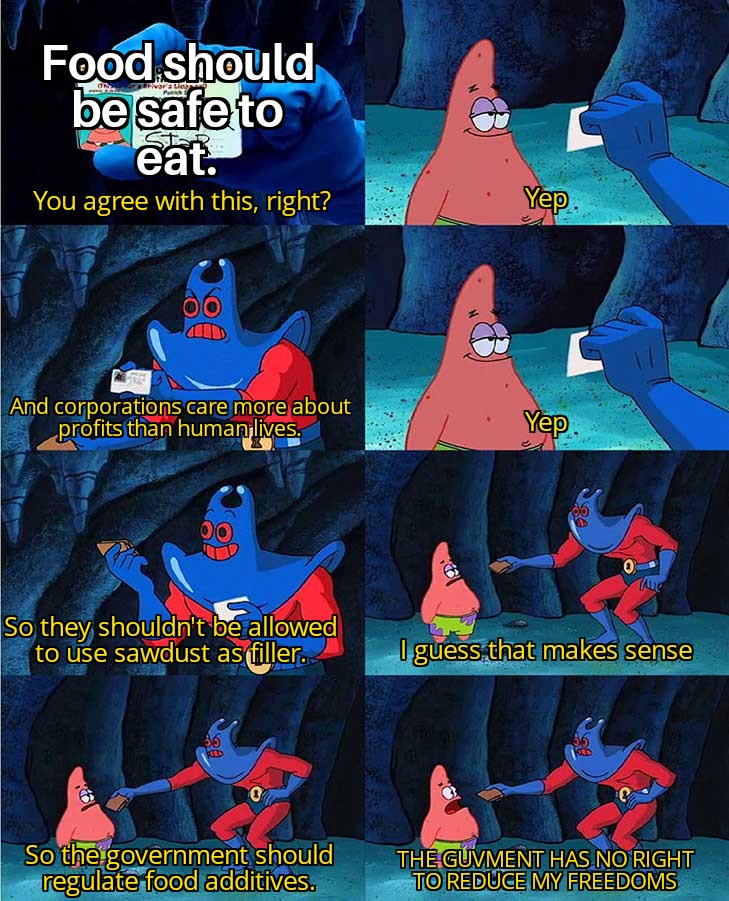
Statement wise “I don’t want the government to tell me what to eat” or variations could mean basically anything. Most of the time it’s posturing on behalf of the idea that a lack of government regulation is a good thing which ignores a rather bloody history of food suppliers adulterating food with harmful substances in the name of preservation / cheapening production cost or using production practices that cause the likelihood of contamination of food.
Once you scratch the surface of the argument you can usually figure out more exactly what they mean and it often isn’t things like government subsidy programs publishing food pyramids based on shady science and economics rather than in the interest of health.
Often it’s based out of perceived personal inconvenience or the appearance of moral judgement such as when there’s some sort of health labelling initiative.
In Canada there are a lot of things that are not considered legal additives for food that are used in the US and the difference in strictness is in part because the Health care system in Canada is funded publicly. Producers of foodstuffs cost the government money directly if whatever they put in it has no nutritional value and causes known health problems. Rather than let companies create messes and tragedies which the government is on the hook to clean up when people’s health fails they remove the issue at it’s source. In the US there’s less incentive as these costs become scattered in the form of individual medical bills and oftentimes the savings are from food being shelf stable for longer. Shrugging one’s shoulders at the fallout or claiming its an exercise of “freedom” is in service to those who make money hand over fist.