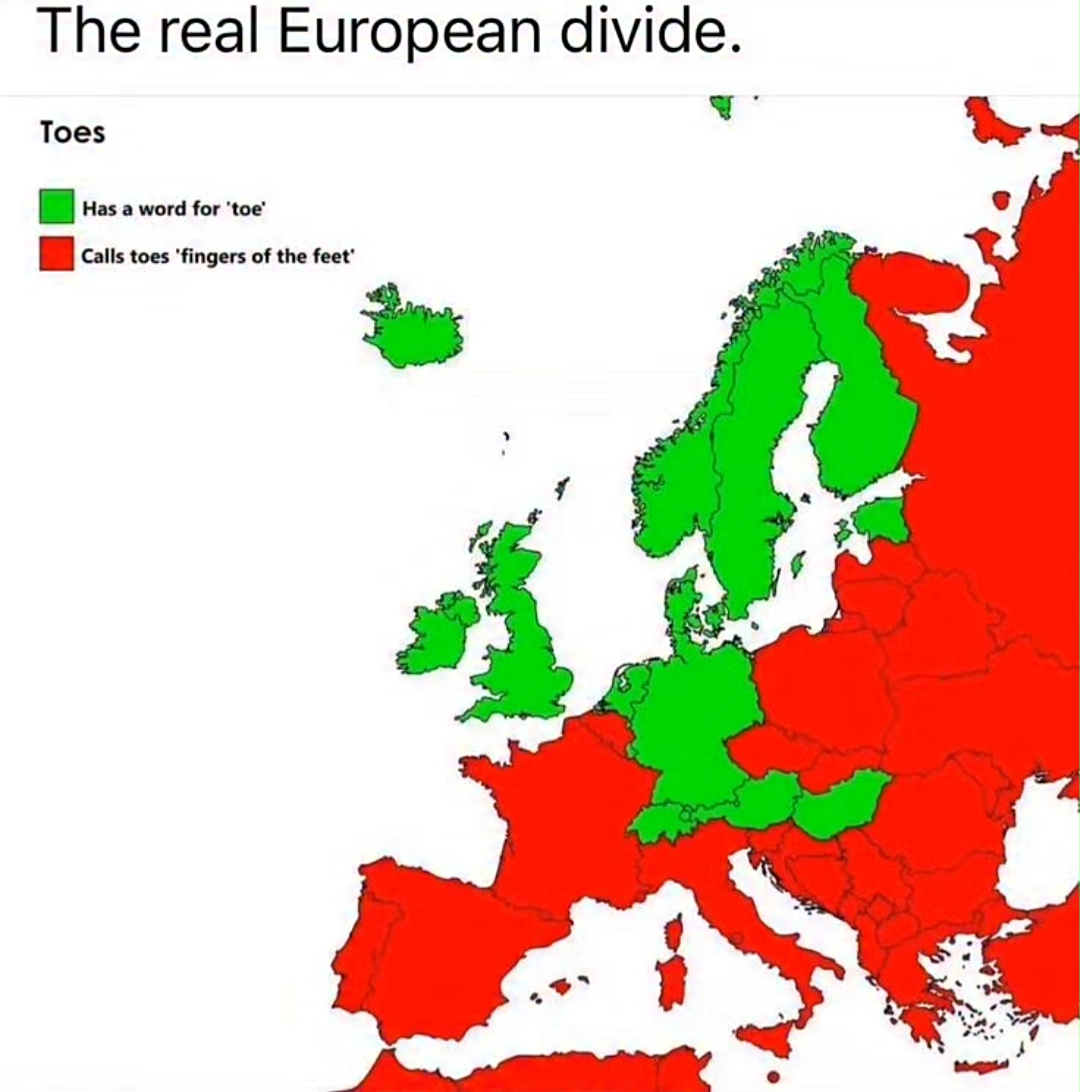
Limbs
Germany not calling them “feet fingers” was unexpected.
Submitted 4 months ago by ObviouslyNotBanana@piefed.world to [deleted]
https://media.piefed.world/posts/p1/oY/p1oYJ3pnSNMiidn.png
Limbs
Germany not calling them “feet fingers” was unexpected.
I’m wondering if they got France and Germany mixed up. I don’t remember all the French I was taught growing up, but it didn’t sound right. So I googled it and got “droigts” and “orteils” for “fingers” and “toes”.
German has “Finger” and “Zehen”
Both “orteils” and “doigts de pied” are used in French, the former sounding less childish than the latter.
or fingersAtTheEndOfTheFeetNotToBeConfusedWithTheOnesOnTheHands
Language maps shouldn’t be country maps. And it’s also wrong, in Hungarian toe is “lábujj” literally means “legfinger”
Sociocultural boundaries are almost entirely grounded in language. Nation states are almost entirely grounded in imagination.
I suspected it was rage bait, starting with the British isles being coloured green, despite the existence of the word ‘toe’ there.
By that logic, it should be both green and red, because it looks like “lábujj” is both a word, and like you said it means “footfinger”.
So the Flemish part of Belgium has “tenen”, which is not toefinger. The french have “orteils”, which is also not fingers of the foot( finger is doigt ).
So the map is at least wrong for those two countries.
You can also use “doigts de pied” in French, so you can be whichever colour you like.
Are you really telling me that cookie clicker was made by a french toe?
yes.
Real funny they coloured it differently, because Flanders literally shares a language with The Netherlands.
To be fair half the world seems to forget Belgium is not all french sometimes, or puts french as the default even though Flanders’ population is almost twice as large as Wallonie. Even adding the population of Brussels and Wallonie, Flanders still has the larger population. (Numbers for stats come from statbel)
Either way if you ignore regional languages you’re not doing linguistics. And the author could not even get it right for national languages, if we even accept that arbitrarily picking one makes any sense.
This map is a masterclass in what not to do and it almost feels like intentional engagement farming.
To be fair half the world seems to forget Belgium is not all french sometimes
It’s annoying as fuck.
Microsoft/Xbox store used to be almost entirely French when visiting from a Belgian IP, even if you set your profile language to Dutch or English. Not sure how it is nowadays, I don’t come there anymore.
Amazon Prime and Netflix still have many movies and series in dubbed French only for Belgian customers, and not the original version with Dutch or even just English subtitles.
Many sites serve you a French language page by default if you visit from a Belgian IP, and then you have to hunt in the header or footer of the page for the language toggle. You usually can’t even read the cookie permission popup in a language you understand.
Nope. In portuguese we do not call the toes “fingers of the feet”. In fact we do not have a word for fingers. Or toes. What we have instead is a word for thoses appendages that one can find at the end of one’s arms or legs. We call them “dedos”. Most of time we do not feel the need to specify if we are talking about fingers or toes. Context is usually enough to distinguish between the two. But when do have to be specific, we call the fingers “dedos of the hands” and the toes “dedos of the feet”. Now, that may seem weird to some, but to me what is really surprising is that some languages feel the need to use two words to describe what is essentially the same fucking shit.
“Digits” would be the English equivalent of “dedos”, and the words are indeed etymologically related.
Now, that may seem weird to some, but to me what is really surprising is that some languages found it necessary to use two words to describe what is essentially the same fucking shit.
Sucking on fingers is an entirely different kink from sucking on toes. So somewhat different I suppose.
to me what is really surprising is that some languages found it necessary to use two words to describe what is essentially the same fucking shit.
I mean, you can start calling all sorts of body parts the same shit, and some of them even have words already. Like we say arms and legs, but we could also say upper and lower limbs. We’ve got knees and elbows and shoulders, but they’re all just joints.
Now I’m wondering what languages have the fewest words that could describe the entire body, as in once you break down the word “body” into any number of parts (without using the word “body”, like upper and lower body), how many other words are needed? I think in English you couldn’t get away with anything less than head, neck, torso, and extremities (although one might argue that the latter refers only to hands and feet so you’d have to put limbs back in as well).
Torso and appendages
Head/neck being an appendage is arguable. But basically because there are better words to describe it, not because it isn’t one.
Axial and appendicular
Sooo… “nubbins”?
(German “Nubsis” comes to mind as well)
thats the most adorable little word owo
It’s the same in spanish
what is essentially the same fucking shit.
?
In portuguese? Absolutely! In english, not so much.
As someone who only speaks English, the cognitive map made by that language is kind of disgusted to think of toes and fingers interchangably.
Fingers are (or should be) clean, and are allowed to touch many things. I am perfectly comfortable touching many things with my fingers that other people’s fingers have touched.
But toes? Toes are gross. They are not interchangeable with fingers. Unless I’m in the shower cleaning my toes, if my fingers touch my toes I probably need to wash my hands after. And other people’s toes?..
No - toes and fingers are not the same thing. My toes are great, I’m glad to have them for balance while walking or running. But they are not fingers, or vis versa
in French, les orteils but also plenty of slang: les nougats, les arpions, les radis, les haricots…
Well we definitely have both, we do also say “doigts de pied”.
We have a word for toe, and we don’t use it very much.
Belgium is in wrong color
No trolling of Wallonia please.
wallifornia
dirty south from belgium, wah wah wah
French supports both designation.
hungary is the wrong colour too: “lábujj” lit. “footfinger”. more confusingly, the middle is “lábfej”, which is “foothead”
Hungarian has a word for the middle toe and it is “foothead”?
No it’s the part that includes everything below the ankle. Basically the foot.
Why is this a map? Some of these countries have multiple languages, like Switzerland, Belgium, Ireland, Wales, even Spain has Catalonian.
Engagement shitposting
No one can say this isn’t the place for it.
In catalán it’s “dits del peu”, so the same as in Spanish. There is no equivalent to toe.
Hungarian here, we’re in the “fingers of the feet” group!
Huh. Us other Finno-Ugrics are on the other side of the divide. Varvas, varpaat. Toe, toes.
Where’s the “toes of the hand” section?
So, Germanic and Uralic languages vs. Latin and Slavic languages.
Ok, so Albanian and Greek are the outliers here. Albanian is it’s own language group.
Though, to be fair to Greek, the word is for toe and finger is δάχτυλο. Dachtylo. Which is kind of like “digit.” Even in Koine Greek. Also, arm and hand are the same word, and leg and foot are the same word.
My Greek isn’t good enough to say for sure, but a pre-Google language manuals call both finger and toe dachtylo. Then specify hand or foot. Or…specify arm or leg? Arm digit? Leg digit?
Greece should be a grey “N/A”
For some reason I always get really annoyed when Lithuanian gets grouped into slavic even when it makes sense.
In Polish, “ręka” can mean both arm and hand and which one it is is context dependent
Kinda same in Slovenian. You don’t shake hands, you shake arms. Anything you do with your hands is done with your arms. The word for hand is not used that often.
Are there jerk off jokes about someone’s arm being their lover instead of their hand?
Well, there’s “dłoń” for hand. “Ręka” means the whole arm, including the hand, I assume.
Dłoń means something more like palm
In Bulgarian “длан” [dɫan] (which in IPA is spelled close enough to “dłoń”] refers specifically to the palm while “ръка” [rɤˈka] can refer to the the hand, whole arm and some people may use it for palm even, although that last one is not correct.
In certain Austroasiatic languages, your wrists and ankles are your hand-necks and foot-necks.
In hungarian we have a similar thing but for your foot and hand, its leg-head and arm-head respectively.
Hungary calls them foot fingers, should be red
False, italian has a word for toe that is separate from the fingers of the feet (alluce)
That is specifically the name for the big toe though, and while there are names for the various other toes (they’re quite uncommon, I don’t remember them), they’re not generic like “toe”
No, only alluce is a real word. The other names seems to be made up just to make a funny story.
i always use this as an example of how deeply the languages we use shape how we understand the world
even the answer to the question “how many fingers do you have?” changes depending on the language, and that’s a physical fact that seems to not have any degree of subjectivity to it
Eight. A thumb is not a finger.
I’ve never seen an explanation why though.
Depends on your definition. Wikipedia is either ambivalent about it, or lists the thumb as a finger.
In Dutch, thumbs are fingers, and there’s word for “digit” in the context of fingers and toes.
What is it then, a leg? That’s dumb.
This unites the Germanic and Uralic languages in by far the most important cultural way.
I don’t know much about it, but I suspect this is just a map of the 'Germanic" language family.
Not quite. Green countries are germanic or uralic (finnish, estonian, hungarian). I assume each country is only represented by a single language on the map, and Ireland is probably assumed to be speaking English according to this map.
Ah excellent, thank you.
I think the numbers speaking Irish Gaelic are incredibly small, whereas Welsh is still a commonly spoken first language away from south Wales.
I looked up the welsh for toes and found toesau which is a Welsh pluralised borrow from English, but also bysedd traed, which is indeed fingers of the foot, so I think Wales should be added to the stripey red and green part of the map as per other comments.
So, feet fingers, or “feengers”?
Slovakia and czechia is in wrong color
I just can’t get over how in Japanese, 足 means from like thigh, all the way down to tippy toes. Drives me nuts.
So it’s basically a map of the Germanic languages ?
Any languages have both? Like Japanese has ashi(no)yubi [foot('s)finger], and although yubi is technically digit it’s much more common to use it for finger. Then there’s also tsumasaki, literally meaning nailtip (or point, end, head, etc).
I have a theory: If you need 3 or 4 words in some language to specify “Fingers of the feet”, they will make their own word for it, because it is troublesome. In Polish it’s just “palce u nóg”.
What are they called is Basque?
Lumidaub@feddit.org 4 months ago
Now do one for who has a word for “glove” vs “hand shoe”.
Samskara@sh.itjust.works 4 months ago
German Word for mittens is Fäustlinge, literally fistlings.
ThatWeirdGuy1001@lemmy.world 4 months ago
Okay but that’s kinda cute
vaionko@sopuli.xyz 4 months ago
Byt then you also have Handschuhe (I bet I typed that wrong)