cross-posted from: feddit.uk/post/44126927
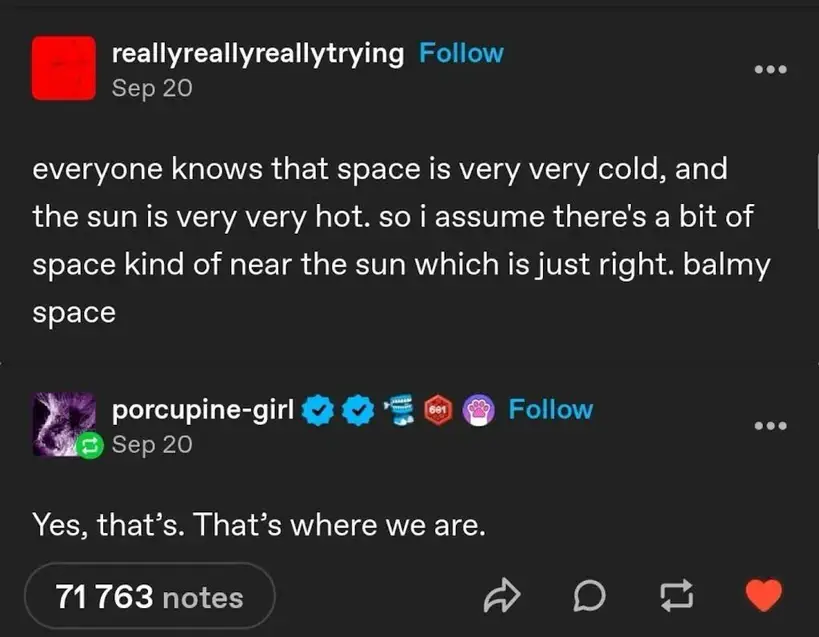
Goldilocks
Submitted 3 months ago by Zuriz@sh.itjust.works to science_memes@mander.xyz
https://files.catbox.moe/vwuhss.webp
cross-posted from: feddit.uk/post/44126927
Goldilocks
Goldilocks space is like “my breath immediately turns solid in the cold and my body is turning to charcoal in the direct sunlight”
You need a giant buffer atmosphere to help average the temperature a bit.
That or a giant space turtle with elephants holding a flatten rock on it’s back.
A strong thaumic field slows down the sunlight too. Doesn’t change the heat but it’s nice to see sunrise pour across the landscape like honey
Vacuum doesn’t have a temperature~
But you will if you sit in a vacuum for a while without a radiation source nearby, and it will be quite low.
Are you dissipating heat in a vacuum, though? Pressure shenanigans aside, would someone’s body heat slowly, continually build up, or would they freeze?
Yes. Like all multipliers the heat of the sun requires not only it’s self but that which is to be acted upon. If you are a handsome wet rock, the distance you are to the sun effects how your heat is multiplied.
Is water wet?
No, water makes other things wet.
This is not completely correct though. It is our atmosphere/albedo/geological and natural processes that help maintain consistently livable temperatures, not just living in the habitable zone. No atmosphere? We’d be like the Moon, where it is too hot in sunlight and too cold in shade despite being similarly far from the sun as Earth.
Also its not true that space is “very very cold”.
If you are in space wearing space suite that doesn’t radiate heat properly, you could die from the excessive heat. Once dead your body stops producing heat and the existing heat eventually radiate away and your body freeze.
Space is neither hot or cold because these are property of matter. Since space has very little atoms, it technically has no temperature.
The dark side of your body in space is freezing cold while the light side gets hot. You really need to rotate to get that even crispy layer.
Not anymore, there’s a blanket
Only with protective layers though.
It’s funny how something can be technically correct and still feel counterintuitive. Space really is extreme in every direction.
balmy is an understatement
Rooskie91@discuss.online 3 months ago
If that blows your mind then think about this: As the universe expanded after the Big Bang, it cooled from unimaginably high temperatures. In principle, this suggest that there could have been a very short window much later, tens of millions of years after the Big Bang, when the background temperature of the entire universe was capable of sustaining life everywhere. Some physicists have suggested this might have created a brief, universe-wide “habitable epoch,” though this remains theoretical.
I’m not an expert, so this is probably not a muture understanding, but it’s cool to imagine a universe where life was incredibly abundant.
marcos@lemmy.world 3 months ago
There was probably nothing but Helium, Hydrogen and a tiny bit of Lithium at that period.
panda_abyss@lemmy.ca 3 months ago
Those are some of the best elements though.
engywook@programming.dev 3 months ago
Interesting theory, I’d never heard of it before. All of the sudden, “a long time ago, in a galaxy far, far away”, actually seems plausible (but this theory looks like it came well after SW in 2014).
The actual paper about it: lweb.cfa.harvard.edu/~loeb/habitable.pdf
teft@piefed.social 3 months ago
No because of the inflationary period the universe cooled tremendously fast since it expanded in size so dramatically. A few yottoseconds after the “bang” started the universe was a small sphere around 4x10-29 meters in diameter and expanded to a sphere of 9 meters diameter. The expansion lasted something like 10-35 seconds and supercooled the universe. This happened really soon after the hot big bang.
wolframhydroxide@sh.itjust.works 3 months ago
More weird to me is that, at some point before the first stars, the entire universe glowed through the entire rainbow, so there is a moment when, were you to travel back in time, the entire universe would glow blindingly green.
SkyeStarfall@lemmy.blahaj.zone 3 months ago
It probably would never appear green, due to the black-body radiation distribution. When the peak is at green, it just looks like white to us. Our sun is kinda a “green” star due to this
But it would go from blue to white to red. Similar colour progression that we can find in the distribution of stars