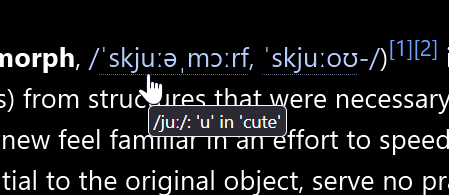
I’ve always been afraid to even click on that thing, it looks like arcane academic patois that isn’t meant for mere mortals. But the tooltips make it very accessible.
The tooltips only appear to work on English words, however.
Submitted 1 year ago by 58008@lemmy.world to youshouldknow@lemmy.world
https://lemmy.world/pictrs/image/07b0ac6d-9fdd-493c-a163-64731d27a5a2.png
I’ve always been afraid to even click on that thing, it looks like arcane academic patois that isn’t meant for mere mortals. But the tooltips make it very accessible.
The tooltips only appear to work on English words, however.
I clicked on it once and it made a baby appear and the baby looked at me.
ipa-reader.com is also helpful.
And possibly IPA as well
Related to the Wikipedia article, my childhood was in the early 2000s so to me skeumorphism, specially in software, feels very nostalgic and warm.
Wikipedia is flirting with you btw.
That’s actually pretty cool. I did not know that. Thanks for sharing.
The IPA is fantastically interesting.
I don’t agree with people who think it should replace our standard alphabets and syllabarries (it is jarring, at least in my opinion, to essentially read other people’s accents from written text when they don’t match your own), but it can be pretty useful in some situations. where you’re actually studying accents, or the most common ways things are said in other languages.
I tried to take a linguistics class in college and I just couldn’t internalize these characters. It was very difficult for me and I respect people who can.
It depends on the language you’re coming from and whose IPA transcription you’re learning. I’ve got a Bachelor’s in English linguistics so I’ve initially learned about IPA in the context of the English language. Being a native German, it was a bit difficult to get into it and remember all “special” characters that are exclusive to English and don’t appear in German or rather “uncharacteristic” realisations of German phonemes.
In my second Bachelor’s, I studied IPA in a German phonetics class and actually were really fine in that class - got used to the character since most German phonemes match with their IPA counterparts.
In my current SLP apprenticeship, I’d wager that I’m best in class in terms of IPA: transcribing utterances phonetically and reading IPA.
All of that to say, it’s weird at first but since German and English share the same language family and both languages’ letters match the IPA versions, it’s quite manageable, I’d wager. Welcoming any other opinions :)
I should really learn the pronunciation characters. The example of cute is helpful though!
“arcane academic patois” is peak. you win the internet today.
g as in gif
gif is pronounced like the ‘g’ in ‘gigantic’
Yiff
no no no no no no no
Cute. Just like you OP.
OP is BOOBS upside down.
Ayo Cute boobs. What is there to not love.
SꓭOOꓭ
No u (too)
No U2?
Apple hated that.
gazby@lemmy.dbzer0.com 1 year ago
What’s it gonna take for them to just PLEASE give me the whole thing in one go? 😭
funkless_eck@sh.itjust.works 1 year ago
they do, it’s just written down. IPA isn’t that hard to learn.
xor@lemmy.blahaj.zone 1 year ago
The whole what? As in you think each Wikipedia article should start by describing every sound in the word?
gazby@lemmy.dbzer0.com 1 year ago
In the mouseover tooltip, in list form, ideally.