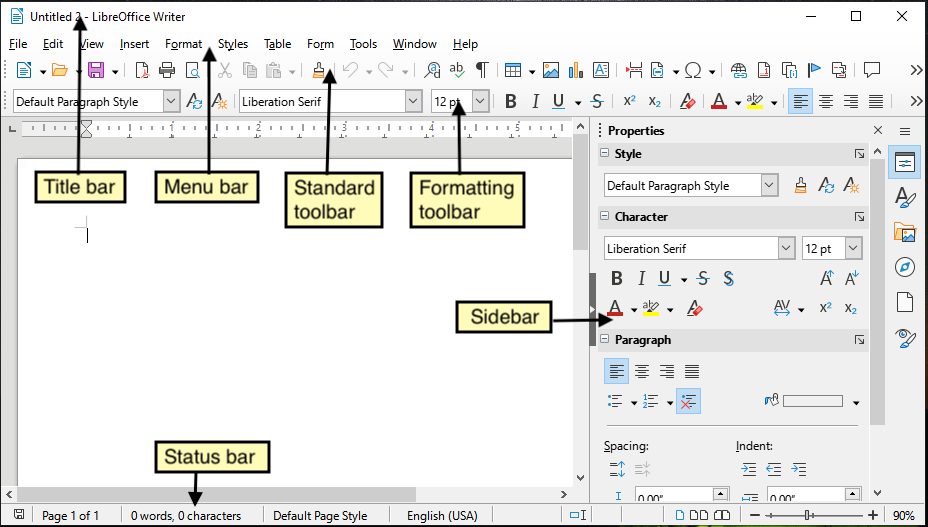
Agreed that there interface looks like the late late 90’s.
I’d recommend Libre more often but it’s a step backwards for most average users in UI. Microsoft has had the ribbon since, what, Office 2007?
Comment on LibreOffice blasts 'fake open source' OnlyOffice for working with Microsoft to lock users in
gedaliyah@lemmy.world 2 months ago
I’ve had a relatively good experience with OnlyOffice, although it has some issues.
Personally I don’t see interoperability as an anti-open issue, but I can appreciate the stance. I think I have to investigate to understand how the Microsoft format diverges from the open standard for office XML files, or in what way the format remains proprietary. I had been under the impression that OnlyOffice follows the open standard.
OnlyOffice does ape Microsoft Office in a lot of ways but I see that as a positive. Users are far more likely in my opinion to switch to something that looks and feels familiar.
LibreOffice is hard to use. The menus and shortcuts are not well organized and the entire suite feels like a relic from the early 2000s. If they invested in a modern UI with less friction for users who are looking for MS alternatives, they wouldn’t be facing competition from projects like OnlyOffice. If they invested in feature parity for mobile users, they wouldn’t be losing potential users to those who offer it.
They have an incredibly powerful backend with far more capability than the more junior OnlyOffice. Yet they fail to recognize why that just doesn’t matter to the majority of users. Most users just want to quickly author and edit files, share them with other users, and get on with the next task. LibreOffice has become overly fixated on niche features and optimizations that are very cool from a technical standpoint but are totally out of touch.
By the way, LibreOffice also supports OOXML, so… do with that what you want.
Agreed that there interface looks like the late late 90’s.
I’d recommend Libre more often but it’s a step backwards for most average users in UI. Microsoft has had the ribbon since, what, Office 2007?
LO also has the ribbon interface. But not by default.
IIRC, the last time I used a new install of LO for the first time, it asked me which interface I preferred instead of defaulting to the old one.
True, but it is a purely aesthetic rearrangement of the menus. It doesn’t make it any more straightforward to navigate. Plus it doesn’t really function correctly on Windows (and it takes up just as much screen space).
It was a good step when they rolled it out about a decade ago, but they still haven’t done the work to make it better organized or show appropriate hierarchy.
but it is a purely aesthetic rearrangement of the menus
And what do you think gui is?
The Ribbon interface is terrible, though. The styles selector doesn’t fit the entire button, and it also doesn’t resize with your window size, remaining super tiny not capable of displaying three full options simultaneously. Image
Word at least got that right.
My preferred layout is Sidebar, but even there the style is just a regular dropdown. LibreOffice is fantastic, but they need to put some more work into UX.
Good. Those that want it can enable it. I don’t. Takes up too much screen space showing a lot of unnecessary icons
It should be by default.
I honestly prefer the classic LibreOffice UI. The ribbon thing takes up a lot of screen space and i really didn’t like it when it debuted in Office 2007. Microsoft changed the color to blue so it could be more fancy. LibreOffice is the best
The Office ribbon is more recent than the previous menu styles, but newer!=better. The ribbon organizes fewer commands into less coherent groups, and replaced the descriptive text menu option for each setting with a tiny glyph instead, creating a modern hieroglyphic system known only to them. It then made sure this less efficient workflow took up more of the already limited vertical monitor real estate. The only benefit I can see would be for the illiterate, but what are they using an office site for if they can’t read?
or in what way the format remains proprietary.
Most of it is proprietary extensions. There’s a whole wikipedia article over the drama.
Stallman quote:
Microsoft corrupted many members of ISO in order to win approval for its phony ‘open’ document format, OOXML. This was so governments that keep their documents in a Microsoft-only format can pretend that they are using ‘open standards.’ The government of South Africa has filed an appeal against the decision, citing the irregularities in the process.
FSFE’ stance on it back then (now offline and only two too late captures, link)
Since the very beginning of the standardisation process for Microsoft’s Office Open XML - OOXML (hereinafter MS-OOXML), the FSFE has expressed serious doubts about whether MS-OOXML could be considered as open, if even, as a standard at all.
The FSFE first raised the issue in the community and led the movement against the standardisation of MS-OOXML, following closely over the years the relevant developments.
But why can MS-OOXML still not be considered an Open Standard, despite its approval by international standards organisations?
MS-OOXML is an XML-based format for office documents developed by Microsoft.
It covers word processing documents, spreadsheets, presentations, charts, diagrams, shapes, and other graphical material.
MS-OOXML was first adopted in 2006 by ECMA International - a private international standards organisation - allegedly as an Open Standard.
In 2008, the International Standards Organisation (ISO) also approved the MS-OOXML, as international Open Standard under the ISO/IEC 29500, after Microsoft requested fast-track process.
ISO approved the standard despite the fact that it was initially rejected, due to a big number of justified concerns expressed by its national member bodies.
In 2001 a collective effort started to create an open document format, promoting Open Standards and trying to limit Microsoft’s office software monopoly.
The result of this effort which lasted four years, was the Open Document Format v1.0 (ODF), implemented with Free Software.
It was first approved in 2006 as an OASIS Standard and later, by ISO/IEC JTC1 as an International Standard, under the code ISO/IEC 26300:2006.
Such a format could threaten Microsoft’s dominant position in the Document market, which at the time ran on closed formats.
Under the fear of losing its power, the latter produced its own allegedly open document through a dubious ISO approval process.
As it can be imagined, the “new” format seemed in a first vote unnecessary to the ISO working group since there was already an existing document standard -ODF- and was, therefore, rejected.
However, Microsoft, in a more political than technical process, got its proposal fast-tracked even though specific clauses of it still met resistance from the national member bodies.
And this is the point in the revision process, where a suggestion came on the table, to create two sub-standards of MS-OOXML, namely ISO 29500 Transitional and ISO 29500 Strict.
Here is what happened: the Strict version got accepted by ISO, while the Transitional version was granted to Microsoft, allowing it to exclude certain legacy features and facilitating conversion from the older closed-source binary formats.
ISO then gave its approval to MS-OOXML in 2008, and justified its decision by claiming that the market needed another document standard.
It is noteworthy that Microsoft did not have, at the time of the approval, an available version of Microsoft Office that would be compliant to the ISO/IEC standard it has just passed.
That was the result of the multiple changes on the original version of the standard in order for the approval process to move forward.
Consequently, although the older binary formats (.doc, xls, and .ppt) continued to be supported by Microsoft, MS-OOXML became the default standard of all Microsoft Office documents (.docx, .xlsx, and .pptx), starting with Microsoft Office 2007.
Nevertheless, MS-OOXML Transitional is the only variant in widespread use and this is a note to keep in mind: those dual requirements led to a situation where one standard exists, and another format is fully implemented and spread all around, despite just having the status of an undocumented, proprietary specification.
In other words, something that started as an intent to enable a transitional period was turned into a norm, setting obstacles to any interoperability claims.
At a glance, Microsoft Office 2010 provides read-support for ECMA-376, read/write-support for ISO/IEC 29500 Transitional, and read support for ISO/IEC 29500 Strict.
Microsoft Office 2013 and Microsoft Office 2016 additionally support both reading and writing of ISO/IEC 29500 Strict.
However, in all of them, the default option is the transitional one, meaning that the strict standard is still not used in practice, unless the users change the default settings ad hoc.
Although many people share the assumption that some widely used formats can be identified as Open Standards, there is a number of them that does not comply with the criteria listed in the Open Standards definition.
MS-OOXML is one of them, the so-called pseudo-standards.
As first objection, MS-OOXML could be seen as unnecessary.
Software engineers could instead use Open Document Format (ODF), as a less complicated office software format that was already an international standard at the time of the MS-OOXML review process, is also built upon XML technology and has the same theoretical capabilities.
Microsoft itself is a member of OASIS, the organisation in which the ODF standard was developed and where it is being maintained.
Microsoft was aware of the whole process and was invited to participate, but allegedly refused to do so, although it could have submitted its technological proposals to OASIS for inclusion into ODF.
Having two overlapping standards for the same thing creates only further burden and confusion, and can be detrimental for competition.
One of the alledged main advantages of MS-OOXML was its ability to allow for backward compatibility.
However, in practice MS-OOXML seems to be compatible only with Microsoft documents, whilst its interoperability with products from other vendors appears to have been made extremely complicated by design.
This is also related to the fact that MS-OOXML was initially designed to be compatible with existing Microsoft closed formats, in comparison to ODF, which was designed with the aim to achieve document interoperability.
Whenever applicable and possible, standards should build upon previous standardisation efforts and not depend on proprietary, vendor-specific technologies.
Albeit, MS-OOXML neglects various standards and uses its own vendor-specific formats instead.
This puts a substantial burden on all vendors to fully implement MS-OOXML.
It seems questionable how any third party could ever implement them equally well, especially when a standard comes with 6000 pages of specifications without serving its minimalistic purpose.
Proprietary, application-specific extensions are a known technique employed in standardisation by vendors to abuse monopoly.
Abusive behaviour was at the core of the decision against Microsoft by the European Commission in 2004.
For this reason, it is common understanding that Open Standards should not allow such proprietary extensions, and that such market-distorting techniques should not be possible on the grounds of an Open Standard.
Standards should not depend on certain operating systems, environments or applications, since application and implementation independence is one of the most important characteristics of all standards.
Nevertheless, MS-OOXML includes references to particular Microsoft products.
MS-OOXML Strict does not serve its purpose as Open Standard.
It was deliberately never implemented, to allow its transitional proprietary version to gain more ground as a default format for MS
Office and to keep people locked in to proprietary solutions.
See what you can do about it.
FSFE Context Briefing: Interoperability woes with MS-OOXML
FSFE Context Briefing: DIS-29500: Deprecated before use?
Six questions to national standardisation bodies
Article on Groklaw: Novell’s “Danaergeschenk”
Article on BBC: Questions for Microsoft on open formats
Article on Heise.de: The converter hoax
OOXML Abuse Index
Originalartikel
To me, this would be like if VLC made an angry post about the evils of MP3 instead of just making a great player that can handle it (which they have). People still use VLC because we know that it will handle anything. Plus, they’ve kept the interface simple and intuitive, with most needed functions front and center, with lots of specialized features in menus and settings.
LibreOffice is losing ground because they don’t take design seriously and instead of making interoperability a priority, they would rather complain about user preferences.
You are missing the parts where MP3 is made by a company that makes a music player, publishes a spec to get recognized as an open standard, then starts diverging from this spec to prevent interoperability while of course still pretending to be an open format.
Said company has also been convicted for anti-competitive practices, against the other spreadsheet software.
Do you work with office workers? Tabbed design does not help them. I literally had a co worker ask me to if I could put spellcheck from the revision tab to the main one (or have it always showing).
Why did FSFE delete this?
No clue. Maybe they g
t rid of old stuff?
Simply the fact that, unlike OO, LO misses inline equations in presentations (unless you resort to strange hacks and workarounds) makes LO unusable for my use case. I’m not complaining, but that’s what it is.
False information. LibreOffice nowadays has multiple types of interfaces to choose from, including some matching more modern MS office. Give it another try.
They should default to a more modern interface rather than asking newbies to make the change.
It still has idiosyncrasies that create friction. Looking like it’s from early 2000s is much less of a problem imo than confusing buttons and unintuitive workflows
I last ran serious testing a year ago. I ended up going with OnlyOffice. Despite some drawbacks, it was an easier switch that offered less friction and better file compatibility coming from MS.
Do know if Calc has some Power Query equivalent ETL-tool or supports multiple people working a file simultaneously in cloud?
You’re the first account I’ve seen endorse OpenOffice, and I’ve been casually looking for a better alternative to word since the copilot bullshit last year.
Do you have a good example of something they added since LibreOffice forked off that’s worth considering if choosing an alternative?
OpenOffice ≠ OnlyOffice
OpenOffice is no longer actively maintained to my knowledge, and should be avoided as such
OpenOffice is not the same as OnlyOffice. The latter is modern software with a decent UI and MS Office file support; the former has had almost no changes since 2014.


sin_free_for_00_days@sopuli.xyz 2 months ago
Yes, from the article: