China's Largest Solar Farm Is Quietly Changing The Desert Around It
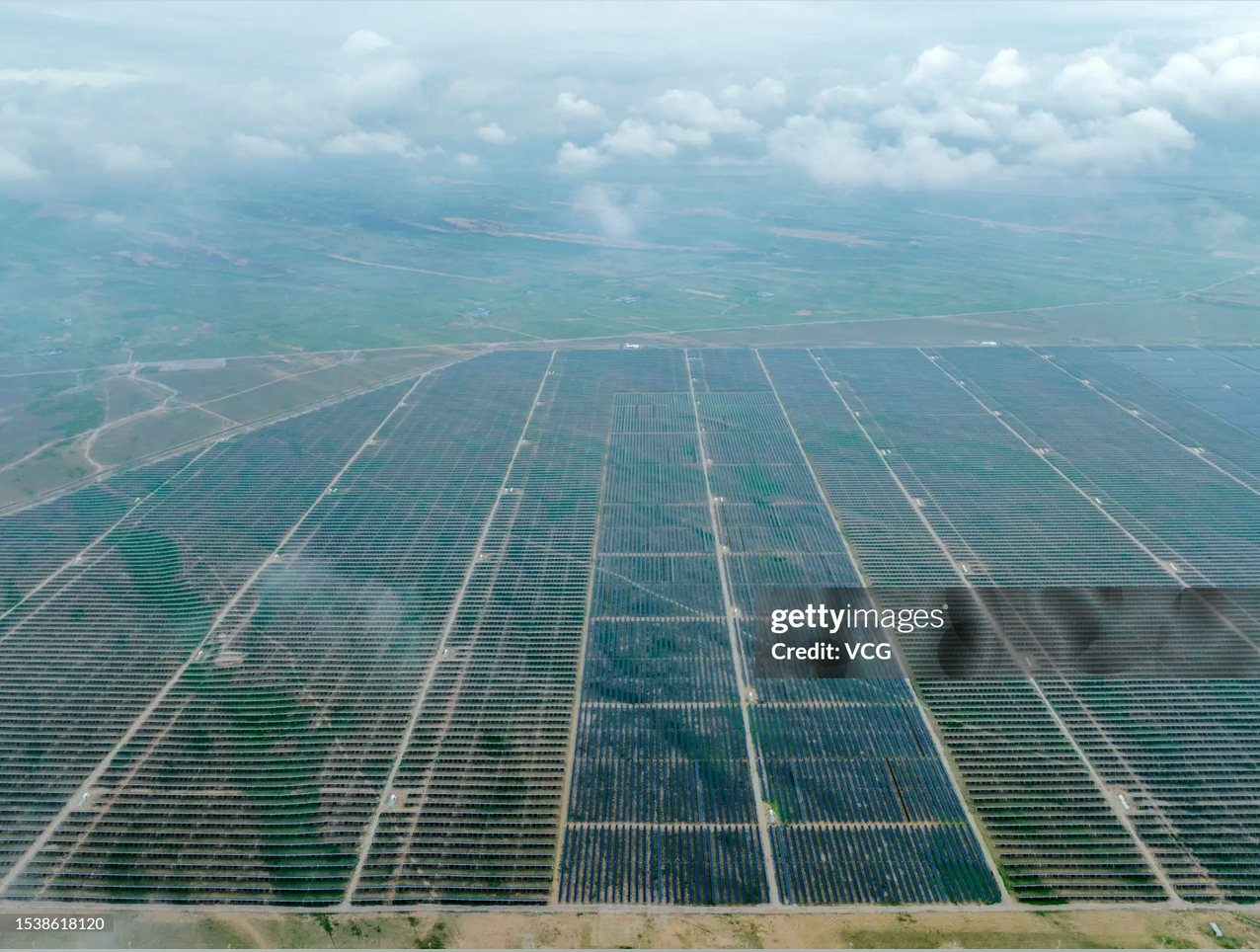
A solar farm in China is greening the land around it by reducing ground water evaporation, cutting down on wind, and adding water to the ground.
Submitted 2 months ago by artifex@piefed.social to energy@slrpnk.net
https://www.bgr.com/2121733/china-solar-farm-changing-world-fertile-soil/
China's Largest Solar Farm Is Quietly Changing The Desert Around It
A solar farm in China is greening the land around it by reducing ground water evaporation, cutting down on wind, and adding water to the ground.
Would be pretty cool if the article showed even one picture of a plant under these solar panels. I can’t believe they picked literal stock images of the solar panels in barren deserts for this article.
Yep definitely an older photo. But getty images has some more recent ones , with plantlife and even grazing animals that are used to maintain the fields.
This one is from 2023: image
Probably most people on lemmy aren’t biogeochemists. But this, especially at this scale, is actually a very interesting finding and I’m going to be sharing it with other biogeochemists. Its also a finding that makes basic, explainable sense: you reduce the windspeed at the earths surface and you reduce evaporation, evapotranspiration, etc. Not to mention shading the surface.
The difference is this offers a form of analysis at scale.
And I think scale is the critical thing for other reasons too. We know, for example, that dust from the Sahara circulates the globe and brings nutrients to US soils. While I don’t think there’s much harm from something even at the current scale of the Gobi deployments, at a certain point deploying anything en masse is basically geoengineering, with all of the potential unexpected consequences that that brings.
deploying anything en masse is basically geoengineering, with all of the potential unexpected consequences that that brings.
Yeah I mean. How many internal combustion engines are running right now? In the course of me responding to your reply how many million tons of CO2 were being emitted?
I mean if were going to talk en masse geoengineering, lets talk en masse geoengineering. And lets just take the piss: Say for example there was an unintended consequence to mounting a bunch of solar panels in the desert. At least, if you had this consequences and wanted to undo it, you could un-mount the solar panels and move them some where else. There is no unburning fossil fuels once emitted. Or clear cutting millions of acres of forested lands and putting it into farm land. Or exterminating a key stone species like buffalo or beavers. Or leaving methane leaks uncapped. Like… We’ve been geoengineering the entire time. What are we even talking about?
There are some interesting questions around what something like mounting these solar panels does to the carbon cycle. Phenology would be a big one. Water storage. ET. Very interesting stuff.
We know, for example, that dust from the Sahara circulates the globe and brings nutrients to US soils.
Eh, the Amazon rainforest survived the African Humid Period, so it’s probably fine.
More to the point, even if this thing is big compared to the average solar farm, it’s still small compared to the scale of geoengineering. For example, enough solar panels to power the entire US would only cover a small fraction of the Chihuahuan Desert:
(source)
Is the water that’s not evaporating missing somewhere else?
Initially yes, a tiny bit, but long term no: it will go to a new equilibrium, where over time just as much leaves as enters. Except thanks to the extra water that is being retained locally, the local environment will be greener + more temperate than without the panels. And that new green lung is likely to have beneficial effects further away as well, similar to forests.
I mean that is quite a good question. My argumentation would be, that by melting the ice caps the amount of liquid water on earth generally increases, so keeping some of it in the desert does not seem like a bad idea.
But i am in no way qualified for a climate simulation. If anyone knows more, ping me!
They could have just put normal plates there too if they wanted to change the area but instead they just used it for solar panels and “oopsie daisy, look there’s grass growing, let’s get some articles about the cool thing we did”.
In addition to providing the cheapest energy in the world on generally useless/valueless land, that is publicly owned because it is useless, solar is increasing the land value. OP mentions grazing use, and a wind break for dust storms. Where Chinese deployment costs are under 50c/watt = $100/sq meter deployed where $60/square meter including bare land buffers, bringing land value close to $1/square meter of agriculture quality land, makes that bare land rental value of $4000/partial hectare a good return on the $6000/solar used hectare, not to mention the energy value generated, or the land surrounding the hectare being improved.
Predicting Earth’s future climate is a race against time. As climate change accelerates, improving models is essential to guide decision-making from governments, especially if we hope to control climate change.
…Do they really believe this?
Read the room. Doesn’t matter if they invent a freaking oracle, governments aren’t going to do squat as long as constituents are manipulated into not seeing it.
We are past the point of praying and hoping science will win an attention war. I feel like all this research is just pointless with the elephants in the room.
If someone wakes up and changes the governments, whatever the new ruling system is will be a government and will need models to choose the best way forward. So I think their statement is literally true (and inevitable conditioning on humanity surviving for a few more millennia). Note that the populace is more aware than ever, and getting more informed over time on climate change.
It’s unlikely that the climate modeling apparatus has siphoned off the people required to convince or force governments to act reasonably. Lift where you can reach: I think the research is not pointless.
Destroying the habitat for endangered desert species

UnderpantsWeevil@lemmy.world 2 months ago
I fucking hate headline writers.
Listen. I like this article. It’s the kind of Hopium Lemmy could use more of. I like that we’re getting a target to aim for that isn’t just “ask politicians very nicely to ask businesses very nicely to stop lighting the planet on fire”. And I recognize that - because all the big commercial venues have been poisoned against Woke Green Energy - we’re just not going to see this kind of coverage in the NYT or the WSJ. I even like that it gets away from a bland “China Did Good” coverage and throws in a project a little closer to home, so we’re not reflexively inundated with China Hate as a response.
But this is some high school essay ass writing style. BRG is not sending their best.
rmrf@lemmy.ml 2 months ago
UnderpantsWeevil rails against shitty headlines, blasts brg for bad writing
UnderpantsWeevil@lemmy.world 2 months ago
Image
kibiz0r@midwest.social 2 months ago
Slammed
GreenCrunch@piefed.blahaj.zone 2 months ago
normally the desert makes a very loud metallic groaning noise when changed, obviously
lemming@anarchist.nexus 2 months ago
Bit of a digression but as a big fan of dates now I really wanna try jujubes. Didn’t even know they existed.
Heliumfart@sh.itjust.works 2 months ago
I recently ordered some seedlings from a nursery, I have never tried them, but figured “why not”. I’ll know if I like them in about 4 years, hopefully