The explosion is over, but the consequences continue. About twelve thousand years ago, a relatively normal star in the constellation Vela suddenly exploded, creating a strange point of light briefly visible to humans living near the beginning of recorded history. The outer layers of the star crashed into the interstellar medium, driving a shock wave that is still visible today. The featured image, taken piecemeal over 60 hours from the Khomas Region of Namibia, captures some of that filamentary and gigantic shock in visible light, with details highlighted by hydrogen (red) and oxygen (blue) emissions. As gas flies away from the detonated star, it decays and reacts with the interstellar medium, producing light in many different colors and energy bands. Remaining at the center of the Vela Supernova Remnant is a pulsar, a star as dense as nuclear matter that spins around more than ten times in a single second.
 humble_boatsman@sh.itjust.works
How is a pulsar or “the center” of that identified?
 johnnyenzyme@piefed.social@piefed.social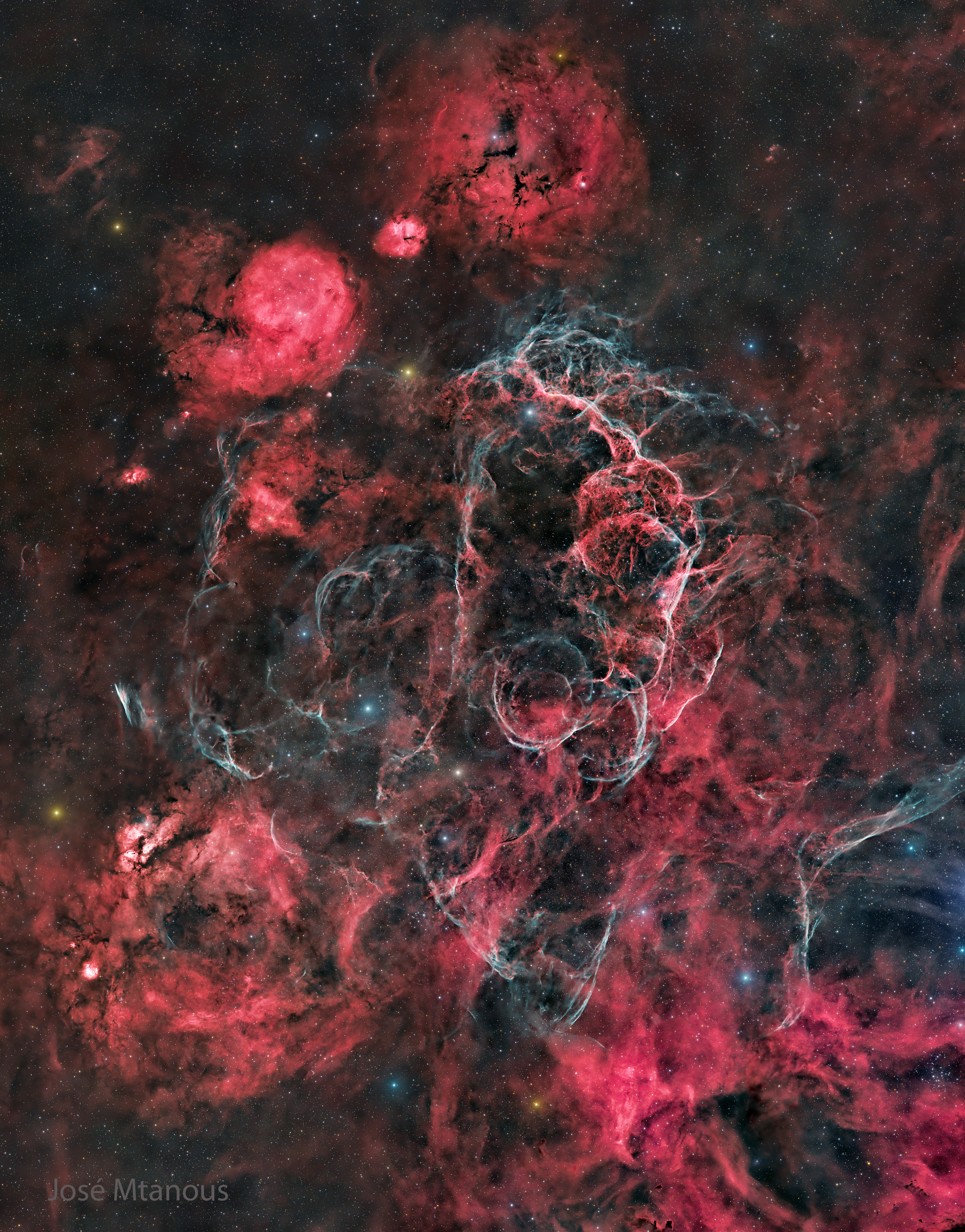
I’m seeing the head of a luminescent rooster, looking to the right, with its comb being blown by cosmic winds, also to the right. Yes, I think I’d bet 10,000 quatloos on that.
Incredible pic, in any case.
@fauxpseudo@lemmy.world
FauxPseudo@lemmy.world 2 months ago
Cosmic silky rooster.
Image
Image
Hah!