Please remember to spread the word about this :(
Submitted 10 months ago by TheImpressiveX@lemmy.today to [deleted]
https://i.postimg.cc/NF8WdM2D/bb1m0bbid17e1.png
Submitted 10 months ago by TheImpressiveX@lemmy.today to [deleted]
https://i.postimg.cc/NF8WdM2D/bb1m0bbid17e1.png
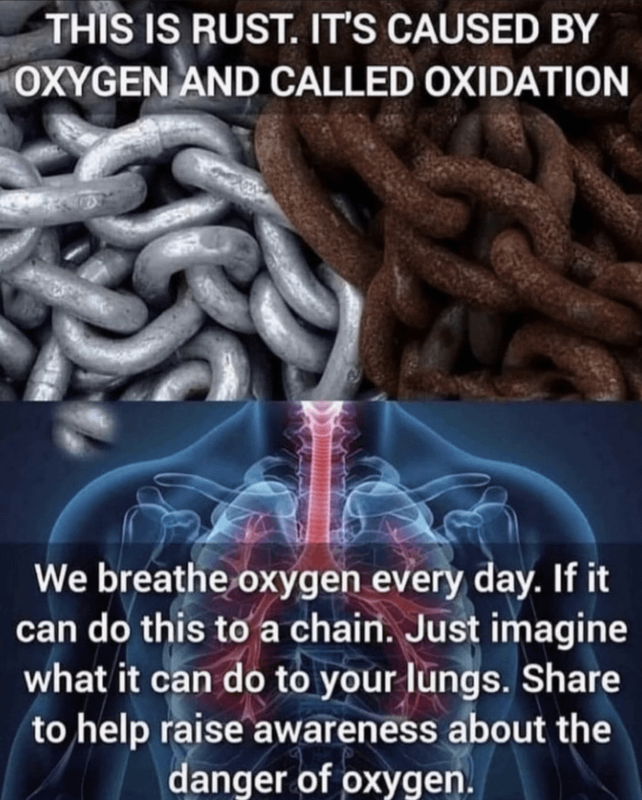
Winter_Oven@piefed.social 10 months ago
On the topic, as oxidation is a pretty prevalent negative side effect of living, our body has multiple mechanisms to deal with it, no? So my question is: where do the "antioxidants" that we can eat come into the picture here? Are they like preventing oxidation from even occurring, or are they like the shields that our cells use to protect themselves from oxidative stress, or what have you?
Ledericas@lemm.ee 10 months ago
we have enzymes to prevent oxygen radicals from forming. such as Superoxide dismutase, which is present in nearly every cell in our body, and we have 3 different version. most oxygen dependant organisms have similar enzymes.
olafurp@lemmy.world 10 months ago
Cell mechanisms cause oxidative stress in the body which can lead to inflammation and faster aging. Antioxidants provide the body with an easy way to neutralise the bi-products.
liquorisquicker@sh.itjust.works 10 months ago
Oxidation is the loss of electrons, whereas reduction is the gain of electrons. The mnemonic is OIL RIG: Oxidation Is Loss, Reduction Is Gain.
Oxygen is highly electronegative (second only to fluorine), meaning that it will strongly pull electrons.
The reason that oxygen is so important for respiration is because of its high electronegativity. It is used as the final electron acceptor in a chain of chemical reactions that are used to convert high energy molecules that you’ve eaten into different high energy molecules that your body can use.
Think of the analogy of a staircase and a ball. The ball is an electron and the stairs are energy states of different molecules along the metabolic pathway. As the ball goes down the stairs, the electron loses energy (which is usually converted to ATP or NADH). At the bottom of the stairs is oxygen, once the electron gets there, it doesn’t have anymore potential energy to lose, unless maybe you have some fluorine around.
An oxygen missing an electron (an oxygen radical) is highly reactive. It’ll just steal an electron from whatever molecule is nearby. That may be DNA or any other molecule that you’d rather keep intact. Antioxidants are helpful as electron donors, neutralizing radicals before they do damage.
This is my understanding, at least. It’s been a while since I took chemistry.
jj4211@lemmy.world 10 months ago
Ok, I’m going to make a new nutritional supplement: “oops! all electrons!”
HeyThisIsntTheYMCA@lemmy.world 10 months ago
antioxidants are our internal sacrificial anodes?
peregrin5@lemm.ee 10 months ago
Oxidation is how red blood cells collect oxygen to pass to the rest of the body. In fact it is iron in hemoglobin that “rusts” to collect the oxygen.
Antioxidants have nothing to do with this.
rhombus@sh.itjust.works 10 months ago
The process you’re thinking of is oxygenation, not oxidation. Oxygenation is the binding of oxygen to other molecules, oxidation is the loss of electrons. When the iron in hemoglobin oxidizes (from Fe2+ to Fe3+) it stops binding with oxygen, and if it oxidizes further (to Fe4+) it can start oxidizing other molecules in your body. Your body has enzymes to reduce the iron back to a reactive state, but antioxidants also play a role in reducing oxidized molecules.
Greyghoster@aussie.zone 10 months ago
Thanks, this is an unexpected image and a fun fact for the next party.
Winter_Oven@piefed.social 10 months ago
ooh, then I must have gotten the terms wrong...
What I was thinking were the free radicals that are generated during basically most oxygen related reactions in the body, I thought that was called oxidation (at least, in terms of the body).
So, you know anything about how (or if) antioxidants are used against free radicals?
knightmare1147@lemmy.world 10 months ago
I actually thought about this a few years ago, is it possible that we age because of oxidation to some degree? Is there a way to prevent that? I thought about it, how blood can rust and just had the connecting thought but I’m not smart enough to know if there’s any actual correlation.
Sadbutdru@sopuli.xyz 10 months ago
I’m no expert but I’m fairly sure that is basically true in a way. As per zr0’s top-level comment. Forms of life that can make do with less cellular respiration, for example by using external sources to regulate temperature (cold- blooded), don’t need to invite as much oxygen into their cells, and so they get less weird damage over time. Mammals in general have not adopted this strategy.
Winter_Oven@piefed.social 10 months ago
Pretty sure oxidation plays a major role in aging, but can't tell you the exact mechanism, I have no idea about it.
But about the blood rust idea, I don't think that can work, cause we don't have just iron particles that can directly interact with oxygen just floating around in our blood, we have a complex (I.e. hemoglobin) that contains significant amounts of iron, which somehow makes it really good for binding to and carrying oxygen.
Deviating a bit, carbon monoxide poisoning is really akin to suffcation iirc, cause it binds and occupies the hemoglobin, effectively reducing the amount of oxygen that can be carried by your blood.
However, do fact check me, I might be wrong about something...