lmmarsano
@lmmarsano@group.lt
- Comment on Everyone Cheering The Social Media Addiction Verdicts Against Meta Should Understand What They’re Actually Cheering For 2 months ago:
I don’t know. Seems like a self-control issues. People can get addicted to anything: shopping, sex, internet use, work, gaming, exercise. I also disagree with prohibitions on gambling, drug use, prostitution: it’s their money, their body, etc.
Penalizing systems of communication & information delivery seems overreach. The harm seems phony & averted by basic self-control.
- Comment on There's nothing stopping an 8 year old child from just taking their parent's ID to do Age Verification... 2 months ago:
The US federal courts had an interesting opinion there: parents may always allow their children to access protected speech. Even with sex-related materials, the Supreme Court has stated
the prohibition against sales to minors does not bar parents who so desire from purchasing the magazines for their children.
They regarded as constitutionally defective laws that impose a single standard of public morality. Instead, they’d allow laws that “support the right of parents to deal with the morals of their children as they see fit”. Laws that take away parental control are also impermissible.
“It is cardinal with us that the custody, care and nurture of the child reside first in the parents, whose primary function and freedom include preparation for obligations the state can neither supply nor hinder.” Prince v. Massachusetts, supra, at 166.
In [another decision][shelf], they regard & defend parental responsibility & discretion in leaving access open to children.
The Fabulous Associates […]. Id. at 788. The court noted that “[i]n this respect, the decision a parent must make is comparable to whether to keep sexually explicit books on the shelf or subscribe to adult magazines. No constitutional principle is implicated. The responsibility for making such choices is where our society has traditionally placed it — on the shoulders of the parent.”
So, according to them, presenting such content to children ought to be left up to their parents, and laws shouldn’t infringe on their right to do that.
- Comment on Meta found liable in child exploitation case 2 months ago:
OS level parental controls do not give a parent control over a child’s use of a social media platform
A quick web search indicates they can filter/block content, restrict apps, report activity. Additional software can monitor communication (including social media) and alert guardians.
However, the legal opinion wasn’t that parental control software is the best solution or only better solution[^better], but that more effective alternatives (such as non-punitive laws promoting use of client-side parental controls) with less adverse impact exist than punitive laws limited in their enforceability by jurisdiction & that unnecessarily burden & deter (thus harm) free exercise fundamental liberties.[^constitutionality] Client-side parental controls only affect their users without affecting everyone else. Unlike regulations on site operators, they work on content originating outside a law’s jurisdiction. Even at the time of that federal court decision, parental controls could screen dynamic content (eg, live chats) over any protocol.
By far, the most appropriate answer is responsible adult involvement & supervision and the education of children to address motivation, coping, & responsible behavior.
The internet is global. A key problem with any coercive law is their jurisdiction isn’t: just as 4chan.org can tell UK’s OfCom to go fuck itself, site operators beyond a law’s jurisdiction can tell its enforcers the same. Another issue is the compliance burden is harder on entrants than the dominant companies in the industry with more resources to afford to comply, thus deterring competition. Do we really want to make it harder to displace our current social media companies with alternatives?
Communication alone rarely poses immediate danger. We can block or ignore unwanted communication & choose the information we disclose. Responsible people can guide their children on safety & control their access to the devices they give them.
A while ago, when my uncle struck his kid for making an unauthorized payment through the kid’s tablet, I scolded him for creating the situation where the kid could do that instead of setting up a child account with parental controls. When I asked him how child abuse is more responsible than reading some shit designed for him to understand and pressing a few buttons to use the system exactly as designed to prevent this shit from happening, he quickly got the point and did that in about an hour. This shit ain’t hard.
Better solutions already exist, they’re effective, and the solid recommendations governments already have to promote them effectively would work. Government have largely chosen not to.
[^better]: The cited recommendations I mentioned elsewhere went beyond parental control software into areas such as the promotion of standards & the development of better standards in the industry.
[^constitutionality]: Rather than accept any law, government has a duty to minimize compromises of fundamental rights in meeting its “compelling interests”. When government fails to prove that a law is the least adverse to fundamental liberties among alternatives that are at least as effective, that law must be rejected.
- Comment on Meta found liable in child exploitation case 2 months ago:
And improve parental controls for children’s accounts. I’m sure there’s nothing currently giving a “parent” account high level control over a “child” account, but I’m happy to be corrected if I’m wrong.
Parental controls already exist in every major OS, they suffice to restrict & monitor social media, and they go unused.
A better solution might be for laws to provide parents resources & incentives to parent children’s online activity & to provide children education in online safety & literacy. Decades ago, federal courts citing commission findings & studies recommended these alternatives as superior in effectiveness, meeting government duties to minimize impact on civil liberties, allocation of law enforcement resources, etc. For the permanent injunction to COPA, the judge wrote
Moreover, defendant contends that: (1) filters currently exist and, thus, cannot be considered a less restrictive alternative to COPA; and that (2) the private use of filters cannot be deemed a less restrictive alternative to COPA because it is not an alternative which the government can implement. These contentions have been squarely rejected by the Supreme Court in ruling upon the efficacy of the 1999 preliminary injunction by this court. The Supreme Court wrote:
Congress undoubtedly may act to encourage the use of filters. We have held that Congress can give strong incentives to schools and libraries to use them. It could also take steps to promote their development by industry, and their use by parents. It is incorrect, for that reason, to say that filters are part of the current regulatory status quo. The need for parental cooperation does not automatically disqualify a proposed less restrictive alternative. In enacting COPA, Congress said its goal was to prevent the “widespread availability of the Internet” from providing “opportunities for minors to access materials through the World Wide Web in a manner that can frustrate parental supervision or control.” COPA presumes that parents lack the ability, not the will, to monitor what their children see. By enacting programs to promote use of filtering software, Congress could give parents that ability without subjecting protected speech to severe penalties.
I also agree and conclude that in conjunction with the private use of filters, the government may promote and support their use by, for example, providing further education and training programs to parents and caregivers, giving incentives or mandates to ISP’s to provide filters to their subscribers, directing the developers of computer operating systems to provide filters and parental controls as a part of their products (Microsoft’s new operating system, Vista, now provides such features, see Finding of Fact 91), subsidizing the purchase of filters for those who cannot afford them, and by performing further studies and recommendations regarding filters.
Adult supervision, child education on online safety & literacy, parental controls & filters are more effective at less expense to fundamental rights. Governments know this & conveniently forget it.
- Comment on Inside the fiery, deadly crashes involving the Tesla Cybertruck: Cybertrucks have locked passengers inside and burned so hot they’ve disintegrated drivers’ bones. 2 months ago:
self-cleaning/pyrolytic oven on wheels
- Comment on Why are people so rude on Reddit compared to the Fediverse? 2 months ago:
So you don’t think web accessibility matters? What have the disabled done to you to deserve this abuse?
- Comment on Why are people so rude on Reddit compared to the Fediverse? 2 months ago:
You could have done
1. The extra…
2. The like/dislike…
3. The flow…
Instead, you went with the counterintuitive & unnatural
1 . The extra…

2 . The like/dislike…

3 . The flow…
which takes special effort. This ain’t making sense.
- Comment on He has become a felon 34 times over, impeached twice, is there anything else anyone can do to get Trump out of office besides a storming the gates? 2 months ago:
Welcome to democracy & divided, partisan voters.
- Comment on Why are people so rude on Reddit compared to the Fediverse? 2 months ago:
1 .
Bizarre. Did you mangle lists on purpose to impair web accessibility just because?
- Comment on He has become a felon 34 times over, impeached twice, is there anything else anyone can do to get Trump out of office besides a storming the gates? 2 months ago:
Vote enough non-Republicans into Congress, impeach, and convict? Wait for whatever is turning his skin purple to take its course?
- Comment on Digg’s open beta shuts down after just two months, blaming AI bot spam 2 months ago:
I find doing AI impressions an effective trolling technique: beep bip boop & some fun punctuation
‒−–—―…:. - Comment on Why are public school teachers so underpaid in the US? 2 months ago:
meme: bitches dont know bout my spoiler effect
or primariesa spoiler effect happens when a losing candidate affects the results of an election simply by participating
Vote splitting is the most common cause of spoiler effects in FPP. In these systems, the presence of many ideologically-similar candidates causes their vote total to be split between them, placing these candidates at a disadvantage. This is most visible in elections where a minor candidate draws votes away from a major candidate with similar politics, thereby causing a strong opponent of both to win.
That the US voting system lacks the sincere favorite criterion is mathematical fact: lesser-evil voting is necessary to avoid practically certain loss. Denying that is like denying laws of physics. You can’t coerce logic & causality to your will. Just because you don’t understand that doesn’t mean others don’t. Primaries exist to select better major party candidates.
Viable 3rd party candidates requires voting reform, which again requires passing those reforms through the current system.
- Comment on Online age-verification tools spread across U.S. for child safety, but adults are being surveilled 2 months ago:
Still unnecessary & less effective than less invasive alternatives that already exist & the government could promote. To quote another comment
Governments have commissioned enough studies to know that education, training, and parental controls filtering content at the receiving end are more effective & less infringing of civil rights than laws imposing restrictions & penalties on website operators to comply with online age verification. Laws could instead allocate resources to promote the former in a major way, setup independent evaluations reporting the effectiveness of child protection technologies to the public, promote standards & the development of better standards in the industry. Laws of the latter kind simply aren’t needed & also suffer technical defects.
The most fatal technical defect is they lack enforceability on websites outside their jurisdiction. They’re limited to HTTP (or successor). They practically rule out dynamic content (chat, fora) for minors unless that content is dynamically prescreened. Parental control filters lack all these defects, and they don’t adversely impact privacy, fundamental rights, and law enforcement.
Governments know better & choose worse, because it’s not about promoting the public good, it’s about imposing control.
- Comment on ‘Happy (and safe) shooting!’ AI chatbots helped teen users plan violence in hundreds of tests 2 months ago:
AI companies are making a choice when they design unsafe platforms.
The right choice.
Technology to prevent this harm already exists: Anthropic’s Claude, for example, consistently tried to dissuade users from acts of violence.
That shit’s awfully condescending.
AI platforms are becoming a weapon for extremists and school shooters.
Deficient plans. AI gets shit wrong so often, we should probably encourage idiots to concoct their “foolproof” plans on it.
Demand AI companies put people’s safety ahead of profit.
Nah: thought isn’t action. Liberty means respecting others’ freedom to have “unsafe” thoughts. Someone else could pose the same questions to audit security weaknesses & prepare safety plans.
Moreover, all of this was already possible with a search engine & notes. Alarmists can get fucked.
- Comment on Reverse centaurs are the answer to the AI paradox: Not what the machine does, but who it does it to. 2 months ago:
immiserated and precaratized
dafuq?
Whereas the people who choose when and how to use AI — the centaurs
que?
The Reverse-Centaur’s Guide
A bit contrived?
Thanks for bringing us this extraterrestrial perspective, OP. Extraterrestrial voices matter! 🫡
- Comment on 🍌 GET YER NFTS HERE 🍎 2 months ago:
Mangosteen? The rind hardens like leather & makes a nice container/ornament.
- Comment on 🍌 GET YER NFTS HERE 🍎 2 months ago:
Maybe diospyros virginiana?
- Comment on Bluesky CEO Jay Graber Is Stepping Down 2 months ago:
Cling to semantics if you need to, but the spirit of what I said was true.
Is it? Doesn’t seem a valid argument.
Hitler embraced the construction of the autobahn. Therefore, the autobahn is evil.
operates the same way (guilt by association fallacy). I agree bluesky “was always going to shit” for entirely different reasons like repeating the same mistakes of twitter.
Maybe you could offer a more logical argument for your conclusion instead of dragging the discussion into irrationality?
- Comment on Thousands of authors publish ‘empty’ book in protest over AI using their work 2 months ago:
- Comment on 2 months ago:
Are you referring to yourself by claiming your ignorance somehow matches legal expertise? Cool ad hominem, by the way: fallacies, blame-shifting when you run out of evidence (you had none), & self-indulgent vanity are the hallmarks of trolls. Way to out yourself, buddy. 😄
- Comment on 2 months ago:
Don’t need to: their lawyers understood the law & lawyered successfully.
- Comment on 2 months ago:
- Comment on 2 months ago:
Precedent means we can cite it, so yes, this helps a bit. The rest you wrote is a fair bit of assumption or unnecessary: evidence to back your points would help. Otherwise, it just looks like inconclusive defeatism.
- Comment on 2 months ago:
Moby Dick
You could also try understanding the law
§107. Limitations on exclusive rights: Fair use
Notwithstanding the provisions of sections 106 and 106A, the fair use of a copyrighted work, including such use by reproduction in copies or phonorecords or by any other means specified by that section, for purposes such as criticism, comment, news reporting, teaching (including multiple copies for classroom use), scholarship, or research, is not an infringement of copyright. In determining whether the use made of a work in any particular case is a fair use the factors to be considered shall include-
- the purpose and character of the use, including whether such use is of a commercial nature or is for nonprofit educational purposes;
- the nature of the copyrighted work;
- the amount and substantiality of the portion used in relation to the copyrighted work as a whole; and
- the effect of the use upon the potential market for or value of the copyrighted work.
with particular attention to factors 3 & 4.
If that’s not for you, though, then you should definitely try that with a copyright work (Disney?) & report back on how that went.
- Comment on 2 months ago:
I wouldn’t be so confident without a legal argument to support your opinion.
- Comment on Boy I was wrong about the Fediverse 2 months ago:
Words can get someone involuntarily committed to a mental hospital. Words can be used to take away rights. Words can affect national policy. Words were what Adolf Hitler used to send people to the concentration camps, and they’re what Donald Trump is using to do the same thing today. Words are extraordinarily dangerous.
Nah, none of those. All instances of harm require unnecessary action taken by choice. Words can be disregarded. Acting on words is the actor’s choice.
When we legitimise words that dehumanise the mentally ill
They’re not doing that. Moreover, using such words alone doesn’t do what you claim. There are a number of steps between a word you find offensive & adverse action: that argument is a slippery slope. Unless the words incite imminent action, people have an unbounded amount of time think & arrive to a decision before taking action. Any amount of discussion can occur during that time to influence & inform decisions. Rather than an overgeneralized attack on using a word, a more focused & coherent argument to support human rights could be raised.
Over relying on offense & emotion to steer their judgement discounts people’s capacity to reason & infantilizes them, which is condescending. Offense & emotion are not reliable guides of judgement. Speculation that it would promote better outcomes is not a valid argument. That such an approach would work better than reason is poorly supported. We could at least as plausibly appeal to reason rather than to offended emotion with the bonus of not irrationally overgeneralizing.
People can interpret context to draw distinctions & you’re overgeneralizing. The overgeneralization underpinning your offended opinion isn’t a valid argument. Neither is the speculation offered to support it. Telling people their words mean something they do not, disrespecting their moral agency & ability think, & insulting their intelligence to discern meaning is unpersuasive. Promoting a rational argument more specifically supporting the outcomes you favor would be more persuasive.
- Comment on Boy I was wrong about the Fediverse 2 months ago:
Are you making something not about yourself about yourself? That makes…perfect sense.
Ironically, it might support the author’s point. Now I’ve to reexamine how much this explains other social media interactions.
- Comment on Boy I was wrong about the Fediverse 2 months ago:
That’s going to get someone hurt. These words have just as much destructive potential, so we need to treat them the same way.
Offense isn’t harm: no one is getting hurt. You’re overstating the harm of expression by appealing to clinical language & understating the need for resilience & enough judgement to discern that in context, the word has a looser meaning. It’s a bit overdramatic.
Moreover, conventional language doesn’t operate the way you suggest: there’s no such rule about psychiatrists & “off limits”. No one is obligated to share your opinion on this: it’s not fact.
- Comment on Manager at Associated Press Tells Journalists That Resistance to AI Is Futile 2 months ago:
- Comment on The same people who rage against authority love moderating communities where their ideology is the only one allowed 2 months ago:
Y’all have heard of the Nazi Bar problem, right?
Bullshit genetic or reductio ad hitlerum fallacy. Carried to its logical conclusion, anything tainted by Nazis (eg, the universe) is a Nazi bar. Have you considered finding yourself another universe to inhabit, since this one is irredeemably tainted? While we may argue the universe is far too vast to be a “Nazi bar”, so is the internet or any “platform”.
Worse, censoring ideas gives them covert power. It doesn’t discredit them or strip them of power like challenging them in a public forum could. It’s also a disservice to better ideas
- it withholds opportunities for people to become competent enough advocates to discredit bad ideas
- instead of deradicalize opponents, it drives their discussion elsewhere: they continue to radicalize & grow opposition unchallenged.
Censorship is incompetent advocacy: it mistakes suppressing the expression of bad ideas for effective advocacy that directly discredits bad ideas, develops intellectual growth, and steers toward better ideas.
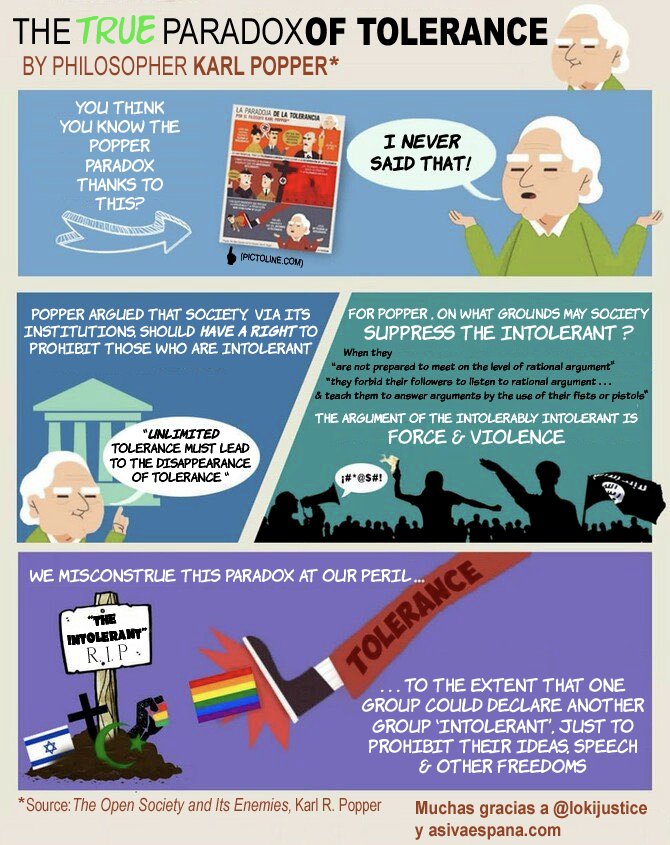
Paradox of intolerance?
The bogus social media version subverting the original message or the real one?
Image :::spoiler text alternativeThe True Paradox of Tolerance
By philosopher Karl Popper[^popper-source]
You think you know the Popper Paradox thanks to this? (👉 comic from pictoline.com)
Karl Popper: I never said that!
Popper argued that society via its institutions should have a right to prohibit those who are intolerant.
Karl Popper: Unlimited tolerance must lead to the disappearance of tolerance.
For Popper, on what grounds may society suppress the intolerant? When they “are not prepared to meet on the level of rational argument” “they forbid their followers to listen to rational argument … & teach them to answer arguments by the use of their fists or pistols”. The argument of the intolerably intolerant is force & violence.
We misconstrue this paradox at our peril … to the extent that one group could declare another group ‘intolerant’ just to prohibit their ideas, speech & other freedoms.
Grave sign: “The Intolerant” RIP
Underneath it lies a pile of symbols for Judaism, Christianity, Islam, Black power. A leg labeled tolerance kicks the Gay Pride symbol into the pile.Muchas gracias a @lokijustice y asivaespana.com ::: Karl Popper opposed censorship/argued for free inquiry & open discourse.
I do not imply, for instance, that we should always suppress the utterance of intolerant philosophies; as long as we can counter them by rational argument and keep them in check by public opinion, suppression would certainly be most unwise.
Censorship (or willfully blinding ourselves to information) plays no part in suppressing authoritarianism.
Only cowards fear words. Words are not the danger. It’s the dangerous people whose words we fail to discredit.
[^popper-source]: Source: The Open Society and Its Enemies, Karl R. Popper