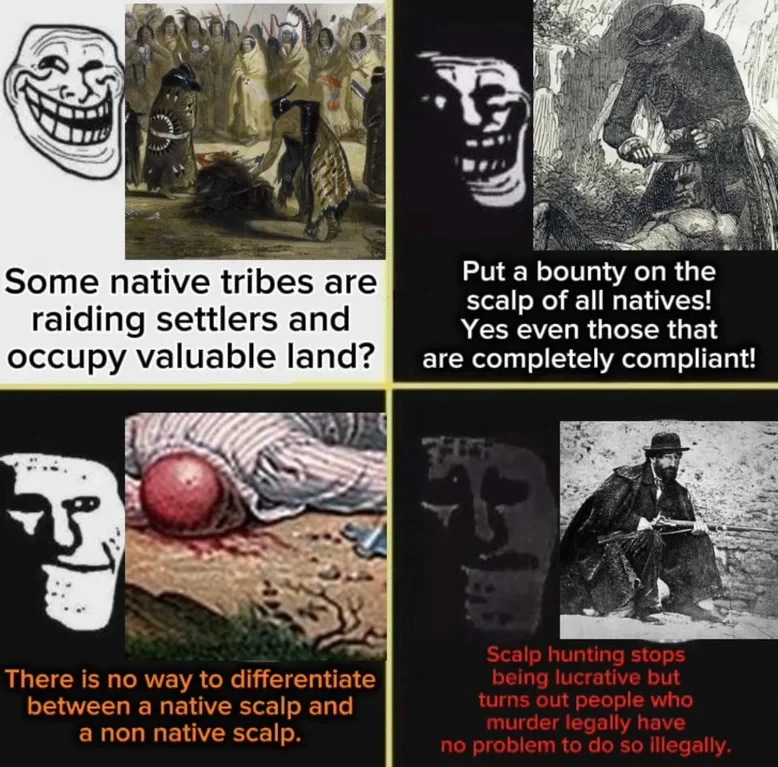
Explanation From Original OP:
I am aware that this is a bit of a controversial topic hence I want to remember the reader that I’m not a historian but am trying to explain to the best of my abilities.
In 1830-1849 many northern Mexican states, mainly Sonora and Chihuahua, established a bounty on the scalps of natives, officially to combat persistent raids by these tribes and secure settler safety. However the main interest seemed to be claiming valuable land, using scalp hunters to eliminate perceived threats and claim territory, often leading to brutal massacres and further conflict as bounties were paid for male, female, and child scalps. It didn’t even matter if it was a tribe that was willing to negotiate with the Mexican government in the past or even completely complied to live under their laws, if it was a native there was a bounty on him/her. The scalps were even paraded through the streets and hung outside the plaza in Chihuahua city.
This would however have big consequences, as the people willing to hunt natives were often criminals, who now would become specialized in hunting and killing human beings and caused more chaos in Mexican cities and villages than they created “safety”. It also caused natives to resort to more violent measures to survive which again came to the detriment of the non native population. It also caused border instability as many native tribes were living in the border territory of Mexico and USA and the scalp hunters didn’t necessarily care if said natives were actually in or outside Mexican territory. I also want to add that Mexico and USA were in a strained political relationship previous to this and the war that would arise in 1846 may not have been caused solely due to these border issues but they certainly were a factor in it. That war would also become important for scalp hunting as native tribes were fighting on both and against both sides which again caused an incentive for the northern states of Mexico wanting to get rid of them, as natives were mainly viewed as trouble makers during times of war.
The large amounts of bounties also took a financial toll as they were draining state funds and caused a diversion of resources from productive development and infrastructure. Also you might be wondering by now, “how does one differentiate a native Mexican scalp from a non native Mexican scalp?” The answer is: you don’t. Official cases are few but there were former scalp hunters confessing to have mixed a few non native scalps with the native scalps to squeeze out more profits, how often this was actually practiced no one knows. In time as it became harder for scalp hunters to track natives (as they have begun to become increasingly careful and wander into different territories and because of their decline in numbers) the scalp hunters would form gangs and return to their criminal careers and were especially terrifying due to their profession having specialized them in hunting and killing humans over the past 19 years.
Swedneck@discuss.tchncs.de 2 months ago
guys, i think- i think murder might be bad
Image