PugJesus
@PugJesus@piefed.social
- Comment on "But my lord, there are no such legions!" 3 months ago:
Explanation: The Roman Republic had a strange capacity to raise troops seemingly out of thin air whenever they suffered massive defeats. One historian of the time compared the Republic’s capacity to raise new armies to ‘water gushing from a fountain.’
The real reasons for this are multifaceted, but in the briefest sense, could be considered the core values of the Roman Republic.
Romans believed that they were born as a city of exiles and outsiders, and while they could be immensely chauvinist as to whose ways were better, this also meant that they were generally willing to accept and assimilate outsiders who ‘wanted in’. This seems unexceptional to our eyes, but in antiquity, where many city-states had populations of ‘foreigners’ who had resided in the city for generations but were never granted the opportunity to become ‘real’ citizens, this was an exceptional advantage. So if there was a shortage of Romans all of a sudden, a little bending of the usual rules to ‘create’ new ones was very much in the cards!
The Romans also believed that their polity was for the good of the people. Again, this sounds unexceptional to our ears, but in antiquity, was positively radical. Not only did the Romans envision their Res Publica as working for the good of non-citizens (if without their input, conveniently) as well as citizens, but also, the Roman citizen body was much broader than most contemporary regimes. Athens, for example, the shining model of Classical democracy, only about ~10% of the city’s population were citizens. In the Roman Republic, it’s generally considered that over 50% of the city was made of citizens. For this reason, a very large percentage of people felt that they had a real stake in the survival of their Res Publica - part of the government, not just ruled by it.
And another was the aforementioned chauvinism. While not an unusual value in societies of antiquity, Roman pride and arrogance was noted as particularly intense even by contemporaries, and nothing stings quite like wounded pride. What, are you going to let a bunch of OUTSIDERS humiliate OUR Republic, citizen!? GET OUT THERE AND TEACH THOSE BASTARDS A LESSON THEY’LL NEVER FORGET!
- Submitted 3 months ago to historymemes@piefed.social | 7 comments
- Comment on What do you know Nazis were wrong 3 months ago:
In some ways, Tacitus made the blueprint for it, even. He relays a lot of ethnographic data impartially, but whenever he starts talking about values of the vague ‘barbarians’ in contrast to Rome, they conveniently are the mirror image of ‘decadent civilization’ and in agreement with all of Tacitus’s critiques of Roman society.
- Comment on What do you know Nazis were wrong 3 months ago:
tbf, Tacitus also did praise the Germanic tribes, but he did so as a means of contrast with his own ‘decadent’ Roman society which had gotten too used to ‘civilization’ and ‘poor people having rights’; while Tacitus imagined the ‘barbarians’ as being unsullied by such ’niceties’.
… in part, yes, because they lived in a frozen waste that no one would voluntarily go to, lmao.
- Comment on Crushing popularity! 3 months ago:
Too much theatre in their culture, they’re ALL drama kids smh
- Comment on Crushing popularity! 3 months ago:
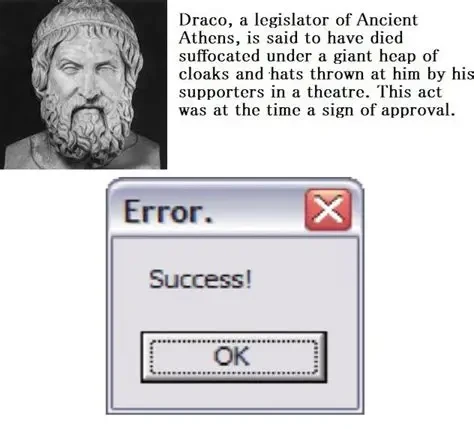
Additional Context: The story is apocryphal, and not attested to until long after Draco’s time. Draco may not even have been a real person. But what a fun story!
- Submitted 3 months ago to historymemes@piefed.social | 6 comments
- Comment on History is written by historians 💪💪💪💪💪 3 months ago:
We know about the Persian empire in the time of the ancient Greeks because the Greeks wrote about them. The Persians didn’t bother.
Much of the Persian corpus of the period is lost to us due to several waves of literary destruction, not because they didn’t bother.
Most Greeks weren’t writing stuff down for history, were they?
As mentioned elsewhere in this comment section, history is not just the events of the past, but how they are arranged into a coherent narrative.
- Comment on History is written by historians 💪💪💪💪💪 3 months ago:
Yeah, but even if we go back to antiquity, reputable historians always acknowledge that sources on military history of that time were often full of shit with things like “yeah, there were 100k of us versus millions of Persians”.
Herodotus, often considered the founder of the Western tradition of history as a discipline, actually is very fascinating on this point - because while he can give numbers that are… dubious… he also often notes discrepancies and where reality intervenes with the stories he’s heard, and engages in rough math to prove and disprove claims at certain points.
“Father of Lies”, because he recorded so much bullshit that was floating around, but “Father of History” because he tried to sort bullshit from fact, and align it in a cohesive narrative. o7
- Comment on History is written by historians 💪💪💪💪💪 3 months ago:
Man, I could give you examples for literal days. The history of the Mongols, by and large, was not written by the victorious Mongol Empire. The history of the Jews was not written by their occupiers and subjugators. The history of Norse conquerors were largely not written by the Norse. The history of unifying pagan Slavic kings was largely not written by pagan Slavs. The history of the Roman Emperor Augustus was not written by his partisans, despite his massive investment in propaganda and trimming ‘inconvenient’ narratives during his (highly successful) life.
History is written neither by winners nor losers; history is written by those who intend to write history. Smart rulers can get a head-start on this during their rule, but can never control it completely, and the longer they’ve passed, the more feeble their efforts at control become.
“I am Ozymandias, King of Kings…”
- Comment on History is written by historians 💪💪💪💪💪 3 months ago:
tbf that’s just historians minus one step
- Comment on History is written by historians 💪💪💪💪💪 3 months ago:
Who wrote the history of the US Civil War for the first ~100 years or so after?
PROTIP: by and large, it wasn’t the victorious North.
- Comment on History is written by historians 💪💪💪💪💪 3 months ago:
History is not just “the past”. History is, specifically, the discipline interested in recording and creating narratives out of events that happened.
Historians - professional or otherwise - create history, and it is the duty of a historian - and the purpose of the discipline - to do so responsibly and truthfully.
- Submitted 3 months ago to historymemes@piefed.social | 22 comments
- Comment on I'm already a dead man, might as well shoot my shot 3 months ago:
Explanation For Those Wondering: Under the Qin, the first imperial dynasty of China, many laws were created in light of the philosophy of Legalism, as expounded upon most famously by Lord Shang. Rather than meaning “The rule of law”, it means something closer to “People from the highest to the lowest are dissolute dogs who must be kept in line by fear and unshakable autocracy.” While Confucianism would take the dominant philosophical role in later Chinese dynasties, Legalist thought never entirely died out.
Unfortunately, the idea that only utter terror can keep people in harmony with the collective welfare can have some… nasty consequences. Namely, that the most reliably terrifying punishment - death - is also one that can’t really be ‘improved’ much upon. So when mid-ranking officials had a fuck-up punishable by death - like being late to their troop muster because of the weather, or losing track of prisoners - oftentimes they would just throw in their lot with a full-fledged rebellion or total banditry. Also both punishable by death, but if you win, it’s not rebellion; or if you’re never caught, you never get the punishment.
Liu Ban was the first Emperor of the Han Dynasty which succeeded the Qin. Liu Ban only defected after some prisoners escaped from his oversight - a ‘crime’ punishable by death regardless of fault.
If your choices are certain death or uncertain death… most people will take the latter. Roll the iron dice!
- Comment on "It's my first day on the job, give me a break!" 3 months ago:
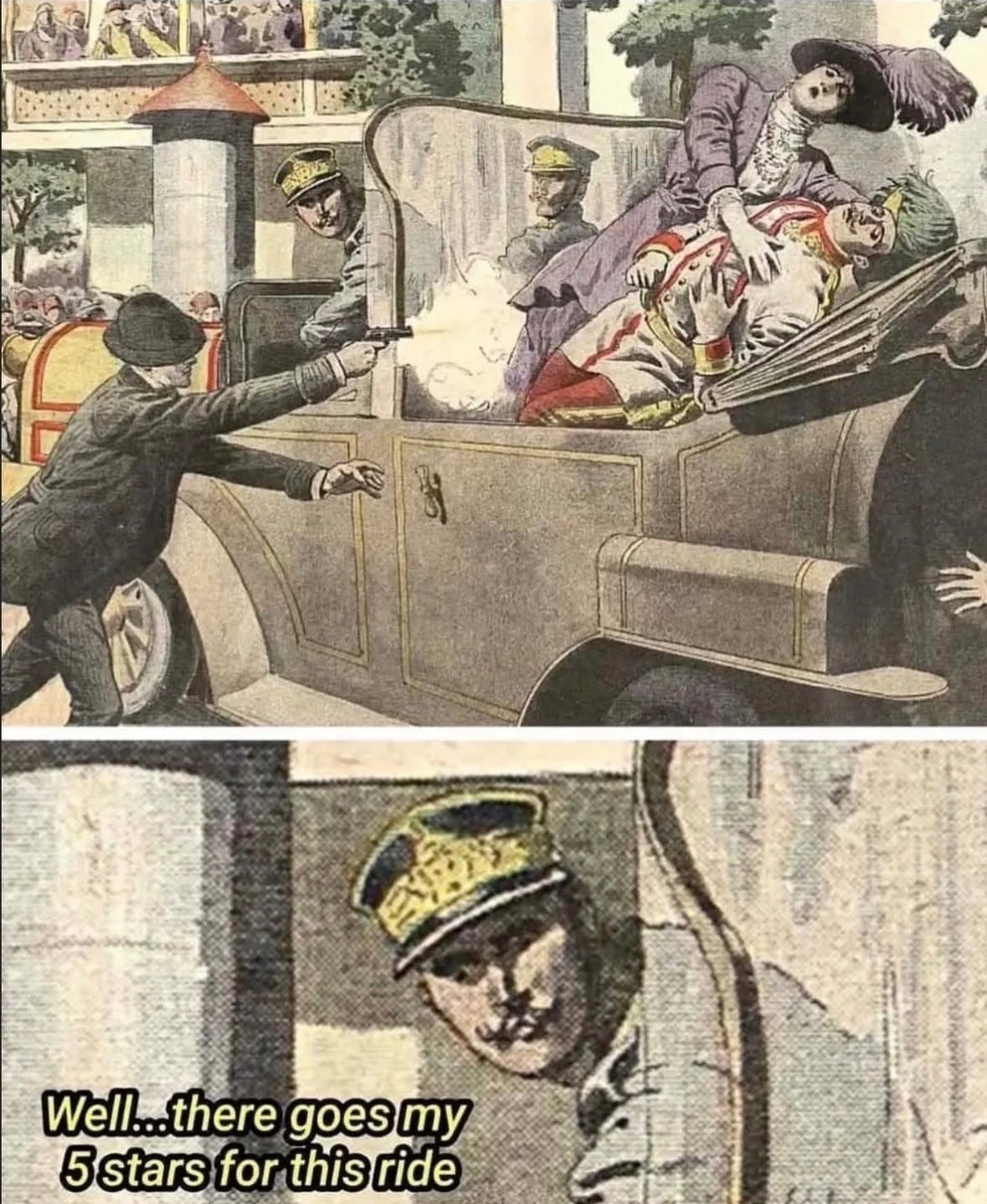
Explanation: Archduke Franz Ferdinand was a member of Austro-Hungarian royalty whose assassination by Serbian nationalists kicked off WW1.
He actually survived the first assassination attempt that day, an attack by a bomb! It was a failure, and the Serbian assassins scattered, some being arrested in the process. The Archduke opted, in fact, to visit the local hospital to pay his respects to the innocent people who had been injured by the bomb.
… but his driver (who was actually quite skilled and level-headed, and got his job for just that reason) got stuck in the confusion and mixed orders and traffic on the way there, and happened to pass by the cafe where one of the (uncaught) assassins, Gavrilo Princip, had decided to stop for a post-failure sandwich. Princip took the opportunity to change the failed assassination attempt into a successful one, and shot the Archduke, beginning a crisis which would result in the First World War.
- Submitted 3 months ago to historymemes@piefed.social | 8 comments
- Comment on Granted the cartoons were low-effort and stupid but freaking out about it just proved their point 3 months ago:
It’s a shame that it’s writing is such low-quality, because the animation is gorgeous. And they snagged some legendary voice actors.
- Comment on Dicks out for victory 3 months ago:
- Comment on Dicks out for victory 3 months ago:
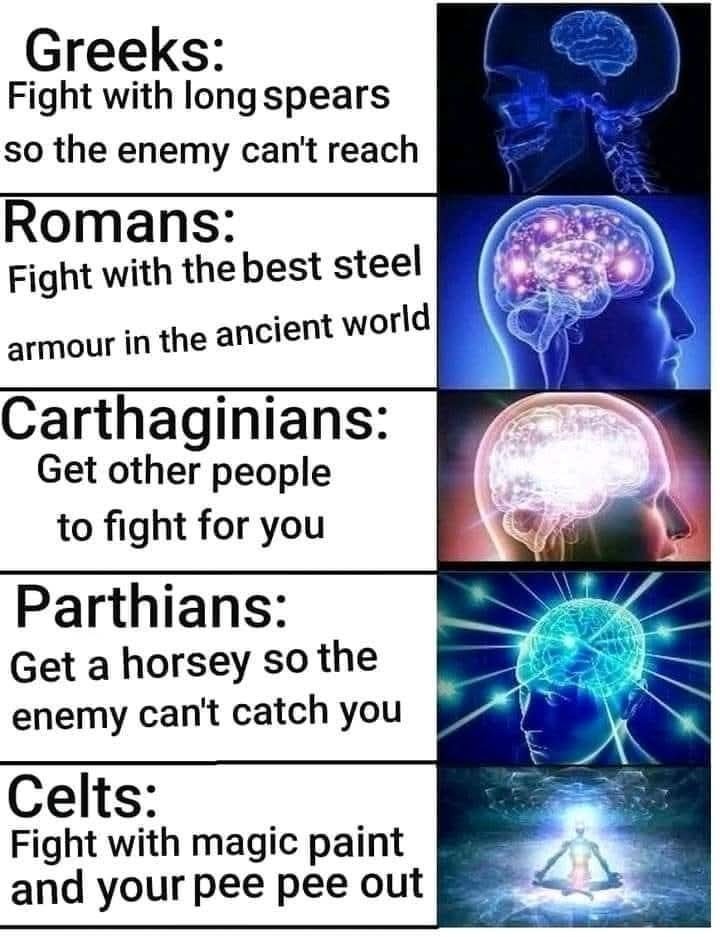
tbf, the swords could be extremely variable. I remember one incident wherein a Celtic tribe’s swords bent after some hard fighting and they had to have their comrades cover them while they tried to straighten them back out to a semi-fight-worthy condition.
Also, while blue paint was Briton, according to Caesar, tattooing and war paint more generally are attested to in literary sources (though not uncontroversially) amongst other Celtic peoples.
- Comment on Why didn't the Byzantines think of sacking the Byzantines? Are they stupid? (AnonHistory) 3 months ago:
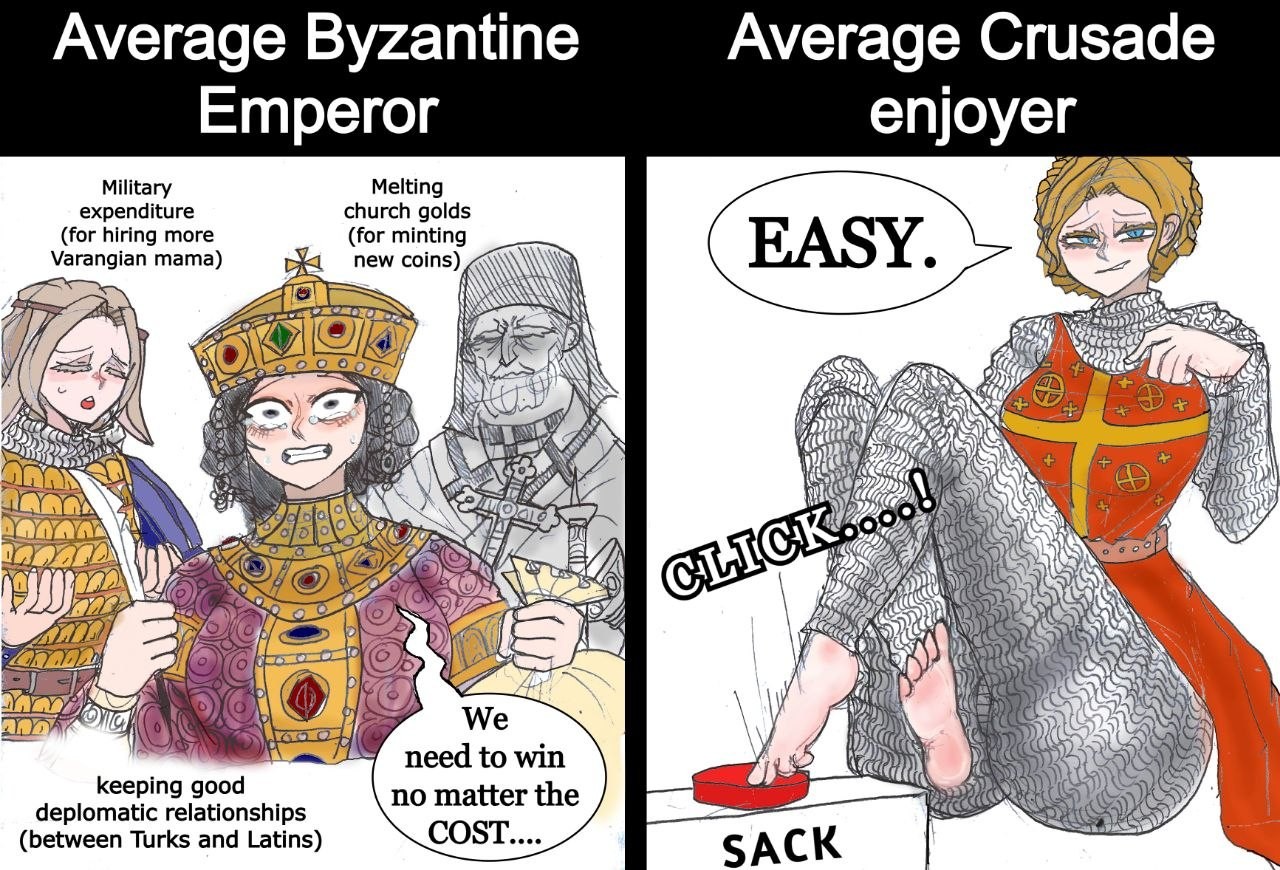
Explanation: In the later Byzantine Empire, centered in modern-day Greece and Turkiye, a delicate balancing act was required by competent Emperors to keep the Empire running, even at a reduced level of efficacy.
The Western European Crusaders, when they came by, just looted the place to sustain themselves. Why didn’t the Byzantines think of that? smh
- Why didn't the Byzantines think of sacking the Byzantines? Are they stupid? (AnonHistory)media.piefed.social ↗Submitted 3 months ago to historymemes@piefed.social | 1 comment
- Comment on Dicks out for victory 3 months ago:
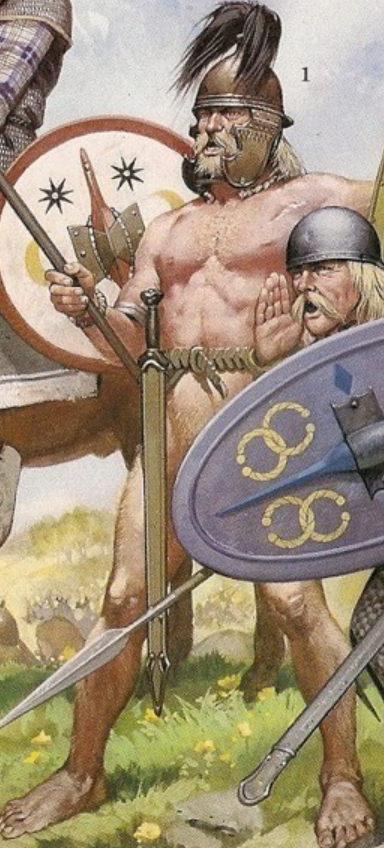
Explanation: While not a universal practice of Celtic peoples, there are occasional incidents wherein Celtic tribes were noted to go into battle naked or near-naked to prove their bravery.
- Submitted 3 months ago to historymemes@piefed.social | 32 comments
- Comment on "Hephaestion was just his homie" 3 months ago:
I’m no historian but it really sounds like Greece was a pretty sweet place, at least for the privileged classes. I consider myself pretty straight, but the idea of truly free love is absolutely magical.
Ancient Greece was very far from a land of truly free love.
- Comment on Who would win? 3 months ago:
Ha, thanks! None of it is OC, just reposts, which helps cut down the burden.
Mostly I just do a post in each comm I’m trying to juggle once a day, usually all in a row so I don’t forget any of them.
- Comment on Who would win? 3 months ago:
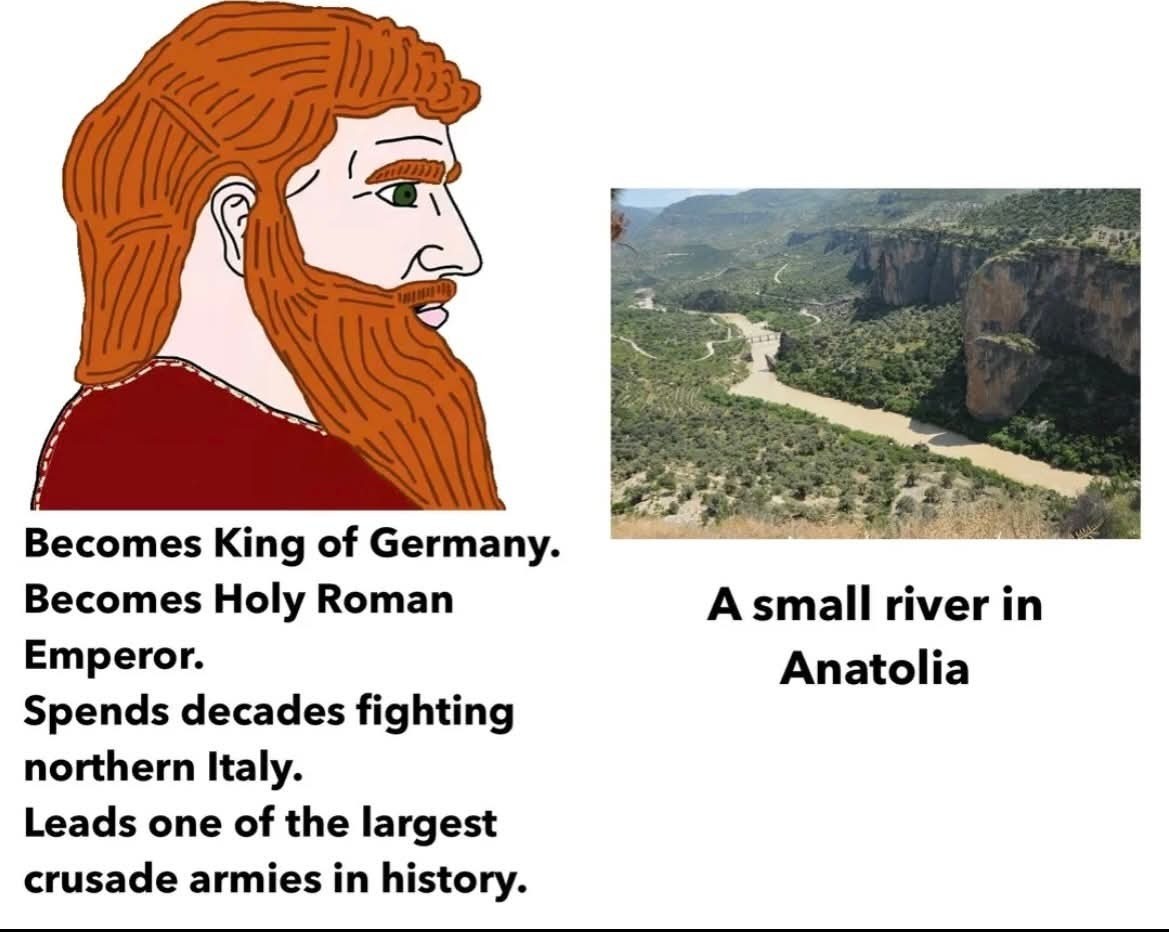
Explanation: Frederick Barbarossa, a German king and emperor, was an immensely accomplished man who set off to join the Third Crusade, a Catholic expedition to recapture Jerusalem from Muslim forces.
… on the way to the Holy Land, Barbarossa drowned in a small river in modern-day Turkiye while taking a swim. Most of his army would turn back after that, disheartened.
- Submitted 3 months ago to historymemes@piefed.social | 6 comments
- Comment on Lordy me, you gave me a case of the vapors 3 months ago:
Basically, the lares were household and neighborhood gods that the Romans themselves didn’t understand well. Two contemporary Roman writers give six possibilities for what the lares might be, with both of them admitting them don’t know which description of the lares is correct.
The lares were widely worshipped all the same, with individual households honoring them at the hearth, and both rural and urban neighborhoods typically having a small shrine to the lares at each crossroad, where yearly sacrifices were made and regular minor offerings were presented for the favor of the lares. The lares, despite this ambiguity of what they actually were, were also widely depicted in religious murals, with surprisingly consistent themes and appearance (twin young figures, non-formal dress, clean-shaven, dancing), and seem to have popped up wherever Roman populations were, regardless of whether the city itself was Roman-majority, suggesting that the lares were a core part of Roman religion despite the fact that even educated Roman writers did not necessarily understand what they were.
The book I recently read posits that the lares were gods of place, essentially one of the (many) holdovers from ancient, pre-Greek-influence Roman religio that has an almost animistic conception of the world. Noted is that not only did every household (including rural farming households) have individual lares, but that the lares at each crossroads were separate not only from other neighborhood lares, but also from the lares of each household in the neighborhood, and that early in Roman seafaring, sacrifices were made to lares of the sea.
The book also compares and contrasts them to the Manes/di parentes, the ancestral spirits of the family; to the genius of individuals; and to the genius loci of individual places. The lares were divine and not derived from mortals, and so were not ancestor spirits; the lares persisted beyond any individual, so they were not individual genius; and the genius loci were associated strongly with the land/region itself (though often paired with depictions of the lares), while the lares were associated with human settlement, rather than being autochthonous.
- Comment on Lordy me, you gave me a case of the vapors 3 months ago:
Eh, not everything I post is a banger. I try to keep up one non-crosspost a day, if I find it vaguely amusing.
I didn’t notice it was GenAI when I saw it, since I didn’t look at the images closely. That’s on me. I’m not removing it since it’s already got traction, but generally I try to identify and avoid posting GenAI.