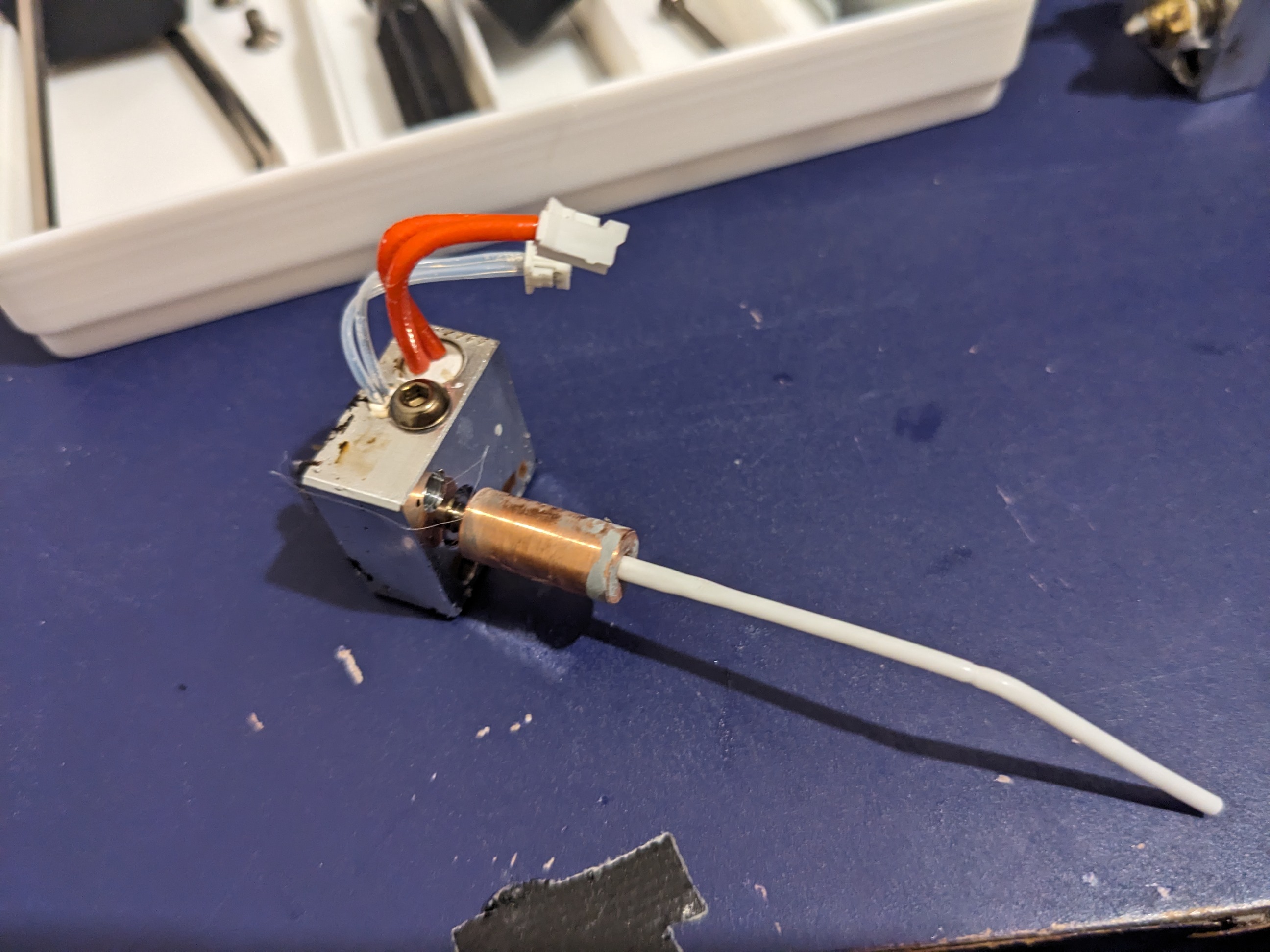
I have another one if neccessary, but I think the screw shafts on it are clogged with plastic, so it might take some work as well.
My old i3 clone came with a 1mm steel rod I use in these situations. Leave the extruder on your printer, cut the filament off, heat up the extruder to a normal printing temp, and push the gunk through the nozzle. If you have a cold side clog you’re probably going to have to add heat from something like a heat gun.

_thebrain_@sh.itjust.works 1 year ago
put them on a sheet of aluminum foil and put them on a cookie tray in your oven. set the oven to 450 degrees and bake it for a half hour plus. everything should melt out of it. you could even suspend it with a rolled up piece of foil under it. depending on the wires your thermistor may suffer but the heating element should be fine. tho, your thermistor probably will be okay too as it looks like it has silicone covering the wire.
Interstellar_1@lemmy.blahaj.zone 1 year ago
This sounds potentially dangerous
_thebrain_@sh.itjust.works 1 year ago
I don’t know. I’ve use this method several times and I’ve never had a problem. I probably should have specified that I’m in the states so 450° f versus 200 or 210° c that your printer runs at isn’t a huge difference. Sure. You run the risk of some fumes, but your printer is already belting the plastic. In that temperature. You need to go a lot hotter than 400° in order to set it on fire. It’s a lot safer than using a blowtorch