Comment on Does the RAM being closed to CPU actually matter?
brucethemoose@lemmy.world 2 months ago
Yes.
Actually, it’s everything: en.wikipedia.org/wiki/Random-access_memory#Memory…
…But also, your friend is wrong. And its complicated.
First some background. There are a couple of “regular” types of RAM basically every product uses under the hood. And every one is a set of tradeoffs: bandwidth, latency, capacity, power efficiency, trace lengths, expense, and so on. A few of types:
-
“Regular” DDR. This is what you see on sticks for desktops, laptops, and servers.
-
LPDDR. Its power-optimized at the expense of some latency and trace length, but its specs are otherwise similar to DDR. This is what smartphones (and Macs) use.
-
GDDR. Optimized for bandwidth and cost over everything. Guzzles power. Used on gaming GPUs.
-
HBM. Low speed, requires extremely short trace lengths, but low power and latency. Uses an exotic bus with exotic manufacturing techniques. This is what you see on more exotic server accelerators.
But the packaging is also really, really important too. For example, regular DDR5 can come in:
-
Unregistered RAM sticks, for your desktop.
-
As registered RAM, for servers.
-
As SODIMM, for laptops.
And these all have long traces, since they have to come in sticks. They’re “far” from the CPU. Laptop SODIMMS, in particular, have a really poor path to the CPU, and start to run into huge scaling issues at DDR5 speed.
…In other words, laptop DDR5 SODIMMS are particularly slow, because the socket they sit in simply cannot keep up with their speeds.
As for LPDDR5: its specification assumes a shorter, higher quality trace or “wire” to the CPU, hence it can only come soldered, and sitting right next to the CPU:
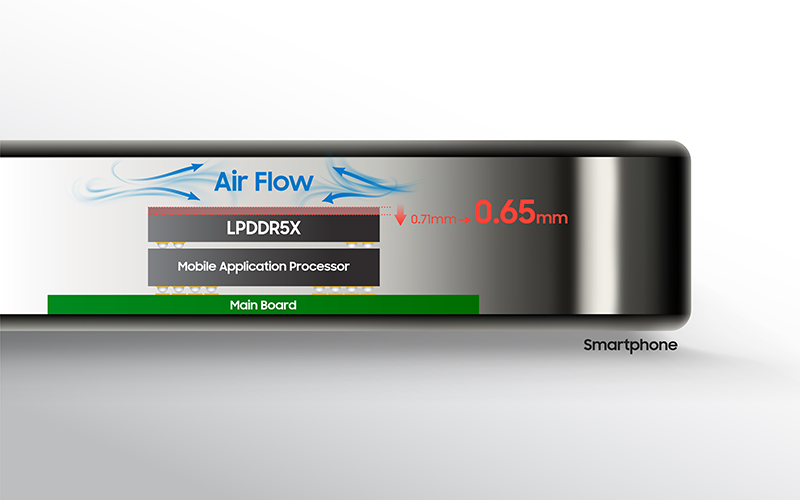
But electrically, it’s almost the same as DDR5! It’s not wider-and-slower like HBM, or more tweaked like GDDR5: it’s just regular old cheap DDR5, massaged to work better soldered to the motherboard.
This is what Macs use.
They’re not using “special Apple RAM” like is the popular perception. They’re using smartphone RAM. Its a bit faster becase it is “closer” to the CPU, but this is misleading, as its nothing like more exotic standards that really take advantage of that proximity. If you read this, its much closer to GDDR5 than HBM: graphicscardhub.com/gddr5-vs-gddr5x-vs-hbm-vs-hbm…
In practice, Apple RAM is faster and “closer” to the CPU, but its more because of business design choices than a particularly exotic memory specification:
-
Apple uses very wide buses for their CPUs. Typical laptops are 64-bit or 128-bit, Apple stuff can be 192-bit to 512-bit. This is more expensive, and you pay for it in the sticker price.
-
Regular laptops use swappable SODIMM sticks, which have a tremendous speed cost. Apple doesn’t have to worry about this.
-
Apple pays a premium for fast, binned LPDDR5, regular OEMs do not.
But it doesn’t have to be this way.
Some laptops already use swappable LPCAMM modules, which for all practical purposes are just as fast as Apple’s RAM, and just as “close to the CPU” from an electrical perspective:

Framework was very close to implementing this for AMD’s 256-bit Strix Halo CPUs. They could quite work out the electrical gremlins before release.
TL;DR
Apple RAM is “closer to the CPU” in the existing market, but there’s no technical reason PCs have to be any different.
Apple uses off-the-shelf smartphone RAM, basically.
An AMD Strix Halo laptop, with 2 LPCAMM modules, would be just as fast as Apple memory, and just as “close” to the CPU. Some PCs already do this on a smaller scale.
So strictly speaking, your friend is correct. But its misleading. All that really matters is the memory specification laptop/desktop manufacturers choose.
veloren23djk@lemmy.zip 2 months ago
You you know some resources when I can learn about these RAM technologies in depth (down to its physics)
brucethemoose@lemmy.world 2 months ago
Like a primer? I don’t know anything off the top of my head, but all this stuff is literaly 1st-year computer engineering in college. The basic of ISAs, circuits, low level programming and computer design are all kinda background you need to understand why RAM trace length is so important.
There are definitely college courses you can look up and read for free.
Most “guides” you’d find on Google repeat outdated information; watch out for that. That’s why the Apple “memory on the CPU” thing keeps persisting; most discussion isn’t even updated to account for CAMM modules. But ECE focused magazines are good about covering and explaining commercial memory tech:
semiengineering.com
www.eetimes.com
brucethemoose@lemmy.world 2 months ago
Also, if you have a more specific question about memory types, I can try to answer them.
But honestly my knowledge getting dated too. For example, I don’t know much about the specifics of GDDR7 (RTX 5000 memory) off the top of my head.
justme@lemmy.dbzer0.com 2 months ago
my ADHD is acting up to much to read all the text above, so in case it wasn’t included: the is a physical limit to frequency in conventional conductors. normally metals have only ohm resistance, which does not depend on frequency and is generally rather low, but for instance in the case of copper a capacitative resistance significantly rises at around 1ghz, which gets only worse. this comes from structural effects in the lattice which form like small capacitors. i don’t know the exact details from a solid state point of view, just remember the fact itself from a fiber optics lecture.
long story short: for high frequency (ergo, high data throughout) signals the resistance becomes insane, so you want to have your conductors as short as possible.
another thing that just pops into mind: i remember that for pci-5 the motherboard length is also more limited, due to the same reason.