Yes, sounds are waves that go thru a medium, usually air.
Think of it like one person speaking in a gym compared to 1,000
The different sounds add up, that’s easy everyone just has to talk. But you don’t get silence, you get a cacophony.
To produce opposite sounds to cancel each other out though, that would be impossible, and becomes even more impossible as you scale up.
It helps if you can see it to visualize what I mean by alternating waves:
askamathematician.com/…/Noise-Cancellation.gif
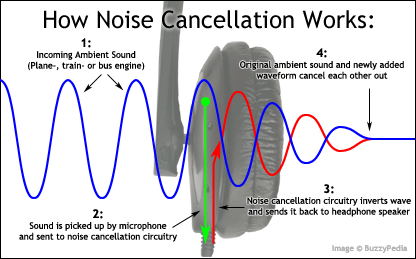
I didn’t think of it till I looked for a diagram, but yeah, it’s exactly how active noise cancellation works
Eatspancakes84@lemmy.world 11 months ago
This answer makes no sense. Sound comes in waves with crests and throughs. In a controlled setting you can harmonize which effectively matches crests to crests and throughs to throughs. This happens in music with choirs, orchestra etc. In that case indeed sounds adds up.
However, with many random sources at many random frequencies you just get chaotic patterns where sound sometimes cancels out and sometimes adds up. No way that the overall result of this is that it adds up in dB. My first approximation would be that if one source emits 1dB and another also emits 1dB, these roughly add up to 1dB.
A very easy test of this is whether you now hear a very loud buzzing in your ear because at this very moment many people talk at the same time. I guess you know the answer.