 rss@news.abolish.capital [bot]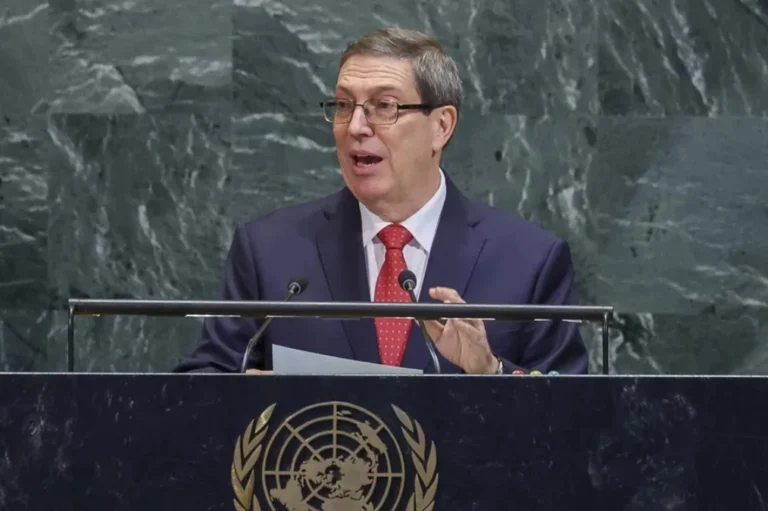
Cuba energy blockade: Bruno Rodríguez condemns U.S. fuel restrictions as an act of war, while UN experts warn sanctions are worsening shortages and blackouts.
Related: Mexico Reaffirms Support For Cuba at UN, Condemns Embargo
Cuba Energy Blockade Denounced as an “Act of War” at UN
The Cuba energy blockade became the focus of a forceful denunciation at the United Nations after Cuban Foreign Minister Bruno Rodríguez Parrilla accused the United States of preventing fuel shipments to the island and described the measures as a de facto naval blockade.
Speaking during the 81st session of the UN General Assembly in New York on September 24, Rodríguez said the intensified restrictions on fuel tankers and essential resources were harming the Cuban population and threatening the country’s basic services.
He argued that the pressure campaign goes beyond economic sanctions because it seeks to prevent commercial and humanitarian fuel supplies from reaching Cuba.
“What defines the current state of Cuba-U.S. relations is the brutal tightening of the economic and financial blockade and the total oil siege imposed on our country, which is equivalent to a naval blockade,” Rodríguez said.
The Cuban foreign minister described the policy as “economic warfare directed against the lives of the Cuban people.”
According to Havana, the restrictions include the retention or intimidation of fuel carriers, pressure on governments and companies that trade with Cuba, and secondary sanctions against entities that help supply the island.
The measures have reportedly affected Cuba’s ability to import fuel for electricity generation, transport, irrigation, hospitals, and other essential services.
Rodríguez said the U.S. policy aims to produce extraordinary humanitarian damage and obstructs Cuba’s commercial relations with the international community.
He also accused Washington of using sanctions and threats to force political change in a sovereign country.
The Cuban government has described the energy restrictions as collective punishment and a violation of the United Nations Charter, international human-rights law, and international humanitarian principles.
The United States maintains that its sanctions are intended to pressure the Cuban government over human rights and democratic freedoms. Washington has not accepted Havana’s characterization of the restrictions as a naval blockade.
The dispute has intensified during the administration of President Donald Trump, which has increased pressure on the island and considered additional restrictions on Cuban officials traveling to the United Nations.
The administration is also weighing stricter controls on Cuban diplomats expected to return to New York for the annual UN General Assembly vote on the U.S. embargo.
The confrontation has made the 2026 UN session a major diplomatic arena for both countries. Cuba is seeking international support against the energy restrictions, while Washington continues to defend its policy as a tool for political pressure.[bastillepost][abcnews]
Cuba Energy Blockade Deepens Fuel Shortages and Blackouts
Read the UN experts’ warning about new U.S. sanctions on Cuba.
The Cuba energy blockade follows a broader expansion of U.S. sanctions that began in June 2026 and intensified with measures announced on July 23.
The new restrictions target energy companies and have made it more difficult to purchase fuel, including fuel intended for humanitarian purposes.
Independent UN human-rights experts condemned the sanctions, saying they appeared designed to force political change in a sovereign state through threats and coercion.
The experts warned that the measures were worsening an already serious humanitarian situation. They cited shortages of fuel, food, medicine, electricity, and transportation.
Cuba’s electrical system has suffered repeated national blackouts. Millions of people were left without power after the grid collapsed earlier this month.
The country’s energy infrastructure was already under severe pressure because of aging power plants, limited maintenance, fuel shortages, and restricted access to spare parts.
The Cuba energy blockade has made those problems more acute by limiting the country’s ability to import crude oil, refined fuel, and equipment needed to maintain thermoelectric plants.
Electricity shortages affect nearly every part of daily life. Households struggle to cook, preserve food, pump water, and access communications.
Hospitals and clinics need fuel for emergency generators and transportation. Farmers rely on diesel for irrigation, agricultural machinery, and the movement of food.
Public transportation has also been affected by shortages, while businesses face interruptions that reduce production and employment.
UN experts said the consequences disproportionately affect women, children, older people, persons with disabilities, and rural communities.
The experts called for the immediate revocation of measures they considered inconsistent with international law. They also urged the Security Council and the General Assembly to examine the situation as an issue related to international peace and security.
The Cuban government says the effects of the blockade cannot be separated from the wider U.S. embargo, which has been in place for decades.
The United States says Cuba’s economic problems are caused primarily by internal mismanagement and the structure of its political system.
The two positions remain sharply opposed. Cuba argues that external restrictions are deliberately targeting the population. Washington argues that sanctions are a response to the Cuban government’s policies.
Independent analysts have noted that both factors may influence the crisis: Cuba faces significant domestic economic and infrastructure problems, while the sanctions restrict its access to fuel, credit, technology, and international markets.
The energy blockade has increased the urgency of the debate because electricity is a basic condition for health, food security, water distribution, communications, and economic activity.
Cuba’s foreign ministry has called on countries and companies to resist pressure from Washington and continue trade with the island.
However, secondary sanctions create significant risks for international businesses, banks, insurers, and shipping companies. Many firms avoid transactions with Cuba even when those transactions are not directly prohibited because they fear losing access to the U.S. market.
This is one of the central features of the Cuba energy blockade: its effects extend beyond the direct restrictions imposed on Cuban entities.
The policy also affects third-country governments and companies that must choose between trading with Havana or avoiding conflict with Washington.
Havana Responds to Trump’s UN Statements
Read about China’s call at the UN to lift the blockade and sanctions against Cuba.
The Cuban denunciation followed a speech by President Donald Trump at the UN General Assembly on September 22.
Trump said Cuba was “failing like never before” and would eventually fall. His comments were interpreted in Havana as a threat and an attempt to justify additional pressure on the island.
Rodríguez responded through social media, saying the U.S. government was incapable of accepting that Cuba is an independent and sovereign country.
“Cuba is and has the right to be a fully independent and sovereign country,” the foreign minister said.
The Cuban delegation left the General Assembly chamber during Trump’s remarks, protesting what it described as slanderous statements.
The delegation reiterated that Cuba does not pose a threat to the United States or any other country.
It argued that the Cuba energy blockade, not Cuba, threatens the island’s population and creates instability across the region.
The confrontation also unfolded during a ministerial meeting of the Community of Latin American and Caribbean States, or CELAC.
Rodríguez described the U.S. policy as an unprecedented reinforcement of the blockade involving secondary sanctions, a media offensive, and threats of military aggression.
He warned that Washington was pursuing a broader campaign against Latin America and the Caribbean based on what he called an outdated version of the Monroe Doctrine.
The Cuban foreign minister said the current policy includes new and unacceptable extensions of that doctrine, which seeks to impose U.S. control over the political and economic choices of countries in the region.
Cuba has used CELAC and the Non-Aligned Movement to seek support from countries that oppose unilateral coercive measures.
Rodríguez said Cuba would continue defending a world in which development is a universal right rather than a privilege available only to a few powerful states.
He made the statement at a high-level UN meeting marking the 40th anniversary of the Declaration on the Right to Development.
The Cuban position links the energy blockade to a larger debate over sovereignty, development, and the right of states to determine their economic systems without external coercion.
The issue has also received support from China. Vice President Han Zheng, speaking at the General Assembly on September 26, called on the United States—without naming it directly—to end threats against Cuba and lift the blockade and sanctions.
“China urges the relevant country to immediately stop using the threat of force against Cuba and immediately and completely lift the blockade and sanctions against Cuba,” Han said.
He also defended the sovereignty and security of countries in the Gulf and rejected unilateral military action that violates the UN Charter.
China’s statement places the Cuba energy blockade within a wider critique of unilateral sanctions, military threats, and pressure against countries in the Global South.
Beijing has presented itself as a defender of state sovereignty and multilateralism. Washington has accused China of supporting governments that oppose U.S. interests.
The dispute over Cuba is therefore connected to broader competition between the United States and China over international rules, trade, energy, and political influence.
Geopolitical Context: Cuba, the Global South, and U.S. Pressure
The Cuba energy blockade has become a symbol of the wider conflict between Washington and governments that reject U.S. dominance in Latin America and the Caribbean.
For Cuba, the restrictions represent an attempt to impose regime change through economic pressure rather than direct military intervention.
For the United States, sanctions are intended to pressure the Cuban government while avoiding the costs of military action.
The difference between those interpretations has made diplomatic compromise difficult. Havana demands an end to sanctions and the restoration of normal commercial relations. Washington seeks political changes before relaxing pressure.
The energy blockade adds a particularly dangerous dimension because it affects basic services rather than only government institutions.
When fuel imports are interrupted, the impact spreads through power generation, transport, agriculture, hospitals, food distribution, and communications.
The crisis also affects neighboring countries. Large-scale shortages can produce migration, public-health emergencies, and instability across the Caribbean.
The Cuban government has warned that the restrictions threaten the lives of approximately 10 million people. UN experts have similarly said the humanitarian consequences could become a full-scale crisis.
The blockade has also become a test of the international system. The UN General Assembly has repeatedly voted by overwhelming margins against the U.S. embargo.
However, General Assembly resolutions are not legally binding in the same way as Security Council decisions. Washington has therefore continued the policy despite broad international opposition.
The 2026 situation may produce another major diplomatic confrontation when the annual embargo resolution is considered. Cuba is expected to argue that the new energy measures violate international law and deepen collective punishment.
The United States is likely to defend its sanctions as a national-policy decision and continue claiming that responsibility for Cuba’s economic difficulties lies primarily with Havana.
Latin American and Caribbean governments face pressure from both sides. Some support Cuba’s demand to lift the blockade, while others avoid direct confrontation with Washington.
The dispute also reveals the limits of regional autonomy. CELAC has called for greater independence in foreign policy, but its member states remain economically and politically connected to the United States.
China’s support for Cuba could provide diplomatic backing and opportunities for alternative energy supplies. However, Chinese companies may also face pressure from Washington if they help transport fuel or provide financing to Havana.
Russia and Venezuela are also potential partners for Cuba, but both face their own sanctions, economic constraints, and geopolitical conflicts.
The Cuba energy blockade therefore has consequences beyond the island’s borders. It forms part of a broader struggle over sanctions, sovereignty, international law, and the right of developing countries to determine their own path.
For Cuban authorities, the immediate priority is securing fuel and preventing further grid collapses. For international organizations, the key issue is protecting the population from humanitarian harm.
The UN experts’ warnings and China’s call to lift the blockade have increased diplomatic pressure on Washington, but no immediate policy change has been announced.
The confrontation is likely to continue through the next UN vote on the embargo and amid further debates over diplomatic travel restrictions.
Cuba’s message remains consistent: it is willing to defend its sovereignty and seek international solidarity, but it will not accept economic pressure aimed at forcing political change.
From teleSUR English via This RSS Feed.