 rss@news.abolish.capital [bot]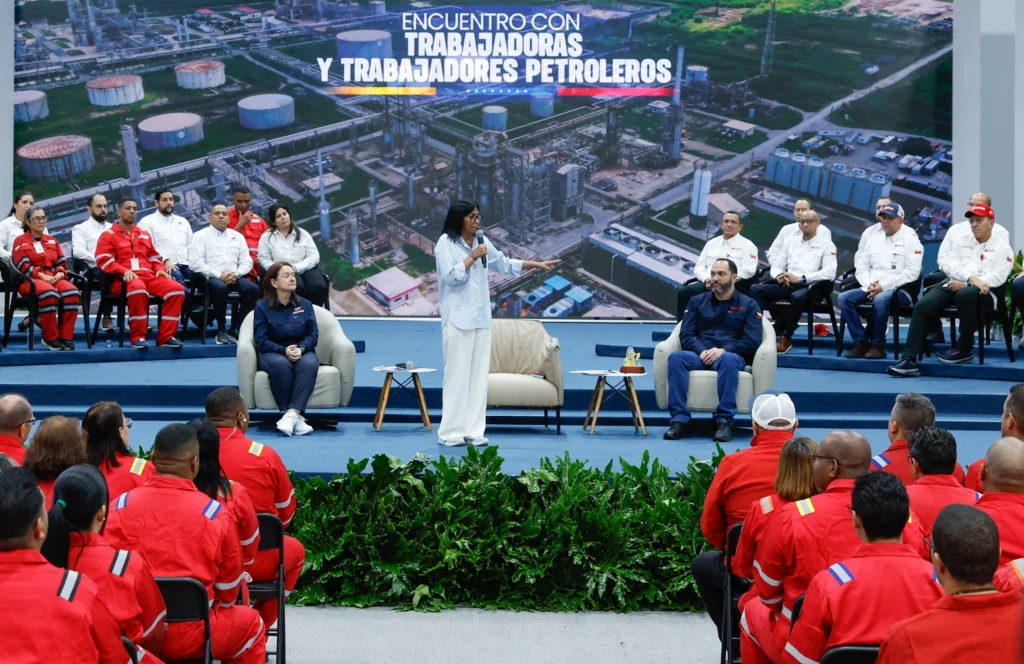
Venezuela’s Acting President, Delcy Rodríguez, met with hydrocarbons sector workers in Caracas on Friday, praising their role in sustaining the oil industry through more than a decade of U.S. sanctions.
Venezuelan Acting President, Delcy Rodríguez, highlighted the crucial role of workers in the petroleum industry and underscored recent international agreements aimed at boosting the country’s energy sector during a meeting with industry workers.
Rodríguez emphasized that the goal is to achieve a production rate exceeding 1.5 million barrels daily, asserting that no one will hinder Venezuela’s path to recovery, meanwhile she denounced the operations of extremist mafias aiming to sabotage energy agreements.
RELATED: Venezuela and GeoPark Sign 25-Year Energy Strategic Deal for Orinoco Belt
“Each barrel produced today bears the mark of this resistance, which has allowed the country to see new possibilities for development and growth for all,” she stated, highlighting the fundamental role of workers in maintaining the industry’s operability despite over a decade of unilateral sanctions against the country.
Rodríguez praised the significance of the bilateral agreement with the U.S. government and strategic alliances with European companies like Repsol and Eni, as well as firms from the United Arab Emirates and Qatar. The recent agreements with the U.S. cover the development of 17 strategic fields, with eight in the Maracaibo Basin and nine in the Orinoco Oil Belt.
Ver esta publicación en Instagram
Una publicación compartida de teleSUR English (@telesurenglish)
Acting President Rodríguez noted that 80% of the world’s petroleum and 90% of its gas come from fields that have reached their peak, with 90% of international investments focused on sustaining these reserves. “We are signing agreements to develop green fields,” she emphasized, highlighting the agreements signed to boost petroleum and gas production.
In this sense, Acting President stressed the central objective of national development through its resources. “Venezuela has the largest petroleum reserves in the world but ranks 20th in exports. What good are these riches if we don’t develop them? We want to be the country with the largest reserves and also a major producer, so that this production translates into the happiness of the Venezuelan people and the workers of the industry,“ she said.
Workers’ Resistance, Sabotage Warnings
Addressing the gathered workers, Rodríguez affirmed that the industry not only survived over a decade of external sanctions against Venezuela, but forged an unbreakable resolve among employees in the process. This identity has ensured that the hydrocarbon industry not only survived over a decade of coercive measures but also forged an unbreakable historical consciousness in each worker.
“Each barrel produced today bears the mark of this resistance, which has allowed the country to see new possibilities for development and growth for all,” she affirmed.
The Acting President also accused extremist groups of sabotaging the national electrical grid in retaliation for the new energy agreements, saying gas pressure levels supplying thermoelectric plants in Zulia state and the western region had been deliberately manipulated in recent days, triggering blackouts.
“Last Saturday there was a power outage in the West; they manipulated gas pressures to cause the thermoelectric system in the state of Zulia to fall and took the West,” she denounced.
Rodríguez thanked the PDVSA Gas team, recalling that the previous Saturday saw a deliberate manipulation of gas pressure levels that caused the thermoelectric system in Zulia state to fail, leading to a blackout across the western region. She detailed that the night before, the same team detected another attempt to shut off gas valves in order to bring down the gas systems, the thermoelectric plants and ultimately the national electrical grid -a grid she described as already strained by external sanctions, rising electricity demand and the effects of high temperatures. “They cannot,” she warned those she accused of seeking to derail the country’s energy advances.
The remarks come as Venezuela’s oil sector continues to navigate the aftermath of prolonged U.S. sanctions, with Caracas betting heavily on renewed foreign investment and its workforce to revive an industry that once ranked among the world’s largest crude producers.
From teleSUR English via This RSS Feed.