 rss@news.abolish.capital [bot]
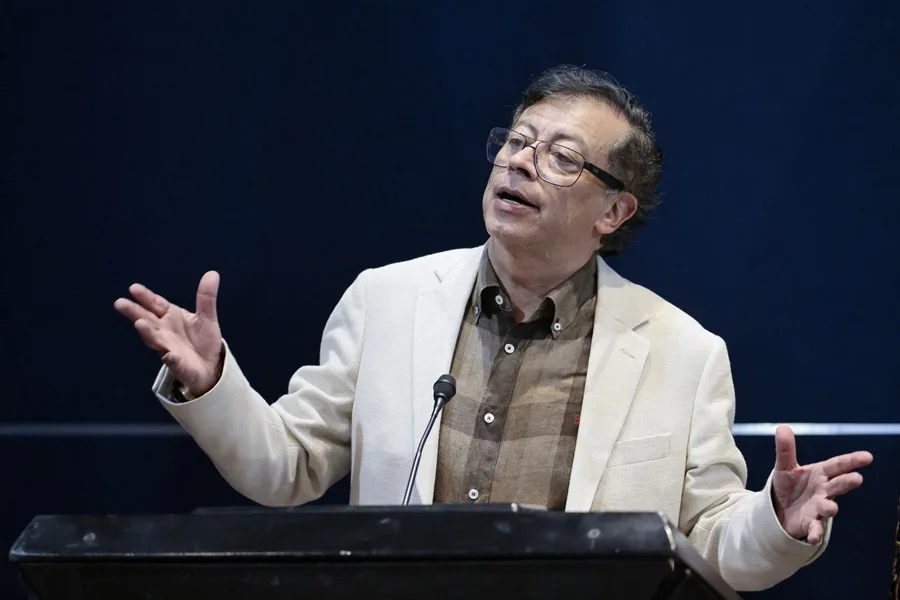
Colombia’s former president says a government request to suspend his account followed a mass protest against President Abelardo de la Espriella.
Former Colombian President Gustavo Petro has accused President Abelardo de la Espriella’s government of trying to silence him after the communications ministry asked social media platform X to suspend his account over alleged incitement to violence.
RELATED: Colombian Workers Stage National Strike Against Economic Rescue Bill
In a statement released Sunday, the Ministry of Information and Communications Technologies (Mintic) confirmed that it had requested the suspension of the account @petrogustavo, citing possible incitement to violence. The request was submitted to X’s Public Policy, Safety and Rules Enforcement team.
The ministry based its request on a post Petro published Saturday, Nov. 21, urging Colombians to demand de la Espriella’s immediate resignation. The post included a video of the former president addressing a demonstration on Thursday, where he called for the slogan “Abelardo, resign now” to become a majority demand and urged people to take to the streets immediately.
Mintic argued that Petro was disregarding the fact that de la Espriella had been democratically elected on June 21, 2026, and took office on Aug. 7. In its request, the ministry warned that X should not become a platform for what it described as an anti-democratic and destabilizing campaign targeting Colombia’s state institutions.
Se llama censura de Abelardo , prohibida expresamente por la constitución.
Aquí se demuestra el grado del ilegitimidad del actual gobierno t.co/XaUf6HdRoi
— Gustavo Petro (@petrogustavo) November 23, 2026
Petro denounced the move on X, arguing that the government was violating the 1991 Constitution by seeking to censor both his account and political alternatives to what he called fascism in power. He also accused the communications minister of publicly advocating unconstitutional restrictions on his ability to communicate with the public.
“The massive popular mobilization frightened them,” Petro wrote, arguing that the government feared a democratic movement unwilling to retreat and representative of what he described as the true majority of Colombians.
The former president also questioned the legitimacy of the midyear elections, claiming de la Espriella had not won the support of Colombia’s actual electorate. He further alleged that the state was in the hands of drug traffickers and several of their armed groups.
Describing the administration as “anti-rights and anti-people,” Petro said it had been imposed by interests that did not serve the national interest. He added that a majority of Colombians instinctively rejected any Nazi project and called for the defense of what he described as the fundamental principles of life, freedom and light.
The government’s request also drew criticism from lawmakers belonging to the Historical Pact (Pacto Histórico), the political movement associated with Petro.
Representative Laura Daniela Beltrán described the move as political persecution and accused the administration of pursuing a campaign against the left, as it had promised during its election campaign.
“This is entirely anti-democratic. It is inexplicable that they continue to pursue a strategy to dismantle the left, just as they promised during the campaign. I call on this government to end censorship and stop attacking the left and democracy,” Beltrán wrote on X.
Fellow representative Isabel Vera also condemned the request, describing Colombia as being under an authoritarian government that had targeted press freedom since its first days in office.
She accused the administration of seeking to undermine people’s freedom to express their opinions, relying on what she called the “dictatorship of the algorithm,” and urged supporters of democracy to reject the move.
Petro is not the only figure to have criticized de la Espriella’s administration. Public allegations against the government include political patronage, a lack of transparency in the management of donations for communities affected by the August earthquake, and delays in recovery efforts, with no clear rehabilitation plan or housing solutions.
Other points of contention include the administration’s opposition to agrarian reform and the Areas of Protection for Food Production (APPA), alleged censorship of the press and repression of protests, the rollback of environmental regulations in favor of mining, and police incursions into universities, including the National University of Colombia, raising concerns over university autonomy guaranteed by the 1991 Constitution.
Criticism has also focused on plans to increase value-added tax (VAT) on basic household goods and a tax reform that critics say shifts the burden onto middle- and working-class households while granting tax reductions to corporations and major capital holders.
From teleSUR English via This RSS Feed.