Welcome back to the Abstract! Here are the studies this week that dive-bombed our ancestors, brightened the sky, recalled an old tune, and got hosed by marine mucus.
First, scientists discover that eagles are hunting large baboons, hinting that early human relatives once sated ancient avian appetites. Then: star-on-star contact, a musical memory lane, and the secrets of cetacean snot.
As always, for more of my work, check out my book [*First Contact: The Story of Our Obsession with Aliens*](https://www.hachettebookgroup.com/titles/becky-ferreira/first-contact/9781523527755/?ref=404media.co)*,* or subscribe to my personal newsletter[ The BeX Files](https://bexfiles.ghost.io/?ref=404media.co).
### **Eagle-eyeing you…for dinner!**
[*Hobaiter, Catherine et al. “Signs of Eagle Predation on a 22-kg Adult Primate.” American Journal of Biological Anthropology.*](https://onlinelibrary.wiley.com/doi/10.1002/ajpa.70377)
Death came from the sky for early humans, according to a new study that suggests giant eagles preyed on our ancestors far more recently than was previously known.
Birds of prey (raptors) have hunted primates for at least 20 million years, including early human relatives, known as hominins. For example, a hominin toddler known as the “Taung child” shows signs of being killed by a raptor roughly 2.5 million years ago. But scientists have assumed that hominins outgrew their status as bird bites since that time, and there are no reports of raptors preying on primates that weigh over 28 pounds on record—until now.
In 2025, scientists discovered that Verreaux’s eagles—one of the largest eagle species in the world—at Ennedi Plateau in Chad are likely hunting adult olive baboons weighing up to 57 pounds. The team found baboon remains among the region’s sandstone cliffs that show signature marks of eagle predation, such as talon punctures on the skull and scrapes to the shoulder bones.
“We cannot definitively rule out scavenging activity, but the severity of punctures is suggestive of lethal interactions through a killing grip,” said researchers led by Catherine Hobaiter of the University of St. Andrews. The team also observed the baboons rapidly retreat when eagles approached, suggesting that they feared aerial attacks.
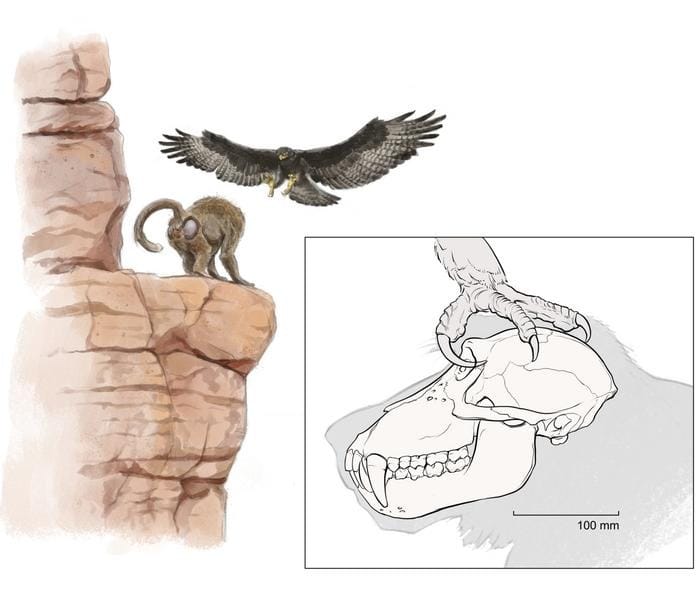**Speculative face-off between adult baboon and an eagle. Image: Javier Lázaro (reproduction permitted: CC-BY-ND)**
Some researchers have argued against the “raptor-mediated predation” of the Taung child on the grounds that the hominin would have been too heavy for a bird. The study’s authors get extra points for including a quote from the comedy *Monty Python and the Holy Grail* on this point: “It is a simple question of weight ratios. A five-ounce bird could not carry a 1-pound coconut.” IYKYK.
However, the laughs stop there, as the team refutes this idea by recounting the grisly “low flight with sustained grip attack” that eagles perform on ungulates, such as antelopes or cattle, which reveal that raptors can kill animals that are many times their own weight with the right approach.
“Briefly, an eagle will land on the back or neck of a moderately large ungulate, gripping it firmly with its talons. If the prey withstands knocking to the ground, the eagle will ride it with wings outstretched and flapping to maintain balance until the quarry collapses, either from exhaustion, shock, or internal injury. A similar tactic is described in the [extraordinary report](https://onlinelibrary.wiley.com/doi/full/10.1002/ece3.71266) of a Harpy eagle (*Harpia harpyja)* attacking a 52-kg adult woman.”
Wow, new fear unlocked! Imagine being an early hominin, minding your own business banging rocks together or something, when suddenly a giant bird of prey either pushes you off a cliff or rides you to death. For everyone preparing to eat a huge bird for Thanksgiving next week, be grateful that it’s no longer the other way around.
*In other news…*
### **A union made in heaven**
[*Karambelkar, Viraj et al. “An inspiral of a star inside a common envelope with its giant companion.” Nature.*](https://www.nature.com/articles/s41586-026-11221-z)
Speaking of unwieldy meals, scientists have captured an unprecedented glimpse of a star eating another star, thereby forming a new mega-star.
Over the past few years, scientists noticed that something weird has been unfolding in a binary star system called AT 2025abao—nicknamed “Bao” (yum!)—in the outskirts of the Andromeda galaxy, which is about 2.5 million miles away from the Milky Way. One of the stars, “Big Bao,” was expanding into its dying red giant phase, which pulled its companion, “Little Bao,” into a deadly spiral. Last year, the system rapidly brightened, signaling that Big Bao had swallowed Little Bao.
**Observations of Bao from 2025. Image: NASA, ESA, CSA, STScI, Viraj Karambelkar (Columbia), Kishalay De (Columbia); Image Processing: Alyssa Pagan (STScI); Acknowledgment: DSS, Robert Gendler**
“In October 2025, the star underwent a dramatic eruption” and exhibited “a sudden increase in its photospheric temperature to about 8,000 K,” said researchers led by Viraj Karambelkar of Columbia University. The system “shows the defining hallmarks of luminous red novae, a class of transients established to arise from impulsive energy injection…during the merger of a star with its companion.”
“This inspiral in such a system has never been observed directly,” the team noted.
Congratulations to the newly-fed couple! Long may Bao shine.
### **Girl, put your records on / but don’t think you own that song**
[*Turnbull, Cara et al. “Music illuminates sociocultural dimensions of autobiographical memory.” Proceedings of the National Academy of Sciences.* ](https://www.pnas.org/doi/10.1073/pnas.2536885123)
We’ve all had that feeling of hearing a familiar song and being transported to a specific time and place in our lives. But as it turns out, the recollections stirred by those cherished songs are probably not all that special, according to a new study that surveyed 233 undergraduate students about these so-called “music-evoked autobiographical memories.”
The students (aged 18-23) listened to clips of [32 popular songs](https://www.pnas.org/action/downloadSupplement?doi=10.1073%2Fpnas.2536885123&file=pnas.2536885123.sapp.pdf) grouped into two categories: “new” songs released from 2014 to 2019, during their adolescence, and “old” songs released from 1985 to 1995, before they were born. When asked to reminisce about the songs, students with similar backgrounds were remarkably aligned in their answers.
“Memories evoked by country songs were more strongly associated with very recent time periods (college) and themes relating to family, driving, summertime, romantic partners, and listening to music (particularly music selected by someone else),” said researchers led by Cara Turnbull of Texas Tech University.
“Alternatively, memories evoked by hip-hop songs were most often associated with friends, acquaintances (such as classmates, coworkers, and teammates), dancing, and being at school, while those evoked by pop songs were most associated with middle school, listening at home or by oneself, and singing along,” the team added.
As an elder millennial, it was humbling to realize what counts as an “oldie” these days. I also felt my generation’s soundtrack was done dirty by offerings like “Achy Breaky Heart” by Billy Ray Cyrus or “Whoomp! There it is” by Tag Team. No Stevie Nicks? Madonna? Wu Tang? All I ask of future generations is that you do not judge us solely by the croonings of C+C Music Factory and Bryan Adams, I beg you.
### **Thar she blows (DNA)!**
[*O’Mahony, Éadin et al. “Breath to Genome: Whole Genome Sequencing of Large Whales From Blow Sampling.” Molecular Ecology Resources.*](https://onlinelibrary.wiley.com/doi/10.1111/1755-0998.70219)
Join hands, dear friends, for we are about to run directly through majestic fountains of whale snot. Scientists who flew drones through whale “blow”—the mucus-filled vapor exhaled by whales through their blowholes—have successfully sequenced whole genomes from the snotty samples, representing “a major step towards non-invasive cetacean sampling,” according to a new study.
“Preserving biodiversity requires the genetic monitoring of wild populations, which is traditionally done through invasive sampling techniques for DNA collection,” said researchers led by Éadin O’Mahony of the University of St. Andrews. “However, this approach can impact animal welfare or be impossible to implement due to behavioural responses to anthropogenic factors or national/international legislation.”
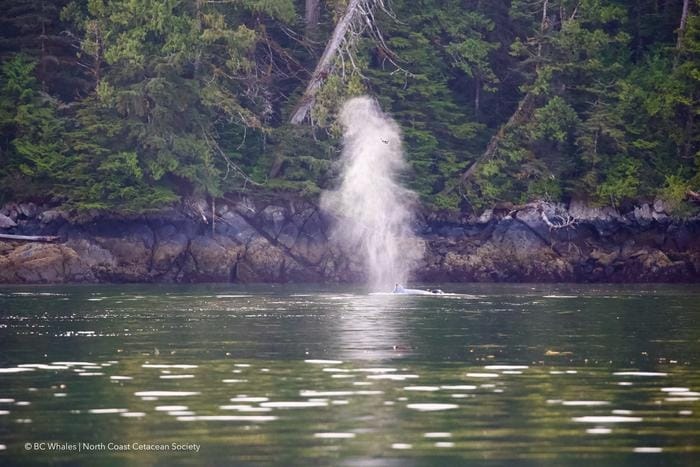**A drone samples whale blow. Image: North Coast Cetacean Society**
Indeed, I think that we can all agree that humans have stressed whales out enough as it is. Instead of invasive biopsies of skin and flesh with darts or scrapers, O’Mahony and his colleagues equipped drones with petri dishes and flew them through a total of 58 blows from 26 Northeast Pacific humpback whales in the Gitga'at First Nation territory of northern British Columbia.
The team “established that a whole humpback whale genome can be recovered from exhaled respiratory vapour (‘blow’), marking a significant methodological advancement in non-invasive cetacean genomics.”
While it’s not the kind of blow most people associate with breathing orifices, it just might be what we need to study whales without hassling them.
Thanks for reading! See you next week.
Scientists Discover New and Horrible Eagle-Based Way Our Ancestors Died
Submitted 9 hours ago by  feed@www.404media.co to random@mbin.linuxnation.social
https://www.404media.co/.ghost/activitypub/article/b42eab3b-a186-46fd-9531-07f1a5d03d71