 rss@news.abolish.capital [bot]
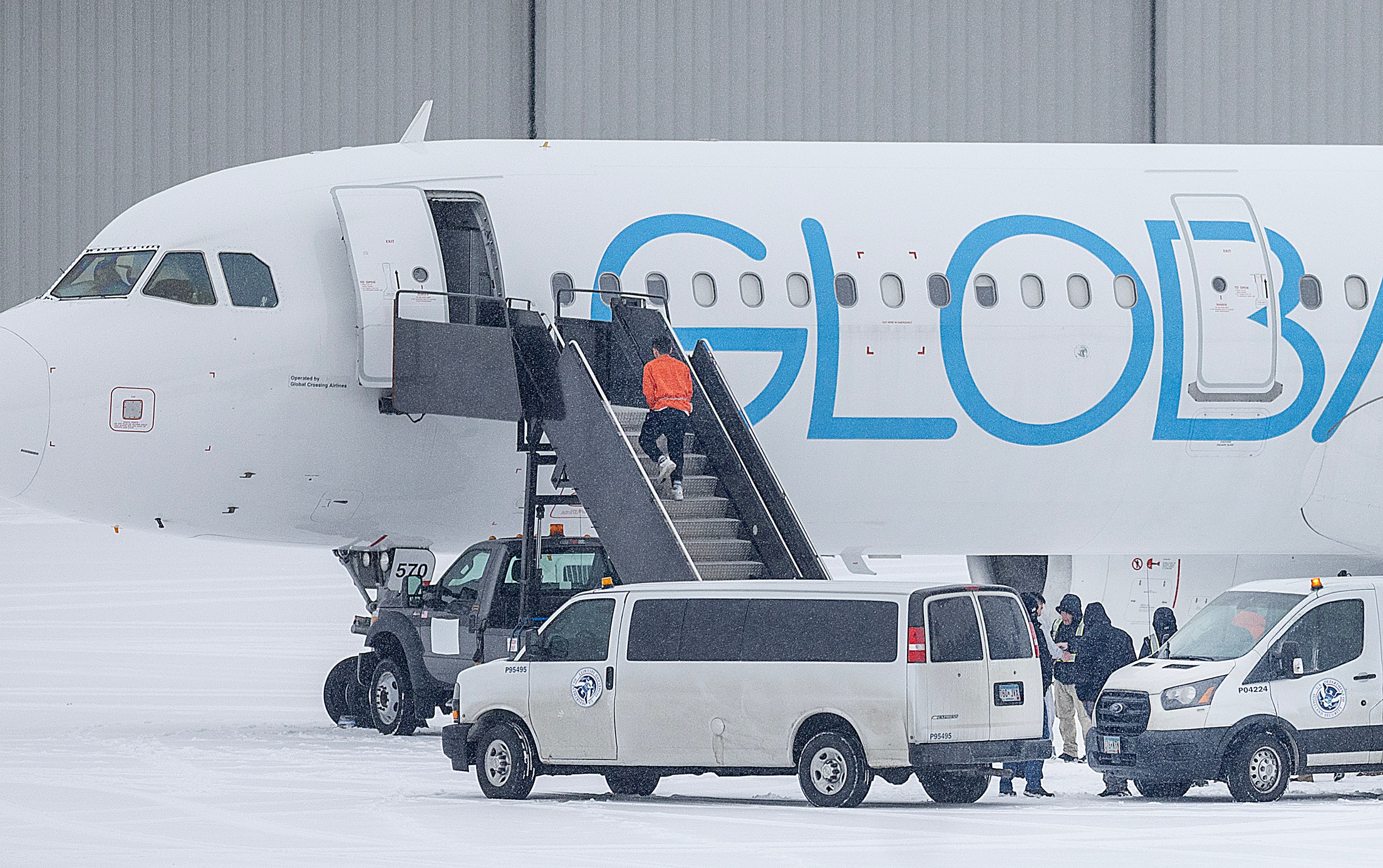
A man wearing a waist chain and handcuffs boards a deportation flight on GlobalX Air at Minneapolis-St. Paul International Airport on Dec. 5, 2025. Photo: Elizabeth Flores/The Minnesota Star Tribune via Getty Images
It’s finally time to talk about air travel safety. High-profile crashes, equipment failures, and last week’s rare nationwide ground stop have thrust a long-overdue conversation about flying to the fore. But the chatter has largely omitted a major factor exacerbating the risk of airline catastrophes: the Trump administration’s aggressive immigration enforcement policies.

Related
“Offensive Driving”: ICE’s Deadly Weaponization of Vehicles Against Civilians](theintercept.com/…/ice-vehicles-cars-hit-weapon/)
With slapdash and violent immigration enforcement as arguably its defining feature, the second Trump administration has mobilized and redirected vast federal resources to hit impossibly high detention and deportation targets. The administration has bent and broken laws, ignored proper vetting processes for new Immigration and Customs Enforcement recruits, and slashed mandatory training hours. The results of these dangerous shortcuts have been deadly: 2025 saw the highest number of deaths for people in ICE custody in decades. At the urging of Stephen Miller, now the White House chief of staff, the detention and deportation quotas have pushed ever higher. To meet them has required the rapid transportation of migrants, often via flights.
In the air, as on the ground, speed kills.
Traditionally, the federal government has not owned and operated its own airline, instead chartering flights from private airlines. Reliance on private contractors is not atypical, but in December 2025, the Trump administration broke with past practice and began to acquire its own fleet to complement the private charters.
ICE flights regularly violate FAA safety standards.
In less than two years, ICE’s air operation has quietly transformed into a full-fledged domestic airline, adding more traffic to the already crowded skies. Just as the Federal Aviation Administration has failed to keep up with flight capacity at major airports, this shadow network of detention shuffle flights has been operating with a reckless attitude toward safety that befits ICE’s overall reputation. As one flight attendant working on ICE Air flights told ProPublica last year, it’s “only a matter of time” before one of these deportation flights ends in disaster.
According to Human Rights First’s ICE Flight Monitor, since Trump’s second inauguration, there have been almost 20,000 individual flights chartered by ICE. Between January 2025 and January 2026, the number of flights inside the U.S. quadrupled. Most of these flights are not actually deportations, but trips shuffling detainees around the country between the hundreds of county jails, state prisons, and privately owned detention centers. Vulnerable migrants are locked in handcuffs, waist chains, and leg irons for the entire trip, unable to unbuckle themselves, violating a federal standard that says a full plane must be evacuated in 90 seconds. ICE Air has quietly removed three safety layers at once — the passenger, the crew, and the airport — and every flight risks triggering an emergency that no one on board could survive.
There was little mention of these risks after the Federal Aviation Administration issued a nationwide ground stop last week, which Secretary of Homeland Security Markwayne Mullin and Secretary of Transportation Sean Duffy blamed on technological upgrades and aging infrastructure.
But an unsafe plane can put anyone at risk, and ICE flights regularly violate FAA safety standards. On ICE’s airliner-size jets, shackled detainees land at one of more than 100 airports in ICE’s expanding network, usually not at major hubs but at small regional airports and airfields. Many of these small, regional airports are not certified by the FAA for planes that size, and some have no fire-and-rescue crews on the ground.
If you live near a small airport in the U.S. and began noticing increased jet noise in the last year and a half, you were probably not imagining things. Your local airfield may be one of the nodes in this network. At the Northeast Alabama Regional Airport in Gadsden, Alabama, for example, over 300 ICE flights have gone in and out since September 2025. The airport, together with the nearby Etowah County detention center, has developed into a transfer node, feeding migrants who were arrested in Alabama, Georgia, and Eastern Tennessee into the major deportation removal hubs centered in Louisiana.
Related
How a Small Kansas City Became a Critical Hub for Trump’s Deportation Regime Against Its Will](theintercept.com/…/leavenworth-kansas-corecivic-i…)
At least five airports in the ICE flight network, including Northeast Alabama, lack FAA Part 139 safety certification, which mandates basic standards like on-the-ground aircraft rescue and firefighting capability. Dozens of other airports have hosted immigration-related aircraft that are sized beyond what their certification index anticipates.
When a small airport falls short of fire and rescue safety minimums, local departments often wait at the airport on standby, further stretching local municipalities’ abilities to keep everyone, even those not flying, safe. As illustrated by numerous videos of federal agents using excessive force or arrest, every encounter between ICE agents and ordinary people brings its own risk of harm. Each chartered flight also brings with it another chance for something to go wrong, and the number of flights keeps climbing. When it does, it could happen at an airport, like Gadsden, with no federal fire-and-rescue requirement and no certification.
If you live near a small airport in the U.S. and began noticing increased jet noise in the last year and a half, you were probably not imagining things.
Reports that ICE used tools to shield deportation flights from public scrutiny and congressional oversight have only compounded these safety concerns. In May, several Democratic members of Congress sent a letter to FAA Administrator Bryan Bedford raising the alarm about ICE’s reported misuse of “Limiting Aircraft Data Displayed,” a program that allows private aircraft to request that the FAA withhold registration numbers and other identifiable data to block public flight trackers. “ICE’s use of this program to obscure routine government operations and suppress information about deportation flights is out of the scope of this program, and therefore inappropriate and dangerous,” the lawmakers wrote.
For the last 18 months, as this network of flights and airports ramped up, supercharged by windfalls from the so-called “Big Beautiful Bill,” congressional Republicans exercised little to no oversight. Come January, once Democrats take the gavel, a new opportunity for accountability will open up. One legislative option includes closing the loophole that lets ICE’s charter contractors operate airliner-size jets out of smaller regional airports that have no FAA Part 139 safety certification, either by amending the negotiated-charter exemption in federal law, or by demanding that the FAA explain — and if necessary enforce — the rules that appear to require certification for flights of this size.
Related
Inside the Business of Trump’s Third-Country Deportations](theintercept.com/…/ice-third-country-deportation-…)
With the power to legislate comes the power to investigate, and congressional Democrats should make full use of the subpoena. Mullen, Bedford, former DHS Secretary Kristi Noem, and representatives from CSI Aviation and the other private airlines making millions off of these flights should answer questions in public, at congressional hearings. In addition to Trump administration officials and those profiting from the flights, the American people also need to hear from those on the ground who run these small airports, and the local municipalities all across the country who have been assuming increased public safety risks, both in the skies and on the ground.
In pursuit of its draconian immigration policy, the Trump administration has pushed the immigration system beyond its ability to function safely, which puts all Americans at risk, with migrants at the most vulnerable end of the spectrum. Failing to mention how immigration enforcement contributes to the crisis plaguing air travel only risks prolonging it.
The post Everyone’s Talking About Air Travel. No One’s Talking About How ICE Flights Make It Less Safe. appeared first on The Intercept.
From The Intercept via This RSS Feed.