ud80-cargo-aircraft-unfolded-catalog-view.jpg
UD80 Cargo Packaging Trials: Compare Cases Before Ordering a Delivery Kit
A reusable cargo case can come back with an intact shell while the instrument inside has shifted enough to bind a connector or change a reference setting. The opposite happens too. A case can pick up a conspicuous scrape while the contents remain in their original positions and pass every receiving check. The two observations belong in the same report. A buyer needs evidence of how the case protects the contents, how consistently staff can repack it, and what the receiving team can verify without guessing.
The UNITED UAV listing identifies the UD80 as a complete cargo transport aircraft. The seller's box list names the aircraft, an MK32 controller, two batteries and one charger. Additional batteries, a payload descent device and a generator appear as separate selections. The base box list does not identify a reusable case for the goods being carried. Ask for an itemized proposal that distinguishes the supplied aircraft equipment from the case, inserts, test articles and receiving tools. That distinction matters even when one supplier offers to quote the entire kit.
The comparison below concerns ordinary instruments or service assemblies and uses a stationary rehearsal with inert stand-ins. The numbers are fictional. Have the relevant engineering team review the proposed case and the aircraft interface separately before anyone treats a package as an approved load. The buyer can settle several packaging questions at a bench, without using the aircraft to discover where an instrument needs support.
1. Write the damage criteria before opening the sample cases
Describe the item in terms of the parts that matter to its function. A dense component may tolerate a cosmetic mark on its base while requiring an undisturbed alignment pin at the other end. A light instrument with a protruding connector can be vulnerable at a point that carries almost none of its weight. Ask the owner or equipment supplier where the item may be supported, which surfaces must remain clear and which changes would make the item unsuitable for its next use.
Give the receiving inspector a before-and-after record. For a mechanical assembly that could include a photographed reference face, a dimension measured from a fixed datum, and a simple check that a captive fitting still moves as expected. For an instrument it might include a baseline from the owner's existing functional check, under the same conditions used for the later reading. Keep cosmetic, dimensional and functional criteria separate. Name who may accept a cosmetic change and what should happen when a reading is near a limit.
Set the limits using requirements for the contents. Ask the receiving team to demonstrate that its tools can resolve those limits on a representative item. A tolerance of a few millimetres is unhelpful if inspectors measure from a different corner every time. Reference the same point in a labelled photo, describe the measurement direction and record the tool. That makes a disputed result reproducible.
2. Ask each bidder to supply a comparable packing assembly
The shell, inserts, sleeves and small protective pieces form one packing assembly. List them by revision and include whatever staff would actually use on a routine job. Ask how they recognize left and right inserts, whether pads can migrate when the case is empty, and what prompts replacement after repeated use. A case that protects a carefully prepared demonstration unit can still be hard to repack correctly at the destination. A photograph showing a correctly seated insert can make that failure easier to prevent.
Use a representative, inert stand-in for the first comparison. Record which properties it reproduces, including the shape that contacts the inserts, the distribution of mass and the location of any vulnerable projections. A rectangular weight that matches the instrument's total mass may press on entirely different surfaces. It can still be useful for a narrow comparison if the report identifies what it represents. Keep the stand-in result separate from a later functional check on a representative real item.
Image/photo
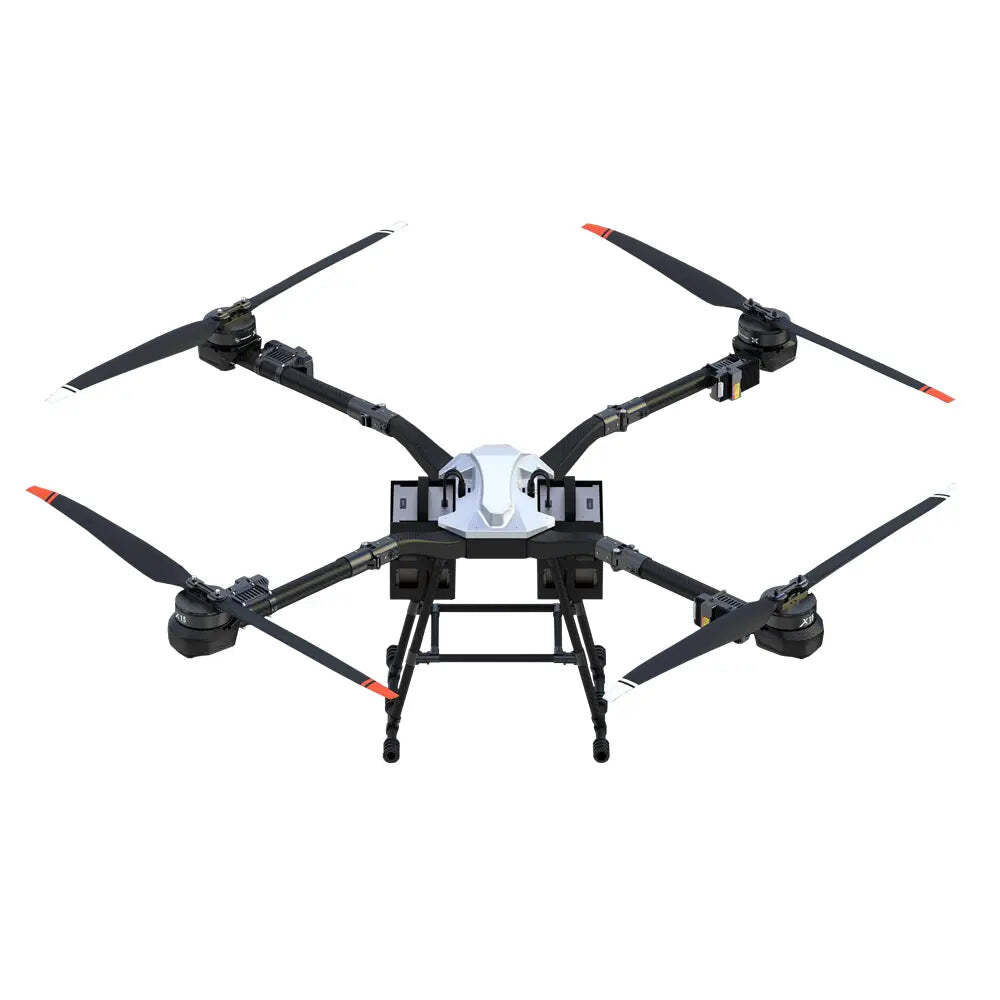
Seller catalog view of the folded UD80 aircraft. The reusable case discussed here is for the cargo. Ask for its own drawing and packing list.
3. Compare like conditions and keep a control sample
Agree which decision the trial needs to support. A buyer can use a short screening exercise to decide which of two packaging concepts deserves further work. A test intended to represent an entire transport environment requires a separate, justified profile. The International Safe Transit Association's test procedures overview distinguishes early screening from tests that simulate defined distribution conditions. The screening exercise here compares two assemblies under agreed bench conditions. Have a packaging specialist choose the method and equipment if the procurement needs a formal transport test.
Compare the cases using the same representative contents, inspection tools, conditioning and sequence. Assign a specimen identifier to each assembled case and note who packed it. If one assembly is unpacked and repacked before the second test while the other is untouched, record that difference. Decide whether the trial is meant to compare new units, units that have already been used, or both. The answer will affect what a failed insert tells you.
Keep an untreated reference where practical. If a dimension changes equally on the tested item and the control, temperature, a measurement fixture or the item itself may explain the movement. Repeat the baseline measurement before blaming the packaging. Several independent packings are generally more informative than several readings on one conveniently prepared sample. When samples are few, report each one individually and limit the decision to the actual specimens and conditions.
Write down the order in which observations will be made. A trial can alter the package even when the team sees no immediate effect. For example, an insert may shift slightly during an early rehearsal step and then leave room for more movement in a later one. If the team wants to diagnose which step caused the problem, it can use separate specimens reserved for intermediate inspection. Opening and reseating the contents midway through a complete sequence changes the specimen. Record that intervention and keep its result separate from the uninterrupted run.
4. Measure the shell and the contents as separate systems
A witness mark at a repeatable location can reveal relative movement after the case is opened. Place and document it during the bench setup with the owner's agreement. Record the initial relationship between the marks or reference points. After the rehearsal, photograph and measure the same locations before disturbing the inserts. An after photo taken after someone has lifted the item cannot resolve whether the movement occurred in transit or during the inspection.
Where instrumentation is useful, agree what a case-mounted logger and a logger on the stand-in are supposed to measure. Identify both mounting points, their orientation, and how events will be associated across records. A case logger observes the shell at one point. An inner logger observes the stand-in near its mounting point. If one sensor clips or its attachment moves, annotate that result before comparing peaks. A reading that hits the recorder's range limit gives no reliable value for the missing part of the signal.
Ask for the event records as well as a summary. Two events with a similar peak can differ in duration and direction. A threshold indicator can tell a receiver that a condition was triggered without supplying a waveform or proving the contents were harmed. Use it to decide which observations to review, alongside physical and functional evidence. If an indicator stays unchanged but a retaining pad has shifted, preserve both observations. The item and the indicator may have responded to different conditions.
Give the receiving team a rule for a missing observation. A lost inner recording leaves the shell recording usable for its own purpose. It leaves a gap in any conclusion about how much of that event reached the contents. If the physical and functional checks pass, the buyer can still decide whether that evidence is sufficient under the agreed screening plan. A report should say which planned checks are complete and which readings were unusable. Blank cells encourage the next reviewer to assume that nothing unusual happened.
5. Work a comparison with a measurable decision boundary
Suppose a buyer has one representative assembly weighing 24.0 kg. In this fictional example, Case A weighs 8.4 kg empty and takes 1.6 kg of inserts and protection. Case B weighs 9.3 kg empty and takes 2.1 kg of inserts and protection. The packed units would be 34.0 and 35.4 kg. Case B therefore adds 1.4 kg for the same contents. Those are procurement worksheet values for the two candidate cases. Have the relevant team evaluate any carried configuration using the actual itemized assembly.
The buyer sets an example residual movement limit of 2.0 mm at a marked reference point. Assume the measurement procedure supports an uncertainty interval of plus or minus 0.3 mm around each reading. Three independently packed A specimens read 1.4, 2.2 and 3.1 mm after the same rehearsal. The first is below the limit even at the upper end of its interval. The second overlaps the limit and needs a better measurement or a repeat under the agreed rule. The third remains above the limit even at the lower end.
Three B specimens read 0.6, 0.9 and 1.1 mm. All three remain below 2.0 mm at the upper end of their intervals. That supports taking B forward on this particular screening criterion while the team investigates the unresolved A reading. It says nothing about a different item, a different test profile, or the functional checks that still need to be completed. Show the individual measurements in the bid file so the purchaser can see exactly where the decision came from.
When a result falls close to the boundary, compare the measurement method with the source of the uncertainty. Another reading from the same position may help if the display is noisy. It will do little for two inspectors using different edges as their datum. In that case the useful improvement is a better reference or a fixture that places the instrument consistently. Verify the revised method on the control before using it to resolve a disputed specimen. Keep the original observation in the report so the later result can be interpreted.
6. Make repacking and receiving part of the comparison
Ask a second person to pack another specimen using the instructions that would travel with the case. Record what they have to infer. A reversible insert with a hidden difference between sides is a source of variation. So is a pocket that can be closed while a connector cover is absent. The purchaser can ask for visible orientation marks, a reference photo and a check that makes a missing protective part obvious before the case is closed.
At receiving, ask someone who did not prepare the package to perform the agreed inspection. Give that person the accepted drawing, an example baseline and the correct tools. Can they identify the contents without unloading unrelated items? Can they distinguish an out-of-limit reading from a damaged mark or a missing reference? If the check cannot be carried out at the destination, state what the receiver can verify there and who is responsible for the later functional check. A sign-off should name the level of inspection that actually took place.
Treat repeated use as a separate buying question. Record insert condition, changes in fit, cleaning constraints and whether replacement parts can be obtained with the same identifiers. If the supplier changes an insert material or a machining dimension, define which comparison must be repeated. A replacement item sold under a similar description may still change how the load is supported. Keep an approved sample or controlled drawing so a future buyer can resolve that question without relying on memory.
Count the small parts needed to prepare the next job. A reusable shell can be ready while a fresh protective cap is missing or an insert is still with the previous shipment. Request the packing list for one ready case and the list of consumables that replenishes it. Ask the supplier to identify what comes with each spare assembly and how replacements are ordered. A buyer comparing initial kit prices can then distinguish a complete case from one that still needs parts and preparation before it can enter service.
7. Ask for evidence that can survive a change of supplier or crew
Put four deliverables in the quotation. Request an itemized packing assembly with identifiers and revisions, a drawing that shows supported and clearance surfaces for the agreed contents, the proposed test and acceptance sheet, and an example of the receiving record. Include the empty and packed masses and the method used to obtain them. Keep aircraft options on separate lines so a change to a generator or battery quantity does not silently change the packaging proposal.
Ask the bidder to show one failed or inconclusive example from the rehearsal and explain how it would be handled. Useful answers identify the affected specimen, the exact measurement or observation, and the next decision. A supplier may recommend a revised insert, a more repeatable measuring fixture or a second test using an actual item. Ask for the resulting report and the revision that it applies to. That is a more concrete deliverable than a photograph of a closed case with a single pass mark.
When enquiring about the UNITED UAV UD80 aircraft and package options, bring the dimensions of the goods, the permitted support points, the condition checks available at receiving and any repeat-use requirements. Ask for the specific aircraft and cargo case proposed, with the packaging test and its limitations recorded separately. You should be able to explain why one case moved forward and which question the next trial still has to answer.
Commercial disclosure: Published by UNITED UAV Official. UNITED UAV sells the UD80. The photographs identify the aircraft and the package details come from the seller's listing. The trial, masses and measurements are illustrative.
UD80 Cargo Packaging Trials: Compare Cases Before Ordering a Delivery Kit
A reusable cargo case can come back with an intact shell while the instrument inside has shifted enough to bind a connector or change a reference setting. The opposite happens too. A case can pick up a conspicuous scrape while the contents remain in their original positions and pass every receiving check. The two observations belong in the same report. A buyer needs evidence of how the case protects the contents, how consistently staff can repack it, and what the receiving team can verify without guessing.
The UNITED UAV listing identifies the UD80 as a complete cargo transport aircraft. The seller's box list names the aircraft, an MK32 controller, two batteries and one charger. Additional batteries, a payload descent device and a generator appear as separate selections. The base box list does not identify a reusable case for the goods being carried. Ask for an itemized proposal that distinguishes the supplied aircraft equipment from the case, inserts, test articles and receiving tools. That distinction matters even when one supplier offers to quote the entire kit.
The comparison below concerns ordinary instruments or service assemblies and uses a stationary rehearsal with inert stand-ins. The numbers are fictional. Have the relevant engineering team review the proposed case and the aircraft interface separately before anyone treats a package as an approved load. The buyer can settle several packaging questions at a bench, without using the aircraft to discover where an instrument needs support.
1. Write the damage criteria before opening the sample cases
Describe the item in terms of the parts that matter to its function. A dense component may tolerate a cosmetic mark on its base while requiring an undisturbed alignment pin at the other end. A light instrument with a protruding connector can be vulnerable at a point that carries almost none of its weight. Ask the owner or equipment supplier where the item may be supported, which surfaces must remain clear and which changes would make the item unsuitable for its next use.
Give the receiving inspector a before-and-after record. For a mechanical assembly that could include a photographed reference face, a dimension measured from a fixed datum, and a simple check that a captive fitting still moves as expected. For an instrument it might include a baseline from the owner's existing functional check, under the same conditions used for the later reading. Keep cosmetic, dimensional and functional criteria separate. Name who may accept a cosmetic change and what should happen when a reading is near a limit.
Set the limits using requirements for the contents. Ask the receiving team to demonstrate that its tools can resolve those limits on a representative item. A tolerance of a few millimetres is unhelpful if inspectors measure from a different corner every time. Reference the same point in a labelled photo, describe the measurement direction and record the tool. That makes a disputed result reproducible.
2. Ask each bidder to supply a comparable packing assembly
The shell, inserts, sleeves and small protective pieces form one packing assembly. List them by revision and include whatever staff would actually use on a routine job. Ask how they recognize left and right inserts, whether pads can migrate when the case is empty, and what prompts replacement after repeated use. A case that protects a carefully prepared demonstration unit can still be hard to repack correctly at the destination. A photograph showing a correctly seated insert can make that failure easier to prevent.
Use a representative, inert stand-in for the first comparison. Record which properties it reproduces, including the shape that contacts the inserts, the distribution of mass and the location of any vulnerable projections. A rectangular weight that matches the instrument's total mass may press on entirely different surfaces. It can still be useful for a narrow comparison if the report identifies what it represents. Keep the stand-in result separate from a later functional check on a representative real item.
Image/photo

Seller catalog view of the folded UD80 aircraft. The reusable case discussed here is for the cargo. Ask for its own drawing and packing list.
3. Compare like conditions and keep a control sample
Agree which decision the trial needs to support. A buyer can use a short screening exercise to decide which of two packaging concepts deserves further work. A test intended to represent an entire transport environment requires a separate, justified profile. The International Safe Transit Association's test procedures overview distinguishes early screening from tests that simulate defined distribution conditions. The screening exercise here compares two assemblies under agreed bench conditions. Have a packaging specialist choose the method and equipment if the procurement needs a formal transport test.
Compare the cases using the same representative contents, inspection tools, conditioning and sequence. Assign a specimen identifier to each assembled case and note who packed it. If one assembly is unpacked and repacked before the second test while the other is untouched, record that difference. Decide whether the trial is meant to compare new units, units that have already been used, or both. The answer will affect what a failed insert tells you.
Keep an untreated reference where practical. If a dimension changes equally on the tested item and the control, temperature, a measurement fixture or the item itself may explain the movement. Repeat the baseline measurement before blaming the packaging. Several independent packings are generally more informative than several readings on one conveniently prepared sample. When samples are few, report each one individually and limit the decision to the actual specimens and conditions.
Write down the order in which observations will be made. A trial can alter the package even when the team sees no immediate effect. For example, an insert may shift slightly during an early rehearsal step and then leave room for more movement in a later one. If the team wants to diagnose which step caused the problem, it can use separate specimens reserved for intermediate inspection. Opening and reseating the contents midway through a complete sequence changes the specimen. Record that intervention and keep its result separate from the uninterrupted run.
4. Measure the shell and the contents as separate systems
A witness mark at a repeatable location can reveal relative movement after the case is opened. Place and document it during the bench setup with the owner's agreement. Record the initial relationship between the marks or reference points. After the rehearsal, photograph and measure the same locations before disturbing the inserts. An after photo taken after someone has lifted the item cannot resolve whether the movement occurred in transit or during the inspection.
Where instrumentation is useful, agree what a case-mounted logger and a logger on the stand-in are supposed to measure. Identify both mounting points, their orientation, and how events will be associated across records. A case logger observes the shell at one point. An inner logger observes the stand-in near its mounting point. If one sensor clips or its attachment moves, annotate that result before comparing peaks. A reading that hits the recorder's range limit gives no reliable value for the missing part of the signal.
Ask for the event records as well as a summary. Two events with a similar peak can differ in duration and direction. A threshold indicator can tell a receiver that a condition was triggered without supplying a waveform or proving the contents were harmed. Use it to decide which observations to review, alongside physical and functional evidence. If an indicator stays unchanged but a retaining pad has shifted, preserve both observations. The item and the indicator may have responded to different conditions.
Give the receiving team a rule for a missing observation. A lost inner recording leaves the shell recording usable for its own purpose. It leaves a gap in any conclusion about how much of that event reached the contents. If the physical and functional checks pass, the buyer can still decide whether that evidence is sufficient under the agreed screening plan. A report should say which planned checks are complete and which readings were unusable. Blank cells encourage the next reviewer to assume that nothing unusual happened.
5. Work a comparison with a measurable decision boundary
Suppose a buyer has one representative assembly weighing 24.0 kg. In this fictional example, Case A weighs 8.4 kg empty and takes 1.6 kg of inserts and protection. Case B weighs 9.3 kg empty and takes 2.1 kg of inserts and protection. The packed units would be 34.0 and 35.4 kg. Case B therefore adds 1.4 kg for the same contents. Those are procurement worksheet values for the two candidate cases. Have the relevant team evaluate any carried configuration using the actual itemized assembly.
The buyer sets an example residual movement limit of 2.0 mm at a marked reference point. Assume the measurement procedure supports an uncertainty interval of plus or minus 0.3 mm around each reading. Three independently packed A specimens read 1.4, 2.2 and 3.1 mm after the same rehearsal. The first is below the limit even at the upper end of its interval. The second overlaps the limit and needs a better measurement or a repeat under the agreed rule. The third remains above the limit even at the lower end.
Three B specimens read 0.6, 0.9 and 1.1 mm. All three remain below 2.0 mm at the upper end of their intervals. That supports taking B forward on this particular screening criterion while the team investigates the unresolved A reading. It says nothing about a different item, a different test profile, or the functional checks that still need to be completed. Show the individual measurements in the bid file so the purchaser can see exactly where the decision came from.
When a result falls close to the boundary, compare the measurement method with the source of the uncertainty. Another reading from the same position may help if the display is noisy. It will do little for two inspectors using different edges as their datum. In that case the useful improvement is a better reference or a fixture that places the instrument consistently. Verify the revised method on the control before using it to resolve a disputed specimen. Keep the original observation in the report so the later result can be interpreted.
6. Make repacking and receiving part of the comparison
Ask a second person to pack another specimen using the instructions that would travel with the case. Record what they have to infer. A reversible insert with a hidden difference between sides is a source of variation. So is a pocket that can be closed while a connector cover is absent. The purchaser can ask for visible orientation marks, a reference photo and a check that makes a missing protective part obvious before the case is closed.
At receiving, ask someone who did not prepare the package to perform the agreed inspection. Give that person the accepted drawing, an example baseline and the correct tools. Can they identify the contents without unloading unrelated items? Can they distinguish an out-of-limit reading from a damaged mark or a missing reference? If the check cannot be carried out at the destination, state what the receiver can verify there and who is responsible for the later functional check. A sign-off should name the level of inspection that actually took place.
Treat repeated use as a separate buying question. Record insert condition, changes in fit, cleaning constraints and whether replacement parts can be obtained with the same identifiers. If the supplier changes an insert material or a machining dimension, define which comparison must be repeated. A replacement item sold under a similar description may still change how the load is supported. Keep an approved sample or controlled drawing so a future buyer can resolve that question without relying on memory.
Count the small parts needed to prepare the next job. A reusable shell can be ready while a fresh protective cap is missing or an insert is still with the previous shipment. Request the packing list for one ready case and the list of consumables that replenishes it. Ask the supplier to identify what comes with each spare assembly and how replacements are ordered. A buyer comparing initial kit prices can then distinguish a complete case from one that still needs parts and preparation before it can enter service.
7. Ask for evidence that can survive a change of supplier or crew
Put four deliverables in the quotation. Request an itemized packing assembly with identifiers and revisions, a drawing that shows supported and clearance surfaces for the agreed contents, the proposed test and acceptance sheet, and an example of the receiving record. Include the empty and packed masses and the method used to obtain them. Keep aircraft options on separate lines so a change to a generator or battery quantity does not silently change the packaging proposal.
Ask the bidder to show one failed or inconclusive example from the rehearsal and explain how it would be handled. Useful answers identify the affected specimen, the exact measurement or observation, and the next decision. A supplier may recommend a revised insert, a more repeatable measuring fixture or a second test using an actual item. Ask for the resulting report and the revision that it applies to. That is a more concrete deliverable than a photograph of a closed case with a single pass mark.
When enquiring about the UNITED UAV UD80 aircraft and package options, bring the dimensions of the goods, the permitted support points, the condition checks available at receiving and any repeat-use requirements. Ask for the specific aircraft and cargo case proposed, with the packaging test and its limitations recorded separately. You should be able to explain why one case moved forward and which question the next trial still has to answer.
Commercial disclosure: Published by UNITED UAV Official. UNITED UAV sells the UD80. The photographs identify the aircraft and the package details come from the seller's listing. The trial, masses and measurements are illustrative.