Comment on lightbulbs
Aceticon@lemmy.dbzer0.com 3 months agoHere are the LED drop voltages for reference.
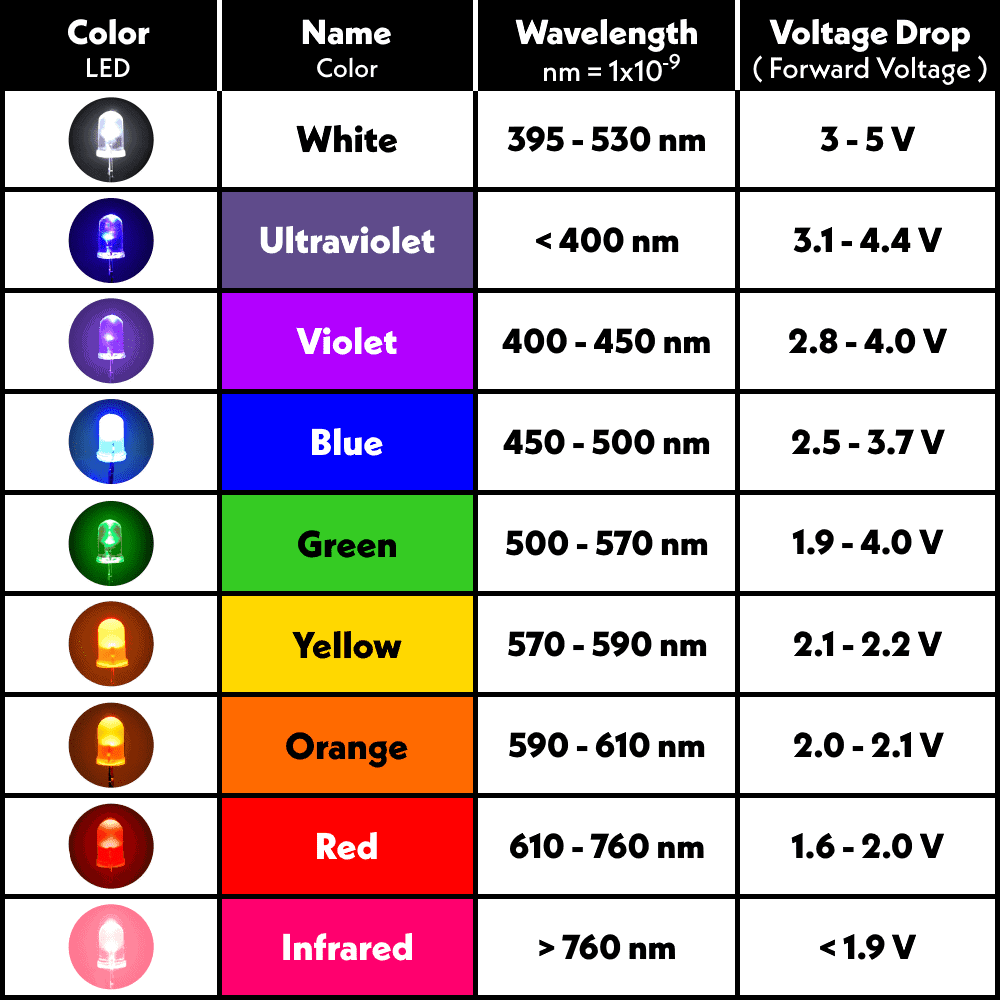
LEDs aren’t just more efficient at those voltages, those are literally the difference in voltage between one side of the LED and the other side when in operation - if you feed it less than that the LED will simply not work. (Note that these drop voltages are not actually an absolute value but rather a very steep curve relative to current, but for simplification we can treat those as absolute ON/OFF voltage values).
Also the phosphor doesn’t filter light - rather it absorbs light and re-emits it in different wavelengths, the process being such that the emitted light covers a range of wavelengths even if the input light has a single wavelength as is the case for LEDs - so it’s not at all light manipulation by filtering and mixing light sources.
That said I went looking at how phosphor is used in LEDs nowadays and judging from this they don’t use red LEDs emitters at all nowadays, only blue and UV ones, and then chose a phosphor (which can be any substance, not just Phosphorous) whose emission range is towards the desired light range.
Fedizen@lemmy.world 3 months ago
The phosphorous coating here is serving to reduce the amount of blue light as an absorptive filter. Its just also doing other stuff. Idk if there’s a proper term for what its doing in whole, but your explanation is otherwise in line with what I’ve read.
Aceticon@lemmy.dbzer0.com 3 months ago
That’s not even close to reality.
Read the material linked.
Fedizen@lemmy.world 3 months ago
Fwiw, I did read the article you linked. That’s one of the articles I looked at originally.
I’m just saying its innapropriate to say its “not a filter” because the coating is doing more than partially filtering a wavelength of light; Its a categorical error.
The coating’s primary engineering function is not a filter, so maybe its frustrating to hear it described as one but it is absolutely incorrect to say its not a filter.
Aceticon@lemmy.dbzer0.com 3 months ago
A phospor absorbs the incoming light and then uses it as power for its own emission process, in a processes called “fluorescence” rather than “filtering”. It’s a very efficient process because almost all of the light coming absorbed by the fluorescent material ends up used to emit light.
A filter just cuts out (literally “filters out”) things other than what it’s supposed to let through. Filters just block stuff and thus cannot have on their output anything that’s not present on their input. Further, filtering can be very inefficient because everything that the filter doesn’t let through just ends up as waste heat.
Filtering doesn’t make any sence for light emitted by a diode junction because that specific light emission process emits light of a single wavelength - it’s a totally different process from incandescence, which only emits photons whose energy exactly matches a specific quantum gap in that junction, hence all have the exact same wavelength so there are no other wavelengths to filter out and if you filter out that specific wavelength no light at all goes through because there’s nothing else there.
Calling a phospor a “filter” is like calling a system with a solar panel connected to a green LED a “filter” - sure, the spectrum of the light coming in is not the same as that of the light going out, but that’s pretty much the only way the thing behaves the same as a filter - it does not share any of the other characteristics of a filter.
Anybody with a Physics or Engineering background will react the same as me when somebody describes a fluorescent material in front of a light source “a filter” because per the scientific and engineering definitions “fluorescence” is not at all the same as “filtering”.
Whatever source you learned information about LED lights from, it’s really bad and shows no domain expertise, which is probably why you ended up with some things right in your explanations and others horribly wrong. If I was to guess, I would say that you “learned” it from AI, as getting the general stuff mostly right and the domain expertise details incredibly wrong is a common problem of AI.