l am German and I had the same impression. English was silly easy to learn (I may still have a slightly harsh pronunciatian, though).
No gender-dependent conjugations and the grammatical exceptions are sparse (mainly a few special cases around the tenses).
But learning French, another dual-gendered latin language: total nightmare.
So my surprise that Spanish is supposed to be easier to learn than the already quite easy English language…
Comment on Do babies learn languages at different rates depending on how hard the language is?
Scrollone@feddit.it 14 hours agoI’m Italian and I feel that both Italian and Spanish are way more difficult to learn than English.
English doesn’t have genders, it has way less verb tenses, and you don’t need to conjugate every verb person in a different way for each tense!
Multiplexer@discuss.tchncs.de 4 hours ago
Scrollone@feddit.it 2 hours ago
Another problem with French (that Italian and Spanish pretty much don’t have) is the pronunciation. They don’t have a 1-to-1 relation between letters and sounds.
But that’s also a problem with English.
SlurpingPus@lemmy.world 2 hours ago
Wouldst I have been having an origin and thus a learning experience that might have been comparable to yours, I expect I should will agree with you. But having not had had my way into English from the same vantage point, I am going to have to go ahead and will have disagreed with you, in that in my view tenses in English are son of a fucking bitch.
Scrollone@feddit.it 2 hours ago
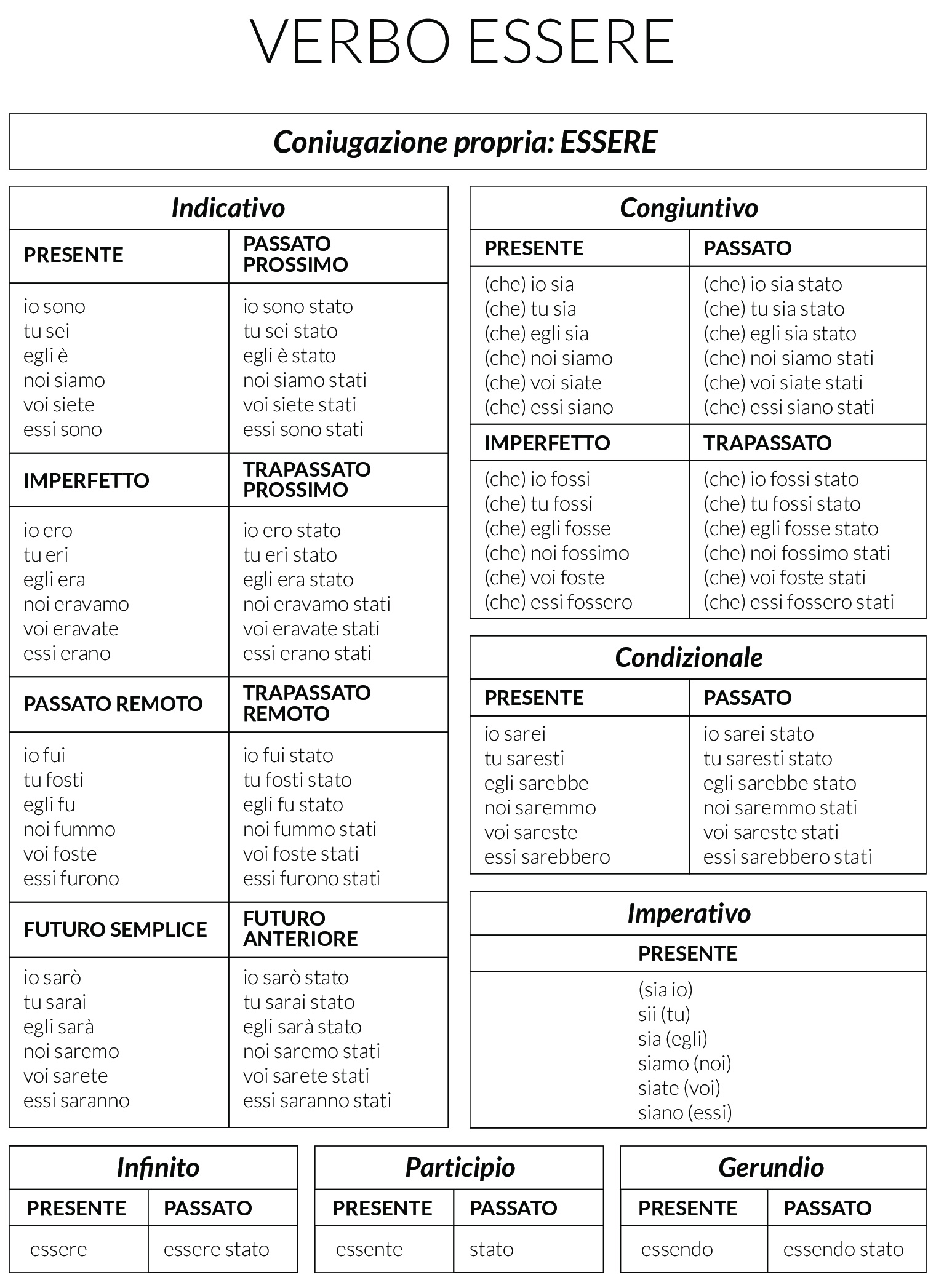
Look at Italian and you’ll be thankful that English verbs are so easy.
This is the conjugation of “to be” in Italian. You need to learn all those tenses also for “to have” and for 3 different categories of verbs called “-are”, “-ere”, “-ire” (almost 4, in reality, because many “-ere” verbs are irregular).
SlurpingPus@lemmy.world 1 hour ago
The number of conjugations is impressive, mostly because of the genders and the plural forms. But regarding the tenses themselves, half of them are formed by adding ‘stato’ to the other kind. Meanwhile English has twelve basic tenses without getting into the subjunctive, conditional and imperative moods (congiuntivo, condizionale and imperativo). The full tense–aspect–mood system greatly complicates things.