Amanda Pica and Scott Richards (plus others) 217 pages Hollow Oak Press (2023)
Read this if you like: Storytelling cycles, urban fantasy, paranormal mystery
tl;dr summary: High school friends who were members of a magical club reconvene twenty years later and get caught up in a new mystery.
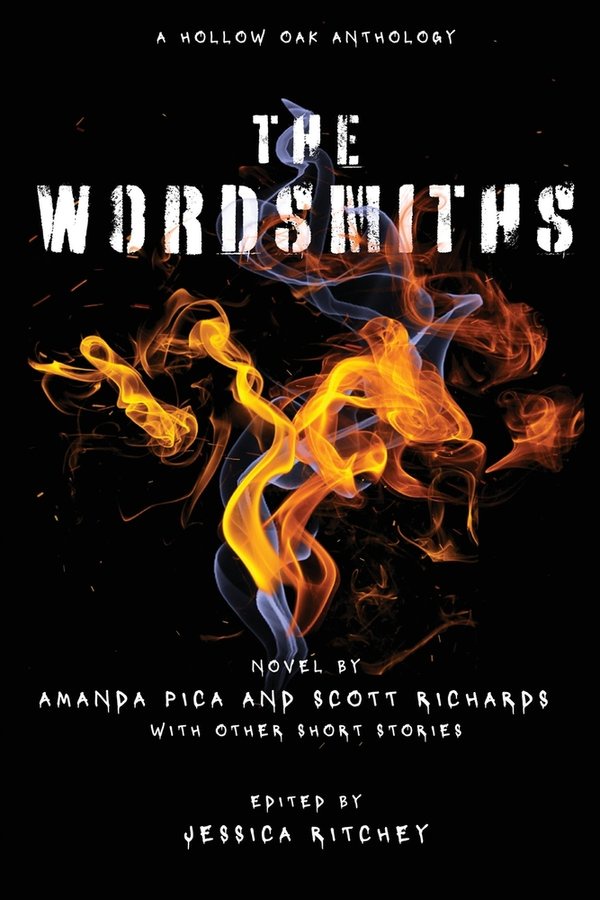
The format of Wordsmith is one that I adore. It's a collection of stories that are linked together by a contiguous narrative running between them. In that narrative, protagonist Kat was part of a group in high school called the Wordsmiths. When they got together, they could tell each other stories that would come to life and seem completely real to the people in the room. They disbanded after one of their members died, and haven't been back together for over 20 years, but have reassembled for one last story cycle after their old teacher's death. The short stories interspersed between the narrative sections are the ones that the group members tell each other during this last story cycle.
From the jump, this concept pulled me in on multiple levels. The idea of people who can create living stories is a fun one on its own, then layering in the background mystery of what happened to Cassie (the member whose death broke them up all those years ago) adds more intrigue. And Kat has her own personal challenges she's coping with on top of that. Her father is suffering from dementia, and her one-time friends don't seem particularly happy to have been pulled back together. In fact, she's barely spoken to them over the last twenty years, and though some of them seem ready to pick things back up where they left off, she feels like the others are in their own little clique that she's now on the outside of.
That's a lot of great tension established early on, and by and large it's managed very well over the course of the narrative to keep it moving forward. The balance of the main narrative sections with the interjecting short stories was also very nicely done. There are a couple of places where things in the main storyline are getting pretty tense, or Kat and her allies seem to be edging closer to solving the mystery, and a story is interjected, creating a kind of cliff-hanger-ey feel. The insertion of other storytelling voices is also a nice little palate cleanser. Other authors were brought in to write each story, which also helps to give each character's story its own cadence and feel, reinforcing the in-book conceit that they're all told by different people.
The only thing introduced toward the beginning that I feel gets a bit neglected in the course of the book is Kat's relationship with her father. Memory and the loss of it ends up becoming a thematic thread that runs through the main narrative, so it feels like there's potential for resonance there between that background thread and the main plot that doesn't get fully utilized.
From a worldbuilding standpoint, I found the mechanism by which the Wordsmiths enter and leave their immersive stories intriguing. Each story needs to be tethered to an object, which they then break when they get to the end of the tale. This will also only work within one specific room on the high school property, a small cement room connected to the stadium, and they all have to be assembled for the magic to function. I appreciate that these rules aren't over-explained. That's always a tricky balance to strike with this kind of magical world. Here, the fact that it's left a bit mysterious helps to maintain the mystique, and it makes sense for the characters, anyway, since they don't fully understand why the storytelling happens the way it does, either. I was a bit curious about the location specifically, and what was special about that place that allowed this magical storytelling to happen there, but wondering about that didn't detract in any way from me enjoying the story.
I also have to give a shout-out to the individual stories, because they were all very enjoyable to read in their own right. My favorite, I think, was “Can't Be Afraid of the Dark”, which follows a kid who finds a bogeyman under his bed, one that has a very inconvenient fear. A close second is “Pink”, which is what I would say is the darkest story in the book, and exists in a kind of atmospheric horror space. It's well-placed, too, close to the end and during a very tense point in the main narrative where going into a more spine-tingling direction feels like it keeps the right energy through the break in the primary plot action.
I'm sure there were a lot of extra logistical things that the authors and editor had to do to make a collection like this come together. But you can't tell from reading it, and that's maybe what impressed me the most about it. The work of 10 different writers comes together here into one cohesive whole, and one that is a very entertaining read from start to finish.
See similar posts: