John Fortunato 340 pages Minotaur Books (2015)
Tl;dr summary: Disgraced Special Agent Joe Evers delays early retirement by taking on a decades-old cold case with big political implications.
Read this if you like: Tony Hillerman, gritty mysteries, conspiracy theories
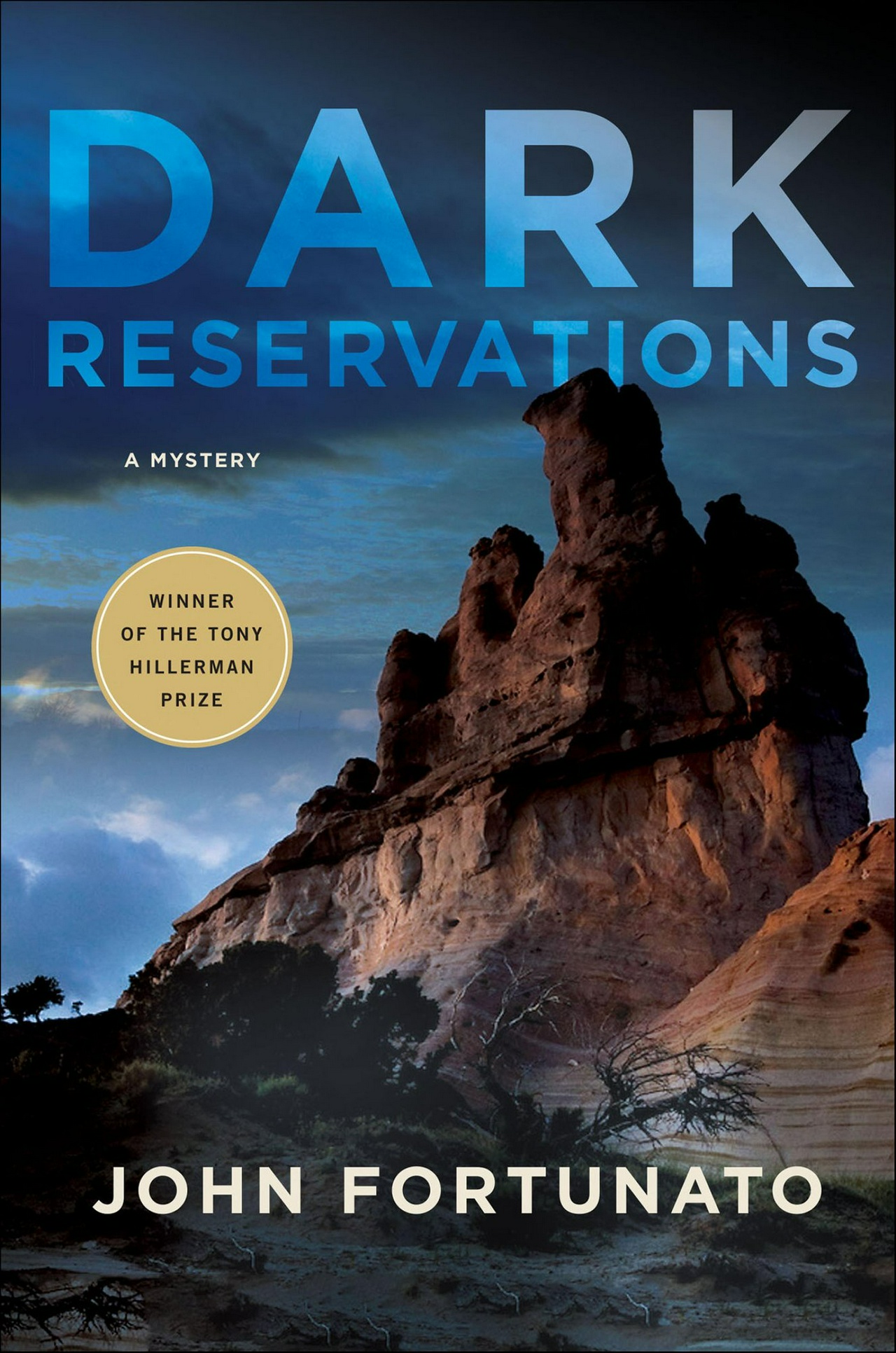
Here's the thing about tropes: there's a reason why they're popular. Yes, they can be overused, but they're also highly effective and enjoyable to read when they're employed correctly. I don't think any genre exemplifies this fact quite as clearly as mystery, and the washed-up detective trope is admittedly one of my favorites. I love a good flawed hero, always root for the underdog, and will rarely turn my nose up at a redemptive arc, so if a story can hit all three of those points I'm probably going to enjoy reading it.
And Dark Reservations did just that. The protagonist, special agent Joe Evers, is about to be forced into an early retirement after a grief-induced downward spiral. But then he lands one last major case: discovery of new evidence in a high-profile cold case that could send him out on a high note, if he manages to solve it before his retirement becomes official. And, just to add some extra tension, the victim in the cold case is the missing-presumed-dead husband of Grace Edgerton, a politician who's currently the front-runner in the New Mexico governor's race. It's trope on trope on trope—but it works, because everything makes sense together. John Fortunato uses tropes here in the smart and productive way, as shortcuts to get the reader up-to-speed on the character and situation so they can jump right in on the action and how that character are plot are going to develop.
I don't want to send the impression that I found Dark Reservations derivative or predictable, either. The story's setting on a Navajo reservation adds another layer of complexity. As Joe digs into the cold case, he realizes that Arlen Edgerton's death was likely connected to the theft and illegal sale of artifacts that belong to the reservation. And not just any artifacts. Their existence is the only thing that verifies controversial research published by Professor Lawrence Trudle, which proposes a connection between the Aztec empire and the Anasazi of New Mexico. His theory was widely dismissed by established archaeologist, and he was made a laughingstock, without the discovered artifacts to prove his assertions. Adding to the conspiracy, Trudle suspects that the then-president of the Navajo nation was involved in the theft, along with a prominent and well-connected art dealer. These aren't necessarily the kinds of complications you expect to have come up in a cold case murder mystery, and they were unexpected in just the right way for me. The interweaving of reservation politics, alongside Joe's personal life travails and the usual justice system drama you'd expect from a police procedural style crime story, really upped the excitement and entertainment level of the story.
Of course, I was predictably most into the artifact side of the story. In part because my interest piques whenever archaeology enters the chat, and especially when it's one of the Mesoamerican cultures I'm mildly obsessed with. But this was also a very fresh angle to bring to the equation. The “shadowy crime organization” is another trope that makes fairly regular appearances in this style of narrative, but usually those mobs trade in things like drugs or arms or people. Shifting the focus to stolen artifacts also means it deals with a different set of moral questions about the commercialization and exploitation of indigenous culture. The thread with Rushingwater and the fight to get the People of Diné recognized as an independent country reinforces this tension, while also introducing an element of chaos at exactly the right moment to ramp up the story’s pace.
From a craft standpoint, something I was paying close attention to in this book was its voice and the pacing of the prose. This book is an excellent example of how clean and straightforward writing can still be literary in its attention to language. It's simple in the kind of way that reads effortless but probably took a lot of time and care to craft. This is also reinforced by the structure. The interpolation of very quick scenes in between longer passages gives it a very cinematic kind of pacing, and the descriptive language within the scenes reinforces this. Most importantly, the writing never gets in the way of the story, and every word feels like it was chosen with a mind to building the character and sense of place first. I'd say it's definitely a strong example of a mystery novel that is also literary.
Overall, this is a very satisfying read. I don't want to say much about the plot progression or ending to avoid the risk of spoilers, but suffice to say it kept me interested and invested the whole way to the end, which is something else I think is very important for books in the crime/mystery genre. I've now read a couple of books from Minotaur and they've consistently delivered. This one in particular I'd absolutely recommend—obviously for folks who are into police-centered mysteries, but also for fans of archaeology and readers of literary suspense.
See similar posts: