Jeff Pepper 323 pages Imagin8 Press (2025)
Read this if you like: Unique worldbuilding, solarpunk, Avatar
Tl;dr summary: Human teens and six-legged wolves learn to coexist.
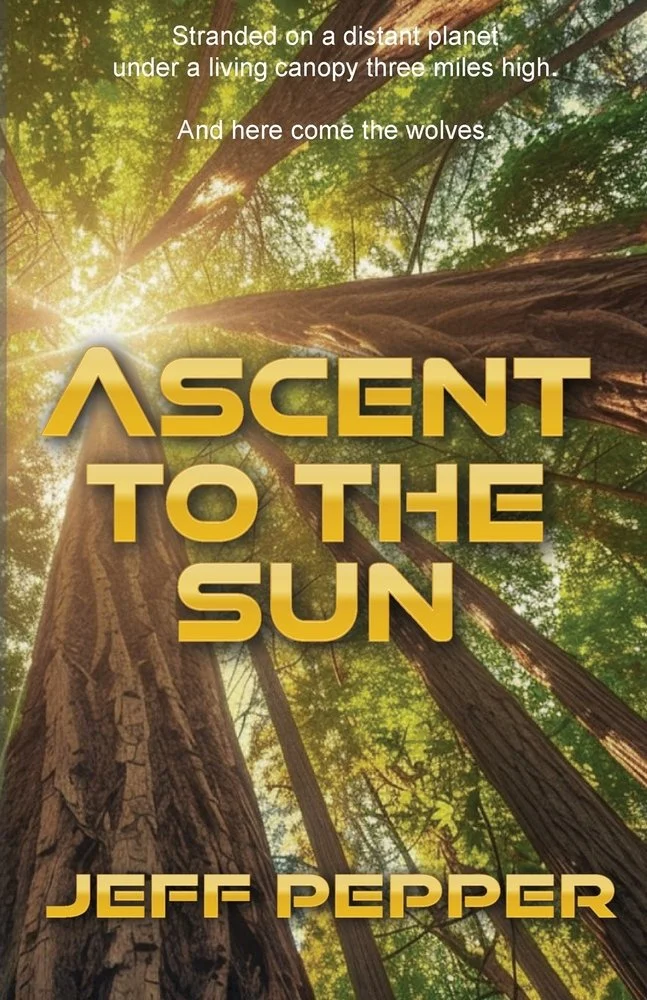
Anyone who reads this blog regularly knows I'm a worldbuilding nerd. When a book has a fully developed secondary world—especially if it includes deep details like a conlang or in-world mythology—then I'm automatically inclined to at least find it entertaining. Ascent to the Sun delivered on this and did something that's even more rare: it presented ideas in its worldbuilding that I found completely new and surprising.
I have to go into more detail here because I'm kind of enamored with the strangeness of this world. The story takes place on a planet far from Earth, where the entire surface is covered in massive trees—and when I say massive, we're talking it's a multi-day climb to reach the top. They even grow out of the oceans, and their branches link together to form a kind of encircling net over the entire surface. Enough light gets through that creatures live on the surface between the trunks.
The main sentient species is a six-limbed lupine species called the Waya, who live in small tribes (the main community involved in the novel numbers 53) spread across the land. They have a symbiotic relationship with a primate species called Simians who live in the big trees but also come down to the ground. There is also a semi-intelligent flying species referred to as angels, although they mostly stay in the branches and upper part of the world, and rarely interact with the creatures on the ground. The origins of some of these things are explained over the course of the book, but since those are tied to plot movement and could potentially be spoilers I'll restrain myself from geeking out about that at the moment.
What I'll focus on instead is that symbiotic relationship between the Waya and Simians, because for me that was maybe the most intriguing thing about this book (which is saying something in a story with so many cool details). The Waya have a very complex means of reproducing. I will state here that this is also information that's revealed over the course of the book, but I don't think knowing the specifics from the jump would ruin anything about the story. So the Waya actually have two ways of reproducing. They mate like other mammals, but at the end of their lifecycle they also produce something called a Crownfruit. This grows in their heads once they reach the end of their natural life, and they're compelled to run out into the forest making a ruckus. This attracts Simians, who kill the crazed and dying Waya and rip open their skull. They compete to be the one who eats the Crownfruit, and whichever one does is compelled to start climbing up the trees until it reaches the very top. There, it shits out the Crownfruit seeds, which by this point have developed into a cluster of red berries, and birds fly by and eat those berries then shit out their seeds far and wide across the land. These seeds hatch into grubs, which burrow into the ground for a couple of years then come out as tiny Waya the size of a mouse that eventually grow up into full-sized versions. These wild babies, as they're called, wander the forest on their own for a while until they stumble across a clan village, where they're adopted and introduce new genetic material into the tribe, thus preventing the genetic bottleneck that would otherwise be likely to form in communities as small as the Waya tribes.
The sheer creativity behind this approach to reproduction is impressive in its own right, but it's also expertly woven into the novel at every level. It serves as a driver of the plot when, early on, we learn the Simians have been nearly wiped out by a plague, which could mean the end of the Waya as well if they don't find another solution. This becomes a primary point of leverage for the humans who want to negotiate peace with the Waya and establish their own tribe on the planet. The humans are currently outnumbered, the second generation of eggs germinated by an intelligent seed ship that landed on the planet. There are enough eggs in the ship to start a self-sustaining population, but it's waiting to do anything with them until it's sure they won't just get wiped out like the first batch of humans it cooked up.
The Waya were the ones who wiped out the humans on the first pass, but it was because those humans killed one of their number—the result of fear and inexperience rather than malice, the reader eventually learns, but that starts their relationship off in a place of violence. The events in Ascent to the Sun show them trying to start again, despite their past conflicts and language barrier, and this underlying spirit is something else I really appreciated. It feels like a very timely and necessary narrative, one of overcoming what seem like irreconcilable differences to find common ground and cooperate to help everyone survive and thrive. In that respect, it had a very solarpunk vibe for me, and it certainly embodies the spirit of hope and aspiration for a better future that I associate with that genre.
There were some moments in Ascent to the Sun where I had slight quibbles. There were times it felt like it couldn't decide if it was a YA or adult novel, and not just because of the youth of the protagonists. I also had a few points that I found myself slipping out of reader brain and into workshop brain—nothing major enough to impact my overall enjoyment, but at some points things felt too easy for the characters, while in others I felt like I could see the author putting obstacles in their way, rather than having them arise organically out of the world. When a book has this level of depth and excitement in the worldbuilding, though, I'm more than willing to look past those kinds of smaller points, and I'd definitely still recommend this one to anyone who likes unique secondary worlds.
See similar posts: