Parallel Adaptation Problems in German Elite Sport and Industry
By Prof. em. Hans Joachim Scholl, PhD, MBA
A Comparative Institutional Analysis (1990–2036)
A Note on Method
Several statistical limitations apply throughout this analysis and are flagged once here rather than repeated in each section below. Medal counts and per-capita ratios are descriptive, not causal, and are sensitive to which countries are chosen for comparison: the charts below track Germany against France, Italy, and the United Kingdom, a set that excludes stronger winter powers such as Norway, Austria, and Switzerland. Per-capita ratios are also a weak proxy for institutional efficiency on their own, since they weigh population rather than funding, athlete numbers, or participation rates, and are structurally biased toward small, wealthy nations. Tournament outcomes (group stage, quarter-final, champion) are ordinal categories plotted as a continuous line for visual clarity, not a cardinal scale, and are vulnerable to small-sample variance, refereeing, and injuries. Finally, a correlation between sporting and industrial outcomes does not establish a shared cause; it can support claims about parallel institutional structures, not about a single national trait or the psychology of a population of eighty million. These limits do not invalidate the comparisons that follow; they set the terms on which the comparisons should be read.
The Reification of Post-Reunification Trajectories
Germany's contemporary sporting and industrial structures consolidated after 1990 under conditions of institutional optimism. West Germany won the 1990 FIFA World Cup in Rome months before political reunification; the merger of Western capital and industrial scale with East Germany's centralized, heavily state-supported sports infrastructure produced an immediate, formidable international presence, confirmed when the newly unified team won eighty-two medals at the 1992 Barcelona Olympics—still, three decades later, the highest total any German Olympic team has produced. To contemporaries, this looked like the durable baseline of a re-engineered sporting power.
It was not sustainable. The medal totals of the early 1990s were a one-time dividend from merging two pre-existing pipelines—East German athletes, coaches, facilities, and structured talent-development networks—not the product of a forward-looking system. That inheritance carries a serious caveat: the GDR's sports apparatus was built on a state-organized, systematic doping program that caused extensive, well-documented medical harm to its athletes. The decline after 1992 is therefore not a story of democratic Germany dismantling an efficient system; it reflects the necessary dissolution of a coercive, medically abusive one. As that merged generation's momentum faded without an equally scaled, modern, and ethically compliant replacement pipeline, the structural limits of Germany's decentralized sports model became visible.
The Divergent Trajectories of Summer and Winter Sports
Summer Olympic Games, 1992-2024
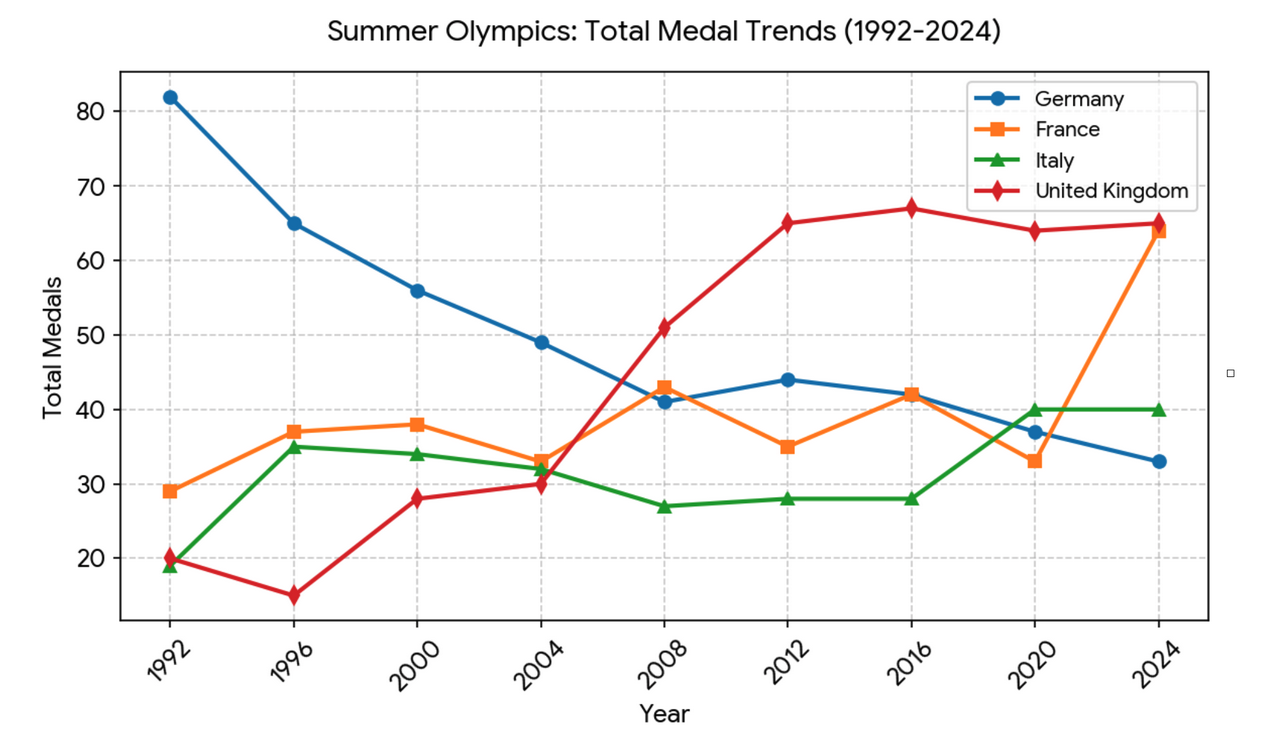
Figure 1. Germany's summer medal total, 1992-2024, against France, Italy, and the United Kingdom.
Germany's summer medal total fell from 82 in 1992 to 65 in 1996 and 56 in 2000, stabilized between 41 and 44 from 2008 through 2016, then dropped to a post-reunification low of 33 at Paris 2024.
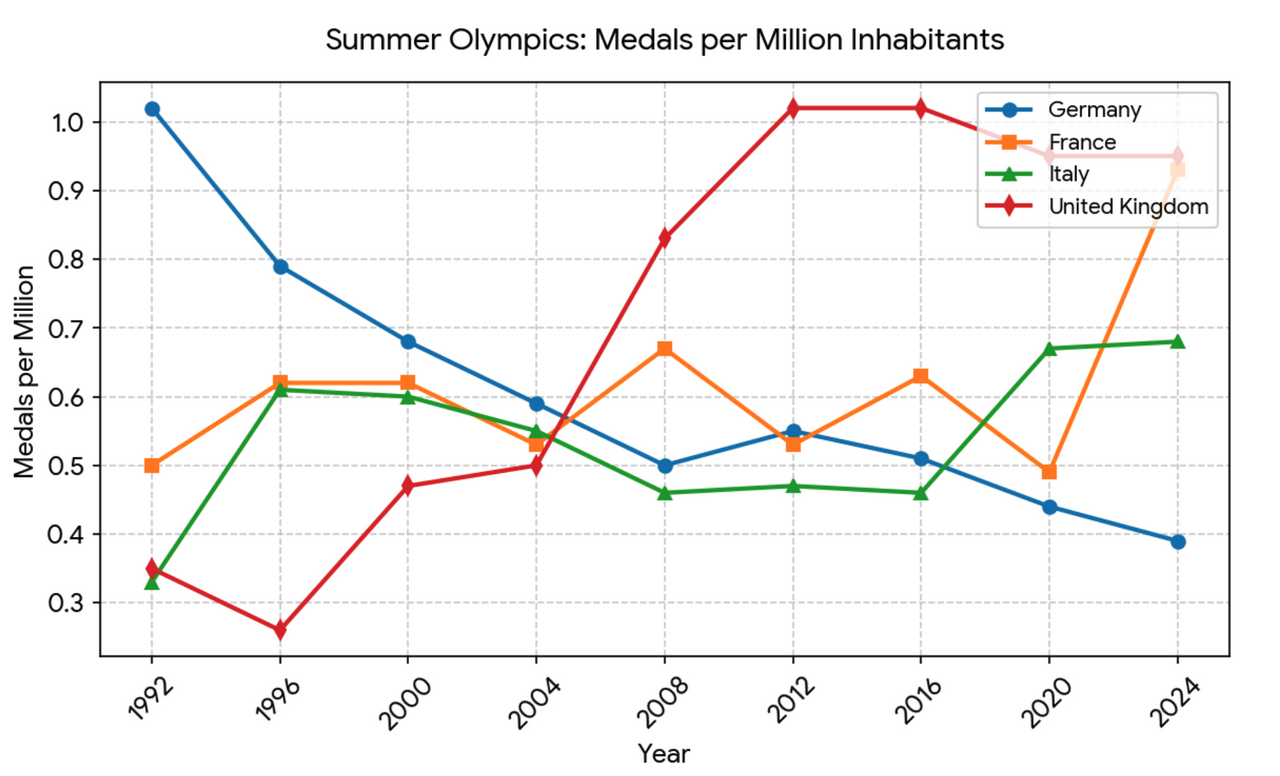
Figure 2. Medals per million inhabitants, summer, 1992-2024.
Population-adjusted, this is a fall from roughly 1.02 medals per million inhabitants in 1992 to 0.39 in 2024—a useful timeline, though a weak measure of institutional efficiency taken alone, since it weighs only population, not the funding, athlete numbers, or participation rates that actually determine output. The United Kingdom and France illustrate an alternative path. After a fifteen-medal collapse at Atlanta 1996—Britain's worst Summer Games since 1952—the country rebuilt elite sport around UK Sport, National Lottery funding, and rigorous four-year, medal-contingent contracts, producing a stable plateau above sixty medals from London 2012 through Paris 2024. That model has also drawn ethical criticism for its narrow, medal-centered focus, and its gains partly reflect a large increase in overall funding rather than governance design alone. France took a parallel but distinct route, creating the Agence Nationale du Sport in 2019 to coordinate the state, sporting federations, local authorities, and corporate partners, and finished fifth in the official gold-first medal table with 64 medals at its home Games in 2024—a result that reform alone does not explain, given the well-documented performance boost host nations typically receive.
Winter Olympic Games, 1992-2022 (with 2026 Context)
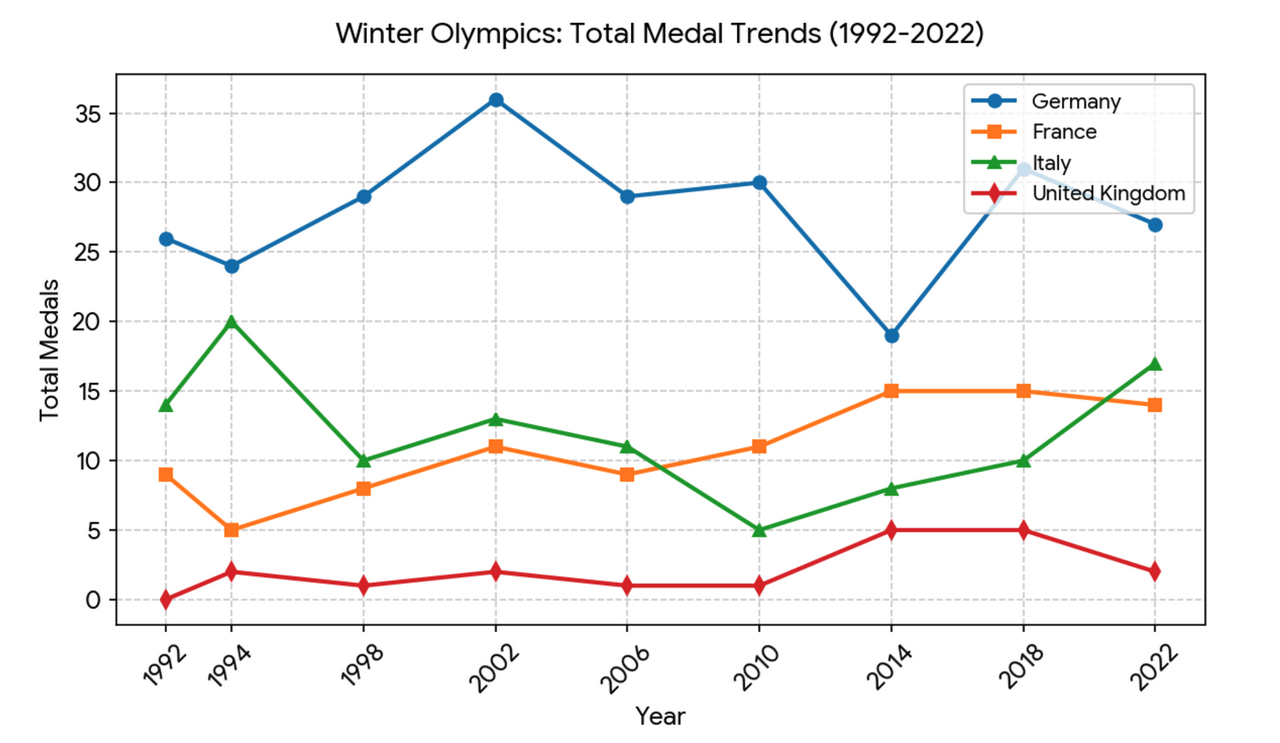
Figure 3. Germany's winter medal total, 1992-2022, against France, Italy, and the United Kingdom.
Winter results tell a narrower, steadier story: Germany took between 19 and 36 medals per edition from 1992 through 2022, extending its strong presence to Milano Cortina 2026 where it secured 26 medals and 8 golds. The stability is a structural shield, not broad strength. Winter sport is geographically and financially exclusive: competitive programs require mountains, cold-weather infrastructure, and expensive, single-purpose facilities such as bobsleigh and luge tracks that few nations ever build—and Germany's success sits almost entirely within disciplines protected by exactly that moat. The shield is partial, though: Norway won 41 medals and 18 golds at the same 2026 Games, more than double Germany's gold count, from roughly a fifteenth of Germany's population. Germany holds a stable position within a shallow field, not dominance within it—the same asset-specific, technical-moat logic that, as the industrial section below suggests, may be shielding parts of German manufacturing as well.
Institutional Evolution within International Football
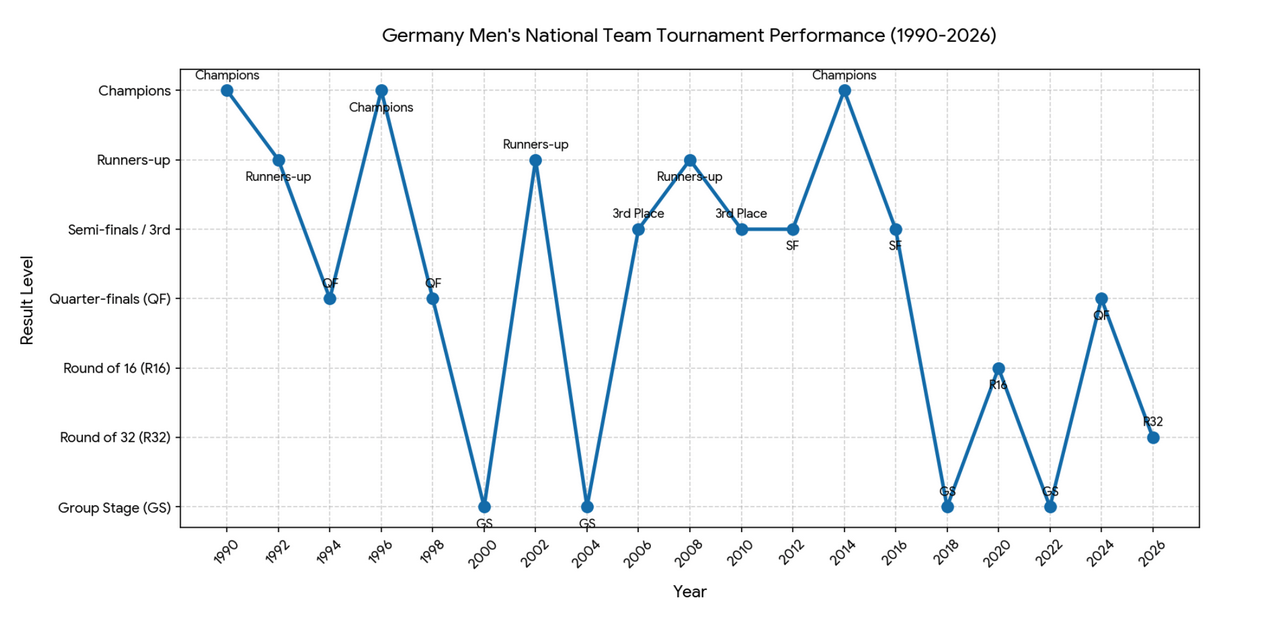
Figure 4. Germany men's national team tournament results, 1990-2026 (ordinal scale).
The men's national football team followed a similar arc. It won the 1990 World Cup and Euro 1996, then suffered group-stage exits at Euro 2000 and Euro 2004. Structural reform followed quickly rather than after a second shock: in February 2001, months after Euro 2000, the DFB made licensed youth academies mandatory for Bundesliga clubs, later extended to all 36 clubs across the top two divisions comprising the Bundesliga and 2. Bundesliga, each required to keep at least twelve nationally-eligible players in its academy ranks, backed by roughly €500 million in youth-infrastructure investment by 2002. That reform underwrote six consecutive major-tournament finishes of semi-final or better between 2006 and 2016, culminating in the 2014 World Cup title in Brazil. The decade since has been worse: group-stage exits at the 2018 and 2022 World Cups, a round-of-16 exit at Euro 2020, and a narrow 2-1 extra-time quarter-final loss to eventual champion Spain at Euro 2024 on home soil—a result some analysts read as partial recovery given the team's improved cohesion relative to 2018 or 2022. The pattern continued at the 2026 World Cup, where Germany lost to Paraguay 1-1 (3-4 on penalties) in the round of 32, its first-ever World Cup shootout defeat, prompting Julian Nagelsmann's exit and Jürgen Klopp's appointment as head coach. As with the ordinal tournament-result scale noted at the outset, a single shootout loss reflects match variance as much as systemic failure.
The Limits of Institutional Engineering
These sport-side patterns have invited comparison to German industry, especially the automotive sector—but a correlation between the two is not evidence of a single overarching national cause, such as declining competitiveness, material security, or risk appetite, nor can elite-team results diagnose the psychology of a population of eighty million. What the two domains plausibly share instead is a specific institutional failure mode: capable incremental optimization inside a stable paradigm, followed by a slow structural response once the paradigm itself shifts. Klopp's appointment illustrates the mechanism on the sporting side. It generated substantial public expectation of a rapid turnaround, but a national-team manager cannot buy talent or directly alter the domestic pipeline, and commands the squad for fewer than forty days a year in brief, interrupted windows. If the underlying development infrastructure has produced too few players of specific positional profiles over a ten-year cycle, an elite coach is left optimizing an existing shortfall rather than correcting it—tactics cannot substitute for a pipeline problem.
The Industrial Matrix: Automotive and Chemical Sectors
For decades the German auto industry led through incremental refinement of internal-combustion engineering and modular, flexible production—the kind of manufacturing framework BMW still deploys, and a genuine engineering achievement that generated real, sustained corporate value. That advantage eroded once the global market shifted toward software-defined architectures, integrated digital cockpits, and vertically integrated battery-electric platforms. Between 2017 and 2023, German vehicle-and-parts production fell 15%, driven by a roughly 50% drop in combustion-engine car production and a 40% drop in combustion-engine exports. From 2019 to 2024, vehicle registrations across Germany's three largest markets—Europe, the United States, and China—fell 9% overall, while registrations of German-made vehicles specifically fell 16%, a relative as well as absolute decline. In China, the world's largest EV market, German brands held roughly 5% of electric-vehicle sales in 2024 against BYD's 34%; BMW's China deliveries fell 13.8% and Mercedes-Benz's 1.2% that year, while Volkswagen's grew 17% slower than the underlying market. Globally, BYD alone sold roughly three times Tesla's electric-vehicle volume in 2025, a scale no German manufacturer approached. Mercedes-Benz has itself pushed back its target date for electric and electrified vehicles to reach half of sales from 2025 to 2030, evidence that the adjustment extends beyond Volkswagen's widely reported restructuring.
The consequences have reached payrolls. Volkswagen agreed to cut 35,000 jobs by 2030 in a deal reached with IG Metall in December 2024; Bosch announced 13,000 cuts in its mobility division in September 2025; ZF and Continental cut roughly 7,000 to 7,600 positions each. Across the sector, an estimated 55,000 automotive jobs were lost in Germany between 2023 and 2025, in an industry that still employs more than 700,000 people. The chemical industry, Germany's other traditional industrial pillar, shows a related but distinct pattern, driven less by a missed technology transition than by industrial electricity costs roughly three times those paid by American competitors. BASF closed several production lines at its Ludwigshafen complex and cut 2,600 jobs across Europe—about 65% of them in Germany—by the end of 2024, while shifting new investment toward China and the United States. National chemical output fell a further 2 to 2.5% in 2025. Across manufacturing broadly, industrial production has now declined for four consecutive years, output remains roughly a quarter below its 2013-2018 trend, and the sector shed an estimated 360,000 jobs between 2019 and 2025—a structural contraction running on a timeline that roughly parallels the sport-side declines described above, though it began later and, unlike a medal count, shows no sign yet of stabilizing. Whether Germany's more specialized industrial niches—precision machine tools, specialty chemicals, certain medical-technology segments—carry an asset-specific moat comparable to winter sport is a plausible hypothesis this analysis has not tested; the automotive and bulk-chemical data above describe the exposed, mass-market end of German industry, not the whole of it.
Comparative Structural Models and Adaptation Frameworks
The United Kingdom and France built centralized, contractual delivery systems: lottery-funded medal targets in Britain, a coordinating national agency in France. (The UK's Olympic model should not be conflated with England's separate professional-football youth system, the Elite Player Performance Plan, which operates under entirely different club-commercial funding and objectives.) Germany's sports funding instead runs through a diffuse, multi-layered relationship between the German Olympic Sports Confederation (DOSB) and the Federal Ministry of the Interior. The DOSB is itself a non-governmental umbrella of 103 member organizations—state sports federations, elite-sport associations, and bodies with special mandates—a structure built for grassroots legitimacy and broad representation rather than for concentrating capital on medal-ready programs. It is structurally bound to spread taxpayer money broadly across regional federations to preserve amateur participation and equity, leaving less capital concentrated on medal-capable programs than its centralized peers deploy. A similar diffusion pattern recurs in industry. Germany's flexible, modular production lines are an efficient mechanical solution, but they compete against hyper-centralized, vertically integrated rivals in the United States and China—firms that treat vehicle manufacturing primarily as a software and battery-chemistry problem, backed by concentrated state and capital support comparable in kind, if not in degree, to UK Sport's or France's centralized athletic targeting.
Institutional Scenarios and Pathways: 2026 to 2036
These are conditional pathways based on current funding, participation, and development patterns, not predictions. If funding fragmentation and decentralized talent pipelines persist, Germany's summer total will likely hold near 30-35 medals through the 2028 and 2032 Games, consistent with the 33-44 medal range seen since 2008—strong in capital-intensive disciplines such as equestrian, canoeing, and rowing, weak in high-yield disciplines such as swimming, gymnastics, and track and field. The winter program should hold its medal volume through 2030 and 2034, provided its regional technical institutes and military and police employment structures remain funded. Football's recovery will likely be volatile and non-linear: short-term tactical gains under Klopp are plausible given his managerial record, but a durable return to 2006-2016-level consistency depends on whether the DFB's renewed grassroots-scouting overhaul takes hold, an effect unlikely to be visible before the 2034 or 2036 tournaments. In the interim, results will likely continue to oscillate within the range already established since 2018—between group-stage exit and quarter-final—rather than settling at either extreme. Industry faces the steeper test. Absent lower energy costs, reduced bureaucratic compliance overhead, and a faster shift to software-first, vertically coordinated production, the automotive and chemical contractions already underway are more likely to continue than reverse. Recovery here is not simply a matter of the next funding cycle, as it may be in sport, but of closing a technological gap that has widened every year since 2017. Across both domains, the underlying pattern is the same: a strong institutional legacy is running down faster than it is being rebuilt, and the response so far has mostly optimized within the old paradigm rather than replaced it.