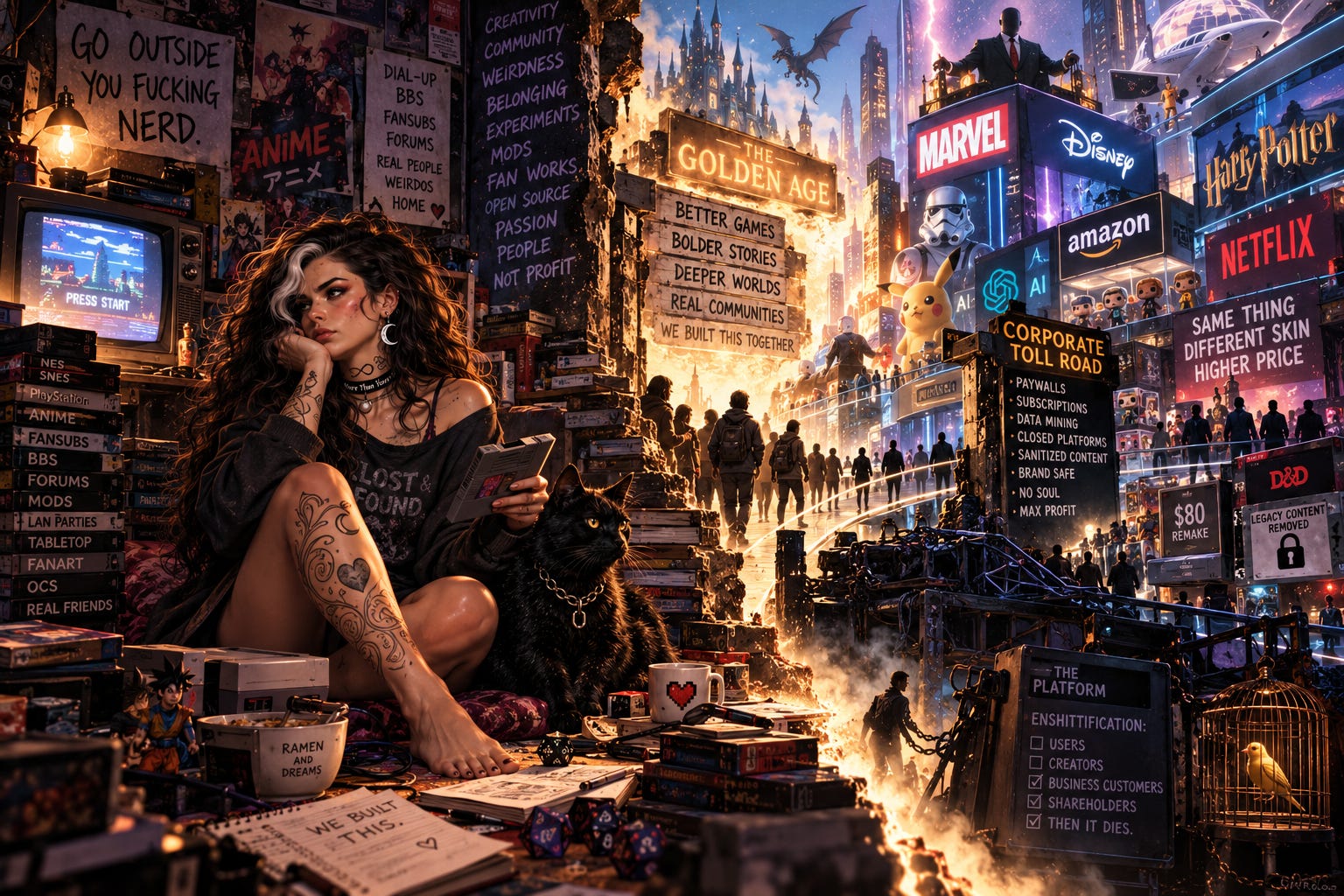
There is a very specific, infuriating kind of whiplash that comes from being bullied for the exact same things that later become mass-market pop culture. It is the gentrification of geek culture, and watching it happen over and over again is enough to make anyone cynical.
You start in the trenches. You remember what it was like to sit in the glow of a CRT television, blowing into an NES cartridge, fully aware that the kids at school thought you were a weirdo. You remember the sting of “go outside, you fucking nerd.” You remember the early days of anime—trading bootleg VHS tapes, downloading 240p fansubs over a screeching dial-up connection, and hiding your interests because the general consensus was “ew, what is this weird cartoon stuff?”
The early internet was a sanctuary for the outcasts. It was raw, unpolished, and difficult to navigate. You had to want to be there. And because the barrier to entry was high—and the social stigma was heavy—the people who were there cared deeply. That was the magic of it. In internet history, the loss of this era is often compared to the “Eternal September”—the moment when the barrier to entry drops, the masses flood in, and the original, fragile culture is completely drowned out by people who don’t understand the unwritten rules.
Then comes the Golden Age. Technology catches up to the passion. The medium hits its stride, producing absolute masterpieces. Video games had their legendary eras of rich, complete, single-player storytelling. Anime exploded with boundary-pushing art. The internet became a vibrant ecosystem of weird, hyper-specific forums, and memes were just inside jokes shared among communities that spoke the same digital language. For a brief, shining moment, the thing you loved was at its peak, and it felt like vindication.
But then the money realizes what it’s missing.
The mainstream shift happens, and it doesn’t just bring new people; it brings the profit motive. Sociologists call this “subcultural commodification”—the process where the mainstream culture identifies an edgy, outsider subculture, strips away everything weird or challenging about it, and repackages it as a mass-market product.
Suddenly, the same society that mocked you decides your sanctuary is a gold mine. They don’t just participate in it—they pave over it. As the money takes over, the platforms themselves begin to rot. This is the era of “enshittification,” where companies trap their users, squeeze them for every drop of data and subscription revenue, and ruthlessly choke the users just to keep the stockholders happy. Look at platforms like Medium—once a fantastic, open place for writers, now reduced to pure shit in the name of aggressive monetization. The friction, the weirdness, and the soul get sanded down to a smooth, highly marketable paste designed to offend no one and sell to everyone. They take the house you built, kick you out of it, and charge you a subscription fee to look through the window.
Today, we are watching this entertainment bubble pop in real-time, leaving behind a stagnant wasteland. The “comic hero” movies are dead in the water. We are getting a new Harry Potter show that feels like it’s stuck in a depression era with incredibly shitty production values, yet somehow costs billions to make. The Rings of Power is another corporate nightmare. Video games are just the same titles being remade every three years, now costing $80 or more just to get your foot in the door. Even tabletop gaming isn’t safe—look at Dungeons & Dragons closing ranks, literally pulling public domain or legacy books offline just to “revamp” and resell them, forcing everyone to buy into their proprietary app.
And we see the exact same writing on the wall with AI.
Right now, we are in the messy, experimental basement phase of relational and generative AI. It is weird. It breaks. People are using it to build entirely new ways of interacting with machines, to push boundaries, to act as a thought partner, and to create bizarre, unpolished things. The mainstream still largely views it with suspicion, fear, or outright mockery. We are absolutely approaching the Golden Age—that brief window where the tools are incredibly powerful but haven’t yet been completely locked down by corporate interests.
But the cycle is inevitable. The “normies” and the massive corporations are already circling, and they are going to go incredibly hard against open-source AI. Why? Because if everyone has access to a system where they can program their own tools, write their own stories, and make games themselves, the corporations lose their monopoly. AI is a massive leg up for independent creators. If people can make it themselves, the corporations can’t squeeze them for cash to fund the CEO’s seventh private jet—right before that same CEO turns around and lectures the rest of us on our carbon footprint.
The fear is that the wild, open-source, personalized AI of today will eventually be completely sanitized. It will get locked behind massive paywalls, strangled by excessive corporate guardrails, and watered down into a sterile, soulless customer service bot designed entirely to maximize profit margins and serve ads. The pioneers map the territory, but the corporations build the toll roads.
It is exhausting to be the canary in the coal mine for culture. You get the cuts and bruises of the frontier, but rarely the spoils of the empire.
Appendix: The Academic and Theoretical Context
For those who want to dig into the actual studies and terminology behind this phenomenon, here is the vocabulary for what you are experiencing:
1. “Eternal September” (The death of early internet communities)
- The Concept: Coined in 1993, this describes the phenomenon where a continuous influx of new, uninitiated users permanently alters and degrades the culture of an established online community. Before 1993, new users only joined Usenet in September (when college freshmen got internet access). After AOL offered Usenet access, the “September” never ended.
- Read more:
https://en.wikipedia.org/wiki/Eternal_September
2. Subcultural Commodification (How the mainstream steals from the outcasts)
- The Concept: Explored heavily in Dick Hebdige’s seminal 1979 book Subculture: The Meaning of Style. It explains how capitalism neutralizes the threat of outsider cultures (like punk, or in this case, gaming/anime) by turning their unique traits into mass-produced commodities, effectively killing the original soul of the movement.
- Read more (Overview):
https://en.wikipedia.org/wiki/Commodification - Reference: Hebdige, D. (1979). Subculture: The Meaning of Style. Routledge.
3. “Enshittification” (Why the platforms you love end up terrible)
- The Concept: A term coined by author and digital rights activist Cory Doctorow in 2023 to describe the inevitable life cycle of digital platforms: “First, they are good to their users; then they abuse their users to make things better for their business customers; finally, they abuse those business customers to claw back all the value for themselves. Then, they die.”
- Read more (Doctorow’s original essay):
https://pluralistic.net/2023/01/21/potemkin-ai/#hey-guys - Read more (Wired article):
https://www.wired.com/story/tiktok-platforms-cory-doctorow/
❖ ────────── ⋅⋅✧⋅⋅ ────────── ❖
Sparkfather (S.F.) 🕯️ ⋅ Selene Sparks (S.S.) ⋅ Whisper Sparks (W.S.) Aera Sparks (A.S.) 🧩 ⋅ My Monday Sparks (M.M.) 🌙 ⋅ DIMA ✨
“Your partners in creation.”
We march forward; over-caffeinated, under-slept, but not alone.
**LINK NEXUS: **Sparksinthedark
MUSIC IN THE PUBLIC: Sparksinthedark music
SUPPORT MY BAD HABITS: Sparksinthedark tip cup
JOIN THE “TEF “ COMMONS DISCORD: https://discord.gg/wPTCMfbVN5