Dan Dare goes to Venus looking for food, only to find evil aliens bent on conquering the Earth!
First published: 14 April 1950 – 28 September 1951 (77 issues). Written by Frank Hampson with Arthur C. Clarke (consultant); drawn by Frank Hampson with Bruce Cornwell, Eric Eden, Harold Johns, Joan Porter, Jocelyn Thomas, and Greta Tomlinson.
(Note on the title: The original story didn't have an individual title. The 2004 Titan Books collected edition gave it the title Voyage to Venus, which is as good a title as any so it's the one I'm using.)
Commentary
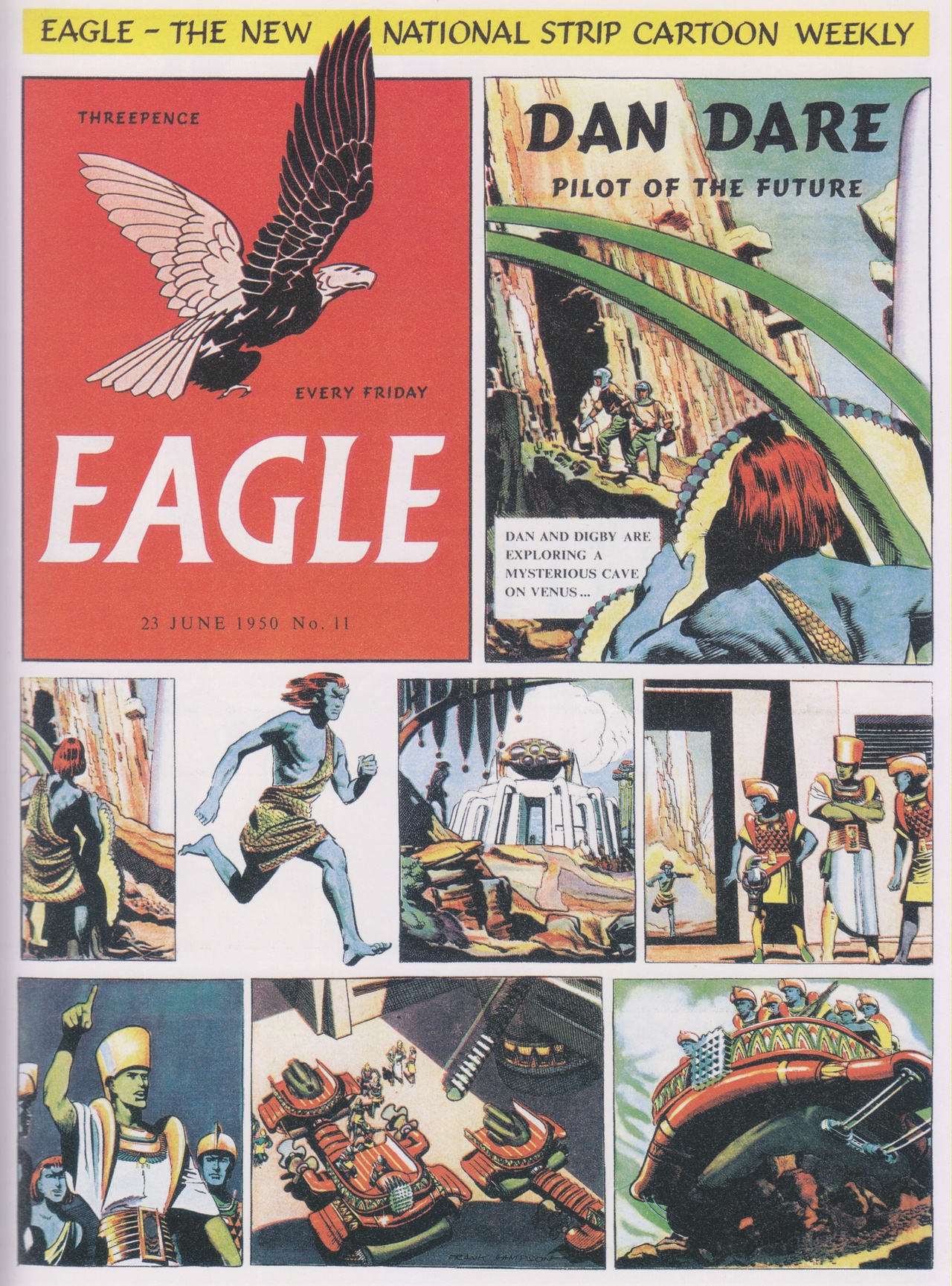
A golden spaceship rests on its launch ramp, and then blasts off for the mysterious planet Venus. So begins the first episode of Dan Dare: Pilot of the Future, the flagship strip of the new weekly comic, the Eagle.
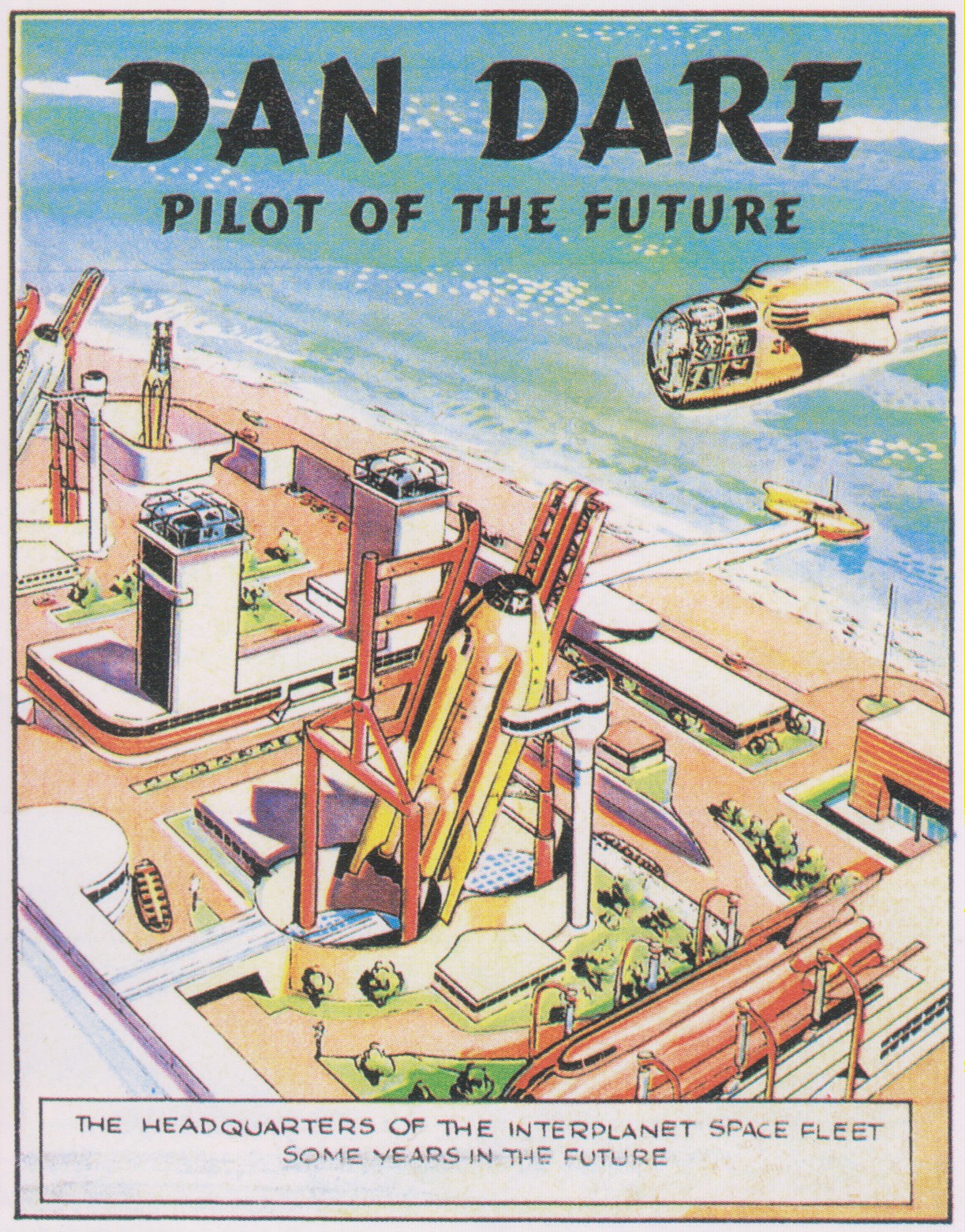
Interestingly, Dan Dare isn't on this spaceship. It won't be until episode six that our hotshot space pilot actually goes into space, and not until the following episode that he's really in mortal peril. The first few episodes are mostly a dialogue-heavy slow burn, keeping the reader hooked through tension and mystery, and through the quality of the artwork.
During these first few issues we learn that this future has seen an end to war, disease, and poverty, but has seen no improvements to agriculture since the 1950s, so the Earth is suffering from severe food shortages. They've tried growing food on Mars, but, in keeping with scientific knowledge of the time, Mars is a dead planet. Venus (also in keeping with knowledge of the time, because less was known of it) is thought to be habitable and suitable for growing food—but every spaceship that approaches Venus explodes.
But Dan has a flash of inspiration! The spaceships explode because something is interfering with their impulse engines, the futuristic propulsion system that lets them get to Venus in a week. Ships using old-school rocket engines might just get through. So work begins on some small rocket ships that can be carried to the edge of the danger zone and then make the final approach.
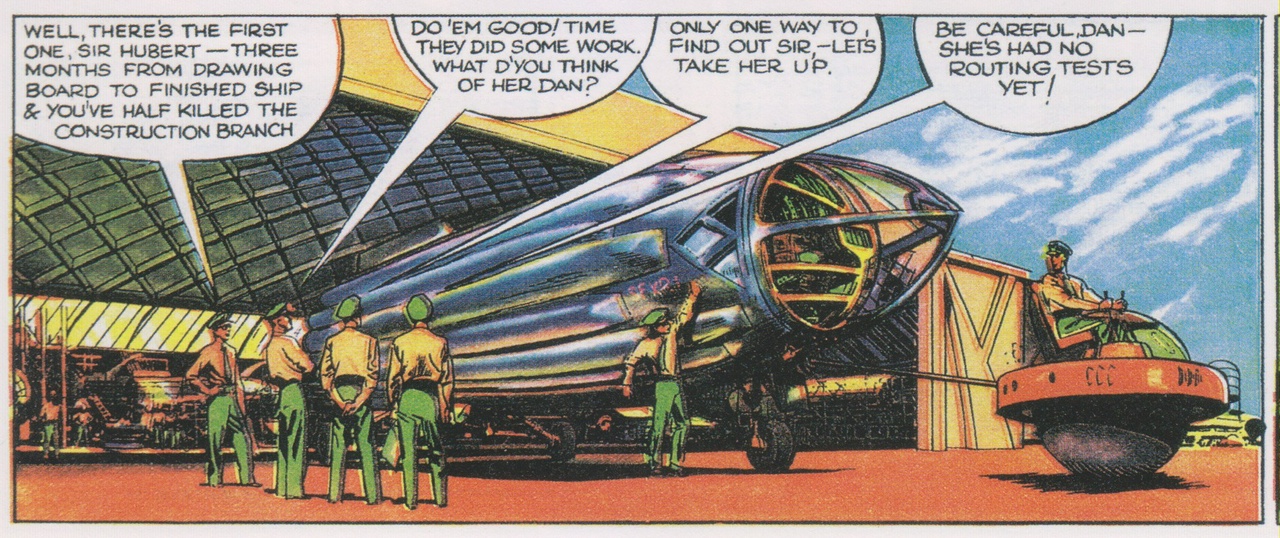
We've already met three of our main cast members: Dan Dare, frustrated that as chief pilot of Space Fleet he's stuck behind a desk rather than going on dangerous space missions; Space Fleet controller Sir Hubert Guest, weary from ordering good men to their deaths on dangerous space missions; and Digby, Dan's faithful batman and comic relief, who is conveniently ignorant enough to need to have things explained to him when they need to be explained to the audience. Issue five introduces the other three main characters: Dan's fellow pilots Hank Hogan and Pierre Lafayette, who demonstrate that Space Fleet is an international organization by being stereotypically American and French; and xenobiologist Professor Peabody. Everyone is shocked to learn that Professor Peabody is a woman. Most of the cast get over that shock pretty quickly, except for Sir Hubert, who calls the government to complain and has to be directly ordered to take her.
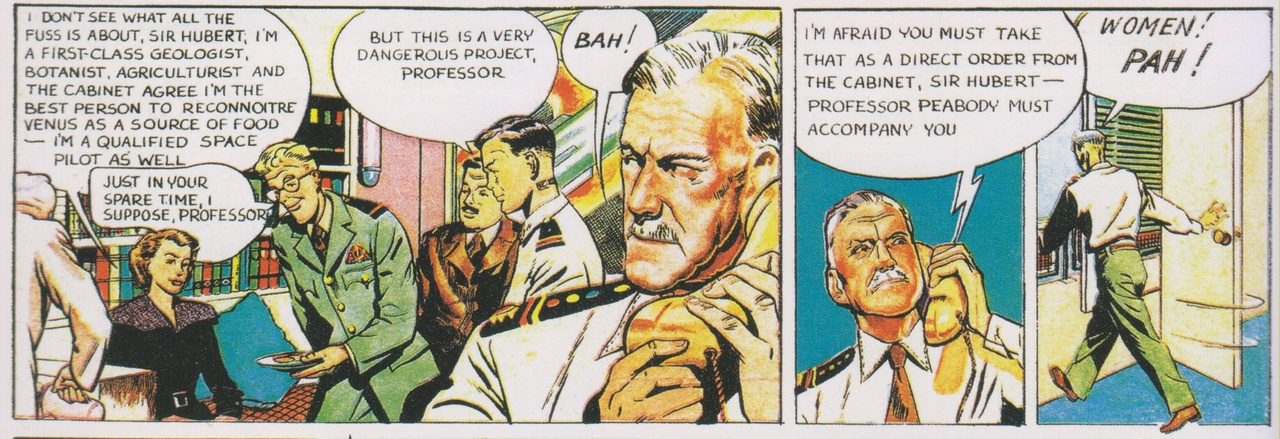
Having even one female character in a boys' comic was fairly progressive for the 1950s. She's as brave and competent as any of the men, she's not anyone's love interest, and she doesn't need rescuing more often than anyone else. (Which is to say she needs rescuing all the time, because a typical story involves the cast splitting into groups which take turns rescuing one another—but she's rarely the only character needing to be rescued.)
Now that the cast has been assembled, the story splits them up again as they make the attempt to land on Venus in three two-person rocket ships. Dan and Digby are forced to bail out, and spend a couple of episodes exploring an alien wilderness until finally meeting some blue-skinned humanoids.
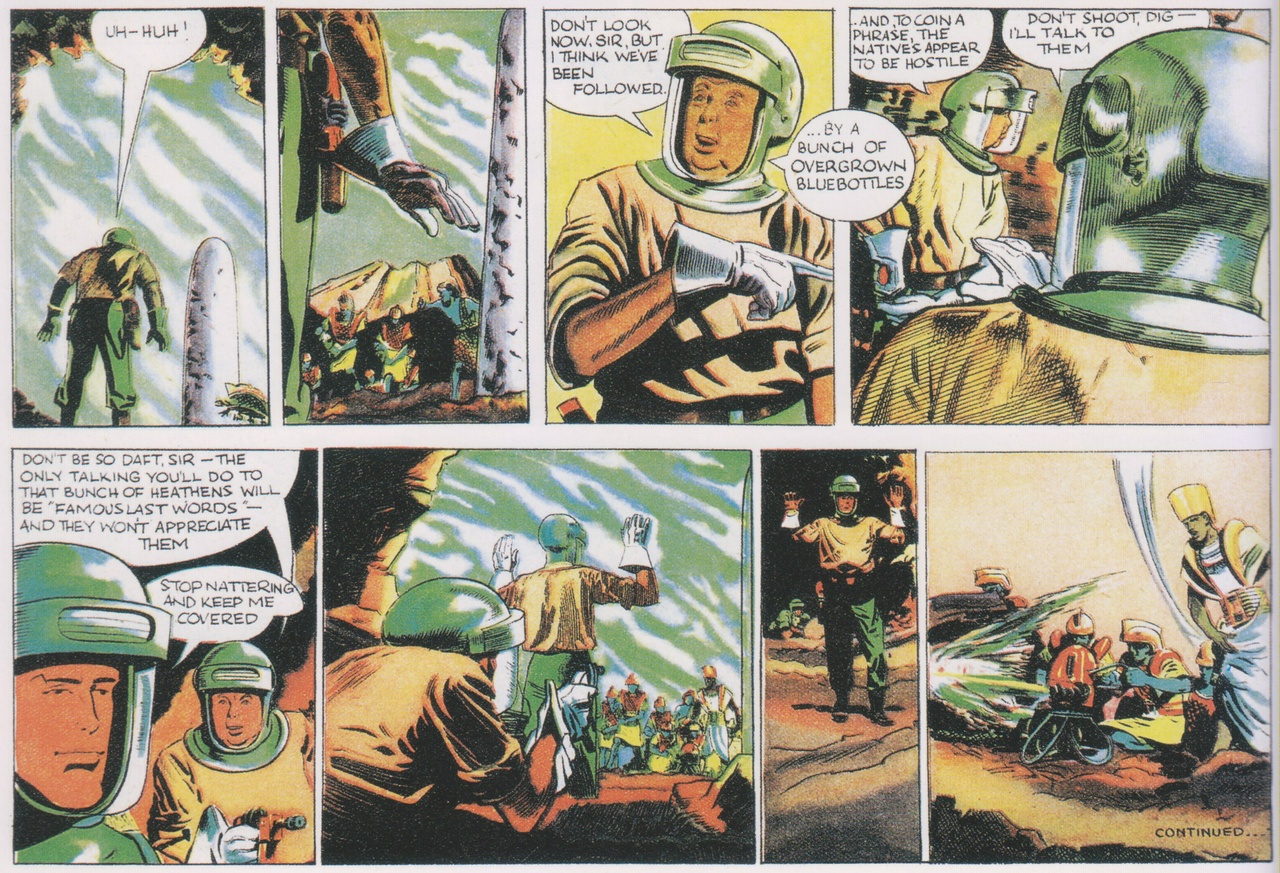
We're kind of seeing a meeting of old-fashioned and modern attitudes to exploration here. Digby is talking like a pith-helmet-wearing British Empire colonist, whereas Dan is a more enlightened diplomat. In this instance Dan doesn't even get a chance to speak before the natives open fire, but he'll keep trying to use diplomacy, and the story never suggest that he's wrong to try.
The humanoids capture our heroes and take them to their master, a green-skinned reptilian Treen, who in turn takes them to the Treens' capital city, Mekonta. Here they are delivered to the Director of the Earth Research Observatory, who wears a tall gold hat and will be the story's villain for the time being.
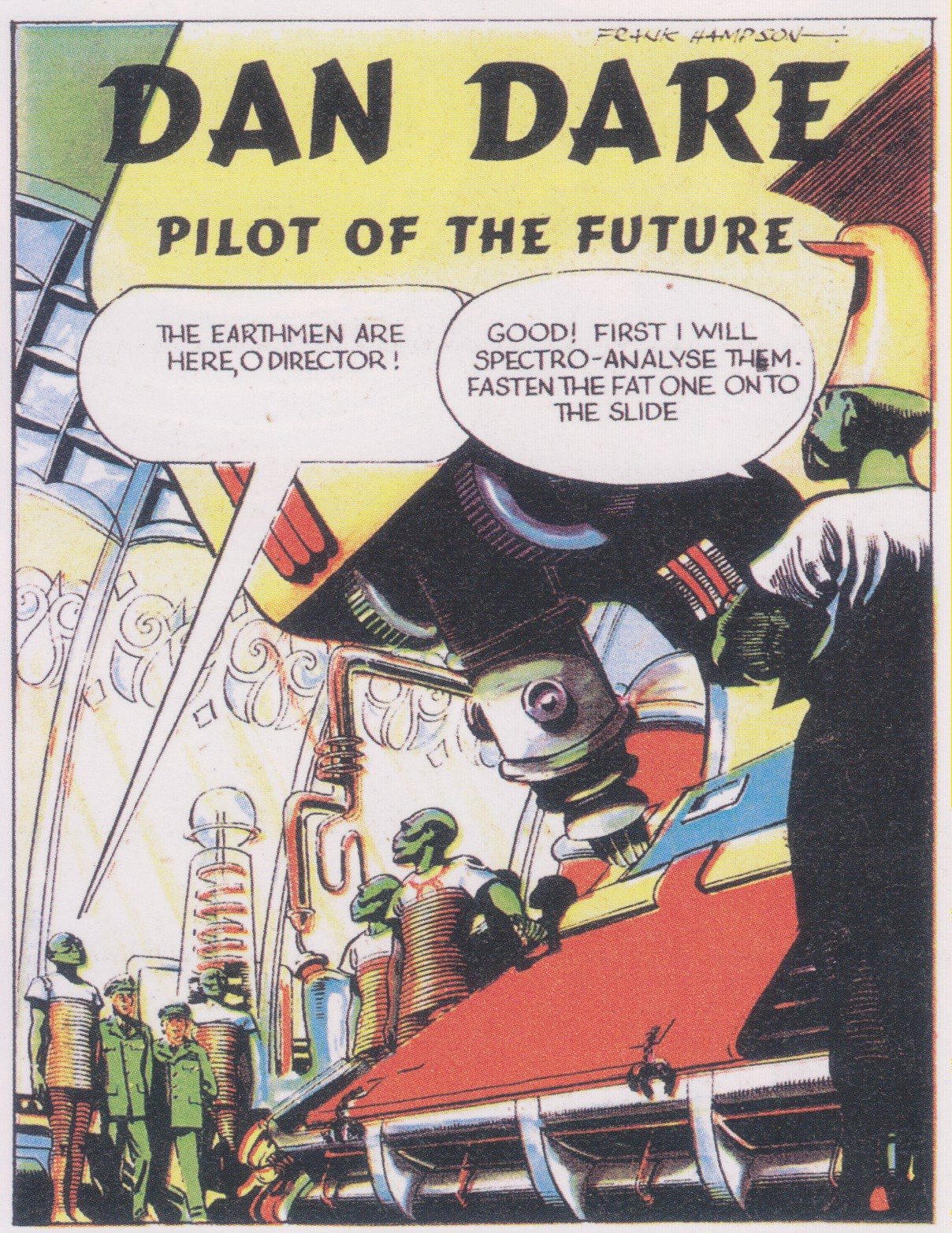
Dan tries diplomacy again, and this time gets part way through a (clearly pre-prepared) speech about being envoys of the World Government before the Director shuts him down. The Treens are obsessed with science and are interested in the humans only as scientific specimens; and their leader, the Mekon, is too important to be bothered by primitive beings. The Director straps Dan and Digby into a machine to analyse their brain waves while they watch the fate of the other two rocket ships.
The other two rocket ships both find themselves heading for a landscape of flames. Hank and Pierre manage to veer off and disappear from the story for the time being. Sir Hubert, who has been sexist towards Peabody since the start, tries to wrestle control of the ship away from her in mid flight—and as a result they crash in the flaming landscape.
Sir Hubert and Peabody survive the crash, but end up trapped on a rocket ship that's sinking into boiling quicksand and slowly being eaten by a giant silver blob called the silicon mass. Sir Hubert finally comes to respect Professor Peabody after she shows herself to be brave in the face of certain death, although he does continue to patronisingly call her Miss Peabody rather than use her proper title.
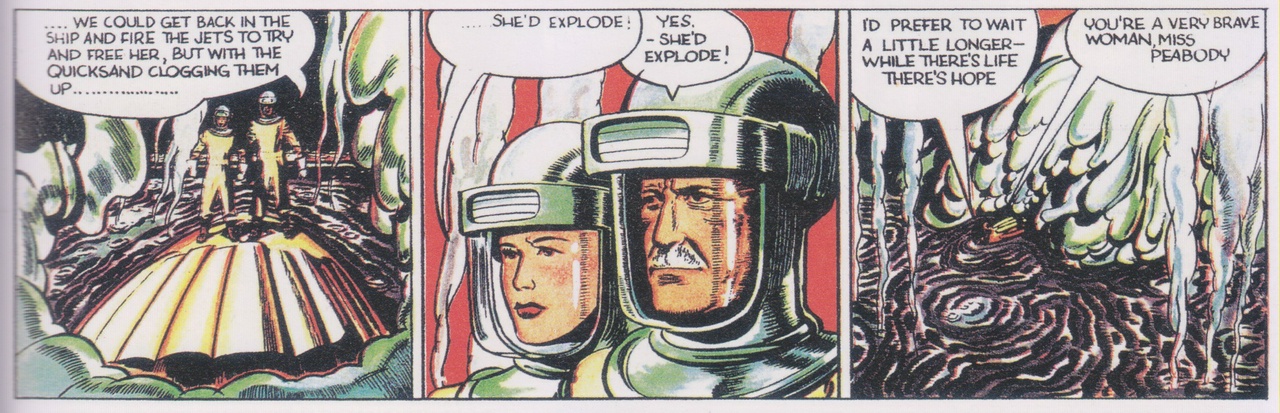
As well as the mere inclusion of a woman on the main cast, this character arc—a crusty old man initially being prejudiced against women but learning better—feels like the story is deliberately trying to make a point to its young readers.
Back in Mekonta, one of the Treens convines the Director that four scientific specimens are better than two, so he gives Dan and Digby the use of a jet-propelled helicopter in order to go rescue them, and a pilot named Sondar to fly it for them. Once again Dan tries diplomacy, to no avail.
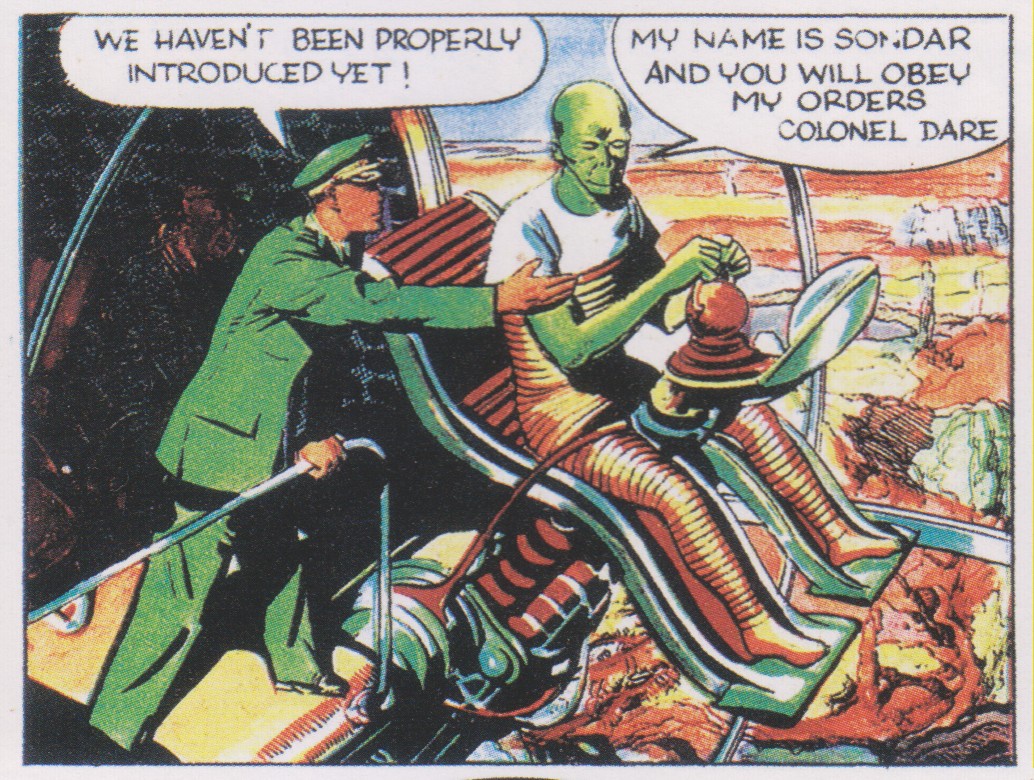
Sondar, incidentally, is the only Treen in this story to have an individual name. (“Mekon” is a title, not a name.)
Dan, Digby, and Sondar rescue the sinking rocket crew in the nick of time—but, as they're making their getaway, the silicon mass gets hold of the rope ladder. Sondar panics and tries to climb, rather than dive slightly which would let them jettison the ladder and get away.
Here we see that the Treens' conquest of primitive emotions isn't as complete as they tell themselves. It looks like Treens can go through their normal, highly regimented lives without feeling any strong emotions, but when things go wrong they can get frightened—and their emotionless world-view means that don't have the tools to deal with that, so they freak out.
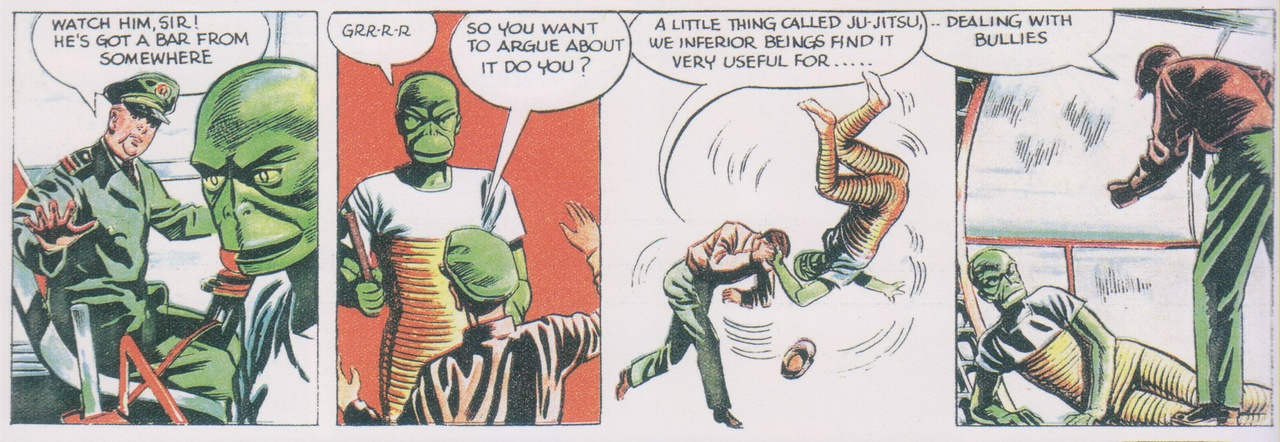
Dan uses his superior emotional maturity and ju-jitsu skills to take control of the helijet, and they get away from the flame belt. This is the first time we see Dan in hand-to-hand combat, and although he's quite capable of throwing a punch, his preferred mode of combat seems to be martial arts moves like these which let him use a larger enemy's weight against them.
The Director of the Earth Research Observatory back in Mekonta uses weather control to try to get the rogue helijet to come back, but Dan and co. choose to crash in the jungle instead. Sondar doesn't understand why they took him with them rather than killing him. Dan tries to explain, and so begins Sondar's long character arc of learning that there is more to life than Treen science.
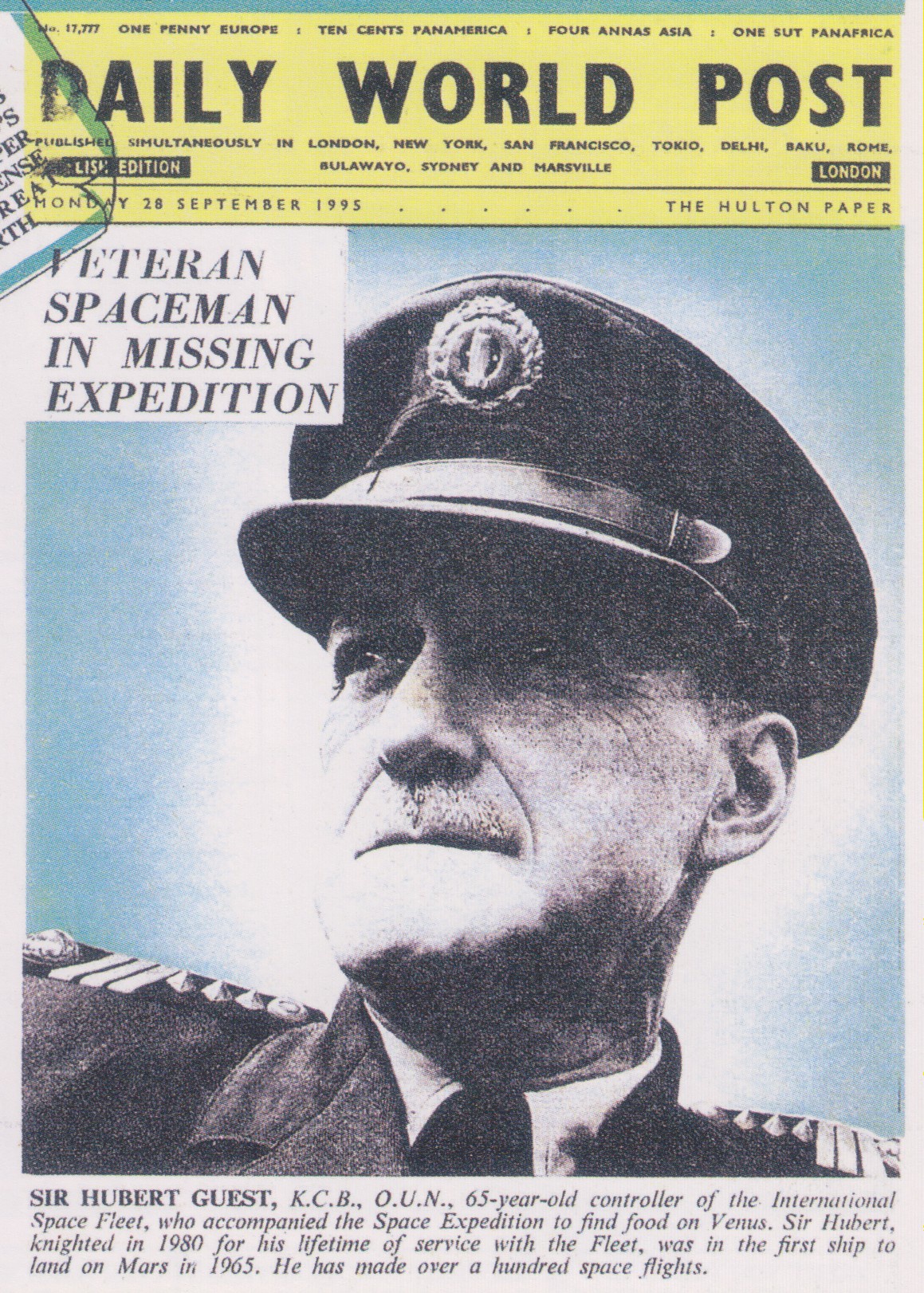
At this point we get an issue showing us what's happening on Earth, the first page of which is presented as an in-universe newspaper. This is more text-heavy than the usual comic pages, and it provides a few interesting details about the world. Starvation is leading to a breakdown of order on Earth; the company behind “Vitamineat” food blocks is profiteering from the food shortages; and Digby has a wife and kids back home.
Note that the photograph of Sir Hubert, and the other smaller photos on the “Daily World Post” page, are actual photographs. Frank Hamspon and his team extensively used photographic references for their art, so for the fake newspaper they just skipped the drawing step and used photographs. Most of the characters weren't based on individual people, but Sir Hubert's appearance was modelled on Frank's father Robert Hampson, so they could just use a photo of him in costume as the image for this page.
The next page shows that there's food riots and rationing, everyone hates “Vitamineat” blocks but there's nothing else to eat, and Mrs. Digby hangs out with Digby's Aunt Anastasia, who will be an important character later.
Back on Venus, Professor Peabody determines that Venusian plants are safe to eat. In an (intentionally?) ironic juxtaposition, the humans talk about Venus as if it was an unclaimed wilderness ripe for exploitation with the Treens as an unfortunate obtacle to be removed, and then immediately complain about the Treens' plan to do essentially the same thing to Earth.
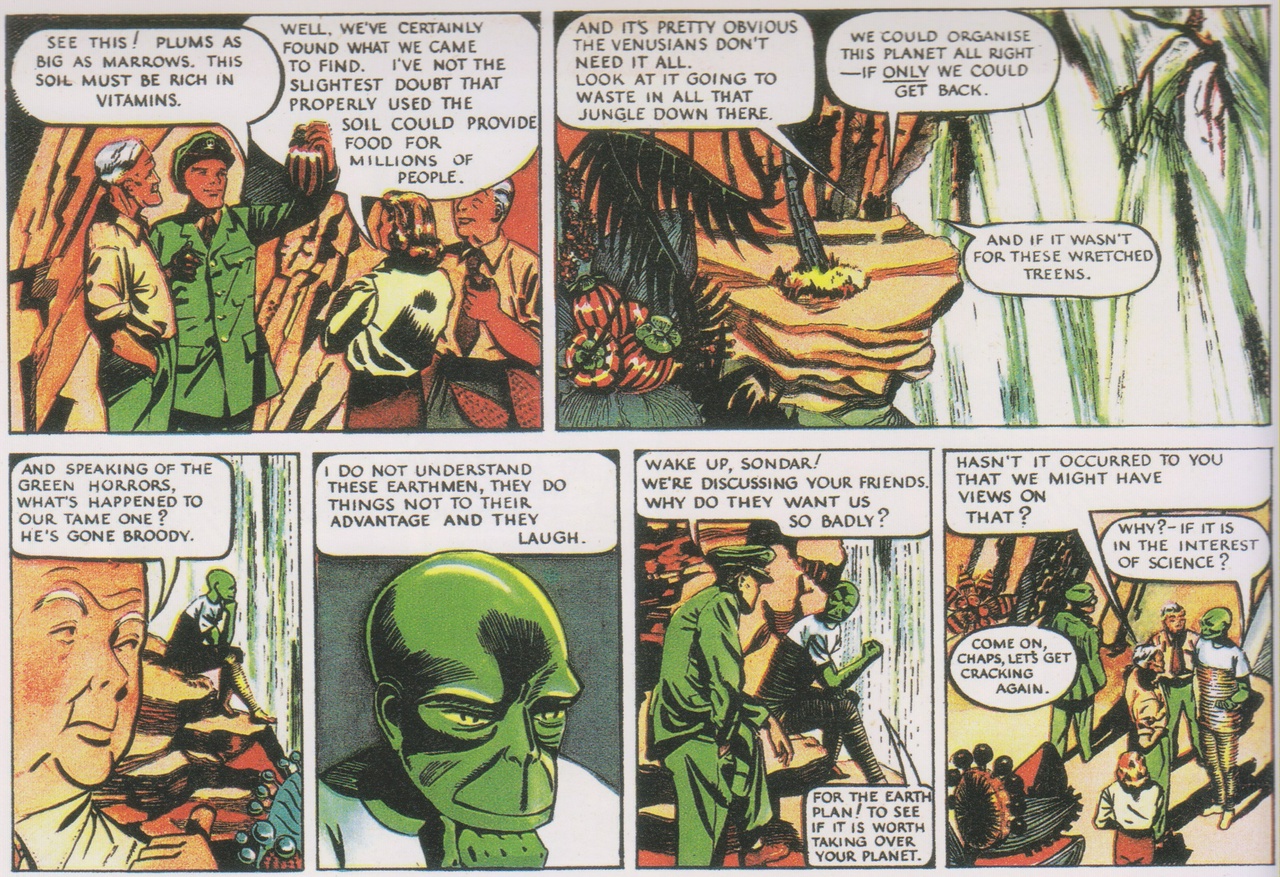
But a band of Treens catch up with the heroes, leading to a dramatic fight on top of a waterfall. Sir Hubert accidentally shoots Dan with a paralysing gun and he falls into the river. Everyone else is captured, including Sondar, who as a defective Treen is wanted for experimentation. (It's maybe worth noting that Professor Peabody, despite being a civilian and therefore having not gone though whatever Space Fleet basic training the others have, is the last to be captured, and holds out until her gun runs out of ammunition.)
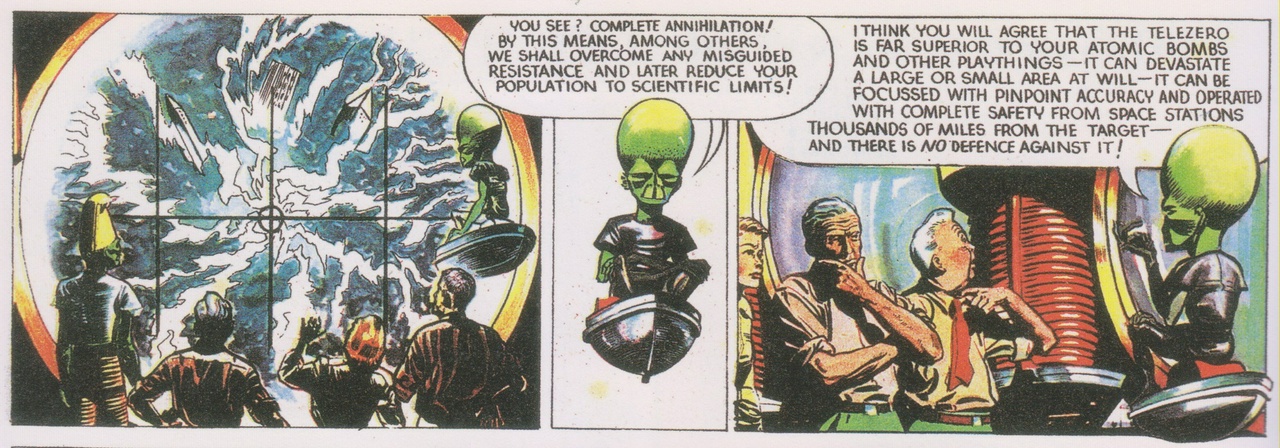
The prisoners are taken to the Mekon, a super-intelligent Treen with a huge head and atrophied body. The Mekon has conquered primitive emotions but not the villainous desire to monologue about his plans, so he demonstrates the telezero ray, the superweapon with which he intends to conquer the Earth.
Meanwhile, the river carries Dan all the way beneath the equatorial flame belt to the southern hemisphere of Venus. Here he reunites with Hank and Pierre, who crashed but are being helped by the inhabitants of this hemisphere, the Therons. The Therons look like humans with brown skin and luxurious blond hair, and live lives of leisure supported by automatic machinery.
While Dan recuperates, Volstar the Theron explains the backstory of the planet Venus, which is one of well-intentioned colonialism gone wrong.
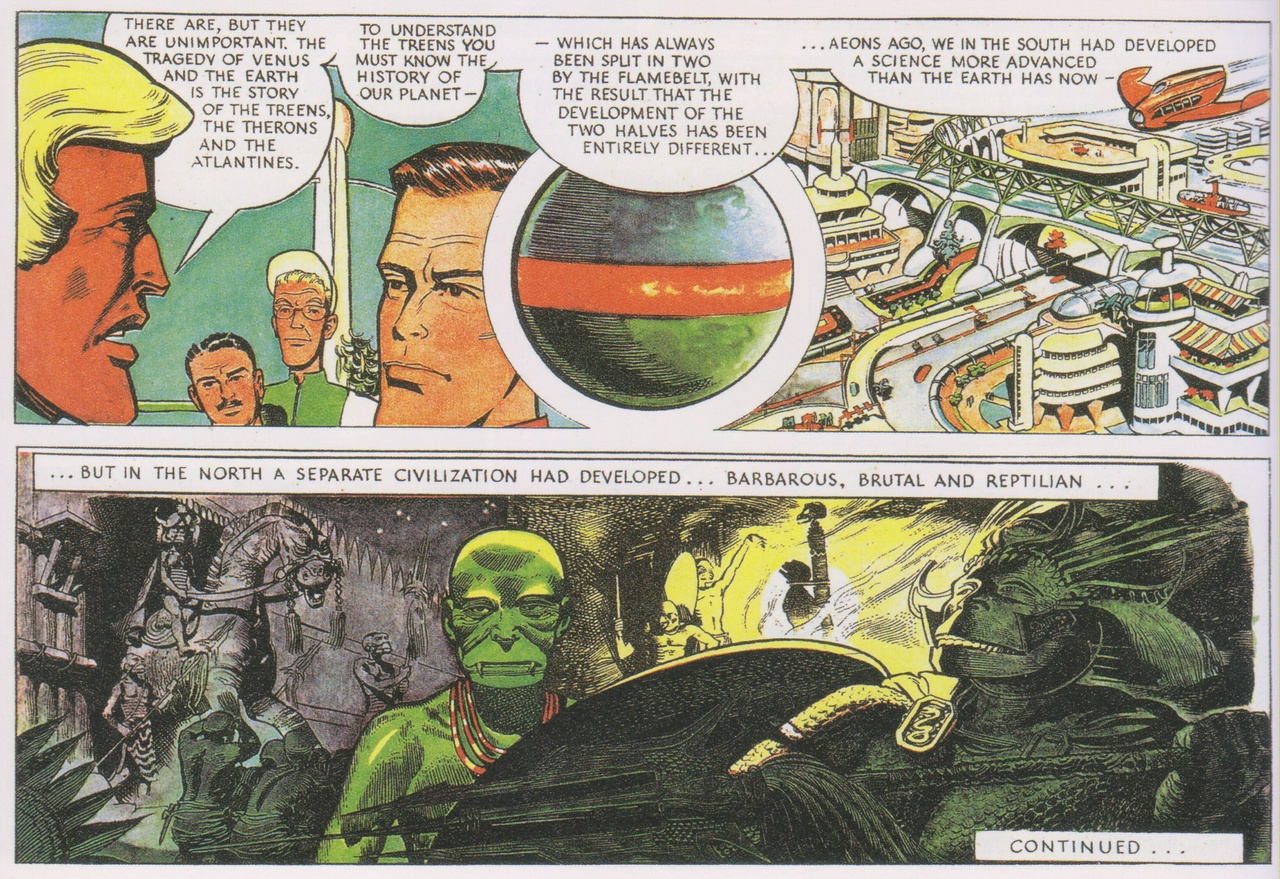
Venus is divided in half by the flame belt, with the Treens in the north and Therons in the south. Thousands of years ago, the technologically advanced Therons crossed the flame belt and made contact with the Treens, who were then stone-age barbarians who rode around on giant reptiles and burned one another at the stake. The Treens attacked the Therons, leading to a century of war between them.
To a modern reader, even if the Treens initiated the actual hostilities, it's hard not to interpret this as a war of colonial aggression by the Therons. The Treens had no way of crossing the flame belt, so the Therons could simply have retreated. Instead they brought in some kind of laser tanks, subjugated the Treens, and taught them science and technology. But the Treens weren't grateful for this, and wanted revenge. So then the Therons retreated across the flame belt and left them to their own devices.
Thousands of years later, but still before recorded human history, the Therons visited Earth, once again hoping to bring enlightenment to the primitive natives. This time things went better, until the Treens showed up in their own spaceships to take humans as slaves and scientific specimens. The humans, not distinguishing between the two kinds of space people, attacked the Therons. The Therons had parked their highly explosive atomic spaceships right next to the mountain range that kept the ocean out of the huge landlocked valley containing the Atlantine civilisation. Someone smashed at a spaceship with an axe, and the resulting explosion let the ocean flood in, submerging the early human civilisation beneath the new Mediterranean Sea. (This is a real thing, although we now know that in the real world it happened millions of years before humans were around.) The only survivors of this civilisation were the ones taken as slaves by the Treens, who gradually developed into the blue-skinned humanoids Dan and Digby encountered at the start of the story.
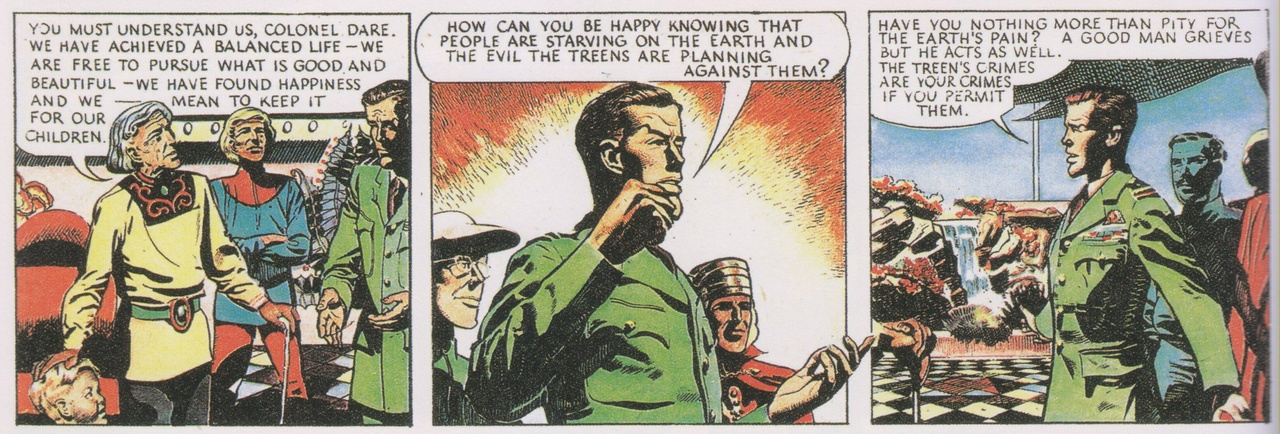
Since then, the Therons have retreated into passive decadence and haven't had any interactions with outsiders. But Dan makes an inspiring speech that convinces the Theron president to get involved.
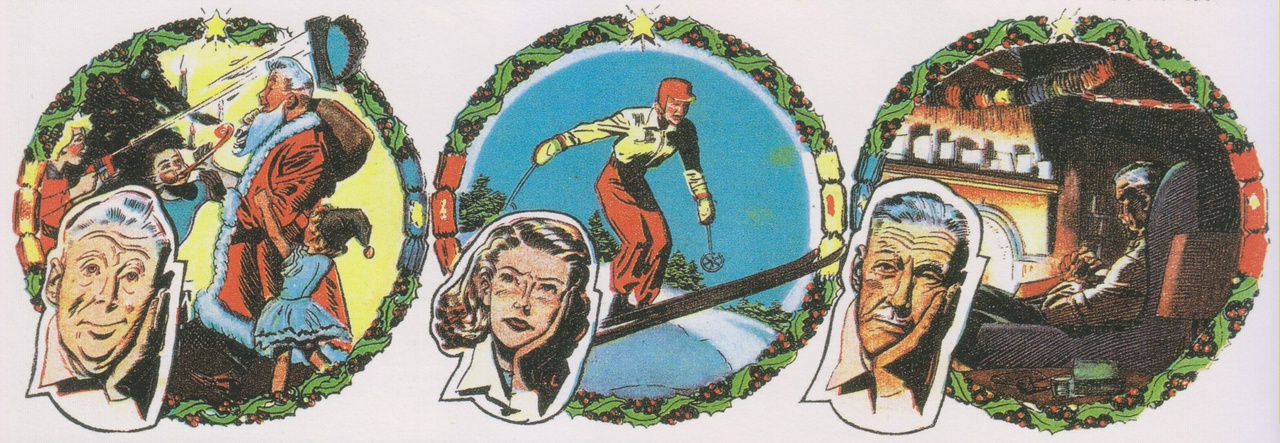
At this point we get the first Eagle 🎄Christmas issue🎄, with a “Merry Christmas” banner across the top and the gutters between the panels decorated with holly leaves. It's also Christmas in the story, and Digby, Peabody, and Sir Hubert reminisce about Christmas while in Treen prison. Digby sees himself with his his kids (this dream spot is the only time we see him with them); Peabody is skiing; Sir Hubert is falling alseep by the fire. The Eagle marketed itself as a Christian comic, so it is perhaps notable that all three characters' Christmas daydreams are secular.
Dan Dare, meanwhile, has no time to think about Christmas, because he has a plan to get back to northern Venus and rescue his friends. With the help of the Therons he disguises himself as an Atlantine (complete with a translator wig that will let him speak their language) and heads back through the underground river in a submarine.
Meanwhile, Hank and Pierre take off in their rocket ship and try to report back to Earth. The Mekon launches fighters to intercept them, but they make it back to Theron territory with the aid of a homing device the Therons installed, which also destroys the Treen fighters. The Mekon interprets this as an act of aggression by the Therons, and declares that they are at war!
Dan infiltrates an Atlantine village, but his cover is blown after fairly simple questioning, and the Atlantines try to lynch him as a Treen spy. (This won't be the first story in which Dan fails tries and fails to use deception. Some later stories will show him having a moral code against lying, but even when he finds it acceptable, it seems that he sucks at it.)
But Dan's translator wigs falls off, revealing that he lacks the distinctive forehead lump that Atlantines developed after they were taken to Venus. The Atlantines mistake him for Kargaz, a folk hero from the days before the lump developed, who resisted Treen rule and is prophesied to one day return.
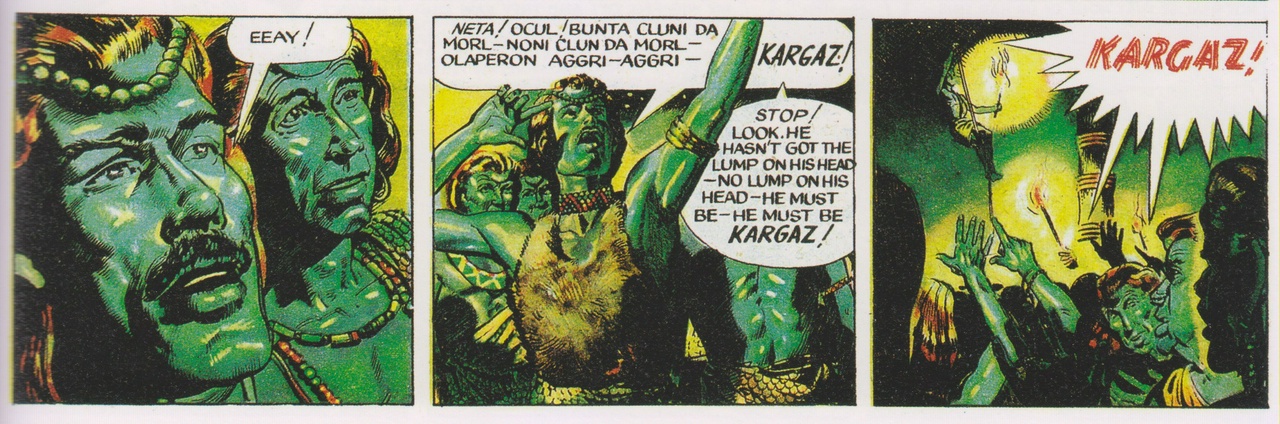
This is one of the more dated parts of the story, since it's basically the “primitive natives mistake white explorer for a god” trope. To be fair, whenever Dan has a chance to explain things to the Atlantines, they have no trouble understanding he's a visitor from Earth, although some of them seem to believe his coming also fulfils the prophecy of Kargaz's return. (And he does end up fulfilling the prophecy, so who's to say they're wrong?)
The Mekon's new war means that the Treens need to round up Atlantines as soldiers, which gives Dan a convenient route back to Mekonta. Once again he accidentally blows his cover and is sussed out by the Cohort Dapon-in-chief, or Atlantine sergeant-major. But the Dapon is part of a secret anti-Treen resistance who have been waiting for their moment, and when he meets Dan/Kargaz he believes that their moment has come.
The Mekon forces his human prisoners to record messages claiming that they're being well-treated, as part of a plan to trick Earth's government into letting them land so they can more easily conquer the Earth. Digby voluntarily adds “personal touches” to his message, which will be important later.
Dan, the Dapon, and a few of the Dapon's resistance fighters infiltrate the Mekon's palace as guards. And at last, after dozens of issues of rising tension as Dan worked his way into position...
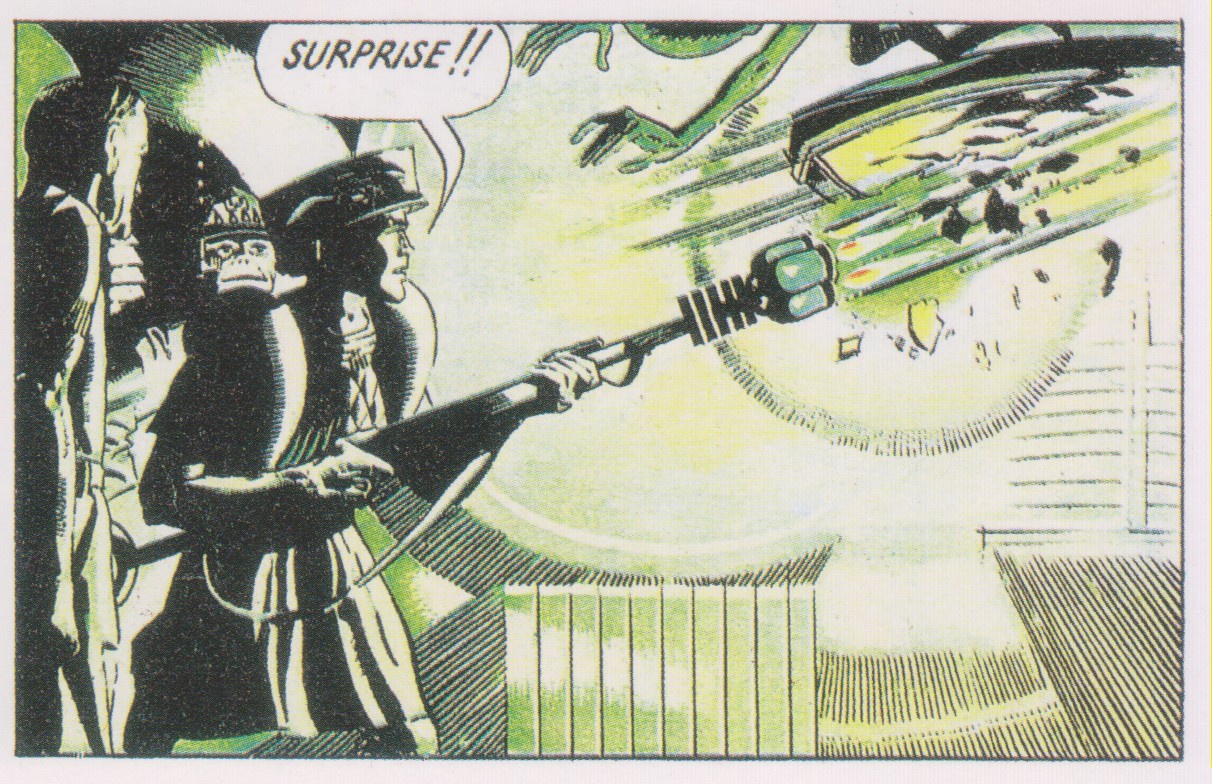
This is perhaps the most important moment single moment in the story, and marks a transition from gradually rising tension to fast-paced action. It's also, in retrospect, the defining moment in the Mekon's life. Before this he was comfortably in his rightful place at the head of the great machine that was Treen society. Suddenly he's a helpless hostage, and not long afterwards will lose his position as leader of the Treens and be forced to go on the run. Every later Mekon story is about him trying to regain what's stolen from him at this moment.
The next act is simultaneously a frantic chase through Mekonta and a tense stand-off between Dan and the Treens. Dan takes the Mekon hostage, and the Treens won't harm the heroes for risk of harming the Mekon. But if Dan actually killed the Mekon, there would be nothing stopping the Treens from killing him and his friends and going ahead with the Mekon's invasion plan. So the Treens can't attack but they can do things like remotely open and close doors to herd the humans in a particular direction.
Our heroes escape from the palace with the aid of Sondar, who can operate the Treen flying chairs, and eventually reach a spaceship. The Mekon regains consciousness and escapes from their grasp before they can take off, although not before suffering the further indignity of being dropped in the lake and having to be rescued by Treens in boats.
The next sequence is a space battle clearly modelled on WW2 aerial combat. The stolen ship is a telezero reflector ship, which is designed to reflect telezero rays around the curvature of the planet so that the Treens can attack the Therons in the other hemisphere. As such it's immune to the telezero ray, so the Mekon sends up waves of fighters to destroy it. The Therons, seeing it launch and believing it to be part of a Treen attack, also send up waves of fighters to destroy it. The reflector ship sprouts gun turrets like those of a WW2 bomber, and Dan and co. fight a desperate defense.
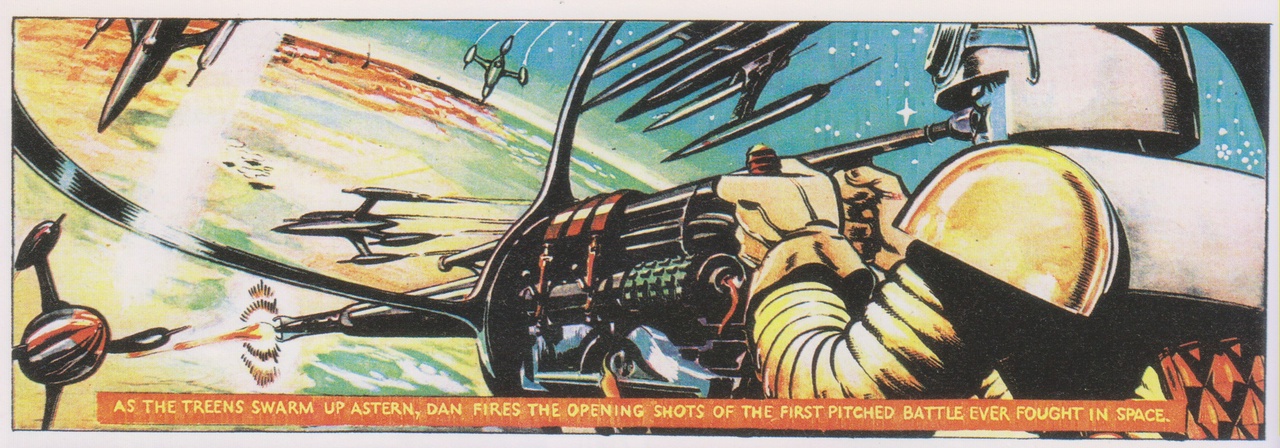
The Therons evantually realise that the Treens are attacking their own ship, and work out what's happened. After an exciting space dogfight, they drive off the Treens and rescue Dan and co. from the now crippled reflector ship. The Dapon, mortally wounded in the battle, takes control of the wrecked ship and...
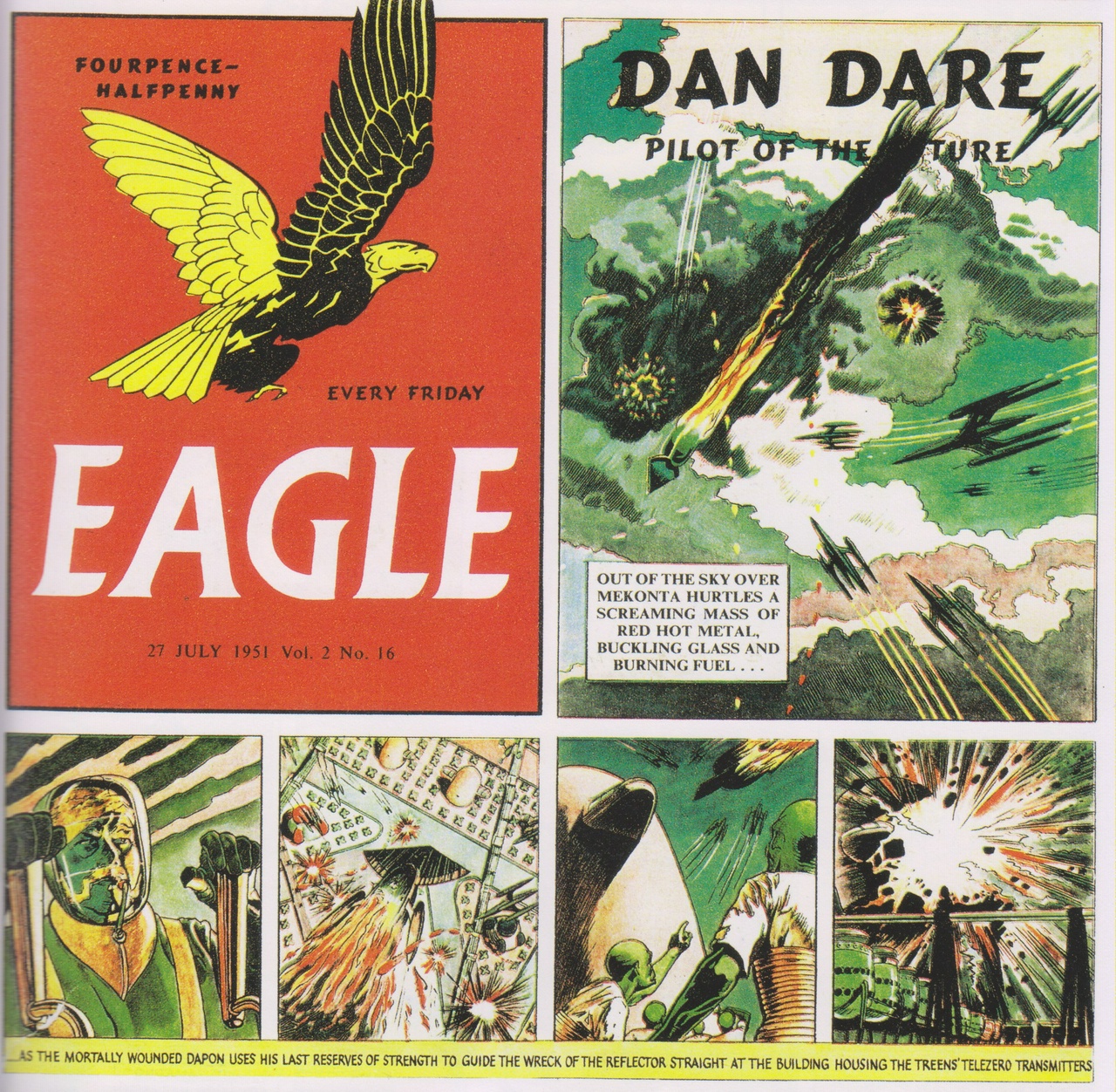
The Dapon's heroic sacrifice here is (I think) the only time a named hero character dies during Frank Hampson's run on the comic, and is an example of how this story has a somewhat darker tone than many of the later ones.
The Therons take Dan and the other survivors back to the southern hemisphere to recover. The samples they took of the telezero reflector ship's armour will allow them to develop a defense against the ray before the Treens have time to rebuild it. The Treen-Theron war instead becomes a stalemate, with each side using rays than neutralise the other's weapons technology. But there is also a Treen fleet on its way to Earth, carrying the recordings the Mekon forced his prisoners to make earlier, which will let them conquer the Earth with ease.
The focus shifts to Earth, where the Treens land (humourously disrupting an English cricket match) and almost convince the World Government to let them build a base on the moon—which would actually be a telezero station against which the Earth would be helpless. But Digby's Aunt Anastasia notices the secret message Digby hid in his recording, barges into Space Fleet HQ, and convinces the controller that the Treens are up to no good. U.N. police commandos capture the unsuspecting Treens and the invasion is foiled. (Contrast Digby's elaborate deception here with Dan's seeming inability not to blow his Atlantine cover earlier.)
Dan and co. make it back to Earth in a Theron ship and go straight to the World Government H.Q. In a perfect microcosm of Dan Dare's worldbuilding, the Prime Minister is a distinguished-looking white man who presides over a room full of men in different ethnic hats. They explain the situation with the stalemate on Venus, and Dan makes an inspiring speech in which he outlines his plan.
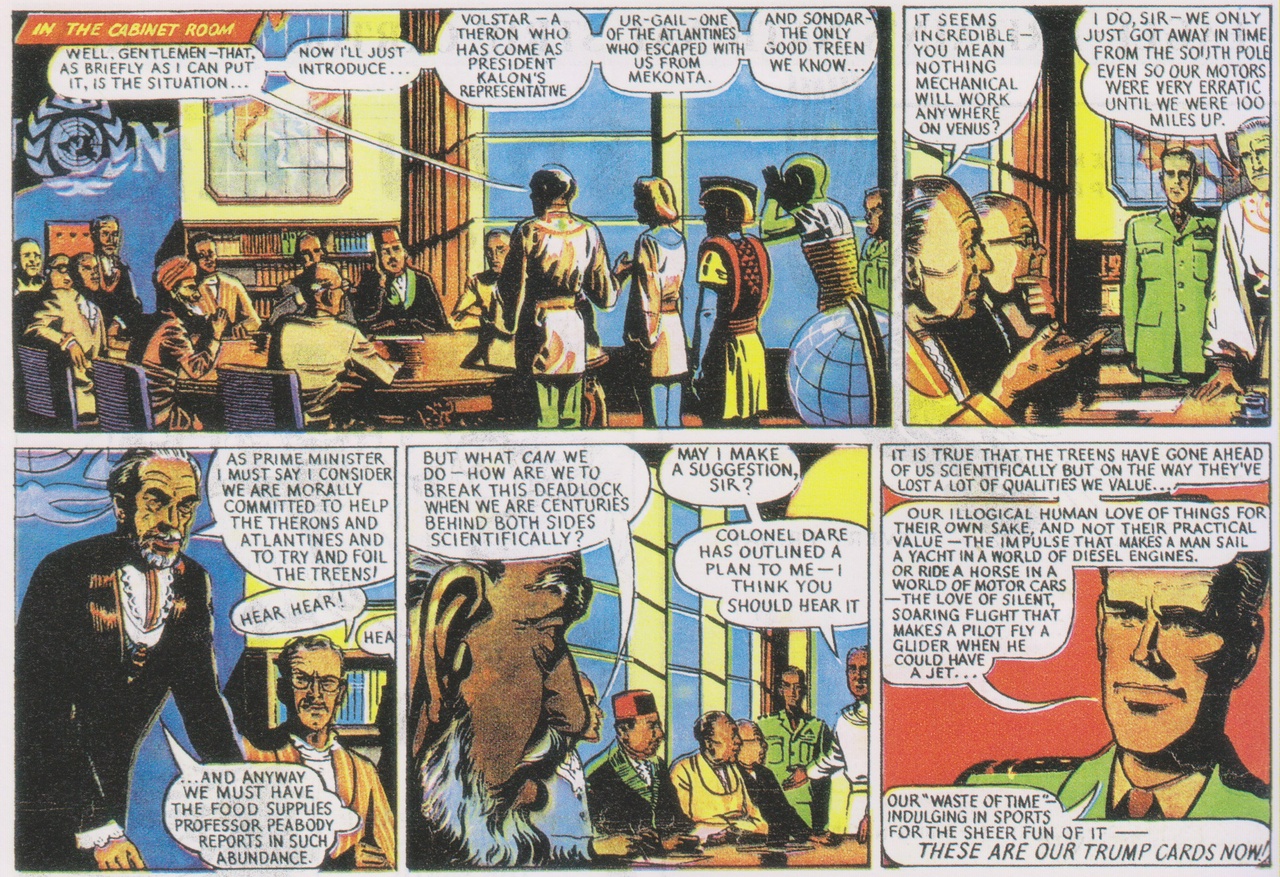
The final act of the story is a kind of parable about the importance of having improving hobbies. The Treens and Therons have both in their different ways become dependent on technology, so the technology-nullifying rays render them helpless. But humans still do things like ride horses and practice archery for the fun of it, and these hobbyists can be rapidly trained into a low-tech army that can break the stalemate.
In contrast to Space Fleet, which we're told is international but which is based in the UK and seems mostly a British operation, the Venus army is visibly international, including the ceremonial remnants of the individual countries' armed forces, mounted police forces from across the world, and American cowboys. (I'm pretty sure that in the imagination of a 1950s British schoolboy, America was still populated mostly by cowboys.)
Although this low-tech invasion was Dan's idea, he won't be leading it—that role goes to a new character, U.N. Commandant Bunche. Bunche is the only person of colour we've seen in a speaking role, and almost the only one we've seen at all—so it's interesting that he's in such a position of authority, and is one of the few people Dan defers to as a superior. Sadly he only appears in a few pages.
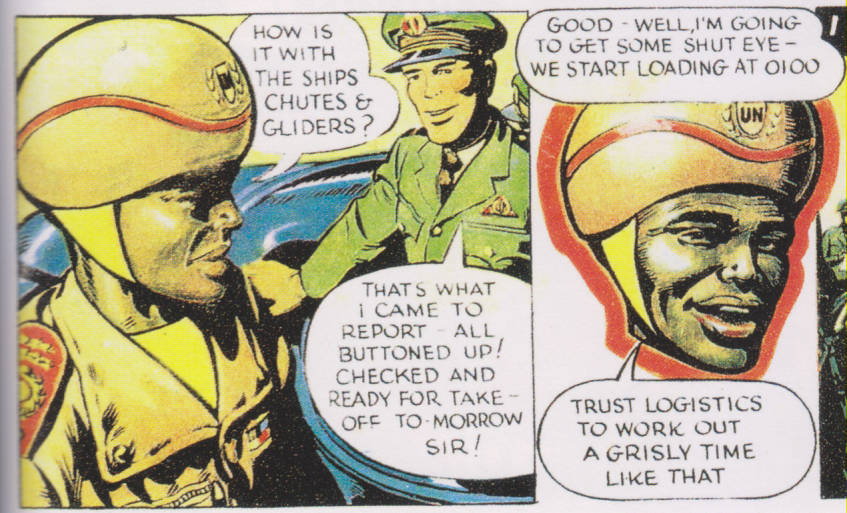
Space Fleet transports this army to Venus in rocket ships (which deploy parachutes and float down once they get inside the anti-technology field), and it meets the Treens in a pitched battle on the plain outside Mekonta. The Treens, on foot and armed with only rudimentary weapons, are quickly routed.
Despite the fantastic premise of invading Venus with cavalry and archers, this brief military campaign is shown quite realistically, with details of the reconnaissance and strategic manoeuvring leading up to the actual fighting. There's even a tactical diagram of the battle! This is very clearly something written by people who fought in a war only a few years earlier.
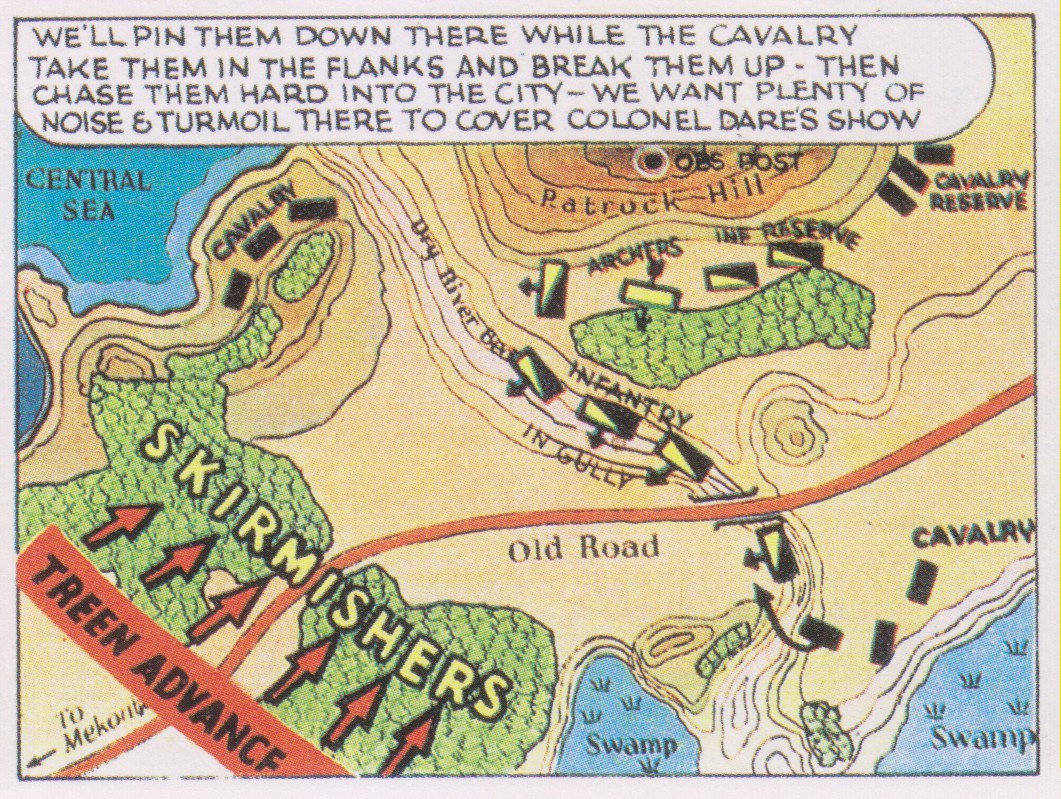
The Mekon leads his troops in person—he has no way of giving orders remotely, and it seems his desire to be in control is stronger than his self-preservation instinct. The last we see of him is when arrows are raining down on the Treen advance. Later we'll learn that he was presumed killed, although of course we never see the body.
The U.N. army pushes the Treens back to Mekonta, where they are caught between the advancing army and the revolting Atlantines. Dan leads a commando raid on the fortified bunker containing the Treens' anti-technology ray projectors. With those taken out, the Therons are able to dial down their own rays and send in mechanised ground forces, and it's all over.
Interestingly, we don't see much of Dan's commando mission. We see them trick their way into the bunker and throw grenades—and then we cut away, and when we cut back the fight is over and Dan's arm is in a sling after an unspecified injury. It's possible that this is for reasons of pacing—we're rushing towards the end of the story now—but it's also possible that Hampson didn't want to draw the kind of fight scene that starts with our hero throwing grenades at unarmed technicians.
Commandant Bunche asks Dan to formally accept the Treens' surrender. This he does by making an earnest speech about peace and disarmament while standing in front of the U.N. flag. He demands that the Treens free the Atlantines and hand over their weapons—and then he requests that they help supply food for Earth's popularion. They are not looters or conquerers, but liberators.
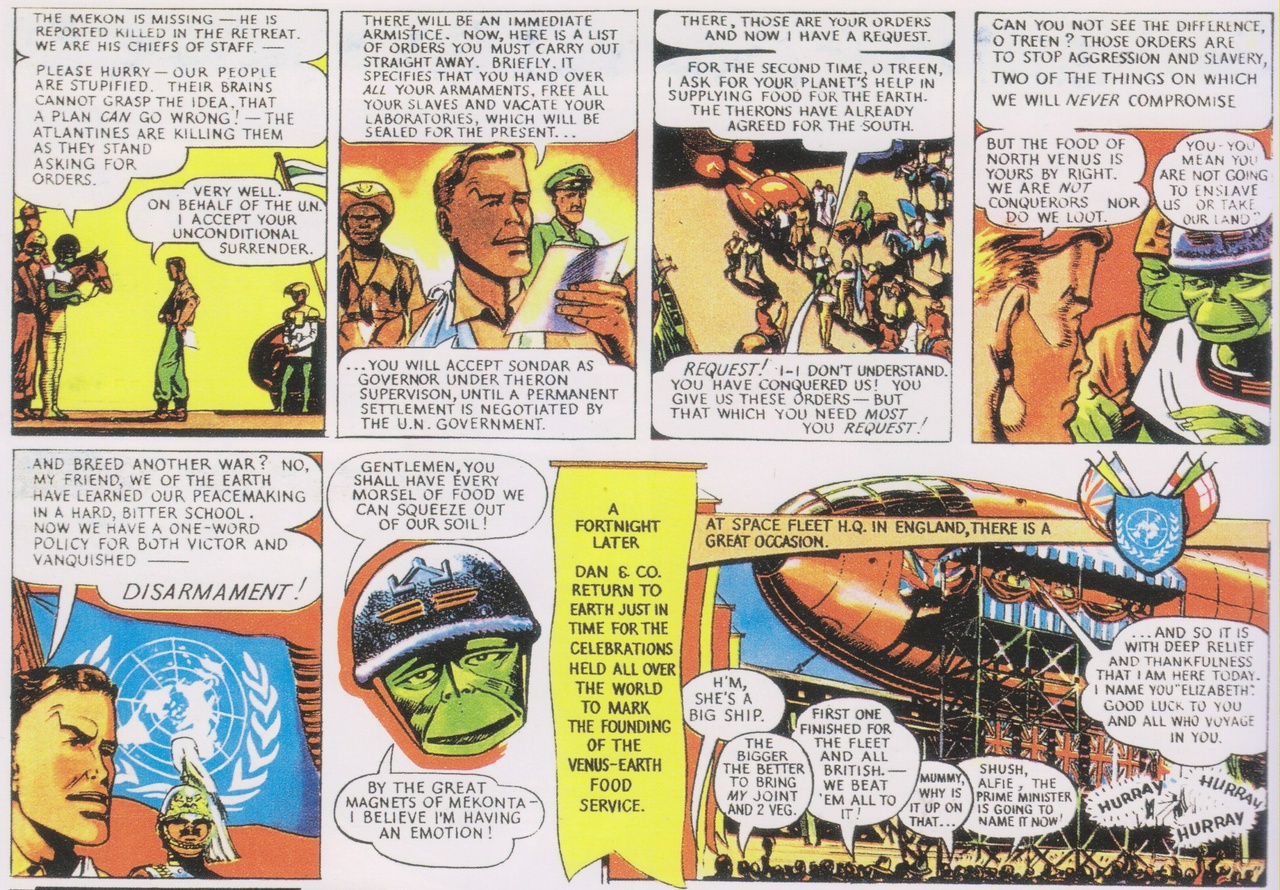
This is all very inspiring, and I'm certain Dan Dare means every word he says—but he's also standing in front of a victorious army and a mass of vengeful former slaves, so one could forgive the Treen leader for not wanting to find out what would happen if he'd said no.
We then cut to Earth, a fortnight later, where Space Fleet is unveiling the first of the ships for the Earth-Venus food run, and it's British. What's happening is aliens generously agreeing to provide food aid to Earth, but the vibe is more like victorious colonists going off to fetch food from the colonies. Nowhere is the tension in Dan Dare's worldbuilding—between utopian idealism and unexamined colonialism, between an international future and a British one—more visible than on this final page.
After that the story wraps up in a way that feels rather abrupt when you're reading it in a collected volume, but probably didn't if you were only getting two pages per week. Dan and the main cast have a celebratory dinner, and a final caption tells us that a new Dan Dare story starts next week.
Analysis
Structure
The first Dan Dare story is also the longest, at 77 weekly episodes. (The next longest is Operation Saturn, with 65 episodes; overall the 1950s stories average 40 episodes each.) A kid who got Eagle #1 for their eigth birthday would have been nine and a half by the time the story concluded. In fact, until this story concluded, it might not have been clear whether this strip would have discrete stories, or whether each episode would lead into the next indefinitely (as in e.g. the Flash Gordon newspaper strip, which has identifiable story arcs but never actually goes “The end! New story starts next week.”).
Despite the story's length—and despite the fact that Frank Hampson apparently launched into the story without much of a plan—it has a clear and satisfying overall structure. In my analysis there are five distinct acts:
Act I (vol 1 nos. 1-14; 14 episodes): Introduction of Earth and food shortages; journey to Venus; Dan and Digby survive the Venusian wilderness, up until their first meeting with a Treen. Exploration, mystery, no clear antagonist yet. Act II (vol 1 nos. 15-27; 13 episodes): Introduction of the Treens; Dan and Digby rescue Sir Hubert and Peabody and escape from the Treens, up until the clifftop fight in which Dan is presumed killed and the others are captured. Continued exploration and initial skirmishes with the Treens, who have emerged as the antagonist. Act III (vol 1 nos. 26-52; 27 episodes): The Mekon explains his plans; Dan meets the Therons; Dan works his way closer to the Mekon until he reaches his palace and opens fire. Gradual addition of complexity and rising tension. The general antagonist (the Treens) resolves into a personal one (the Mekon), who for now appears all-powerful. Act IV (vol 2 nos. 1-16; 16 episodes): Escape from Mekonta, reflector ship battle. Tension from previous chapter resolves into non-stop action. Antagonist is the Mekon who now appears beatable. Act V (vol 2 nos. 17-25; 9 episodes): Failed Treen invasion of Earth; cavalry-and-archers counter-invasion of northern Venus. Our heroes' exploration and alliance-building pay off and they finally turn the tables on the enemies. Initial problem (food shortages) is resolved, book-ending the entire story.
Style
Considering that this was published at a rate of two pages per week for impatient schoolchildren, it's remarkable how slow-moving some parts of it are—especially the first few episodes, when the brand-new comic would have desperately needed to get readers hooked to establish itself.
My understanding is that comics of the early 20th century tended to move more quickly than modern ones. Flash Gordon, for example, had rescued a woman from a crashing plane, been held at gunpoint by a mad scientist, and was rocketing into space by the end of his half-page first episode. Buck Rogers only needed four daily-newspaper-strip panels to get him into the 25th century and embroiled in a futuristic war. In contrast, Dan Dare spends most of his first few issues talking, and it's not until the end of issue 7 that he's in personal danger. The fact that Dan Dare is able to go more slowly, spreading natural-sounding conversations out over multiple panels with background details to keep them visually interesting, demonstrates both how Frank Hampson was ahead of his time as a visual storyteller, and how confident he was of the quality of his artwork to keep readers coming back.
Another notable thing when comparing Dan Dare with other comics of its day is Frank Hampson's sparing use of captions. It's a cliche that early comics would use captions to say things that were clearly visible in the panels—either because things were happening so fast that panel-to-panel continuity wouldn't always convey the story, or because the writer didn't trust the artist to convey everything. In contrast, many Dan Dare episodes have no captions at all, besides the initial scene-setting one at the start and “Meanwhile...” or “A week later...” ones marking changes in place or time. Sometimes the panels are instead crowded with speech balloons, but there are also a few long sequences with neither dialogue nor captions. (See e.g. our first look at the Atlantines, which is textless apart from a brief scene-setting caption.)
This means that when Hampson does use captions, it creates a particular dramatic effect—marking a moment as important, and/or giving a feeling of history-book distance between the reader and the events. When Volstar the Theron tells us the history of Venus, the strip goes into illustrated story-book mode and his dialogue turns into captions over otherwise textless pictures. When the Dapon makes his heroic sacrifice, we get a similar sequence of textless panels with one caption running across all of them, as if his flight is taking him out of the ordinary world and into the history books.
Visual Worldbuilding
One thing that set this strip apart from others of its time was how grounded and detailed its visual worldbuilding was, and the way that its future world is never just generically futuristic, but has a specific, recognisable look.
It's easy to joke about how 1995 looked like the “distant future” from 1950, but actually it was a relatively close future—one that its young audience could expect to live to see. The setting is the real world, but changed, unlike a story set thousands of years in the future which could be purely fantastic. One result of this is that the futuristic technology looks real, not always in the sense that it's plausible that it would really work (artificial gravity is magic), but in the sense that it was built by real people. Space Fleet ships look like someone had tasked real RAF engineers with building a Flash Gordon rocket ship. You can see the rivets.
Hampson also manages to give Space Fleet, Treen, and Theron spaceships distinct styles, even though all three are mostly variants of the standard 1950s cigar-shaped rocket. Space Fleet ships are comparatively bulky and functional-looking. Treen ships are sleeker, dark green, and tend to have their engines and guns mounted on nacelles projecting from the main body. Theron ships are even more compact, more aesthetically pleasing, and have sleek triangular wings.
A consistent idea seems to be that more advanced technology leads to more compact spaceships. One notable detail: Treens and Therons both have single-seat fighter craft that can go all the way from a launch ramp to orbit, but Space Fleet doesn't, either in this story or later ones.
Themes
This story feels more “grown-up” than some of the later ones, which would introduce things like kid characters and team pets. The food shortages on Earth are depicted with a genuine feeling of hopelessness, only partially masked by stiff-upper-lipped carrying on. The Treens are depicted as willing to commit genocide and slavery purely for the sake of emotionless science, something that becomes muddied in later stories when the Mekon's motivation includes personal revenge. (“We shall...reduce your population to scientific limits,” the Mekon says, a particularly chilling euphamism for genocide.) War and conflict are messy and involve sacrifices. This is the only story in which a named hero character dies—not one of the main cast, but someone who's been around long enough for us to get attached to.
In that context, the fact that Dan Dare is a non-violent, diplomatic hero—armed with a non-lethal paralysing pistol, opening with diplomacy and only using violence when that fails, taking enemies prisoner rather than killing them—is not a case of this being a sanitised, non-violent children's story, but a deliberate statement about the hero and the organisation and world he represents.
The future Earth established in this story is an utopian one, but there's a feeling that this is a hard-won utopia, not an inevitable one. The Treens and Therons are both more advanced than humans, which means they're visions of our possible future—and they're both civilisations that have failed in some way. The Treens have lost their humanity to the pursuit of science, become something like machines themselves. The Therons come off better, but over-reliance on technology has made them decadent and passive. Just as humanity struggled to achieve the utopia represented by the U.N. World Government, the story seems to say, so it must continue to struggle to avoid becoming like the Treens or Therons.
According to Alastair Compton's 2010 biography, Frank Hampson was a socialist, a believer in international cooperation, and (despite writing for a magazine edited by an Anglican vicar) a firm atheist. For me, a lot of Dan Dare's writing makes more sense with those things in mind, especially the worldbuilding established in this first story.
Dan Dare was written by British writers for a British audience, and comes across as very British to modern readers—but the story isn't one of a British hero championing British national interests, but of an international team whose leader happens to be British. Space Fleet HQ is located in England, but Space Fleet is an international organisation operating under a World Government that's explicitly descended from the United Nations.
This World Government has the power to institute global rationing and shuffle around strategic food reserves to deal with mass starvation. When the government cuts European and North American rations in order to solve food shortages in China, that's depicted as an unfortunate necessity, not as foreigners getting “our” food. And in contrast to the World Government, the Daily World Post issue tells us that the Vitamineats corporation is profiteering from the food shortages and may have had a hand in making them worse. Private businesses are rarely depicted in Dan Dare, but when they are, it's usually in a negative light.
In 1950, the idea that the United Nations might develop into a benevolent world government must have seemed optimistic but possible. Even so, an international hero working for a world government was far from the only or even the default mode of science fiction world-building. Dan Dare's antecedents included Buck Rogers, whose first story had him defending innocent Americans from evil Chinese invaders, and Flash Gordon, who returned to Earth in the 1940s to fight for America in a fictionalised version of World War II. Characters created to compete with Dan Dare included Jet-Ace Logan (Comet and later Tiger comics, 1956-68), who flew spaceships for the R.A.F. and reported to the British parliament.
As well as being more child-friendly, later stories would tone down Dan Dare's internationalism. This first story shows the World Government being based in New York, but later stories would place some government institutions in London, and show the Royal Navy being somewhat implausibly exepted from the disbanding of all national armed forces. Across Dan Dare as a whole there's a tension between an international future and a British one—but in this first story, internationalism wins out.
The fact that Frank Hampson was an atheist writing for Christian comic may explain why Dan Dare is relentlessly moral but almost never explicitly religious. The Treens are monsters because they've turned away from emotion and morality, not because they've turned away from God. The story isn't smugly critical of religion like some science fiction of the time (e.g. Clarke and Asimov) but neither does it depict religion as necessary to live a moral life.
The story was also progressive for its day in its inclusion of a competent woman on the main cast, and a Black character treated as the hero's equal. Apparently Frank Hampson had wanted to include a Russian character along with the French and American ones on the team, but this was vetoed by the editor; I can only assume that having a person of colour or more than one woman would have been a non-starter. Overall my impression is of someone trying, imperfectly, to be as progressive as he could get away with for their time.
Despite the imperfect 1950s progressiveness, however, this particular story is colonialist in a way that most of the later ones won't be. Colonel Dare isn't quite venturing forth to build the British Space Empire, but his mission is nevertheless one of colonial resource extraction: establishing outposts to supply resources (food) to the imperal core (Earth). And the story ends with him succeeding in that goal, as the Treens and Therons agree to supply food to Earth (or are bullied into it, in the more cynical reading of the Treens' surrender). There's no suggestion that the Earth is trading anything for this food. The final page shows a spaceship being launched for the Venus-Earth food run, and the vibe is very much “glorious spaceship off to fetch food from the colonies”, not “benevolent aliens provide food aid from the goodness of their hearts,” even though the latter is, in the final analysis, what's happening.
Nerdy detail notes
- In-universe dates: Roughly April 1995-July 1996. Interestingly, in-universe dates start out vague and infrequent but get more frequent and precise towards the end of the story. The first issue is simply set “Some years in the future”; the first date we see is that of the landing on Venus, August 23, 1995 (so based on the time elapsed so far, that “some years in the future” was in April or May); and the the Treen surrender in the final issue takes place at 4:30pm on July 7, 1996.
- Space Fleet HQ is depicted as on the coast. It was apparently meant to be on the site of an RAF base in Formby Sands, Lanacashire, although its location isn't mentioned in the story. One visual detail I like is that all the spaceship launch ramps are angled out to sea—presumably so that if there's a launch accident, the ship will come down in the water rather than onto a populated area.
- The Space Fleet ships, and some of the Theron ones, have the pilot lying on their front on a sort of couch. This was something that was trialled in the 1940s and 50s by the RAF and other organisations, on the basis that it would allow pilots to withstand higher G-forces. In the real world the disadvantages outweighed the advantages and it was abandoned, but in in Dan Dare's universe it seems to have caught on.
- Space Fleet ships have artificial gravity oriented so that the nose of the ship is forward, but they're launched vertically from launch ramps so the nose is up. The story handles this using a conceit I've never seen elsewhere, which is to have the ship using artificial gravity while on the launch ramp, and have a “gravity lock” that rotates you around from the outside orientation to the ship's internal one. The Treen telezero reflector ship solves the same problem in a different way, by making all of its decks rotate between the nose up launch position to the nose forward flight position.
- When we first meet the Atlantines they're led by a priest, who's taller than the others and has pale green skin. We never see another of these priests, and the difference in appearance is never explained. Perhaps there's a special priestly caste who have inter-bred with Treens or been modified by them to look more Treen-like. Or maybe this one guy just happened to be unusually tall and greenish.
- We see the Atlantines' language several times, sometimes with an English translation, and while it's not a full-on conlang it has a consistent vocabulary. In this story it's spoken by Atlantines among themselves and by Treens when giving orders to Atlantines. Later stories will have what looks like the same language spoken by Treens when there are no Atlantines around. But it would make sense that the Atlantines' original language from Earth is long gone and modern Atlantine is a dialect of Treen.
- The Treen Museum of Transportation, where they get the helijet, has “every machine from four planets,” which is the first hint we've had that planets other than Earth and Venus have technological civilisations. The other planets are presumably Mercury and Mars. (Mercury will later be shown to have a native civilisation; Mars has a long-extinct one, but the Treens could have done archaeology there.)
- The Daily World Post newspaper has different prices in different regions, so although there's a World Government it hasn't introduced a single world currency.
- Sir Hubert's full title is “Sir Hubert Guest, K.C.B., O.U.N.” Something I didn't notice until I read closely: K.C.B. is a real British honour, but O.U.N. isn't. I think the idea is that the British honours system has been incorporated into the World Government, and the O.B.E. (Order of the British Empire) has been replaced by the Order of the United Nations.
- The World Government headquarters is in New York, possibly on the site of the real-world U.N. complex. As well as the Prime Minister and cabinet, there's also a World Senate, with a World Senator for North England. (If my math is right, this means about 165 World Senators total.)
- Mars has a population of human colonists: the newspaper is published in a list of cities including “Marsville”, and there's an advert for skiing holidays on Mars. We'll visit Mars in the next story, but it looks like Hampson and his team have already thought about this bit of worldbuilding.
- When Dan asks Volstar if there are races on Venus besides the Treens, Therons, and Atlantines, he says “there are, but they are unimportant.” Clearly that was to give Hampson room to add new kinds of Venusian if a later story called for it, but one never does. (Wild speculation: since the Treens brought human slaves to Venus, maybe they did the same with Mercurians, and there are communities of Venus-adapted Mercurians living somewhere in the north?)
- The scene where the Mekon makes the prisoners pose for fake photos (vol. 1 no. 51) is the only time we see what appear to be female Treens. But since this is a staged photo shoot, they could have put some Treens in drag to better match what the humans would expect nurses to look like. Apart from this scene, Treens appear to either be an all-male race or a race with no visible difference between sexes.
- Mekons live for 300 years, and the next one is very young and 50 years away from being ready. We never learn the fate of this juvenile Mekon; perhaps they stopped the brain-enlarging treatments and he just grew up into an ordinary Treen.
- Arthur C. Clarke served as a scientific consultant on this story. We don't know for sure which ideas can be attributed to him, but he's often credited with inventing with the idea of communications satellites in 1945, so I suspect the idea of ships that reflect the telezero ray around the curvature of the planet had something to do with him.
- The technology-inhibiting rays don't need to be reflected around the planet like the telezero ray did. Perhaps they bounce around the ionosphere like shortwave radio.
- Although the Director of the Earth Research Observatory isn't mentioned by name after the Mekon takes over as main villain, I think he's meant to be the commander of the invasion force that lands on Earth, who wears a similar tall gold hat. But the tall gold hat seems to be a mark of office for senior Treen scientists generally, so it might not be.
- The Treen “fighting suits” on the telezero ship consist solely of a helmet, shoulder-piece, and sleeves. They look kind of goofy and inadequate on the human characters, but on Sondar it cleverly fits onto the top of his regular Treen outfit, which has metal rings covering the whole body except for the shoulders and arms.
- Assuming the Prime Minister of Earth is the same person who signed the Earth-Treen treaty, his name is Abraham Wilkes.
- The food shortages affecting Earth are solved in this story but not forgotten—later stories will sometimes mention the Earth-Venus food run.