In 2013 there were 39 of them. Now there are more than a thousand, and the math never got better.
The first time I heard the word “unicorn” used to describe a startup, I laughed. It sounded like something a five-year-old would name a stuffed animal. That was a long time ago now. The word stuck, and somewhere along the way I stopped laughing and started using it myself, in meetings, without noticing.
My name is Alexander Kopylkov, and I have spent more than twenty years investing in and building companies, first in real estate and later across AI, deeptech, and infrastructure. I have watched this one word do more to shape how people think about a startup's worth than almost any actual financial metric.
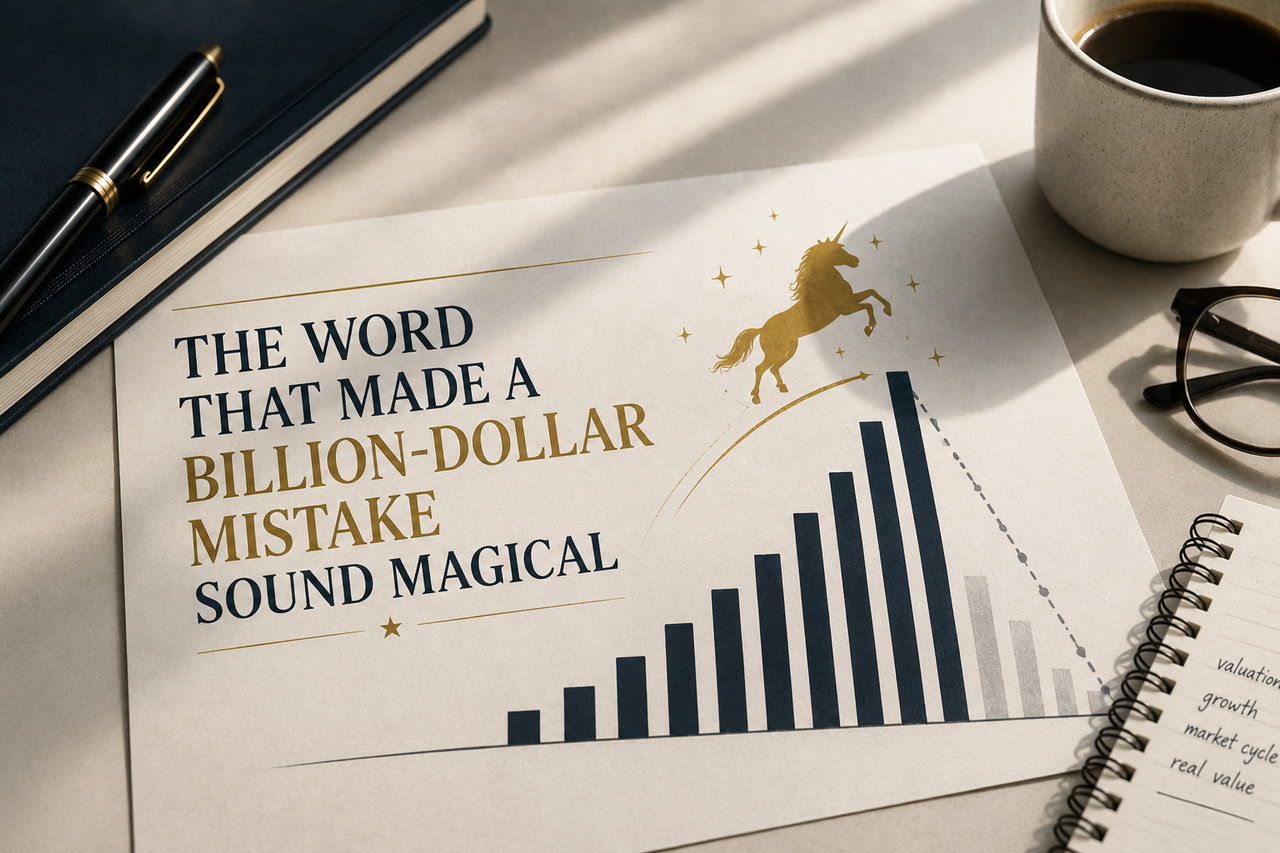
A word invented to describe an exception now describes a category.
A venture capitalist coined “unicorn” in 2013 to flag something specific: a US startup worth a billion dollars or more. At the time, only 39 companies on earth qualified. It was meant as a rarity marker, the startup equivalent of a blue moon. Today there are well over a thousand of them by most counts, and some trackers that go back further put the number closer to two thousand once you include the ones that no longer qualify. A word built to mean “this almost never happens” now applies to something that happens every few days.
I don't think anyone planned for that. By most accounts, the term was always meant to be a snapshot, not a verdict. But snapshots have a way of getting treated as permanent once enough people repeat them. Founders started introducing themselves with the word. Journalists started using it as a headline shortcut. I started hearing it in pitches before I heard the actual revenue number.
The billion-dollar price tag stopped meaning what people think it means.
Here is the part that took me a while to internalize: a unicorn valuation was never a statement about a company's health. It was a statement about what one investor was willing to pay for one slice of it, on one day. That's a meaningfully smaller claim than “this company is worth a billion dollars,” but the smaller claim doesn't make for as good a headline.
The last two years have made that gap obvious. Trackers that follow the broader unicorn population have found that hundreds of companies have raised their most recent round at or below their prior peak valuation, and a meaningful chunk of those are no longer worth a billion dollars on paper at all. Europe has felt this especially hard, with multiple market analyses pointing to tens of billions in paper value now under pressure across its unicorn class. None of those companies did anything differently the day their valuation dropped. The number just stopped being defended by someone willing to pay it.
I have started treating the word as a starting question, not a finish line.
The thing that changed for me is what I do the moment I hear the word now. It used to end the conversation, in a good way. Hearing “they're a unicorn” meant someone else had already done the digging. Now it's where I start asking questions: who set that price, how long ago, on what terms, and would they set it again today.
That shift matters more than it used to, because the timeline to earn the label has collapsed. It used to take founders the better part of a decade to reach a billion-dollar valuation. Some AI-native companies now clear that bar in their very first funding round, before they've shipped much of anything. I don't say that as a criticism of those founders. I say it because a label that used to take the better part of ten years and can now happen before a product ships has, almost by definition, stopped measuring the same thing.
The word will keep getting used. What it's supposed to prove needs to be checked separately.
Investors have started using another word for what happens next: “unicorpse,” a company that quietly loses the valuation it once had. I don't love the term, but I understand why people reach for it. It captures something the original word never could: a valuation is a moment, and moments pass.
I still don't mind the word “unicorn.” It's a useful piece of shorthand, and shorthand earns its keep. What I've stopped doing is treating it as evidence. A billion-dollar price tag tells you what someone paid. It has never told you, and was never built to tell you, what the company is actually worth to hold for the next ten years. That distinction was true in 2013 with 39 companies, and it's just as true now with a thousand more of them.