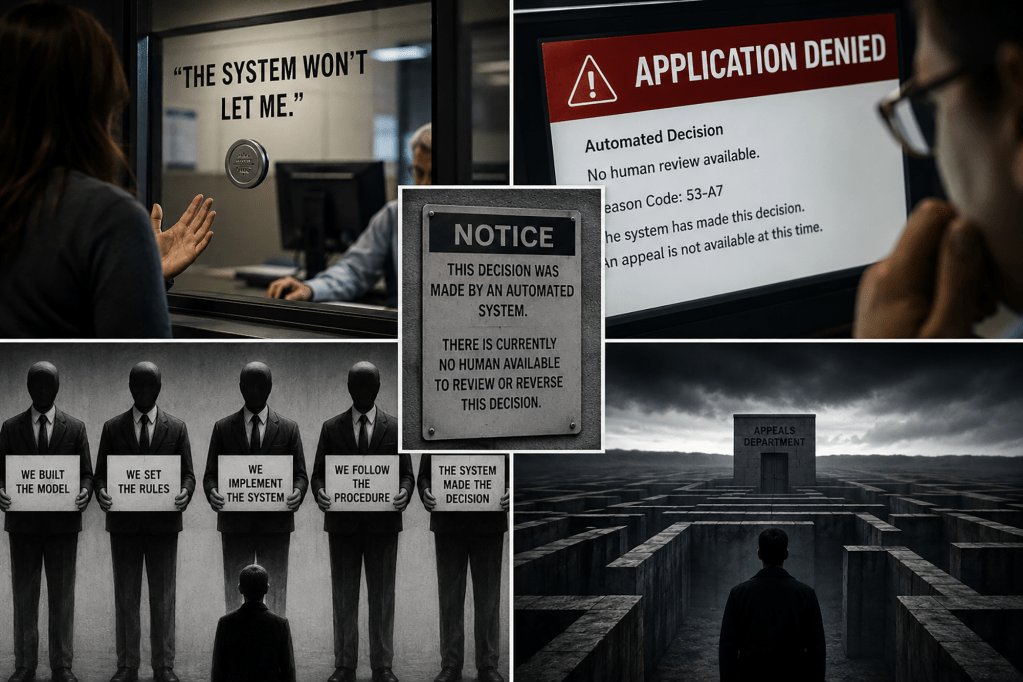
The most revealing sentence in modern institutional life is not, “You have been denied.” A denial still implies a denier. The more revealing sentence is, “The system won’t let me.” That sentence empties the room while everyone remains inside it. The employee is present. The institution is present. The consequence is present. Only authorship has disappeared. A machine with no legal personality has exercised practical power, while a human being with legal personality claims to possess none. You may hear the sentence after a medical authorization is refused, an account is frozen, a job application is rejected, a benefit is interrupted, or a manuscript is accused. The speaker may be genuinely sympathetic. Sympathy, however, cannot reopen the file, suspend the penalty, or restore what the system has taken.

The principal danger is not that machines will become persons. It is that persons inside institutions will stop acting as moral agents, enforcing decisions they claim no power to make or reverse. The machine will not have seized sovereignty. Human beings will have abandoned it while continuing to exercise its force.
The defining civil right of the automated age should be the right to reach an identifiable human being who possesses the knowledge, independence, time, and actual authority to change a machine-assisted decision. Anything less is not human review. It is human scenery.
The Orphaned Decision
I call this new institutional creature the orphaned decision. An orphaned decision has consequences but no acknowledged author. The software company says it supplied only a tool. The institution says it relied upon specialized technology. The manager says the procedure was established elsewhere. The front-line worker says the system will not permit another result. The appeals office checks whether the process was followed, then sends the case back into the process. Nobody claims the choice, but everyone enforces it. This is power stripped of confession. The decision may remove money, employment, medical care, opportunity, reputation, or access. Yet every participant describes himself as a messenger rather than an author.
Automation makes this evasion durable because the moral act is divided across time and departments. One group chooses the data, another sets the threshold, another buys the product, another writes policy, and another communicates the result. When injury follows, each points toward a different fragment of the chain. The result resembles a firing squad in which every rifle is said to contain a blank. The person falls, but no shooter accepts responsibility.
In Swimming the Author, I examined instruments that convert disputed human judgments into verdicts wearing the authority of measurement. A percentage, score, certificate, chart, or detector can make an accusation appear to have arisen from the nature of things rather than from people who selected the test and decided how its output would be used.[1] The orphaned decision is the next stage. The instrument becomes the institution’s alibi for refusing to own the verdict. A decision without an author cannot be legitimate. Authorship does not require that one person perform every calculation. It requires that an identifiable person accept the burden of judgment, state the reasons for the result, and possess the authority to correct it. A signature matters because it joins power to a name.
Bureaucracy Discovers the Perfect Alibi
Traditional bureaucracy was often slow, cruel, and evasive, but it usually preserved some visible chain of command. A clerk had a supervisor. A decision carried a signature. A hearing officer could reverse an initial determination. The system might resist correction, but a citizen could at least search for the office in which responsibility lived. Automated bureaucracy improves the efficiency of resistance. The vendor controls the architecture but not the use. The institution controls the use but not the architecture. The employee controls the message but not the outcome. The reviewer controls the appeal but not the remedy. This fragmentation is often presented as technical complexity. It is more accurately understood as political design.
“The system won’t let me” declares that the institution has created a zone in which authority operates without an available author. The sentence converts a human choice into an environmental condition, like rain or gravity. It asks the injured person to accept that nothing was decided because everything was processed. That claim is false. Every automated determination contains prior human judgments: what counts as risk, which errors are tolerable, which facts are relevant, how uncertainty is treated, when the machine may act, and whether anyone may overrule it. The computer does not remove discretion. It conceals discretion upstream. Power without authorship is not neutrality. It is immunity.
Kafka With Customer Service
Kafka’s institutional terror depended upon inaccessible authority. The accused could not locate the source of the charge, comprehend the procedure, or reach anyone capable of ending the case. The modern version is more polished. The telephone is answered. The portal supplies a ticket number. A representative expresses concern. The institution may even provide a detailed explanation. Yet the person answering has no power. The door is open, but there is nobody behind it. This is also a dramatic failure. Traditional tragedy requires an agent. Someone chooses, refuses, betrays, misjudges, hesitates, or acts too late. Character produces action, and action produces consequence. Algorithmic bureaucracy produces consequence without admitting a protagonist. Every human actor claims to be stage machinery.
There is always a decisive act. It may have occurred months earlier in a procurement meeting, a threshold setting, a workflow, or a default. The institution avoids accountability by separating the moment of choice from the moment of harm. The injured person encounters only the final performer, who has been given a script but no power to revise it.
Human Above the Loop
Institutions now promise a “human in the loop.” The phrase sounds reassuring because it implies supervision. It proves almost nothing. A human may be in the loop as an operator, observer, rubber stamp, customer-service representative, or ceremonial reviewer. A person who can inspect a machine’s output but cannot reject it is not exercising judgment. A reviewer measured by agreement with the model may possess theoretical discretion while being punished for using it. The proper standard is not a human in the loop. It is a human above the loop. That person must have access to the evidence, competence to understand the system’s role, independence from the original determination, and authority to suspend or reverse the result. The reviewer must be permitted to say that the model followed its instructions correctly and still produced an unjust answer. Otherwise, the appeal asks whether the machine was faithful to itself. A human reviewer who cannot reverse the machine is not a reviewer. That person is the machine’s spokesperson.
The federal government has acknowledged parts of this principle. Office of Management and Budget Memorandum M-25-21, issued April 3, 2025, directs covered agencies to use signatures for certain high-impact AI risk acceptances, conduct periodic human review, provide human oversight and intervention, and offer timely human review and an opportunity to appeal negative impacts when appropriate. Remedy processes should avoid unnecessary burdens.[2] The memorandum does not create public rights, but its architecture is revealing. Accountability requires a person who accepts risk.
Transparency Is Not a Remedy
Much of AI governance concentrates on transparency, explanation, auditing, and disclosure. These are necessary protections. They are not sufficient ones. Transparency concerns legibility. It tells a person what happened. Appeal concerns reversibility. It gives someone the power to change what happened. An institution may precisely explain why its system denied a claim, ranked an applicant, flagged a transaction, or classified a document. It may identify variables, publish an audit, and disclose a score. None of that restores the benefit, reopens the application, releases the money, or removes the accusation. A perfectly transparent injustice remains an injustice. New York City’s Local Law 144 illustrates the boundary. The city’s official guidance says that covered employers and employment agencies may not use an automated employment decision tool unless it has received a recent bias audit, information about that audit is made public, and required notices are provided. Enforcement began on July 5, 2023.[3] Those duties create visibility around systems that might otherwise operate in secret. Yet the rejected applicant still has a separate question: who can reconsider my result?
European law moves further. The General Data Protection Regulation restricts certain decisions based solely on automated processing when they produce legal or similarly significant effects. In covered circumstances, safeguards include information about the logic involved, human intervention, an opportunity to express a view, and a right to contest the decision.[4] The European Union’s Artificial Intelligence Act also establishes, for specified decisions based on the output of certain Annex III high-risk systems, a right to a clear and meaningful explanation of the AI system’s role and the main elements of the decision.[5] After the 2026 AI Omnibus, the relevant Annex III high-risk rules are scheduled to apply beginning December 2, 2027.[6]
These developments reject the idea that an output becomes legitimate because a computer produced it. But explanation cannot become the final remedy. Explanation without corrective authority is an autopsy. It tells us how the person was injured after the institution declined to stop the injury. The real test is not whether the institution can describe the decision. It is whether anyone can still change it.
The Long Law of Reversal
The right to challenge official power predates artificial intelligence. The Fifth Amendment bars the federal government from depriving a person of life, liberty, or property without due process, and procedural due process commonly requires notice and a meaningful opportunity to be heard before protected interests are finally taken.[7]
On March 23, 1970, the Supreme Court decided Goldberg v. Kelly. In the welfare-benefit context before it, the Court required an adequate evidentiary hearing before termination. The later availability of a fair proceeding did not cure the immediate danger because an eligible recipient could lose the means of subsistence while waiting. The Court emphasized timely notice, an opportunity to present evidence, and an impartial decision-maker who states reasons.[8] On February 24, 1976, Mathews v. Eldridge refused to impose the same pretermination hearing requirement upon the Social Security disability procedure at issue there. The Court instead articulated a three-part inquiry: the private interest affected, the risk of erroneous deprivation and value of additional safeguards, and the government’s interest, including administrative burdens.[9]
The cases do not produce one mechanical rule. They establish something more useful: procedure must answer to consequence. The graver the possible injury, the greater the need for timely and meaningful correction. Administrative convenience matters, but it is not the only value in the balance. AI intensifies that logic. A system may act faster than a former bureaucracy, apply one defect across thousands of cases, and appear objective before a person understands the accusation. Speed increases the value of a stay. Scale increases the value of audit. Opacity increases the value of access. Statistical authority increases the need for an independent human willing to disagree. Appeal is not wasteful friction. It is democratic redundancy. Engineers do not call every backup system inefficiency. They recognize that a structure without redundancy may appear economical until its first consequential failure. A legitimate institution should be designed on the same principle.
The Right to Mercy
Machines classify. They infer likely outcomes from prior patterns and place people into categories. Institutions value this because categories promise consistency. Justice requires something categories cannot guarantee: the capacity to confront the exceptional person and the unprecedented circumstance.
Law developed equity because a general rule can produce an intolerable result in a particular case. Medicine preserves clinical judgment because a protocol cannot exhaust the patient. Education relies upon professional evaluation because intellectual ability is not identical to a score. Publishing requires discernment because originality often appears improbable before it becomes undeniable. Human discretion can be prejudiced, corrupt, or incompetent. The answer is not to abolish discretion and bury it inside software. That only moves power into datasets, labels, thresholds, and procurement decisions where it becomes harder to see. The moral alternative is accountable discretion. The decision-maker must be named. Reasons must be stated. Evidence must be available. The outcome must remain reviewable. Mercy is not sentimental exception-making. It is the recognition that a person is more than the category into which a system has placed him.
The Boles Doctrine of Accountable Reversal
No consequential automated or machine-assisted decision should be enforceable unless an identifiable human being accepts responsibility for the outcome and meaningful authority exists to change it. That principle requires seven protections.
First, notice. The affected person must be told when an automated system materially influenced the decision. Institutions should not conceal machine judgment behind phrases such as “internal process” or “proprietary method.”
Second, named authorship. A human officer must own the final institutional act and accept responsibility for using the system’s output in this case.
Third, access. The person must be able to inspect the relevant record, correct factual errors, understand the decisive factors, and know which evidence was excluded. A secret case cannot be meaningfully contested.
Fourth, independence. Review must be conducted by someone who did not merely reproduce or approve the first determination. An appeal to the original decision-maker is a request for self-vindication.
Fifth, actual authority. The reviewer must be able to suspend, reverse, modify, or replace the result. A powerless reviewer is worse than no reviewer because the ceremony creates false legitimacy.
Sixth, timeliness. Review must occur before avoidable harm becomes irreversible. Restoring a benefit months later may not replace lost housing. Correcting an accusation after withdrawal, dismissal, or medical deterioration is not complete justice.
Seventh, institutional learning. Every reversal should be examined for systemic significance. If the same error recurs, the institution must change the model, data, threshold, policy, or workflow. Private correction without public learning merely produces a succession of hidden casualties.
These protections will cost money. So do courts, appeals, medical consultations, editorial review, and elections. Expense is not an argument against accountability. It is the price of exercising consequential authority without abandoning human dignity.
Who Can Say Yes?
The decisive question of the automated age is not whether a machine can say no. Machines already say no through scores, flags, locks, rankings, filters, and classifications. The decisive question is whether any responsible human being can still say yes. Can someone reopen the application? Restore the benefit? Release the account? Approve the treatment? Remove the accusation? Read the work rather than worship the detector? Can that person act before the injury becomes permanent? Will that person sign a name to the decision and answer for it afterward? When the answer is no, the institution has not eliminated human judgment. It has eliminated human responsibility while preserving institutional force.
No machine may have the final word where a human life, right, livelihood, reputation, education, health, liberty, or home is at stake. The machine may advise, calculate, identify patterns, improve speed, and expose inconsistency. It may become an excellent instrument. It must not become an alibi. The system is not a weather event. It was built, purchased, configured, authorized, and maintained by people. When it acts upon a person, somebody must own the action. Somebody must be able to stop it. Somebody must be able to change it. Anything less is not administration. It is power pretending that nobody is home.
Verified Source Note
David Boles Books, Swimming the Author: Who Is Allowed to Have Written This? (2026).
Office of Management and Budget, Memorandum M-25-21, Accelerating Federal Use of AI through Innovation, Governance, and Public Trust (April 3, 2025), especially the minimum practices for high-impact AI.
New York City Department of Consumer and Worker Protection, official guidance on Local Law 144 of 2021 and automated employment decision tools.
European Commission, official guidance concerning GDPR Article 22 and automated decision-making; Regulation (EU) 2016/679.
Regulation (EU) 2024/1689, Artificial Intelligence Act, Article 86.
European Commission, AI Omnibus Enters into Force (July 27, 2026).
U.S. Constitution, Fifth Amendment; Constitution Annotated, procedural due process overview.
Goldberg v. Kelly, 397 U.S. 254 (1970).
Mathews v. Eldridge, 424 U.S. 319 (1976).