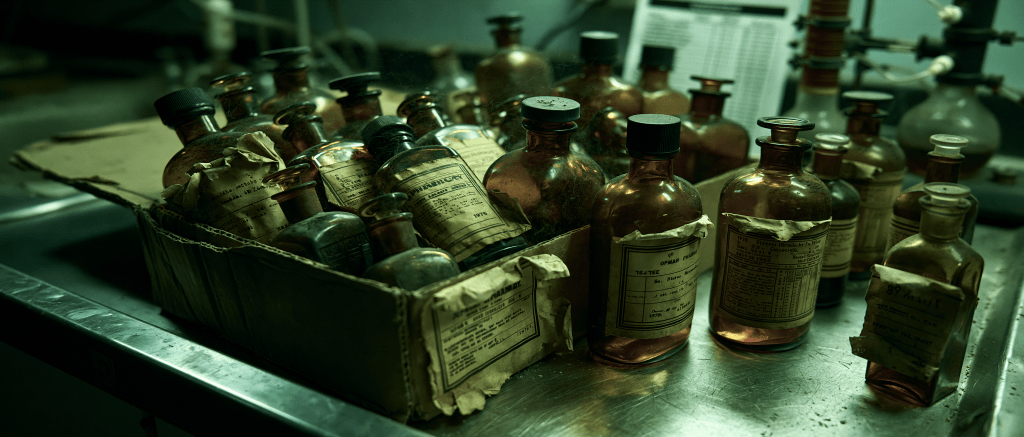
A box of prescription drugs sat forgotten in the back closet of a retail pharmacy long enough that some of the pills predated the 1969 moon landing. Sealed bottles, original containers, never opened. Diet pills under brand names nobody has spoken aloud in forty years. Barbiturates. A four-ingredient headache compound. Every one of them was at least twenty-eight years past the date stamped on the label, which meant that under every rule governing American pharmacy, they were garbage. Lee Cantrell, who helps run the California Poison Control System, looked at the box and saw an experiment nobody could afford to run on purpose. He called Roy Gerona at the University of California, San Francisco, a chemist who had grown up in the Philippines watching people take outdated medicine and get better anyway. Gerona ran the contents through liquid chromatography and mass spectrometry. The results were published in the Archives of Internal Medicine on October 8, 2012, under a title that gives away nothing: “Stability of Active Ingredients in Long-Expired Prescription Medications.”

Eight products. Fifteen labeled active ingredients, fourteen of which could be tested, since no analytical standard existed for homatropine. Three tablets or capsules of each, each assayed three times. Twelve of the fourteen compounds, eighty-six percent, came in at ninety percent or more of the strength printed on the label, which is the floor the Food and Drug Administration accepts for a drug in current commerce. Three of them measured above one hundred ten percent, likely because they were made before 1963, when the agency tightened manufacturing quality control. Eight compounds held full potency for four decades.
That study is the source of a claim now in wide circulation, and the claim has drifted a long way from the paper that produced it.
First, the correction
The version in circulation assigns the work to Yale, stretches the storage to sixty years, and reports that the pills came through at ninety-five percent of strength while the liquids held about sixty. The institution is wrong. So is the duration. The liquid figure cannot have come from this paper at all, because the paper tested no liquids: eight products, every one of them a tablet or a capsule. Only the pill number survives contact with the source, and it survives as a rounding.
The work came out of the California Poison Control System and the UCSF School of Pharmacy, with additional analysis by Alan Wu and Gerona at San Francisco General. No Yale trial matching that description appears in the literature. The drugs had been expired for twenty-eight to forty years, which is astonishing enough without anyone rounding it up to sixty. What the record holds instead is a body of work spanning six decades, and the real figures are stranger and more useful than the remembered ones.
Take the failures in Cantrell’s own sample. Two compounds fell below the ninety percent floor, and they did not fail gently. Amphetamine came in under sixty percent. Aspirin came in under five percent. A tablet of aspirin sitting sealed in a bottle for three decades had converted almost entirely into something else. So the tidy formulation, pills good and liquids bad, breaks on the first hard case: the single most spectacular collapse in the study happened in a solid tablet, and it happened for a reason any first-year chemistry student can write on the board.
None of which makes eight bottles a large study. Cantrell assayed three tablets of each product, the paper drew a published critique in the journal and a reply from its authors, and Cantrell himself has been careful to say he was never advising patients to take outdated medicine, only pointing out how arbitrarily the dates get chosen. The weight of the argument sits elsewhere, in a federal testing program that has been working through drug lots by the thousand for four decades.
Acetylsalicylic acid plus water yields salicylic acid plus acetic acid. Aspirin hydrolyzes. Give it moisture and time and it becomes a weaker painkiller and a puff of vinegar, which is why an old bottle of aspirin announces its own condition the moment you unscrew the cap. Nothing about expiration dating explains that outcome. A molecule with a labile ester bond met humidity in a bathroom cabinet, and lost.
What the date on the label legally means
Since drug products packaged after September 29, 1979, federal law under 21 CFR 211.137 has required an expiration date supported by stability testing. The manufacturer runs the study, using real-time data and accelerated protocols that cook and steam the product to model degradation, then proposes a date. The agency reviews the data and approves it. Most American drug products come out of that process with a shelf life somewhere between twelve and sixty months.
Here is the sentence that changes everything, and it comes from the FDA’s own posture, with no critic required to supply it: the expiration date certifies that the product will still meet its standards of identity, strength, quality, and purity at least until that day, in the unopened original container, under labeled storage conditions. Nothing in the regulation asks what happens on the day after. Nothing requires the manufacturer to find out. A firm that runs a three-year stability study gets a three-year date, and a firm that runs a five-year study gets a five-year date, and the difference between them is a matter of budget. The molecule has no opinion.
The Medical Letter, reviewing the evidence in a piece the Journal of the American Medical Association reprinted in February 2016, put the point plainly: the date carries no finding that the drug went unstable afterward, only a record of where the testing stopped.
There is a second date that most patients never think about, and it is the one behind the belief that medicine must be thrown out a year after it is dispensed. That rule comes from the United States Pharmacopeia’s labeling chapter, which instructs the dispensing pharmacist to assign a beyond-use date no later than the manufacturer’s expiration date or one year from the day the drug is handed across the counter, whichever comes first. State boards of pharmacy adopt it into administrative code. Minnesota’s rule, to take one example, says exactly that for drugs prepackaged into prescription vials. The logic is defensible on its face: the pills have left the manufacturer’s sealed container, the pharmacist has poured them into an amber plastic vial with a paper label, and the original stability data no longer describes the packaging the patient is holding. The FDA applies similar reasoning to commercial repackagers, capping repackaged unit-dose solids at six months or twenty-five percent of the remaining time, whichever is shorter. That same guidance excludes liquid dosage forms outright, on the ground that they degrade substantially faster than solids.
So the one-year rule was written by a standards-setting convention and enforced by state regulators. Your neighborhood pharmacist did not invent it and cannot waive it.
The government does not believe its own rule
In 1986 the Air Force, staring at the replacement cost of an enormous medical stockpile, asked the FDA whether certain drugs could be kept past their printed dates. The answer became the Shelf Life Extension Program, run by the FDA on behalf of the Department of Defense, and it has been quietly testing aging federal drug stocks ever since. It is the largest body of pharmaceutical stability data in existence.
Robbe Lyon and colleagues at the FDA published the summary in the Journal of Pharmaceutical Sciences in 2006. One hundred twenty-two different drug products. Three thousand five lots. Two thousand six hundred fifty of those lots, eighty-eight percent, were extended at least a year past their original expiration dates, with an average extension of sixty-six months. Five and a half years, on average, added to products that federal law would have required a hospital to destroy. Roughly one lot in six eventually failed some criterion, whether potency, pH, water content, dissolution, appearance, or impurities. According to the Medical Letter’s review of the same dataset, none of them failed within the first year past the labeled date.
The money is where the argument stops being academic. The Department of Defense maintains a drug stockpile valued around $13.6 billion. In 2016 the extension program cost $3.1 million to operate and saved the department $2.1 billion in drugs it did not have to replace. Marc Young, who helped run the program in the late 2000s, put the annual savings at $600 to $800 million. Cantrell’s own paper estimated that every dollar spent demonstrating longer stability returns between thirteen and ninety-four dollars in avoided reacquisition cost.
Meanwhile, at Newton-Wellesley Hospital outside Boston, a 240-bed facility, the pharmacy destroys roughly $200,000 of expired medication a year. Assistant director David Berkowitz once counted fifty expired epinephrine auto-injectors out of an emergency-kit bin into a destruction container, close to $15,000 of adrenaline in plastic tubes. Play that across American hospitals and the estimate runs to about $800 million annually, before anyone counts long-term care pharmacies, retail shelves, and the boxes in fifty million bathroom cabinets.
The same drugs get opposite treatment depending on who owns them. Atropine and sodium bicarbonate sitting in a federal warehouse get tested and extended. The identical products sitting in a hospital pharmacy get hauled away by a destruction contractor. When Pfizer released extended dating on certain injectable lots in June 2017 during a critical-care shortage, Berkowitz went to his own trash pile and rescued seventy-five atropine, fifteen dextrose, one hundred sixty-four epinephrine, and twenty-two sodium bicarbonate syringes, about $7,500 of medicine that had been worthless on Tuesday and usable on Wednesday because a table on a federal website had changed.
Pills and liquids, and why the split is softer than you think
The general rule holds. Solid dosage forms outlast solutions and suspensions, because a tablet is a low-water environment where degradation reactions run slowly, while a liquid puts the active molecule in permanent contact with water, the reagent that most often destroys it. Solvents evaporate and concentrate what remains. Suspensions settle and freeze. Preservative systems lose the fight against microbial growth long before the active ingredient gives out.
Then the exceptions arrive. In 2024, Kannan Sridharan and Satyendra Kumar Jain published an analysis in Pharmacy Practice of two products roughly thirty years past their dates: an acetaminophen suspension that expired in October 1994 and captopril tablets that expired in January 1992. The suspension assayed at 97.21 percent of labeled strength. Its degradation products sat within permitted limits, and even the methylparaben preservative was still present at 93.7 percent of claim. The tablets assayed at 96.12 percent and passed dissolution testing at 104.84 percent. And yet the tablets were the sample that failed, because captopril disulphide, the impurity that matters, exceeded the allowable limit by 19.3 percent.
The thirty-year-old liquid passed on both potency and purity. The thirty-year-old tablet held its potency and failed on impurities.
Toxicologists preparing for chemical terrorism found something similar with atropine solution, testing four outdated samples, three of them up to twelve years past expiration and one more than fifty years past, and finding meaningful drug concentrations in all four. Theophylline tablets have been shown to retain ninety percent potency at thirty years. Captopril, theophylline, and cefoxitin sodium powder held up for one and a half to nine years past expiration while stored at forty degrees Celsius and seventy-five percent relative humidity, which is a laboratory simulation of a bad Louisiana summer.
The honest formulation is that dosage form is a probability, and storage is the mechanism.
Where the date earns its keep
Four categories deserve genuine respect, and lumping them in with a bottle of ibuprofen is how a reasonable argument turns into a dangerous one.
Nitroglycerin is volatile in the literal sense. The molecule leaves the tablet. James Nawarskas and colleagues published an open-label study in the American Journal of Cardiology in 2018 that carried commercial sublingual tablets through simulated real life, and the findings turned on physics. Tablets kept in the original bottle in a temperate environment held potency past two years when carried in a purse. Carried in a pants pocket against body heat, a twenty-five-count bottle still made two years while a hundred-count bottle dropped below acceptable potency at twelve months, because the empty headspace above the tablets gave the nitroglycerin somewhere to go. The container, the fill level, and the trouser matter more than the printing on the label.
Epinephrine auto-injectors repeat the lesson at higher stakes. Cantrell and Gerona tested forty consumer-donated EpiPens and EpiPen Jrs. expired between one and fifty months; twenty-four held at least ninety percent of labeled epinephrine and every single one held at least eighty percent. A Florida allergy practice found pens three to thirty-six months past date carrying 84.2 to 101.5 percent of the labeled dose. Then look at pens pulled from EMS vehicles, expired one to eleven years, cooking through summers in an ambulance compartment: 12.6 to 31.3 percent remaining. Same device, same molecule, wildly different answer, and the variable is heat.
Insulin sits in a category of its own, and the received wisdom there is also softer than the label suggests. A 2023 Cochrane review of human insulin thermal stability found no clinically relevant potency loss in unopened vials and cartridges held between roughly twenty-nine and thirty-seven degrees Celsius for up to four months. Opened vials and cartridges at up to thirty-seven degrees for twelve weeks came through as well, and company data supports six months at twenty-five degrees for unopened short-acting and intermediate-acting product. That evidence matters most to the patient in a blackout or a refugee camp, and it does not license anyone to run a vial for a year.
Finally, the reconstituted and the sterile. An amoxicillin suspension mixed by the pharmacist carries a fourteen-day refrigerated life, and the reason is microbiological. Eye drops fail when the preservative can no longer hold back growth in a bottle you have touched to your own lash line. Vaccines and monoclonal antibodies can be destroyed by a single temperature excursion months before the printed date arrives. In those cases the date is a proxy for sterility and cold chain, and it is telling the truth.
The one documented casualty
The strongest safety claim in this literature is also the quietest one. The Medical Letter’s review states that there are no published reports of human toxicity from ingestion, injection, or topical application of a current drug formulation after its expiration date. Cantrell has said as much: no recorded instance in the medical literature.
The famous exception is real and worth knowing. In 1963, physicians reported reversible Fanconi syndrome, a serious injury to the kidney’s proximal tubules, in patients who had taken outdated tetracycline. The degradation products, anhydrotetracycline and its epimer, are the toxic agents. Later analytical work identified citric acid in the formulation as the accelerant that drove that breakdown. The formulation implicated in those cases is no longer marketed. Sixty years on, it remains the case pharmacists cite, and it earns both the citation and the footnote.
Whose interest does the date serve?
The suspicion underneath all of this is the obvious one: that expiration dating exists to serve the pharmacy and not the patient. It deserves a straight evaluation.
The claim is effective because the financial asymmetry is real and is documented by people inside the system. Manufacturers set the dates. Manufacturers have no economic reason to extend them, since a longer date means fewer refills of the same inventory and an expensive regulatory filing to prove it. Yan Wu, an analytical chemist working on long-term stability questions within the American Association of Pharmaceutical Scientists, has said the regulations make extension expensive and time-consuming and that most firms would rather develop new products. Waste at the hospital, the retail counter, and the home cabinet all converts into replacement sales. The trade association’s answer, that dates are chosen for the period in which a lot maintains identity, potency, and purity, is accurate and beside the point, because nobody is arguing that the dates are too long.
The claim is not effective because it aims at the wrong party. A retail pharmacy is a rule-taker in this system, and has been since the rule was written. Federal and state law forbid dispensing expired drugs, the accrediting bodies require their removal from stock, and the pharmacist who wanted to hand you a still-potent bottle past its date would be committing a licensing violation to save you money. Hospital pharmacies pay to destroy inventory they have already bought, which lands on the ledger as a loss. The beneficiary is upstream, and the enforcement mechanism sits in regulation.
There is also a real counterargument, and the FDA makes it. Drugs held by consumers have been stored under unknown conditions. The agency has said that testing to establish meaningful, generally applicable dates after prolonged storage under varied conditions would be difficult, and the ambulance EpiPens prove the point. A stockpile in a climate-controlled federal warehouse and a bottle in a Phoenix glovebox share a label and nothing else.
That defense justifies caution about a blanket extension for consumer-held medicine. It does not explain why a hospital pharmacy, with continuous temperature and humidity monitoring, cannot participate in the same program that saves the Pentagon two billion dollars a year.
What could be done, and what I would do
Five options are on the table.
The first is the status quo, in which the FDA extends dates case by case during shortages through its published extended-use tables. This works and is already saving supply, and it is effective because it is data-driven and lot-specific. It is not effective because it is reactive, triggered only when supply fails, and it leaves the routine waste untouched.
The second is to require manufacturers to label the longest expiration date their stability data will support. That was the design of the Drug Shortages Shelf Life Extension Act, introduced in 2022 by Senators Susan Collins and Ben Cardin with a House companion. It directed the agency to issue guidance on submitting stability data and setting the longest feasible dating. It never became law; it was referred to committee and died there with the Congress that produced it. The approach is effective because it attacks the incentive problem at its origin. It is not effective because it asks firms to fund studies against their own revenue, which is precisely the resistance that has stalled reform since the American Medical Association passed a resolution on this in 2000 and sent letters to the FDA, the Pharmacopeia, and the industry that produced nothing.
The third is to extend the military shelf-life program to hospital pharmacies with documented storage control. Four scientists who worked on the federal program told ProPublica this could work. It is effective because the storage conditions are already comparable and the testing methodology already exists. It is not effective as a complete answer, because it does nothing for the patient at home.
The fourth is an independent testing body, funded publicly, that publishes extension data no manufacturer has a reason to generate. Effective because it breaks the conflict of interest cleanly. Not effective in the short run, because it requires appropriations and a new institution in a political climate hostile to both.
The fifth, proposed in Mayo Clinic Proceedings in 2015, is two-stage dating: a conservative preliminary date at launch, updated upward once long-term real-time data accumulates. Effective because it costs almost nothing, since the stability program is already running and the data already exists inside the firms. Not effective without a mandate, because a voluntary version has been available for forty years and no one has used it.
My recommendation is the fifth paired with the third. Require the update, since the testing is already happening and the only missing element is the obligation to report it and relabel. Then open the federal extension program to accredited pharmacies that can document their storage. Together those two changes would capture most of the waste without asking a single patient to gamble on an unknown bottle, and they would leave the harder consumer question where it belongs, in a conversation between a person and a pharmacist, where a rule written for the average of fifty million bathrooms cannot reach.
The part that matters at home
Everything above concerns policy. Here is the practical residue, offered with the caveat that I am reporting evidence and prescribing nothing.
The date is a floor, not a cliff, and it describes a sealed container under decent storage. A sealed bottle of a solid tablet, kept cool and dry, is likely to be close to full strength for years past its date. That same bottle, opened, half empty, and stored above a shower for a decade, is a different object about which nobody has data.
The hazard of an expired drug is almost always weakness, and weakness is silent. A weak antibiotic gives no sign of itself. The infection carries on while the patient assumes the treatment is working. That is why the calculus should turn on consequence. For a headache, the stakes of a slightly weak tablet are a headache. For anaphylaxis, angina, seizure, clotting, thyroid replacement, or a serious infection, an underdose is the whole danger, and those are the products to keep current without argument.
And the medicine cabinet, which is the one piece of advice with no counterargument at all: it is the worst storage location in the house. Heat and humidity are what actually run the reactions that destroy drugs, and Americans have spent a century keeping their pills in the single room engineered to produce both.
Cantrell keeps a collection of old chemical and pharmaceutical bottles in his office. He has tested some of them. They still work. The box from that pharmacy closet had been sitting in the dark, sealed, at room temperature, for longer than most of the pharmacists handling it had been alive. When it finally reached a mass spectrometer, time turned out to have done far less than anyone assumed. The label had been telling the truth the whole while, a much smaller truth than anyone had read into it.