Travel has always been about discovery—new places, new cultures, new experiences. But behind every great journey lies a complex web of planning, booking, and decision-making that can often feel overwhelming. From choosing the right destination to finding the best flight deals, travelers juggle countless variables before they even pack their bags.
Artificial intelligence is changing that. Quietly and steadily, AI has woven itself into the fabric of modern travel—from the moment you start researching a trip to the time you check into your hotel and beyond. It powers the recommendations you see, the prices you pay, and the support you receive when something goes wrong.
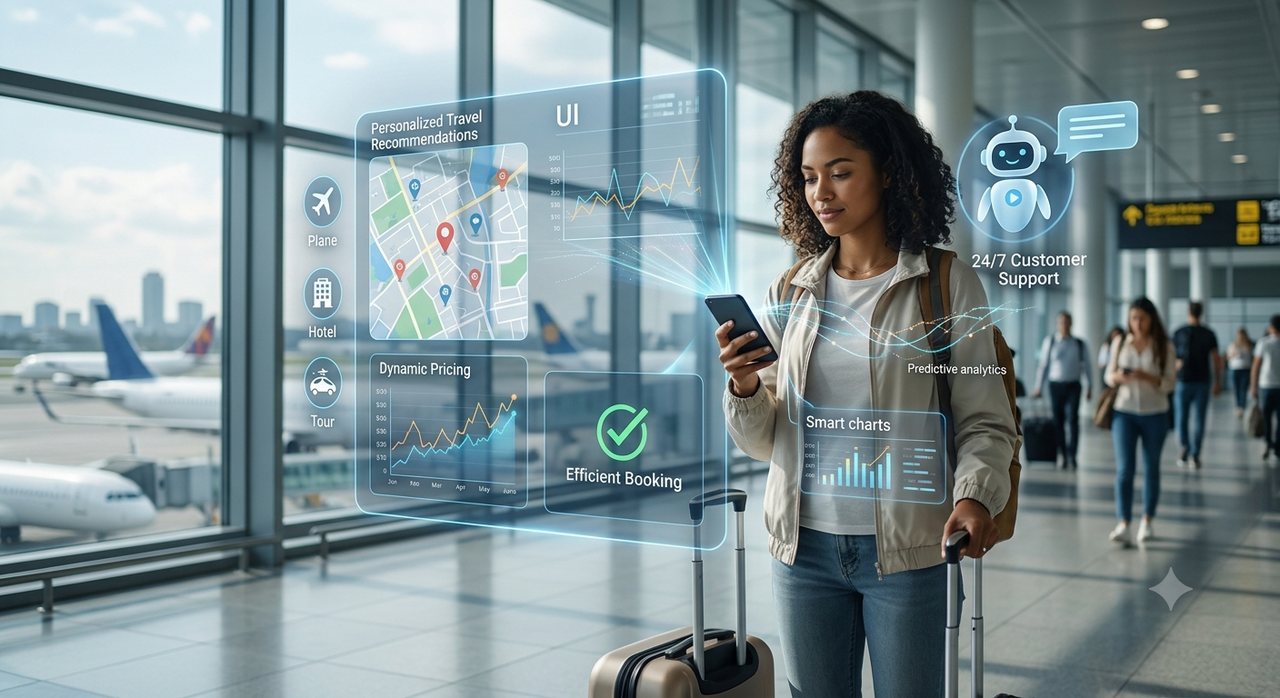
This article explores seven key ways AI is transforming travel making it more personalized, efficient, and enjoyable for tourists while helping businesses operate smarter.
- Personalized Travel Recommendations
Driven by modern travel app development in tourism, personalization has become one of the most visible applications of AI in travel is personalization. Travelers today are no longer satisfied with one-size-fits-all suggestions. They want recommendations that feel tailor-made for their preferences, budgets, and travel styles.
AI-powered systems analyze vast amounts of data—past bookings, search history, social media activity, even real-time factors like weather patterns—to understand what a traveler truly wants. For example, if a traveler is planning a beach getaway, the system can suggest the best nearby beaches, the optimal time to visit based on historical weather data, and even recommend activities that align with their interests.
The result is a more intuitive, less stressful planning experience. Travelers spend less time sifting through irrelevant options and more time anticipating their trip. For businesses, this translates to higher engagement and conversion rates—studies show that AI-powered personalization can boost engagement by up to 40%.
Why it matters: Personalization turns generic travel planning into a curated experience that feels human, even though it's powered by algorithms.
- Efficient and Streamlined Booking
Booking travel has traditionally been a tedious process—filling out forms, comparing prices, double-checking dates, and hoping you didn't miss a detail. AI is changing this by automating repetitive tasks and reducing manual errors.
Machine learning algorithms can predict user preferences based on past behavior and pre-fill booking forms, making the entire process faster and more user-friendly. Travelers can complete bookings in minutes instead of hours, with fewer clicks and less frustration.
For travel businesses, this efficiency translates to higher conversion rates. Industry reports indicate that AI implementation in travel apps has led to a 28% improvement in booking conversion rates. Every friction point removed from the booking process is a potential customer retained.
Why it matters: In an industry where seconds count, AI-driven automation helps travelers book faster and businesses close more sales.
- Dynamic Pricing Strategies
Pricing in the travel industry has always been fluid—flight prices change by the hour, hotel rates fluctuate with demand, and tour packages shift with the season. But manual price adjustments are slow and reactive. AI-powered dynamic pricing changes that.
AI algorithms analyze real-time data—demand patterns, seasonality, competitor pricing, and other market factors—to adjust prices instantly. This ensures that travel companies remain competitive while maximizing profitability. When demand is high, prices rise; when demand is low, prices adjust to attract more bookings.
For travelers, this means they benefit from fairer, more transparent pricing. For businesses, it means optimizing revenue without constant manual intervention.
Why it matters: Dynamic pricing creates a win-win—travelers get competitive rates, and businesses capture maximum value from each booking.
- 24/7 Customer Support with AI Chatbots
Travel doesn't follow a 9-to-5 schedule. Flights get delayed at midnight, hotel check-ins happen at odd hours, and travelers need answers whenever questions arise. AI chatbots have become the frontline of customer support in the travel industry, providing instant assistance around the clock.
Travelers can ask chatbots about flight status, baggage policies, local attractions, or booking changes—and receive immediate, accurate responses. This reduces wait times and eliminates the frustration of being stuck on hold.
For travel businesses, chatbots reduce the burden on human support teams, allowing them to focus on complex issues while routine queries are handled automatically. The result is faster response times, higher customer satisfaction, and lower operational costs.
Why it matters: In travel, timing is everything. AI-powered support ensures help is always available when travelers need it most.
- Predictive Analytics for Smarter Decision-Making
Predictive analytics is one of AI's most powerful capabilities in travel. By analyzing historical data, current trends, and external factors, AI can forecast future patterns with remarkable accuracy.
Travel companies use predictive analytics to anticipate demand, optimize inventory, and plan marketing campaigns. For example, an airline might use AI to predict which routes will see increased demand during holiday seasons and adjust capacity accordingly. A hotel chain might forecast occupancy rates and staff accordingly.
For travelers, predictive analytics means better planning. AI can suggest the best time to book a flight, recommend destinations based on upcoming weather patterns, or alert travelers to potential disruptions before they happen.
Why it matters: Predictive analytics transforms guesswork into data-driven confidence—for both businesses and travelers.
- Smart Analytics for Business Growth
Beyond customer-facing applications, AI provides travel businesses with deep, actionable insights through smart analytics.
AI systems can process enormous datasets—booking patterns, customer feedback, operational metrics, market trends—to identify opportunities and risks that might otherwise go unnoticed. A tour operator might discover that certain destinations are gaining popularity among a specific demographic. A travel agency might identify which marketing channels deliver the highest ROI.
These insights enable data-driven decision-making across every aspect of the business, from product development to customer acquisition to operational efficiency.
Why it matters: In a competitive industry, the ability to make smarter, faster decisions is a significant advantage. AI provides the intelligence to do exactly that.
- Emerging Technologies: The Future of AI in Travel
The current applications of AI in travel are impressive, but they are just the beginning. Emerging technologies promise to further revolutionize how we travel.
Computer Vision is enabling automated check-ins through facial recognition and document verification, reducing wait times at airports and hotels.
Natural Language Processing is powering advanced voice assistants that can handle complex booking requests through simple conversation.
IoT Integration is creating smart hotel rooms that adjust lighting, temperature, and entertainment based on guest preferences.
Predictive Analytics is being refined to proactively manage travel disruptions—alerting travelers to delays before they happen and suggesting alternative arrangements.
Blockchain Integration is adding layers of security and transparency to travel transactions.
These technologies are not distant futures—they are being deployed today, making travel smoother, safer, and more personalized than ever before.
Industry Impact: The Numbers Speak
The impact of AI on the travel industry is measurable and significant. According to industry reports:
- 35% increase in customer satisfaction
- 28% improvement in booking conversion rates
- Up to 40% higher engagement rates with AI-powered personalization
These numbers reflect a simple truth: AI is not just a technological trend—it is a competitive necessity in modern travel.
Conclusion
Artificial intelligence is not replacing the human elements of travel—the joy of discovery, the warmth of hospitality, the thrill of adventure. Instead, it is enhancing them. By handling the complexity behind the scenes, AI frees travelers to focus on what matters most: the experience itself.
From personalized recommendations to 24/7 support, from dynamic pricing to predictive analytics, AI is making travel smarter, easier, and more enjoyable for everyone involved.
For tourism businesses, the message is clear: embracing AI is no longer optional. It is the key to staying competitive in an increasingly digital world. For travelers, it means better experiences, fewer hassles, and more time to explore.
The future of travel is intelligent—and it is already here.