I. Overall Market Phased adjustment against a high base
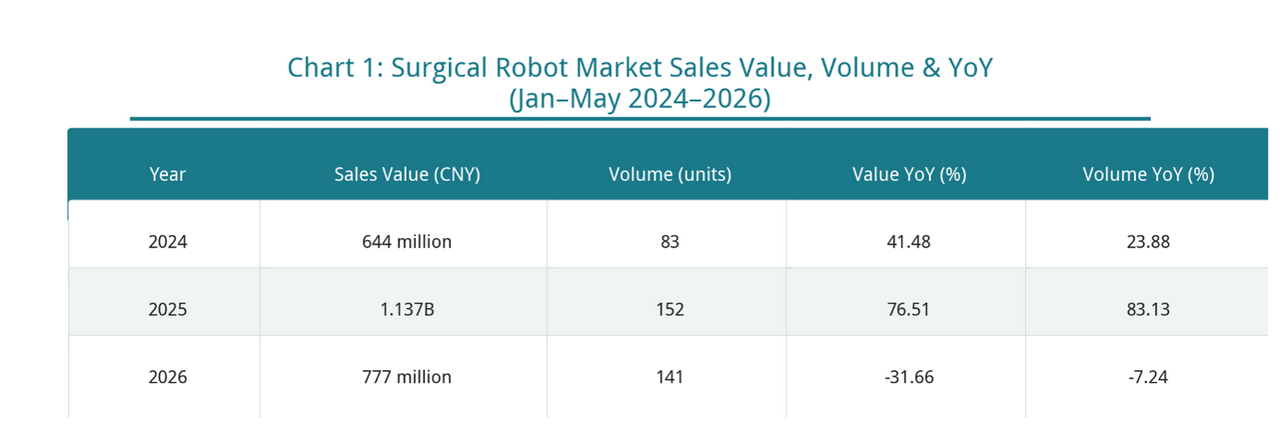
From the overall market performance, China's surgical robot market recorded sales of RMB 777 million and volume of 141 units in the first five months of 2026.
Reviewing data for the same period over the past three years:
From January to May 2024, the market recorded sales of approximately RMB 644 million, up 41.48% YoY, with volume of 83 units, up 23.88% YoY.
In 2025, the market expanded further to RMB 1.137 billion, with volume reaching 152 units. Sales value increased 76.51% YoY and volume increased 83.13% YoY, hitting the highest level for the same period in recent years.
Entering 2026, the market saw a phased pullback. Sales value fell 31.66% YoY and volume fell 7.24% YoY.
On June 3, 2026, the website of the China Securities Regulatory Commission (CSRC) showed that Beijing Surgerii Robotics Company Limited and its sponsor CITIC Securities had submitted the Report on Completion of Tutoring Work to the Beijing Bureau of the CSRC. This marks the completion of Surgeri Robotics' STAR Market IPO tutoring, bringing it one step closer to formally submitting its listing application.
This progress is not an isolated event.
Over the past few years, China's surgical robot industry has completed the first round of industrialization validation spanning R&D, clinical verification, registration approval, and capital market listing. TINAVl Medical Technologies, MicroPort MedBot, and Shenzhen Edge Medical have successively entered the public capital markets; Edge Medical's STAR Market IPO passed review in 2023; Shanghai Simple Touch Robot has also submitted a listing application to the Hong Kong Stock Exchange, reflecting continued capital-market activity among percutaneous intervention robotics companies.
The fact that a growing number of enterprises are entering the IPO stage signals a shift in industry competition.
The focus of capital market attention is no longer whether an enterprise owns a robotic product, but whether the product can achieve scaled installation, sustained clinical application, and stable commercialization revenue. In other words, China's surgical robot industry is gradually transitioning from the “technology validation phase” to the “commercialization validation phase.”
Market data has thus become the most direct window through which to observe this transformation.
It is worth noting that the decline in volume was significantly smaller than the decline in sales value.
This phenomenon indicates that the current market is not experiencing rapid demand contraction, but rather that the product mix is undergoing changes. As Chinese products continue to scale up and more mid-to-low-priced products enter the market, the proportion of high-priced models has declined, driving the industry's overall transaction prices to gradually return to rational levels.
From the perspective of industry development patterns, this is typically an important characteristic of the market transitioning from the demonstration-and-application stage to the scaled-popularization stage.
II. Segment Breakdown
Orthopedic and Laparoscopic Robots as Dual Core Driver
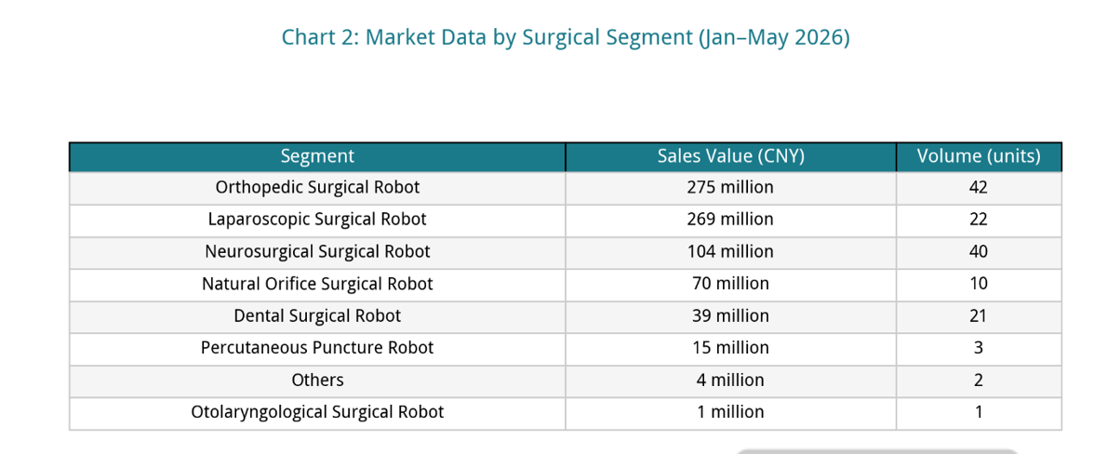
From the perspective of segment structure, orthopedic surgical robots and laparoscopic surgical robots remain the two largest categories by market size.
Among them: Orthopedic surgical robots achieved sales of RMB 275 million and volume of 42 units; laparoscopic surgical robots achieved sales of RMB 269 million and volume of 22 units. The two major tracks together contributed approximately RMB 544 million in sales value, accounting for nearly 70% of the overall market, and remain the core pillars of industry development.
Unlike laparoscopic robots, which are subject to large medical equipment configuration license regulations, orthopedic robots do not require such a license. With a relatively lower procurement threshold, they hold certain advantages in installation and promotion.
From the perspective of volume, neurosurgical robots have gradually formed a trend of scaled procurement, reflecting the continuously increasing acceptance of brain surgery navigation and robot-assisted positioning technology in clinical applications.
In addition, natural orifice robots achieved sales of nearly RMB 70 million and volume of 10 units; dental robots achieved sales of RMB 39 million and volume of 21 units; percutaneous puncture robots achieved sales of RMB 15 million and volume of 3 units.
Overall, China's surgical robot market is gradually breaking away from the past pattern of “laparoscopic robots standing alone,” entering a new stage of coordinated development across multiple specialties including orthopedics, neurosurgery, dentistry, and natural orifice surgery.
III. Brand Competitive Landscape
International Leaders Retain Advantages; Domestic Enterprises Accelerate Catch-up
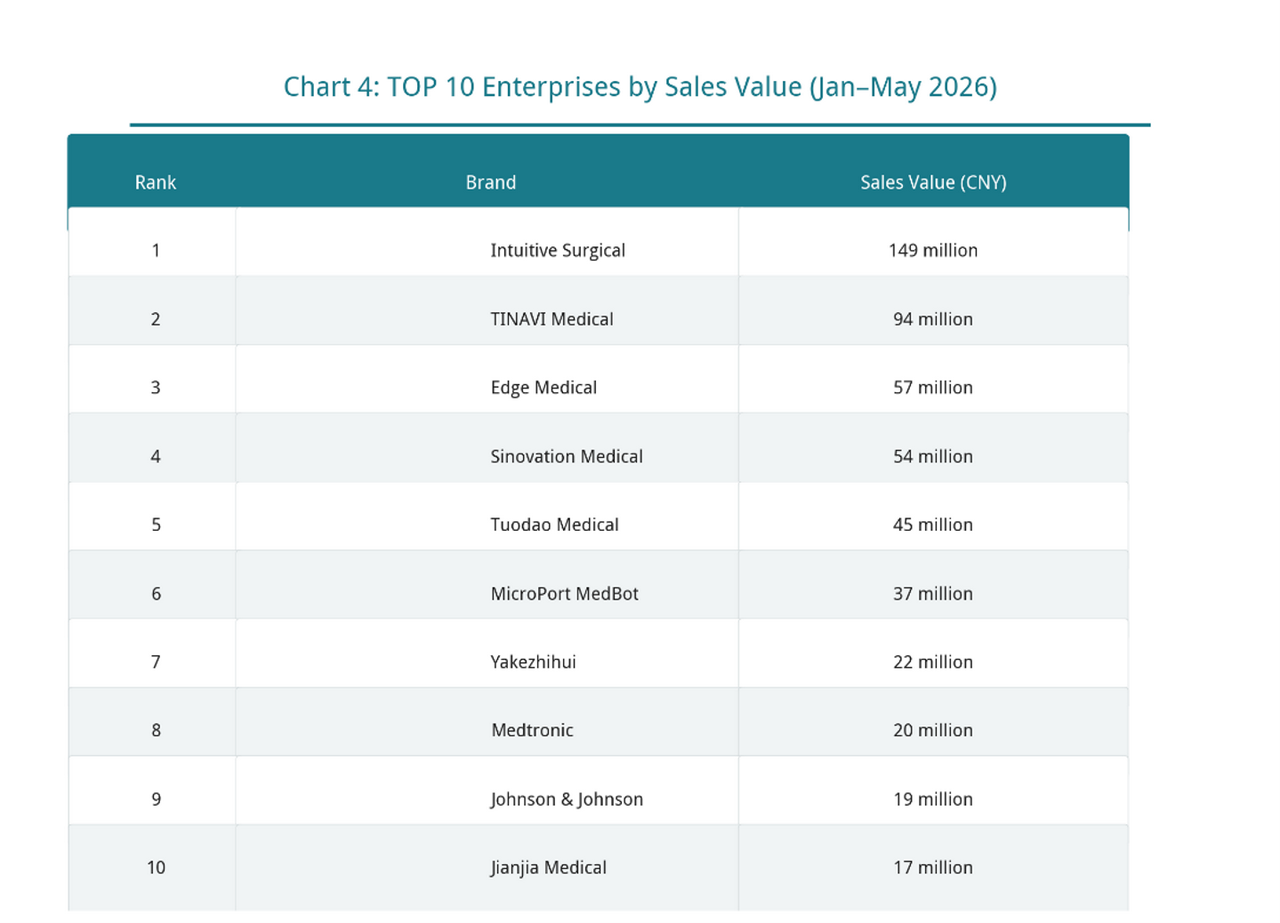
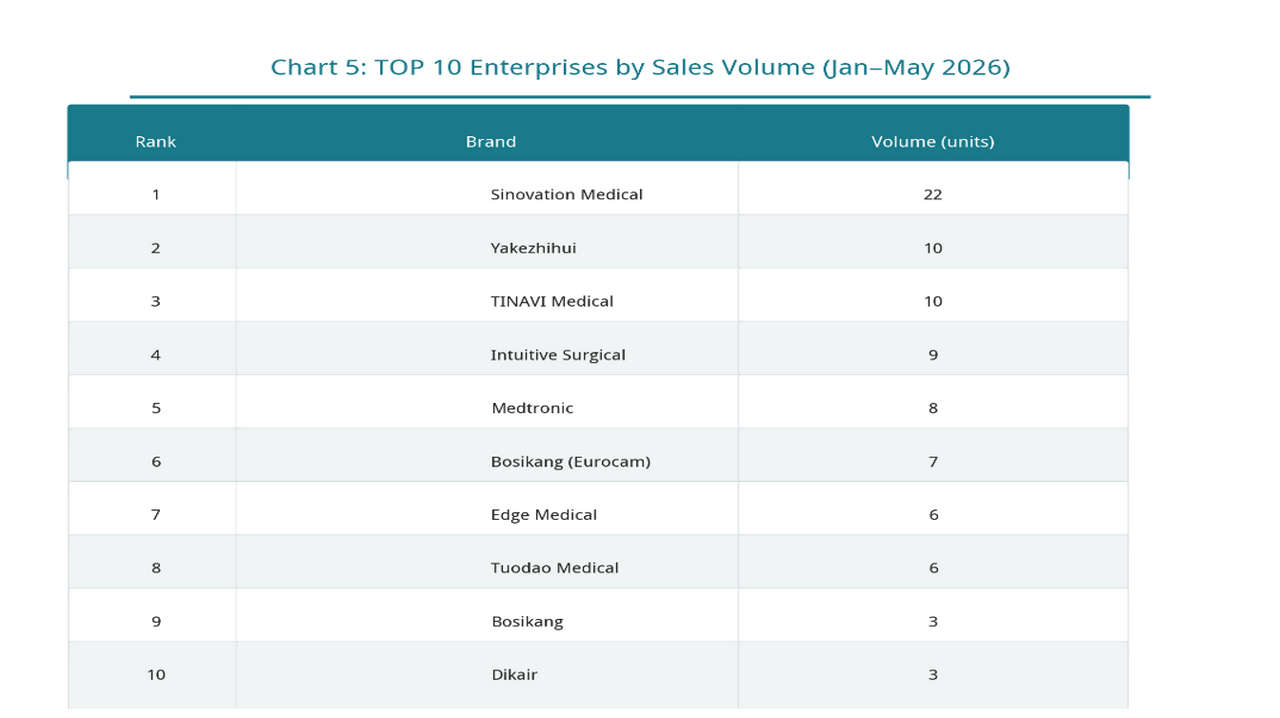
From the perspective of sales value ranking, international leading enterprises still maintain their leading advantage.
In the first five months of 2026, Intuitive Surgical ranked first in the market with sales of RMB 149 million, occupying an industry-leading position. As the owner of the da Vinci surgical robot, Intuitive Surgical retains strong market influence by virtue of its mature product system and long-accumulated clinical foundation.
Among Chinese enterprises, TINAVI Medical Technologies ranked second with RMB 94 million in sales. SenseRobot, Huake Precision, Tuodao Medical, MicroPort MedBot and other Chinese brands followed closely behind, together forming the first echelon of Chinese robots.
Observing from the perspective of sales volume, the market pattern presents different characteristics. Huake Precision ranked first in the industry with 22 units; Yake Smart and TINAVI Medical Technologies both achieved sales of 10 units; Intuitive Surgical and Medtronic sold 9 and 8 units respectively.
From the above analysis, it can be found that leading sales value does not completely equate to leading sales volume.
Some high-end robots occupy the sales value advantage by virtue of their higher unit prices, while specialty robots such as neurosurgical and dental robots achieve market penetration through higher installation volumes. Industry competition is gradually shifting from product R&D competition to commercialization capability competition.
Whoever can enter more hospitals, cover more departments, and achieve sustained clinical application will become the core of future market competition.
IV. Procurement Entities Grade 3 Class A Hospitals Remain the Market Core
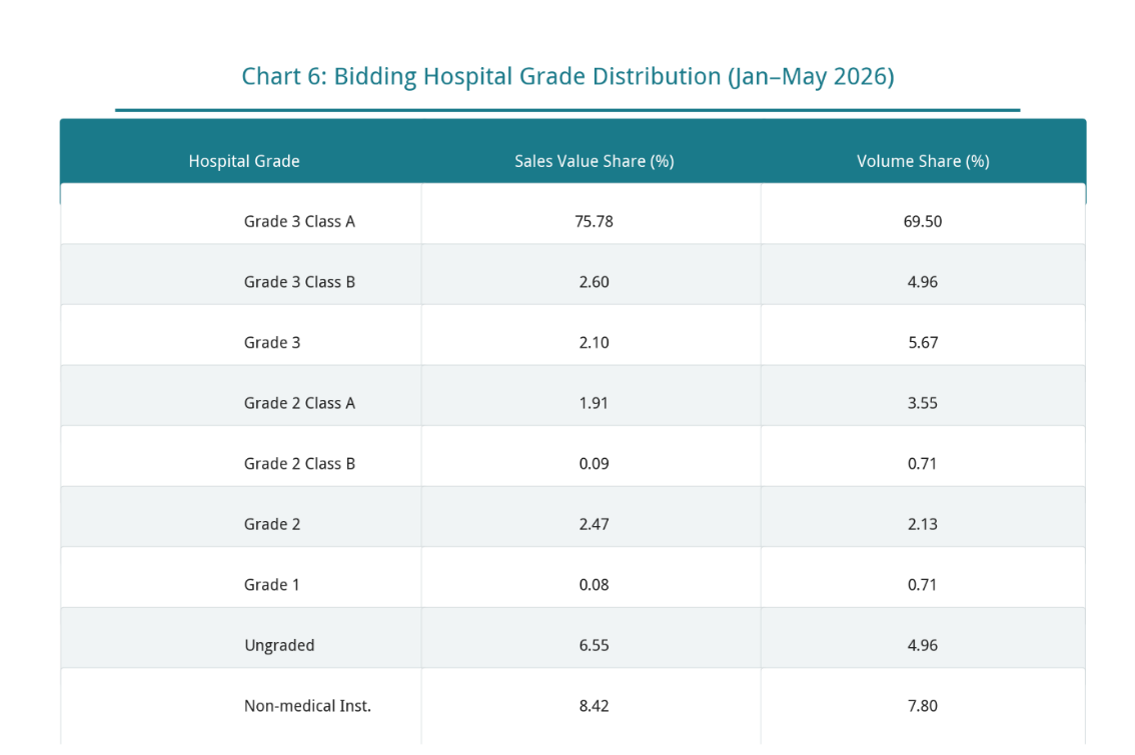
From the perspective of procurement entity structure, Grade 3 Class A hospitals remain the most important procurement force in the current surgical robot market. Data shows that Grade 3 Class A hospitals contributed 75.78% of market sales value and accounted for 69.50% of total volume. Whether from the perspective of procurement amount or procurement quantity, Grade 3 Class A hospitals still constitute the fundamental base of the market.
Non-medical institutions accounted for 8.42% of market sales value, ranking second, reflecting that research institutions, teaching platforms, and related experimental centers remain an important component of robot procurement. Grade 3 Class B hospitals, other Grade 3 hospitals, and Grade 2 medical institutions together contributed approximately 9% of market sales value. Although their share is still low, they have begun to form sustained procurement demand.
Overall, the current surgical robot market remains highly dependent on top-tier hospitals. However, as product prices gradually decline and the medical insurance payment system continues to improve, the downstream market is expected to become an important incremental source for the future.
Conclusion
2026 marks an important turning point for the surgical robot industry.
If the core task of China's surgical robot industry over the past decade was to complete technological breakthroughs and obtain product approvals, then the current industry is entering a new stage of commercialization capability validation.
From the perspective of market data, although the surgical robot market experienced a phased adjustment in the first five months of 2026, the underlying logic of industry development has not changed.
On one hand, orthopedic and laparoscopic robots still constitute the main body of the market; on the other hand, segments such as neurosurgery, dentistry, and natural orifice surgery are gradually opening up market space, and the industrial pattern of multi-specialty coordinated development has initially taken shape.
For enterprises, the key to future competition is no longer just the number of registration certificates and technical parameters, but rather hospital installation capability, clinical promotion capability, and commercial operation capability.
At the same time, the number of approved products continues to increase, the supply capacity of domestic enterprises continues to grow, and market competition is gradually shifting from “whether one has a product” to “who can achieve scaled application”.
For hospitals, as the medical insurance payment system gradually improves and the product pricing system continuously optimizes, surgical robots are gradually penetrating from being an innovative configuration of a few large medical centers toward more specialties and medical institutions.
And for the capital market, the fact that a growing number of surgical robot enterprises are entering the IPO stage essentially reflects that the industry has walked through the technology-validation cycle and is beginning to enter the commercial-value realization cycle.
What will determine enterprise value in the future may no longer be how many innovative technologies one possesses, but rather who can truly transform technology into clinical value, and ultimately form sustainable market demand.
From this perspective, 2026 may not be the year of fastest growth for China's surgical robot market, but it is likely to become an important watershed for the industry's transition from technology-driven to commercialization-driven development.