The fluctuations in the CT market during 2026 were both unexpected and inevitable.
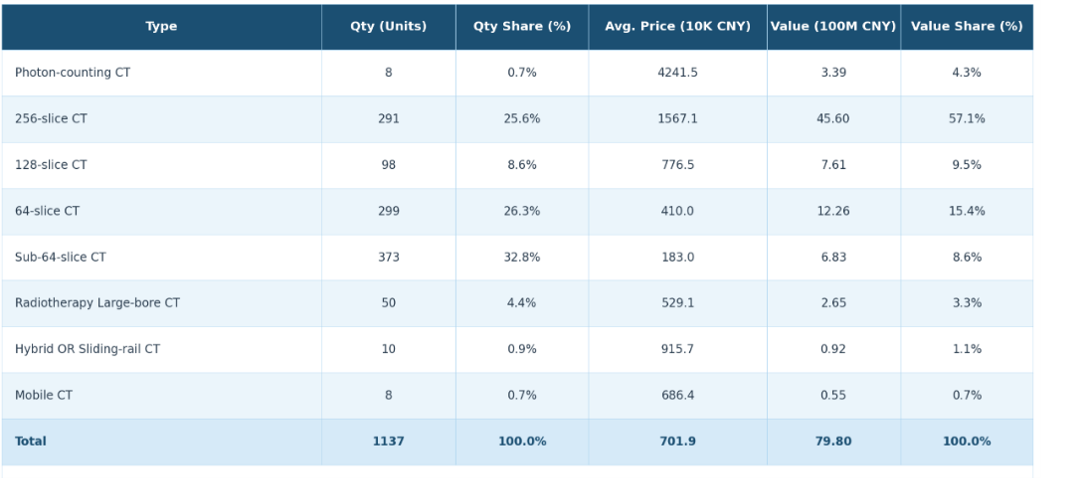
In the first half of 2026 (H1), based on public tender data, a total of 1,137 CT units were procured, amounting to approximately RMB 7.98 billion. Factoring in non-disclosed transactions, China's total CT procurement volume for H1 2026 is estimated at approximately 1,624 units, with a total value of around RMB 11.4 billion, representing a year-on-year decrease of about 24.7%. Details are as follows:
1)Photon-counting CT sales declined by 55.6% YoY, indicating that the initial wave of demand has largely been satisfied. Due to high procurement costs, a significant second wave of demand has yet to emerge.
2)256-slice CT sales grew by 28.8% YoY, while 128-slice CT sales fell by 46.6% YoY. Demand for high-end CT remains robust, though the market increasingly recognizes the premium positioning of 256-slice systems.
3)64-slice CT sales increased by 26.9% YoY, confirming its status as the most cost-effective product for medical institutions.
4)Sub-64-slice CT sales dropped by 38.0% YoY. This reflects both near-saturation in primary care settings and an ongoing upgrade trend toward 64-slice systems at the grassroots level.
I. Industry Overview and Centralized Procurement (VBP)
Regarding end-user hierarchy, Grade 3 Class A hospitals remain the dominant purchasers, accounting for approximately 29.2% of total procurement volume and 50.7% of total value. Procurement has further concentrated in tertiary hospitals compared to the same period last year.
In terms of market segments, the share of sub-64-slice CT has fallen to 32.8%. Procurement continues to shift toward 64-slice and higher systems, particularly 256-slice CT and photon-counting CT. These two segments combined accounted for 26.3% of units procured but represented 61.4% of total expenditure.
Meanwhile, procurement of radiotherapy large-bore CT and hybrid OR sliding-rail CT remained largely consistent with the same period last year. This supports forecasts of a stable annual baseline of 100–150 units for large-bore CT and 30–50 units for sliding-rail CT.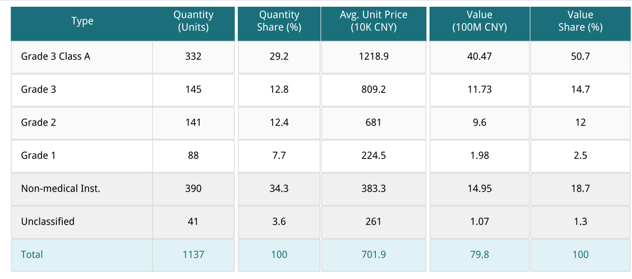
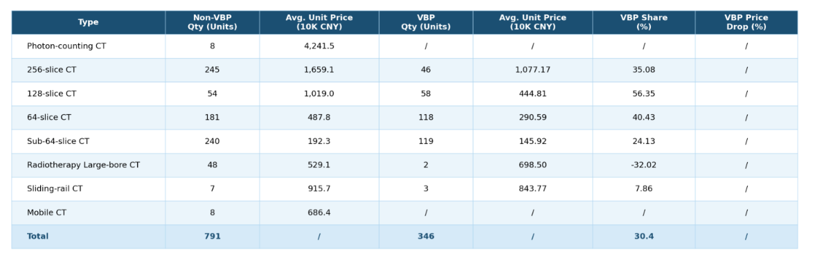
 The IBMD Data Center discloses, for the first time, VBP performance data for CT in H1 2026.Average unit prices fell as follows: 256-slice CT down 35.39% YoY, 128-slice CT down 53.01% YoY, 64-slice CT down 40.43% YoY, and sub-64-slice CT down 13.61% YoY.
II. CT Industry Scorecards
Statistics indicate that China's CT market comprises nearly 100 brands. In H1 2026, 20 brands recorded sales volume, including approximately 14 in conventional CT and 6 in mobile CT.
In terms of market share, the industry exhibits a distinct three-tier structure:
Tier 1: United Imaging Healthcare, GE Healthcare, Siemens Healthineers.
Tier 2: Philips, Neusoft Medical.
Tier 3: Anke High-Tech, SinoVision, Canon Medical Systems, Wandong Medical.
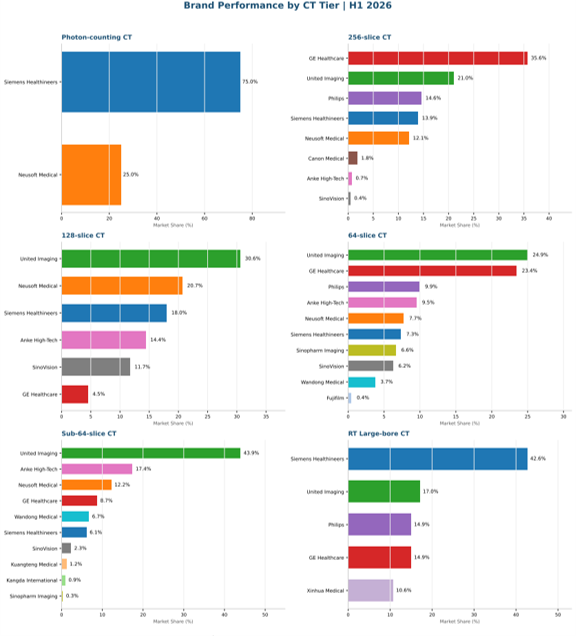
The CR5 (top 5 vendors) captured 81.8% of total units and 92.3% of total value, underscoring extreme market concentration. United Imaging Healthcare (UIH) has secured the top position across both metrics. GE, Siemens, and Philips maintain strong performance in high-end and 64-slice segments. Anke has emerged as a notable contender, particularly excelling in VBP scenarios. Consolidated brand rankings by CT segment (H1 2026) are summarized below.
1. Photon-Counting CT
In H1 2026, public tenders recorded 8 photon-counting CT units procured, totaling approximately RMB 393 million, with an average unit price of about RMB 42.415 million. Adjusting for non-disclosure, the estimated national volume is 11 units, valued at approximately RMB 485 million.
2. 256-Slice CT
In H1 2026, public tenders recorded 291 units of 256-slice CT (including 256/320-slice, high-end dual-source, and dual-layer detector systems), totaling approximately RMB 4.56 billion, with an average unit price of about RMB 15.671 million. Adjusting for non-disclosure, the estimated national volume is 416 units, valued at approximately RMB 6.515 billion.
3. 128-Slice CT
In H1 2026, public tenders recorded 98 units of high-end CT (including 128/160-slice and dual-source systems), totaling approximately RMB 761 million, with an average unit price of about RMB 7.765 million. Adjusting for non-disclosure, the estimated national volume is 140 units, valued at approximately RMB 1.087 billion.
4. 64-Slice CT
In H1 2026, public tenders recorded 299 units of high-end CT (including 64/80-slice systems), totaling approximately RMB 1.226 billion, with an average unit price of about RMB 4.100 million. Adjusting for non-disclosure, the estimated national volume is 427 units, valued at approximately RMB 1.751 billion.
5. Sub-64-Slice CT
In H1 2026, public tenders recorded 373 units of high-end CT (including 16/32/40/48-slice systems), totaling approximately RMB 683 million, with an average unit price of about RMB 1.830 million. Adjusting for non-disclosure, the estimated national volume is 533 units, valued at approximately RMB 975 million.
6. Radiotherapy Large-Bore CT
In H1 2026, public tenders recorded 50 units of radiotherapy large-bore CT, totaling approximately RMB 265 million, with an average unit price of about RMB 5.291 million. Adjusting for non-disclosure, the estimated national volume is 71 units, valued at approximately RMB 378 million.
7. Hybrid OR Sliding-Rail CT
In H1 2026, public tenders recorded 10 units of hybrid OR sliding-rail CT, totaling approximately RMB 92 million, with an average unit price of about RMB 9.157 million. Adjusting for non-disclosure, the estimated national volume is 14 units, valued at approximately RMB 131 million.
9. Mobile CT
In H1 2026, public tenders recorded 8 units of mobile CT, totaling approximately RMB 55 million, with an average unit price of about RMB 6.864 million. Adjusting for non-disclosure, the estimated national volume is 11 units, valued at approximately RMB 78 million.
Statistical Period: 2026 (Announcement dates: January 1, 2026 – June 30, 2026).
Statistical Scope: Based on publicly disclosed winning bid data. Excludes undisclosed projects. Certain fields (brand, model, price) may be incomplete; price gaps were not filled. Excludes maintenance contracts, spare parts, and other non-new equipment procurements.
Data Sources: Publicly collected from national/provincial government procurement websites, public resource trading centers, hospital tender portals, major Chinese third-party bidding data platforms, and select tender agencies.
Guangdong Institute of Advanced Biomaterials and Medical Devices (IBMD), China
A public institution of Guangdong Province, China.
Established by South China University of Technology, with the support of four national ministries and commissions.
Led by Professor Wang Yingjun, Member of the Chinese Academy of Engineering.
Focused on collaborative innovation and technology commercialization in advanced medical devices and biomaterials.
IBMD Data Center
Medical device data governance, analytics, and digital applications.
Covering registration, regulatory oversight, procurement, market access, clinical application, medical insurance reimbursement, and industry development.