This month I've revised the overall structure of the game and come up with something I'm happy with, but I haven't had a lot of time to work it so I haven't getten back to the writing yet. But the project was actually in a good place for me to step back and let it “lie fallow” for a little while, so taking a break at this point will hopefully help me overall.
But that means I don't have anything to show in this diary, so instead here is a fluffy listicle of some of my favourite space villains who inspired the game, and my personal crazy fan theories about each of them. (These are in chronological order of first appearance.)
Ming the Merciless
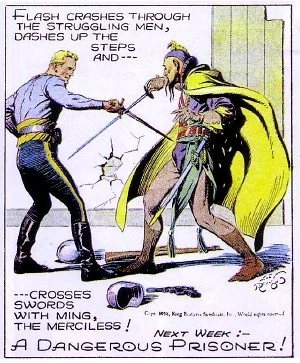 First appearance: Flash Gordon Sunday newspaper strip, 1934.
Ming is a cruel and scheming politician who gained usurped the rightful emperor of Mongo and who now rules the planet with an iron fist.
Ming started out as a “yellow peril” stereotype with his fu manchu mustache and orientalist palaces, but this aspect of his character was downplayed almost immediately. As Alex Raymond's art style evolved, Ming's skin changed from bright yellow to a more natural colour, and as the strip moved into the late 30s Ming and his minions looked and acted less like orientalist fantasy villains and more like real-life Nazis.
(When Raymond eventually left the Flash Gordon strip in 1944 it was to enlist in the U.S. Marines, which he insisted on doing despite having already done enough military service to be exempt from the draft.)
Interestingly, the idea of Ming wanting to conquer the Earth is actually not in the original comics, but first appears in the 1936 movie serial. Ming's goals in the early comics are to forcibly marry Dale Arden and to retain control of his empire in the face of rebellious vassals and a population that hates him. Later versions of Flash Gordon have given Ming more far-reaching ambitions, and have tended to downplay his orientalist origins even further by e.g. making him a grey-skinned alien.
My fan theory: Ming wants to marry Dale Arden not because he lusts after her (although he does), but because she exists outside the Mongothic social structure and thus solves a political problem. If he marries a noble it'll affect the balance of power between his vassals, and if he marries a commoner he'll lose everyone's respect, but Dale is from another planet, so he can present her as some kind of exotic alien princess. This is also why (in the original 1930s comic) he loses interest in Dale once Princess Aura has given him a grandson, instead shifting his focus to kidnapping the baby in order to raise him as his ideal heir.
The Mekon
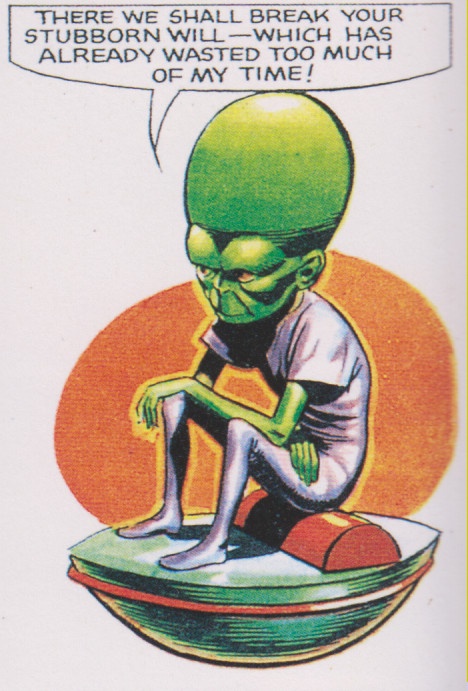 First appearance: Eagle comic, 1950.
The first Dan Dare story introduces the Treens, reptilian aliens who have done away with emotions and devote themselves to remorseless scientific logic. Whereas Flash met Ming almost immediately, it is several months before Dan meets the Mekon, a diminutive creature with a swollen head and atrophied body, whom the Treens had specifically engineered to be their super-intelligent ruler.
Unlike Ming and his quarrelling vassals, the Mekon has absolute authority over his Treens—at least until the end of the first story, when he is deposed and flees into space. After that he pops up in roughly every second story, with a small band of fanatically loyal Treens and a new plan to conquer the Earth.
(Once the Mekon is removed, most of the Treens seem content to return to their ordered, scientific lives and live in peace with Earth people. I like to imagine Treen science lab directors being quietly relieved to be able to focus on their obscure research areas now that this disruptive business of conquering the universe is out of the way.)
The Mekon remains mostly unchanged across all the later versions of Dan Dare, although the 2007 Garth Ennis/Gary Erskine version does redesign his flying chair to finally give it a back rest. Possibly if his chair had been more ergonomically designed from the start, he wouldn't have been so unpleasant.
My fan theory: We know that the Mekon is the last in a long line of similar Mekons, so why does this Mekon have designs on conquering the universe when previous ones seemed content to keep Treen society running? Perhaps this Mekon is defective somehow, dominated by unusually powerful emotions that he can't admit to himself and doesn't have the ability to process. Perhaps a “normal” Mekon would look at him in disgust...and perhaps, deep down, he knows that...
Davros
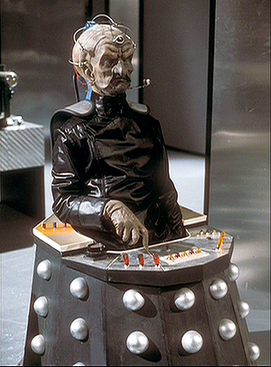 First appearance: Doctor Who, “Genesis of the Daleks”, 1975.
Doctor Who has lots of great villains, but the one that's most relevant to this list is Davros, creator of the Daleks.
Like the Mekon (who partially inspired him), Davros is super-intelligent but physically frail, and is confined to a mobile life support unit. That life support module was also the design basis of the Daleks, whom he intended to be the ultimate life-form according to his genocidal ideology—so he resembles an intermediate step between Daleks and ordinary humanoids.
Davros is an unusual villain in that he's super-intelligent but still treats the hero as an intellectual equal, or at least close enough to one to engage them in philosophical conversations. (Ming and the Mekon might monologue at their respective heroes, but there's never a chance that they'll listen to what the hero says and change their mind.) “Genesis of the Daleks” is in part a sort of intellectual duel between the hero and villain, one in which the villain listens to what the hero says, is confronted with the philosophical ramifications of their plans, realises that they're utterly evil—and decides to do it anyway.
My fan theory: Even when Davros is seemingly in charge of things, he only exists because the Daleks keep resurrecting him and keeping him alive—and they only do that because they need his non-Dalek intelligence to deal with some problem—which is usually the Doctor—so in a sense Davros only continues to exist because the Doctor does. (Actually I'm not sure this is a fan theory, it might be canon, but I'm not enough of a Doctor Who nerd to be sure.)
The Borg Queen
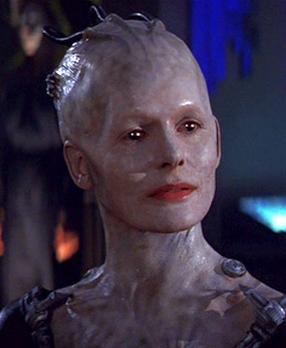 First appearance: Star Trek: First Contact, 1996.
The Borg, like the Daleks, were introduced without an overall leader, and in fact their lack of individual identity seemed to make such a concept meaningless. The Star Trek story “The Best of Both Worlds” gave them a temporary spokesperson in the form of an assimilated Picard (who called himself “Locutus of Borg”), which implied that the Borg might do a similar thing when dealing with other species they wanted to assimilate. The fact that the Borg didn't have individuals in the normal sense was one of the things that made them alien and scary. They were a sort of twisted mirror image of the Federation, an interplanetary culture based not on diversity but on a complete negation of diversity.
So the introduction of an individual ruler of the Borg, in the form of the Borg Queen, would seem to contradict one of the things that makes the Borg work—but she's such a great villain that I think they get away with it.
Like the previous villains in this list, the Queen is intelligent and articulate, but unlike them hers is an alien intelligence because it's bent towards utterly inhuman goals. Conquering the universe and enslaving or exterminating everyone is evil, but it's understandable; assimilating everyone into a hive mind is a science fiction concept that requires an imaginative leap; and an individual intelligence devoted to a hive-mind goal is a further conceptual leap. And the visual design, with its seamless integration of flesh and technology, is great.
My fan theory: The Borg Queen isn't an individual with a continuous identity, but something the Borg collective can sort of extrude when it needs an administrative or diplomatic focal point, whenever and wherever is required. So the question of whether the Borg Queen who dies at the end of First Contact is “the same” as the one who later appears in Voyager is meaningless.
Bonus fan theory: Assimilated Picard is called “Locutus of Borg” because that's the kind of pretentious Latinate name the Borg would get from rummaging around in Picard's subconscious. If they'd assimilated Riker he'd have called himself something straightforward like “Speaker for the Borg”.
*
OK that's all for now. I'm hoping that next month I'll have time to make progress on the game so I'll be able to give you a normal developer diary at the end of May.
Will Vorak, the Master Brain join this canon of space villains, or will our hero fail to make progress once again? Find out in next month's developer diary...
#FoolishEarthCreatures #DevDiary #FlashGordon #DanDare #DoctorWho #StarTrek