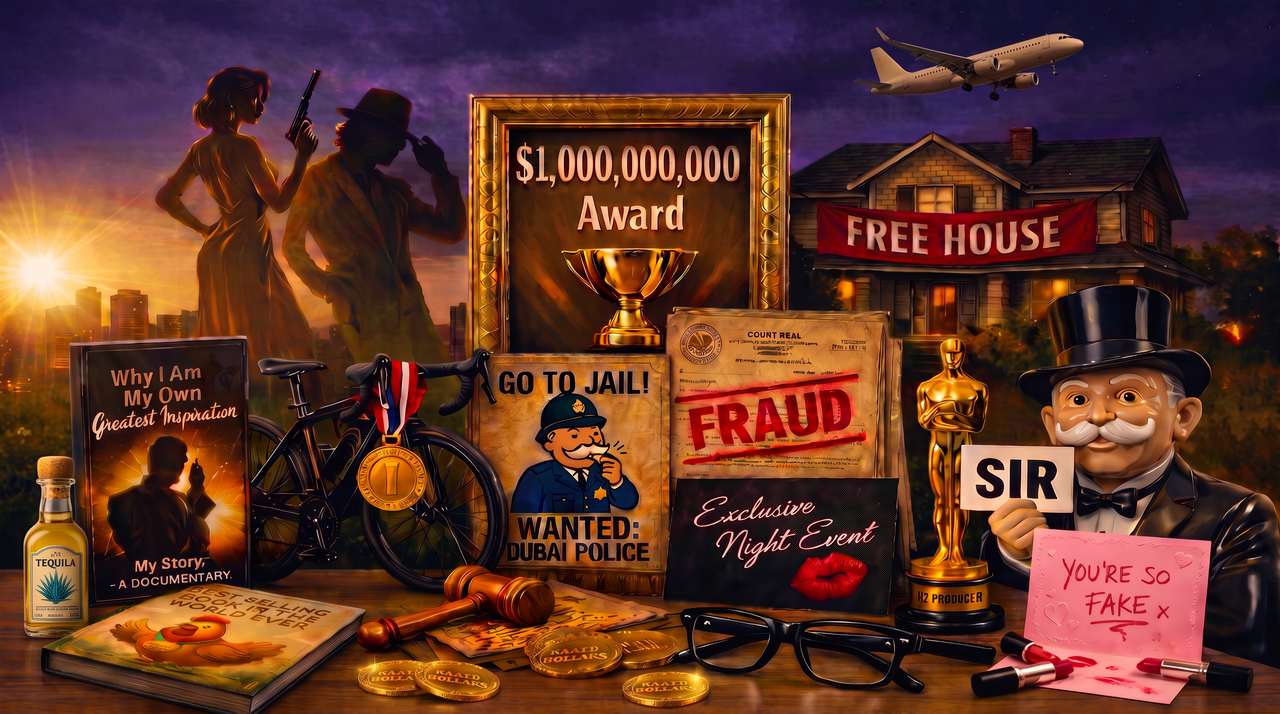
Beyond Deadline: An independent investigation into Marco Robinson, the Start Over program, the scam accusations, litigation history, negative customer reviews, his Naked Diablo Airlines association, and the verified evidence behind his public claims.
Click to expand Table of Contents (35 Sections)
- Introduction (TL;DR)
- 1. The Malaysian Timeshare Era (circa 1990s—Early 2000s)
- 2. The Billion Dollar Man
- 3. Time Shares: The Hard‑Sell Roots Behind the Reinvention
- 4. The Max Generation Blueprint: The First Draft of the Same Old Play
- 5. The Tatler Tale He Turned Into a Trophy
- 6. The Play Experience: The Unmentioned Venture
- 7. From Singapore Click Vote to ‘Investor of the Year’
- 8. Get a House for Free — Just Not From Marco
- 9. The “Property Mogul” Illusion
- 10. The Naked Technologies Crypto Scandal
- 11. #2 Netflix Producer: #1 in Judgments Against Him
- 12. Coaching Zeroes — A Movement So Inspiring Even Its Co Founder Left
- 13. Naked Diablo: The Night He Declared His Tequila Era
- 14. Rob Fitzpatrick: The Global Mogul, Per His Own Homepage
- 15. A Premium Tequila Brand — According to Marco & Rob
- 16. The “Award Winning” Tequila Show With No Awards
- 17. When # IPO Means “Imaginary Public Offering”
- 18. Start Over: The Six Figure Investment With a Zero Figure Paper Trail
- 19. Naked Diablo Airlines: Disrupting the Ability to Find Any Trace of It
- 20. The Magazine Mirage: Buying the Appearance of Credibility
- 21. Times Square: Where Marco Is Happiest Being Amazed by Marco
- 22. “295,000 Followers and 50 Likes?” — The Maths not Mathsing
- 23. ‘Sir’ Marco Robinson
- 24. Why Be One Thing When You Can Be Everything?
- 25. The Marco Mitty Problem
- 26. “The Best Selling Book Series Since Chicken Soup for the Soul,” Apparently
- 27. Bestseller by Screenshot, Not by Sales
- 28. The Industry Blueprint Behind Start Over — And How It Ended in Federal Court
- 29. A Scheme Already Written to Its Ending
- 30. The “Give Back” Charity That Forgot the ‘Charity’
- 31. Criticism & Tantrums
- 32. The Paid Newswire Echo Chamber: Pushing Down the Truth
- 33. Giving Himself A Standing Ovation
- 34. Personal Life
- The Marco Mitty Finale: A Life Lived in Fiction
- Sources
Introduction (TL;DR)
This post won’t re‑cover the ground already addressed in the Deadline article, nor will it revisit the Start Over programme which is examined separately in Marco Robinson & Start Over — A Closer Look. Instead, this piece digs into the parts of Marco Robinson’s history that Deadline didn’t touch. And when you look at the full record, his entire public persona collapses under basic fact‑checking.
His billion‑dollar timeshare claims are arithmetically impossible, his “award‑winning” restaurant was just a directory listing, his £25m property empire never existed in his own filings, his crypto project collapsed leaving investors with nothing, his tequila “success” is just a failed restaurant house‑pour rebranded as a global empire he never built, his airline exists only in his imagination, and his magazine covers were bought, not earned. A major chapter of his past — a publicly promoted adult‑nightlife venture that most of his current followers have no idea ever existed — has quietly disappeared from his self‑presentation. So has the fact he’s an absconded convict in the UAE. His personal stories change with the weather, his romantic relationship is unstable and often performative, and when faced with criticism he typically defaults to defensiveness and self‑victimisation rather than accountability.
Across every domain — business, biography, relationships, reputation — the pattern is the same: nothing holds up under scrutiny.
The only thing consistent about Marco Robinson is the fiction.
1. The Malaysian Timeshare Era (circa 1990s–Early 2000s)
Marco Robinson began his career in commission‑only timeshare sales, eventually joining Tanco Resorts Berhad, the vacation‑ownership arm of Tanco Holdings Berhad, a publicly listed Malaysian property and leisure group.
In his modern promotional mythology, Robinson claims he “transformed the company” and personally generated $1 billion in sales.
However, public financial filings from Tanco Holdings during his tenure (circa late 90s/early 2000s) prove this number is a total arithmetical impossibility.
During the late 1990s and early 2000s, Tanco Holdings was a micro‑to‑small‑cap company still recovering from the 1997 Asian Financial Crisis. Its total market capitalisation sat in the tens of millions of Malaysian Ringgit (MYR) — nowhere near the scale of a major regional player, let alone a billion‑dollar enterprise.
At the time, the Ringgit was pegged at 3.8 MYR to 1 USD, meaning even RM 1 billion in total sales would convert to roughly $260 million USD. Tanco was never valued at that level, never generated revenue on that scale, and never operated in a market segment capable of producing it. Against that backdrop, Robinson’s claim that he personally drove $1 billion USD in sales is not just exaggerated, it is completely impossible.
Marco Robinson did not even work for the main listed parent company; he worked for Tanco Resorts Berhad, which was just one subsidiary branch handling the timeshare club. The timeshare branch made up only a slice of Tanco’s modest revenue, alongside their construction and property divisions.
For a single sales manager of a minor subsidiary to personally generate $1 billion USD in sales would mean he somehow generated significantly more money than the entire parent company was worth, owned, or traded on the stock exchange.
The claim of generating $1 billion dollars in sales isn’t just exaggerated, it falls apart the moment you compare it to the company’s actual size.
A more recent version of the story inflates the numbers even further. In updated promotional copy, Robinson now claims he “helped transform” Tanco Resorts into a business “valued at more than $6 billion.” This figure not only contradicts his earlier “$1 billion in sales” story, it is even further removed from Tanco’s actual financial reality. The parent company never approached anything close to a billion‑dollar valuation, let alone six.
The escalation from $1B to $6B isn’t evidence of success, it’s evidence of a story that grows each time he retells it.
2. The Billion Dollar Man
When you look for actual proof, independent business journalism and public financial records show absolutely nothing.
There is no regulatory filing, stock exchange disclosure, or independent news reporting that confirms Robinson’s exact job title, his corporate seniority, or his role in Tanco’s expansion decisions. There is no proof he introduced their points system, and zero audited evidence that he had any measurable financial impact on the company’s bottom line.
Tanco Holdings Berhad’s audited annual reports and Bursa Malaysia disclosures from the late 1990s and early 2000s — the exact period Robinson references — contain no mention of him whatsoever. These filings document the company’s leadership, subsidiaries, revenue streams, and strategic decisions in detail. Robinson does not appear in any of them (search under Tanco Holdings (2429) or Tune Protect (5230), and look for any mention of his name in their historical audited filings. You will find absolutely nothing).
Every online claim attributing Tanco’s corporate evolution to Robinson traces back to his own self‑published Medium posts, his personal websites, or paid PR distribution networks that disguise sponsored content as journalism.
But beyond the missing paper trail, Robinson’s “Billion Dollar Man” claim collapses the moment you apply the calculations his own boast inevitably invites.
He says he was a commission‑only timeshare sales manager in Malaysia. On that structure, a standard 5–10% managerial override on $1 billion USD in sales would have paid him between $50 million and $100 million personally.
In that era, anyone earning that in Malaysia or Singapore would have been a visible business figure — profiled in regional press or, at UK thresholds, appearing in the Sunday Times Rich List. Instead, there is no trace of such wealth anywhere, only a later return to the UK marked by tiny property shells and pay‑to‑participate book schemes.
Even the origin story behind this supposed success — being “headhunted from Manchester to Asia” at 27 — exists solely in his own self‑written biography and has never been corroborated by any employer, filing, or independent source.
In other words, the “Billion Dollar Man” story isn’t backed by Tanco, by records, or by reality — it survives only because Marco Robinson keeps telling it.
3. Time Shares: The Hard‑Sell Roots Behind the Reinvention
The Malaysian timeshare world Marco came up through wasn’t a “billion‑dollar proving ground”, it was one of the most notoriously hard‑sell ecosystems in Southeast Asia.
Throughout the 90s and 2000s the entire sector was awash with boiler‑room tactics, pressure‑cooker closing rooms, and a conveyor belt of consumer complaints. Tanco Resorts wasn’t some exception — it operated in the same churn‑and‑burn sales culture that defined the industry.
It doesn’t prove Robinson personally crossed any lines, but it does show the truth behind his origin story: he didn’t rise from corporate brilliance, he rose from an industry where hype was currency, pressure was technique, and the “product” was whatever got someone to sign.
4. The Max Generation Blueprint: The First Draft of the Same Old Play
Circa the late 2000s to early 2010s, Robinson fronted Max Generation (MaxGen). In his own marketing copy, he describes it as a breakout vacation-incentive empire, claiming it generated more than $12 million in its first year by packaging unsold hotel rooms into corporate rewards.
Robinson’s promotional materials and sponsored articles list global corporations—including Citibank, IKEA, Shell, BMW, Mercedes-Benz, and Nikon—as clients. However, there is no public paper trail, independent business reporting, or documentary record to confirm the nature or scale of these corporate relationships.
The likely explanation for these listings involves third-party incentive marketing. If a regional branch or local dealership purchased bulk travel vouchers from MaxGen for a seasonal promotion, the parent corporation could then be listed as a client in Robinson's marketing frameworks. Ultimately, without public contracts or corporate confirmation, these high-level corporate associations remain entirely self-reported.
Robinson explicitly states that he “has been hired by some of the biggest brands in the world,” utilising these corporate names to imply a high-level consulting pedigree. By placing these global giants directly next to discussions of business and executive strategy, the marketing builds a deliberate narrative of elite boardroom consultancy. In reality, because public corporate and operational registries leave no trace of MaxGen’s actual business activities, there is no independent confirmation that he ever consulted for these organisations, or that MaxGen engaged in any commercial business with them at all.
While MaxGen did leave a small regional footprint in Southeast Asia — mostly limited to scattered seminar listings and localized incentive events — there is no independent evidence that it operated at anything approaching the scale Robinson describes. The $12 million revenue claim remains entirely unsupported by external sources: there are no public audited accounts, no transparent corporate filings, no verified client confirmations, and no independent operational records consistent with a business generating an eight‑figure income. For a venture allegedly performing at that level, the absence of verifiable, third-party data is striking.
What survives from that era is an unmistakable operational blueprint. When the B2B voucher fulfilment model hit its limits, MaxGen pivoted into selling the strategy itself—hosting high-ticket seminars teaching business owners how to achieve 'financial freedom.' It ran on the same mechanics Robinson still uses today: big, round revenue claims with no documentation; self‑manufactured authority; and a closed ecosystem where the seminar upsell matters more than the initial product. It’s the prototype for Start Over — not a reinvention, just the same playbook with new branding.
5. The Tatler Tale He Turned Into a Trophy
Marco Robinson often claims that his former Kuala Lumpur venue, Naked Restaurant & Bar, “won Tatler’s Best Restaurant award,” but again, the facts don’t support that.
Malaysia Tatler did a routine write‑up on the venue in 2014, and the restaurant later appeared in Tatler’s annual dining guide — a large directory that lists hundreds of mid‑to high‑end restaurants each year.
But it isn’t an award, it isn’t a ranking, and it certainly isn’t a competitive title. Robinson simply removed all the context and reframed a standard directory inclusion as if Tatler had singled him out as the country’s top restaurant.
Meanwhile, ordinary diners on Tripadvisor were experiencing a reality that bore little resemblance to the award‑winning utopia described in Robinson’s promotional materials. Local reviews painted a picture of basic administrative chaos: slow kitchen service, painfully long waits for bills, and uncomfortably hot, humid seating. Most striking of all was a 2014 review warning future visitors to avoid the venue entirely “unless you enjoy being conned” — a choice of phrasing that, given the corporate manoeuvres to come, now reads with an almost ironic sense of foreboding.
As with many of his other claims, Robinson took an ordinary media mention, attached a luxury‑magazine logo to it, and spun it into a story of high‑end international success for his social media audience.
6. The Play Experience: The Unmentioned Venture
In 2015, Robinson’s emerging lifestyle‑branding efforts took a different turn when he was publicly presented as a co‑founder of an adult‑nightlife venture called The Play Experience, alongside business partner Sarah Banahan (Sarah Jane). The brand’s social‑media output promoted an overtly sexualised nightlife identity, using hashtags such as # erotica, # sexparty, and # debauchery, and positioning itself as a secretive environment for “high‑profile guests”.
As part of its promotional campaign, the venture announced a special‑invitation‑only launch event at Home House, the private members’ club in West London. In its own marketing copy, the brand described Home House as a “Pleasurable Palace” and framed the event as the beginning of a “fresh, new, exciting sexual revolution.” The founders claimed that “PLAY was created from equally sexy minds and people, who have indulged in the most decadent sexual experiences they could have EVER imagined,” presenting the project as a curated community built around exclusivity, fantasy, and erotic spectacle. Invitees were urged to “put the date in your diary — June 12th 2015” and register for a “free 30‑page Play Info Pack.”
Across its Instagram presence, The Play Experience used a wide range of explicit‑themed hashtags — including # spanking, # tieherup, # playkink, # spitorswallow, # themedsexparties, and # groupsex — as part of its promotional identity. The account also featured slogan‑style graphics with statements such as “More play. More intimacy. More passion. More sensations. MORE ORGASMS.” and “Kiss her until she sighs… and always respect her”. Another post stated, “Real women swallow because spitting isn’t ladylike.”
Some of the original slogan content contained graphic sexual language; in this rewrite, the most explicit wording has been removed for clarity and appropriateness, while representative examples are retained to document the brand’s marketing tone.
Additional Instagram posts from The Play Experience further illustrate the project’s tone, with accompanying text ranging from pseudo‑educational language about “taboo‑breaking” to open promotion of group sex and invite‑only orgies. The following examples are taken directly from the posts as originally published.
- “ANAL PLEASURE THROUGH ORAL SEX This year is predicted to be the year of the broken taboo, particularly as it pertains to exploration of anal pleasure. Outdated stigmas and assumptions are being shed and we’re shifting towards a more tolerant cultural space, even if it doesn’t always feel like it.”
- “If you are a sophisticated individual, you will also love new experimentation in sex. Therefore, we assume that having the same one on one sex with the same person everyday might make you become sick and tired after some times. You can come out of this rut when you indulge in group sex.”
- “WHAT ARE YOUR THOUGHTS ON GROUP SEX?”
- “The PLAY Experience invites you to a night of erotic couple swapping and playful debauchery, hidden in a secret private London residence in central London town.”
- “Take your pick...”
- “At this invite-only orgy for A-listers, the people are actually hot—and have sex with each other. An intrepid reporter discovers a secret sexual utopia for beautiful people!”
Archived versions of the now-defunct The Play Experience website, preserved on the Wayback Machine Internet Archive, show a far more explicit description of the venture than its Instagram presence.
The archived front page featured a promotional video showing Marco Robinson in nothing but his underpants, posing with co‑founder Sarah Jane in a series of highly eroticised clips, including one where he runs his hand over her buttocks and another showing him standing with his arms raised and his wrists secured in restraints while a photographer shoots him. The site featured promotional graphics including Marco on the information pack, and a site banner depicting him nude in a stylised sexual embrace with a young woman. It also reused the same BDSM‑themed imagery seen on social media. The archived pages described the events in unambiguous sexual terms. The following excerpts are taken directly from the website’s own published copy.
From the FAQ section:
“1. What is the Play Experience?
What we mean by that is most people’s impression of Sex Parties is Trashy, Seedy, Dirty, and downright shagging, without any Imagination at all…
We have been to those parties, and we have been extremely disappointed indeed..”
“3. What Kind of Events does The Play Experience offer?
There are presently Seven Options you can choose from as a Member; The Play Mansion, Fore‑Play, Extreme Play, Play Masks, Intimate Play, Play Away, VIP Yacht and Private Jet Parties.”
The events listed above are described in the Events section:
“PLAY Intimate: The AFTER PARTY, Only 35 people allowed. When all the fun has taken place, we like to chill for a while with some great music, great conversation and close intimate sex between friends and only friends. These are the MOST talked about parties at PLAY simply because the guests are ridiculously hot, erotic and intelligent… it really is unforgettable.”
“PLAY Away: Retreat Sex Vacations. To truly feel free, the only way to experience this is by leaving your home country to join us in a sun-kissed vacation retreat in a secluded boutique private resort where we have ALL of the hotel to ourselves and the Beach. This means you can delight in walking around naked or wear your favorite fetish outfit anywhere you want…”
“PLAY Mansion: The Private Residence Party where your luxurious decadent surroundings compel you to indulge in your favourite wines, food and foreplay…where you can watch other couples and groups in the main lounge or our swimming pool or take your own private party in your own private room.”
“PLAY Extreme: PLAY Hard in complete uninhibited heaven, The Shy are not welcome, the people who want to f..k hard and all night belong here, the people at this event want to be shown the meaning of true sex and orgasmic highs.”
There are three annual membership levels offered on the website: PLAY Elite for £3,995, PLAY Gold for £995, and PLAY White for £195.
The various levels offer free or discounted entries to all parties and “Play Sex Vacations”, the ability to bring a new couple with you, and even a “Meet the Founders Private Dinner” amongst other benefits — a perk Robinson would later recycle for Start Over, where VIP ticket‑holders are sold access to the exact same privilege.
The advertisement for the Play Gold Couple Swap held on 7th November 2015 lists that non‑members may pay £250 per couple to attend.
Beyond the archived website material, the venture’s social‑media presence echoed the same aesthetic. One promotional image showed Robinson wearing a suit in a stylised BDSM‑themed pose with a young woman, the same photograph used to advertise Play Extreme on the website, visually aligning his personal branding with the project’s erotic identity. The operation also promoted an online interview in which Banahan was introduced by a digital sex‑education platform and discussed her role as a host for the events.
Despite early references to West London venues, the only fully documented in‑person event linked to the founders was a regional masquerade in Worcester called The Black Door Event, advertised with a “no mask, no entry” rule, London showgirl performers, a free bar, and an 11:45 p.m. start time.
As with several of Robinson’s later ventures, The Play Experience relied heavily on authority‑marketing language — mixing exclusivity, lifestyle aspiration, and corporate‑style hashtags — before disappearing quietly in late 2016, leaving behind only its archived digital footprint.
The Play Experience does not appear anywhere in Robinson’s later public biography. It is absent from his official website, from his published interviews, and from the curated personal‑branding material he promotes as his professional history. There is no record of him discussing the venture in any subsequent speaking engagements or media appearances, despite the Instagram page publicly naming him as a founder.
Some of the imagery from The Play Experience website is recognisable in Marco’s later promotional material, appearing in toned‑down, PG‑style versions without attribution to its original source.
It is notable that several years after The Play Experience, Robinson went on to attach the “Naked” prefix to multiple later ventures. While there’s no proven link to The Play Experience, the recurring exposure‑themed branding across different ventures does stand out.
7. From Singapore Click Vote to ‘Investor of the Year’
Marco Robinson frequently promotes himself as the “People’s Choice Property Investor of the Year,” a title presented as if it were a major professional honour. The only verifiable source for this claim is his own LinkedIn biography, where the original wording appears: “Winner of the iProperty People’s Choice Award for Best Real Estate Investment Company, Singapore 2014/15.”
iProperty is a commercial real‑estate listings portal in Southeast Asia, not an industry judging panel or regulatory body. Its “People’s Choice” categories are standard online popularity votes. In practice, anyone with a large email list, a marketing budget, or a motivated follower base can drive mass clicks to a voting link and win such a poll through volume rather than merit.
When Robinson later shifted his marketing back to the UK, the award’s presentation changed. The Singapore context disappeared, the company‑level award was reframed as a personal title, and the phrasing evolved into the far grander “Property Investor of the Year.” No independent record supports this upgraded version. Searches of the major UK property award bodies — including the Property Investor Awards, the Property Awards, and the National Landlord Investment Show Awards — show no instance of Robinson winning any recognised investment title.
In reality, the “People’s Choice Property Investor of the Year” branding is a reworked description of a decade‑old, consumer‑voted website poll from a Singaporean property portal, later repackaged to resemble a prestigious industry accolade.
8. Get a House for Free — Just Not From Marco
See also Deadline article: Marco Robinson: TV Show Creator
Across his social media pages, Robinson repeatedly boasts of creating and starring in an “award‑winning” Channel 4 television series called Get a House for Free. Broadcasting records tell a far smaller story. The programme was a single, one‑off documentary that aired on Wednesday 9 August 2017 at 9:00 PM — and it was never repeated on terrestrial television. It did not win — or even receive — any recognised industry award. Far from being celebrated, it was widely savaged by national critics, who called it “a new low in TV nastiness” and “poverty porn at its most pernicious” for forcing desperate families to compete for a roof over their heads.
There is also no evidence that Robinson “created” the programme. Channel 4 does not credit him as a creator, the production company does not list him as a creator, and no industry database attributes the format to him. His role was limited to on‑screen host for a single commissioned documentary. The “creator” claim appears only in his own marketing materials.
The production attracted more than 8,000 applications for a single mortgage‑free flat, yet the project’s nature was muddied from the outset: the production company’s own promotional site originally mislabelled it as a “six‑part series,” a stray piece of marketing that has lingered online and which Robinson has happily recycled ever since — including the line, “Creator & Host of Channel 4’s prime‑time TV show Get a House for Free, where he gave homes to homeless families.” In reality, Channel 4 aired one episode, and one family was selected.
On social media, Robinson also claims “I SOLD MY FERRARI” to fund the property he gave away on the programme. Contemporary reporting — including The Telegraph —makes clear the giveaway was a £120,000 Preston flat already sitting in his buy‑to‑let portfolio.
Despite the show’s grand premise, the aftermath of the giveaway is invisible: no follow‑up reporting and no verified Land Registry transfer confirming the property was ever signed over. For a publicity‑hungry marketer who documents every scrap of personal validation, that silence is puzzling. A man constitutionally incapable of modesty would never ignore the chance to pin a life‑changing house giveaway to the top of his feeds—especially when the winner’s backstory so neatly echoed the hardship story he trades on. Yet the public record remains dark, and the supposed act of charity never appeared. Even shouting the Ferrari claim in full caps, a habit with his grander stories, didn’t bring it into view.
Elsewhere, his own promotional material quietly replaces the Ferrari with footage of a custom TVR Chimaera to illustrate his early success. Whether the Ferrari ever existed as a purchase, a lease, or a short‑term prop cannot be verified through any public record. What is verifiable is that the car appears and disappears in his story depending on which version of his past he is selling.
Robinson has used that single episode to claim “He is the first person in the world to give homes away to homeless families on his own prime time TV on Channel 4 TV in the U.K.” However, that is untrue. Robinson was not the first person in the world to give away homes on television — major international formats had been gifting debt‑free houses to families in crisis for years before his 2017 appearance. Extreme Makeover: Home Edition built and donated more than 200 mortgage‑free homes from 2003 onward; The Oprah Winfrey Show regularly bought, built, and gifted homes to families facing financial ruin; and Channel 4 itself had already aired The Secret Millionaire, in which wealthy benefactors regularly provided life‑changing financial assistance, including housing support and other major gifts. The “first in the world” line has no independent support — it appears nowhere in Channel 4’s materials, nowhere in press coverage, nowhere in industry records. It exists only in Robinson’s own marketing, relying on the assumption that audiences won’t know the history of television, won’t look up the broadcast, and won’t question the claim.
In reality, the only way his claim makes sense is if he means he was the first person to do this on a show specifically about himself, broadcast on Channel 4, in the UK — a category so narrow that he’s the only person it could ever apply to.
A single, un‑repeated broadcast stretched into a decade‑long credential — the kind of legacy only someone with no legacy would cling to.
9. The “Property Mogul” Illusion
Marco Robinson has repeatedly used his appearance on the 2017 Channel 4 show Get a House for Free to market himself as a multi‑millionaire property tycoon supposedly sitting on a £25 million portfolio. But when you line that TV persona up against his own filings, the numbers don’t come close to matching.
According to 2017 accounts filed at Companies House for his flagship vehicle, Wealth Creation (UK) Ltd, the company reported fixed assets of roughly £5.4 million and annual turnover of just £8,747 for that year—orders of magnitude below the empire he was promoting on national television. Whatever he was selling to the public, it wasn’t reflected in the balance sheet of the company he was using as his main brand.
Neither was it reflected in past property seminars he hosted, as a former attendee reported in August 2017:
“You're right to say he did 'launder' his reputation. He changed his name from Mark to Marco and set up base in Asia (where the financial systems in some countries are as liberal as Switzerland), after he racked up a whole load of debt in the UK and didn't/couldn't pay (he proudly told us himself at one of his talks...to show how he managed to screw the system).”
The story of being ‘headhunted to Asia’ sits awkwardly beside a first‑hand account of him fleeing the UK under a weight of unpaid debt. And that same gap between image and reality shows up again when you look at how he sold himself as a ‘UK property mogul’.
When you compare the on-screen persona Robinson was promoting on television with what actual UK investors say they experienced, a very different pattern emerges. On the landlord forum Property Tribes, a long multi‑year thread documents investors describing over‑leveraged developments, promised returns that never materialised, and projects that stalled or collapsed. Several posters report losing tens of thousands of pounds on schemes linked to Robinson, including the Oakglade House development in Manchester, where buyers say they were funnelled into the deal via Wealth Creation (UK) Ltd and ended up with serious losses instead of the hands‑off income they were sold. Taken together, the posts don’t describe a stable, cash‑rich mogul; they describe volatile, fragile ventures that buckled under financial strain, leaving ordinary investors exposed.
One of the flashpoints in that property saga involves a building with serious external cladding and safety‑compliance problems. In later paid‑for PR and self‑authored narratives, Robinson has tried to recast this as a story of personal heroism—claiming he took legal action at his own expense and fought to save everyone involved.
But there is no independent evidence that he personally funded remedial works or paid to fix the building: no contractor invoices in the public domain, no regulatory confirmations, and no corroborating documentation from affected owners.
What is documented is that buyers were left stuck in unsafe, effectively unmortgageable units while legal and financial structures around the project unravelled, and that they—not Robinson—bore the long‑term consequences.
Yet, despite the collapse of that project and the official dissolution of Wealth Creation (UK) Ltd on 9 December 2020, Robinson still aggressively markets himself as a top-tier property tycoon. On his social media channels and Start Over Movement platforms, he continues to promote and headline property seminars. He routinely uses clips from his 2017 Channel 4 appearance as proof of his credentials, completely omitting the fact that the corporate vehicle behind that television fame is legally dead.
As one contributor on Property Tribes put it, Robinson is simply an operator who “got lucky once and perceived himself as a success story,” leaving peers on the platform to warn others to “avoid him at all costs.”
10. The Naked Technologies Crypto Scandal
During the peak of the 2017 cryptocurrency bubble, Marco Robinson pivoted into digital assets by launching an Initial Coin Offering (ICO) for a project called Naked Technologies Limited, introducing a token known as “Naked Dollars.”
In one of Robinson’s own ICO presentations — still publicly available on YouTube — he talks about a potential 7000% return on the Naked Dollars token. It’s right there in the recording, in his own voice, which makes it one of the more striking claims from that period.
And it’s entirely in keeping with the promotional style he’s used across multiple ventures: bold upside projections, dramatic claims, and forecasts that never had evidence behind them or never materialised. It’s also a particularly confident projection from someone who repeatedly tells audiences he has no qualifications or formal education — a contrast that only makes the scale of the claim more remarkable.
A seventy‑fold increase like that simply isn’t a realistic financial projection; it’s pure marketing fantasy. The market conditions required for a 7000% return — huge liquidity, major exchange listings, and global demand — never existed for Naked Dollars, which is why figures like this are widely recognised in crypto‑promotion analysis as hype rather than economics.
Robinson heavily marketed the project as the world’s first asset‑backed cryptocurrency, successfully pulling in a self‑reported $8 million USD from retail investors. But once the funding rounds closed, the familiar pattern reappeared: ambitious claims with no independent verification, no audited explanation of what the supposed “assets” were, and no clear mechanism showing how the token was meant to hold or grow value. Almost immediately, the project unravelled as investors discovered their tokens were completely illiquid and impossible to trade or sell — the promised backing nowhere to be found.
With the financial side collapsing, the internal relationships followed. The organisational collapse quickly devolved into a bitter corporate civil war filled with mutual accusations of fraud and money laundering between Robinson and his former associates.
The situation escalated to the point where leaked court documents circulated online alleging that an arrest warrant and a short prison sentence had been issued against Robinson in Dubai for fraud, which he aggressively denied by claiming the documents were forged by rogue ex-employees trying to smear him.
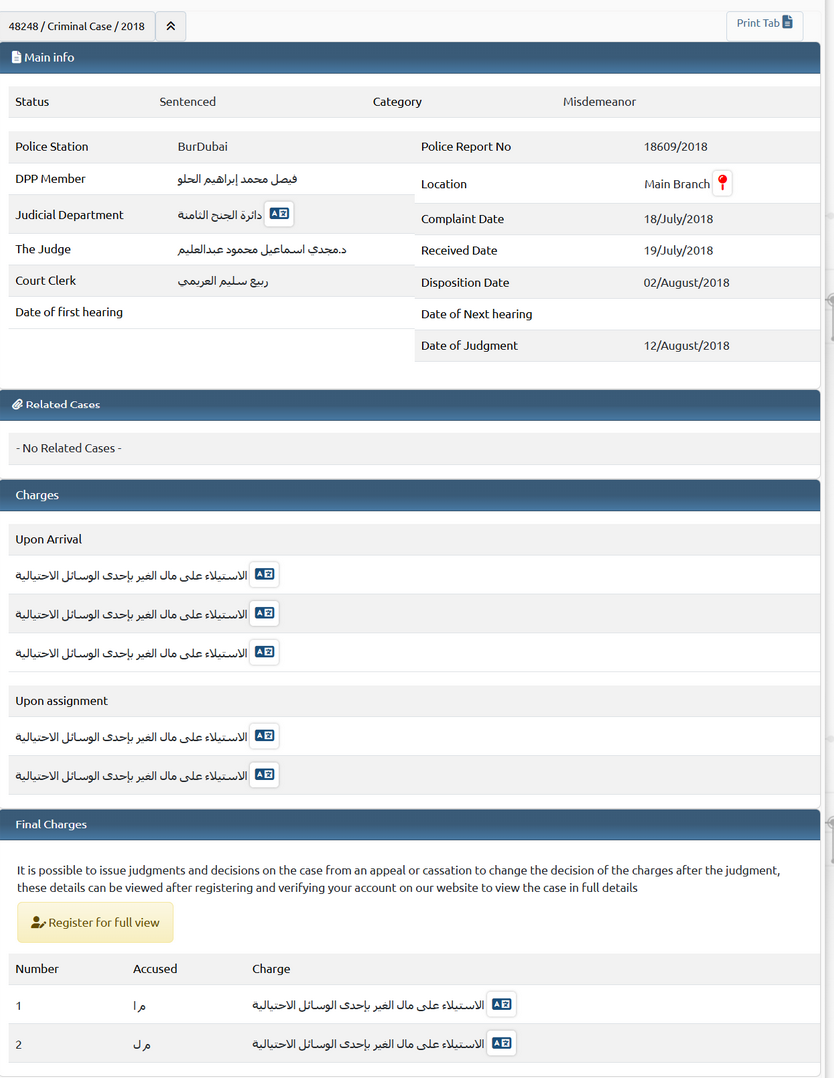
A since‑removed Medium article also circulated images purporting to show photocopies of the judgement said to be from the Dubai Prosecution Centre, citing penal case number 48248/2018 and claiming Robinson remained wanted to serve a two‑month prison sentence should he return. The authenticity of these documents has never been independently verified, but their appearance — and subsequent disappearance — became part of the wider online story surrounding him.
NOTE: UAE court paperwork often only shows a person’s first and middle name, especially for expatriates, because the system follows Arabic naming conventions where the surname isn’t the main identifier. The full legal name sits in the immigration and passport records — in this case, Mark Lawrence Robinson — but the judgment itself only reproduces whatever appears in the original Arabic text. So “Mark Lawrence” isn’t a different person; it’s just the shortened legal form the Dubai courts used in the judgment.
EDIT: Since publishing I have obtained a screenshot taken directly from the Dubai Public Prosecution portal confirming that Case No. 48248/2018 is a genuine penal case (access to the portal requires a UAE‑based VPN). Although the portal anonymises defendants with Arabic initials, every structural detail — case number, dates, judge, charges, and judgment timeline — matches the translated judgment document that briefly appeared online before being removed. The judgment states that the defendants fraudulently seized 441,000 dirhams (approx. £89,920 GBP/$120,072 USD) through a fake NKD Technologies digital‑currency website, conduct that corresponds to the offence of appropriating others’ funds by fraudulent means under Article 399 of the UAE Penal Code. Together, the portal and the judgment align precisely, confirming they refer to the same case and that the two‑month prison sentence and deportation order issued in 2018 remain on the official record and enforceable upon Marco Robinson’s return to the UAE.
Under UAE penal procedure, a person who leaves the country while a criminal conviction and sentence remain unserved is classified as an absconded convict — the formal status applied to defendants sentenced in absentia who do not return to execute the judgment, effectively a fugitive from justice under UAE law.
On his personal Medium blog, Robinson reprinted a NullTX article under the banner “Acclaimed Author MARCO ROBINSON EXONERATED,” presenting it as proof that he’d been cleared — but the article itself doesn’t actually exonerate him. NullTX said it had received an emailed tip containing a press release titled “Arrest warrant with jail / imprisonment sentence has been issued against the Founders of NAKED Technology ICO,” yet no trace of that press release exists today. With NullTX now defunct, there’s no way to verify whether the piece was sponsored, submitted by Robinson, or independently authored. What is clear is that the writer took Robinson’s explanation at face value, without scrutiny or independent fact‑checking. By reposting the NullTX piece on Medium as evidence of his innocence, Robinson turned an uncritical crypto‑blog write‑up into a self‑referential claim of ‘exoneration’ unsupported by any regulator, court, or credible newsroom.
While Robinson used his personal blog to declare himself entirely vindicated, Companies House records tell the real corporate outcome; he resigned as a director of Naked Technologies Limited in July 2019, and the company was later dissolved without delivering a working product or a functioning token ecosystem. Investors were left holding tokens with no liquidity, no exchange listings, and no practical value — a collapse documented across multiple investor grievance groups that formed in the aftermath.
That was not vindication but failure: the company folded, the token never materialised, and those who bought into the ICO saw their capital wiped out.
The human toll of the project's collapse can be seen on public video, as distressed investors plead to camera with Robinson for refunds, having been left with absolutely nothing to show for their investment.
Set against that reality, the branding collapses. This is not the track record of a man who calls himself “an icon in the business world.” It is the wreckage left behind by a fraud conviction, an unserved two‑month prison sentence, and a deportation order still waiting for him in the UAE.
11. #2 Netflix Producer: #1 in Judgments Against Him
See also Deadline article: Marco Robinson: Film Producer
By 2024, Robinson had begun presenting himself as a “Netflix producer” and the creative force behind the action film Legacy of Lies, using that claim as the foundation for a new line of film-development masterclasses aimed at aspiring writers. It was a lucrative identity: part insider, part mentor, part Hollywood success story. His main pitch relied heavily on the movie briefly hitting the number two trending spot on Netflix in the US back in 2020.
Robinson repeatedly doubled down on his high-level involvement, writing on his official blog: “I was responsible for the entire marketing strategy and campaign rollout, and I single-handedly drove the positioning that took Legacy of Lies all the way to #2 on Netflix USA. That’s not opinion – it’s history.”
Robinson's assertion that he was the “sole marketer” of Legacy of Lies is not corroborated by independent industry records and overlooks the role played by the film's established distribution partners. His website further claims that “He also funds and finances films up to a $20 million budget.” However, no publicly available corporate filings or independent industry documentation substantiate the existence of a $20 million film financing vehicle or show that Robinson has deployed capital on that scale. The only publicly reported film investment independently attributed to Robinson relates to Legacy of Lies. In reporting a dispute over executive producer credit, Deadline quoted the filmmakers as alleging that Robinson committed £445,000 but contributed only about $70,000 during development.
The festival “wins” Robinson lists rely on a similar tactic of authority transference. Legacy of Lies did legitimately win Best Feature Film at the Munich Film Awards in 2020, but that award belonged to the film and its director, Adrian Bol. Robinson presents these accolades as personal achievements (“His films have won…”), while padding the list with low‑tier online “monthly notification” festivals such as the Miami Independent Film Festival and Latitude Film Awards — events widely recognised in the indie community as pay‑to‑enter digital‑certificate platforms. By combining an independent director’s genuine award with paid‑for digital laurels and an unsubstantiated $20 million fund, Robinson constructs the appearance of a Hollywood career from a single confirmed involvement with one film.
That pattern extended to the way Robinson described his role on the film itself. Although he appeared briefly on screen as the minor character ‘Burns’, he held no formal producer credit on the film’s official roster. According to the filmmakers, he had no creative involvement in the project, and his investor agreement was later terminated after the funding dispute reported by Deadline. They subsequently issued a legal letter instructing him to stop repeating the producer claim altogether.
Robinson’s grand claims simply didn't survive contact with the people who actually worked on the film—or ultimately with the courts. What began as a marketing hook quickly unravelled into a series of disputes, legal judgments, and public corrections that exposed just how far the Netflix narrative had drifted from reality.
That gap between his marketing and reality led three separate clients to take Robinson to UK small‑claims court — and all three won, securing full refunds worth thousands. One of those rulings went further: the judge found that Robinson had engaged in fraudulent misrepresentation when selling his high‑ticket film‑development masterclasses. In other words, the moment his Hollywood persona faced a real judge, the entire narrative legally fell apart.
Yet today, despite losing multiple court cases and receiving formal legal instructions to stop, Robinson still continues to market himself as a “#2 Netflix Producer” and the posts promoting his film course and these disproven credentials remain live on his social media accounts, website and blog at the time of writing. And appearing as recently as February 2026, his recycled ‘producer’ claim was syndicated onto Cooperative Grain & Supply — a farm‑industry site where most content involves manure, and some may say this paid press‑release fits right in.
Rather than clarify or retract the title, Robinson continues to present it as part of his professional identity, folding it into the broader pattern of self‑authored accolades that do not withstand independent verification.
According to a public complaint filed on the Trustpilot review page for Robinson, one participant who joined his programme alleged: “Beyond the financial loss, association with Mr. Robinson caused reputational harm in a small industry where credibility matters.”
It is a sentiment shared by the very filmmakers Robinson claimed to work alongside; within the Deadline investigation, an actual producer of the film bluntly summarised that Robinson knows “nothing about nothing” of the film business.
12. Coaching Zeroes — A Movement So Inspiring Even Its Co Founder Left
In August 2025, just weeks before the Deadline investigation was published, Robinson launched a new programme called “Coaching Heroes” with actress and coach Michaela Longden, who was presented as the programme’s co‑founder.
In his official LinkedIn announcement, he described it as a “fully ICF‑certified coaching movement,” even though his own fine print admitted the programme had only been “submitted to ICF” and was “97% approved,” with full approval merely hoped for by September.
Robinson marketed himself as running a “fully ICF‑certified” coaching movement despite not appearing in the ICF’s (or EMCC’s) credential listings and appears to have no recognised coaching accreditation at all — a textbook case of credential theatre.
Following the publication of the Deadline exposé, the promised institutional backing never materialised, and Longden’s active involvement as lead instructor ceased, with her later removing public association with Robinson. Robinson was subsequently forced to walk back the marketing; by the end of the year, his corporate site had quietly downgraded the grand claims of official accreditation, stating instead that the programme was merely “aligned with ICF standards.”
Notably, the original Coaching Heroes launch in August–September 2025 was supported by accredited industry figures, including ICF Master Certified Coach Merci Miglino and former ICF New York President Antoy Grant. Grant’s own corporate speaker biography states she joined as Partner, COO, and Accreditation Strategist for the September 2025 launch, and her digital footprint shows her actively posting promotional videos for Coaching Heroes as early as August 2025, tagging both her profile and “Sir Marco Robinson.” Miglino’s credentials are likewise legitimate, but neither she nor Grant were ever presented as co‑founders.
Their presence served as borrowed prestige rather than institutional legitimacy; featuring accredited individuals does not confer accreditation on the organisation itself, and Coaching Heroes still holds no ICF organisational approval, no listing in the federation’s accredited‑training directories, and no recognised status of any kind. The brand’s “expert‑fronted” façade is simply a borrowed layer of credibility designed to mask the fact that the underlying entity remains entirely unaccredited, and the Coaching Heroes organisation cannot award a single recognised institutional credential to its students.
At time of writing, the Coaching Heroes curriculum page has never been updated since launch and still displays the original “12‑Week Cohort | September 17 – December 8, 2025” schedule. No subsequent cohorts were ever announced, no revised dates were added, and no updated faculty or accreditation information was published. The frozen curriculum page indicates that the programme never progressed beyond its initial launch window and that the supposed coaching “movement” failed to develop into an ongoing educational institution. In practice, Coaching Heroes functioned as a single‑cycle marketing funnel rather than a continuing accredited school.
Which is at odds with the claims made on the front page that Coaching Heroes has served 25,000 students, delivered 5,000 completed classes, employed over 100 coaches, and operated across 35 countries — figures impossible to reconcile with a programme that never progressed beyond its single 12‑week launch cohort and whose curriculum page still displays the original 2025 course schedule dates.
Left without genuine certification, the supposed globally recognised coaching movement remains exactly what it started as: a launch‑only marketing stunt designed to sell an unregulated programme under a shield of borrowed credibility, built entirely to monetise Robinson’s existing book chapters and followers. Coaching Heroes never developed beyond its initial promotional cycle.
In the end, the only thing “fully certified” about Coaching Heroes was the confidence with which Robinson sold something he never actually had — a point unintentionally underscored by the site’s AI‑generated portrait of him as a caped superhero, crouched in gold‑trimmed armour emblazoned with his own initials. When a programme needs its founder rendered as his own comic‑book character, the accreditation story tends to speak for itself.
13. Naked Diablo: The Night He Declared His Tequila Era
Robinson first announced his involvement with Naked Diablo Tequila in September 2025 and has since marketed it as a “disruptive,” luxury, billion‑dollar tequila brand, using borrowed startup buzzwords he recycles across everything Naked Diablo, even though nothing about the product or its model actually disrupts anything.
The timing of this new ‘launch’ worked out incredibly well for Robinson. On 15 September 2025, he took to Instagram to announce his big push into Naked Diablo Tequila. To make a splash, he posted a glamorous video reel filmed at Manchester's rooftop restaurant, 20 Stories — while tagging the neighbouring hotspot, The Ivy Spinningfields — claiming they were “taking over” both venues for the shoot.
What Robinson explicitly billed as a venue ‘takeover’ while “filming TEQUILA EMPIRE in Manchester” at 20 Stories was not a commercial milestone, but a private booking arranged for the purpose of filming the show. Neither establishment promoted, acknowledged, or listed the event on any official channel, and neither bar has ever stocked, sold, or promoted Naked Diablo Tequila — leaving no record of a venue partnership, menu placement, or branded cocktails, all standard hallmarks of a genuine commercial rollout. At most, Robinson supplied his own bottles for the shoot, a routine allowance for private events. By later presenting this orchestrated filming session as part of his narrative about “building a tequila empire from scratch,” he elevated a hired‑venue production day into the impression of brand momentum, despite no evidence of any real distribution.
The night was simply a pre‑arranged shoot, but the timing ended up being perfect. Just ten days later, on 25 September 2025, Deadline published its heavy‑hitting investigation into Robinson’s past media credentials. In the months that followed, the self‑described luxury‑tequila venture emerged as a prominent fixture in his social‑media narrative. Rather than addressing the journalistic exposure head‑on, Robinson increasingly positioned this project as a central part of his public identity — presenting it as a “billion‑dollar empire” at the exact moment his past public credentials were facing severe scrutiny.
It should be noted that this “billion‑dollar empire” that Robinson trumpets doesn’t quite live up to the marketing slogan. The company’s official financial snapshot on file at Companies House for the period ending 31 March 2024 (the baseline accounts anchoring the enterprise right up to their autumn 2025 media campaigns) shows that Naked Diablo Limited declared just £46,678 in cash at bank and a mere £59,054 in total net assets—a financial position amounting to roughly 0.0059% of a billion dollars.
14. Rob Fitzpatrick: The Global Mogul, Per His Own Homepage
That evening at 20 Stories also introduced another key figure in the project. Standing right beside Robinson was Rob Fitzpatrick — the man Robinson calls his “brother from another mother” and the touted “billion‑dollar brand architect” behind the tequila venture and airline idea of the same name.
On his own website, Fitzpatrick hosts a front-page newspaper article linking him to a “billion-dollar fund” and describes himself as a “self made Multi-Millionaire” (capitalisation his own) with business interests in 22 countries, shareholdings in more than 80 companies, and an investment portfolio exceeding US$400 million. However, these claims are presented largely as self-descriptions, and the website provides little documentary evidence that would allow an independent reader to verify them. Taken together, they imply a level of investment activity that would ordinarily be expected to leave a substantial corporate, regulatory, or transactional footprint.
Yet outside Fitzpatrick’s and Robinson’s own promotional bubbles, the public record doesn’t reflect the claims. Fitzpatrick isn’t on the UK FCA register, nor in readily accessible investment-industry databases, and there’s no publicly identifiable physical family office or investment platform linked to him that demonstrates management of capital at a scale of hundreds of millions. What does exist in the public record is a small number of UK Companies House filings, including a single active micro-entity, Naked Diablo Limited, alongside several dissolved or inactive ventures such as Legends Data Company and Bahamas Developments Limited.
While Fitzpatrick’s website describes a large international business network, the corporate address he lists is located on the island of Nevis, part of the Caribbean federation of St Kitts & Nevis, a jurisdiction well‑known for offshore company registrations. The address itself is a standard registered‑agent mailing location used by multiple unrelated companies, functioning as a correspondence point rather than a physical operating base or headquarters. In practical terms, it is a PO Box.
Fitzpatrick’s UK corporate address is equally modest. His primary business entities, including Naked Diablo Limited, are registered to Sue Barker Accountancy Services at Cunliffe House Farm in rural Langho, Blackburn (BB6 8AD).
Rather than a high‑security headquarters or luxury estate, this supposed global empire is anchored in a subdivided 18th‑century farm outbuilding shared with a horse‑riding stables, a tack shop, an ATV repair garage, and other small rural businesses on the busy A59. It is, in reality, an accountant’s mail‑drop in a communal agricultural courtyard — a far cry from the international corporate infrastructure implied in Fitzpatrick’s promotional materials.
Fitzpatrick presents his “Family Office” as the command centre of a substantial global investment operation, implying the kind of long‑standing, multi‑asset wealth normally associated with established family offices. Yet Companies House records show that Fitzpatrick Family Office Ltd did not exist until 4 November 2025, when it was quietly incorporated as a brand‑new entity. The timing aligns with his partnership with Robinson and the promotional push around Tequila Empire, revealing the “Family Office” as a freshly manufactured façade rather than a long-standing institution.
Because the entity is so new, it has no statutory accounts, no public financial footprint, and no evidence of holding any assets at all. Fitzpatrick’s promotional materials gesture toward offshore trusts and global holdings, but nothing in the UK record supports the existence of any substantial investment activity.
To anchor his public claims of managing a multi‑million‑dollar global empire, Fitzpatrick’s own professional profiles point to two offshore investment vehicles: Netstart Capital and Elite Property Fund. On LinkedIn, he presents himself as a shareholder and board member of Netstart Capital and a shareholder in Elite Property Fund, describing Netstart as a Business Development Company with “in excess of $150 million under management” and “tens of millions deployed.”
Yet none of these claims are supported by independently verifiable evidence. Neither vehicle has ever published audited financial statements, statutory balance sheets, or third‑party asset verifications. There is no record of regulated fund status, no filings with bodies such as the Financial Conduct Authority, and no public documentation showing they held — or deployed — any real capital.
Both associated domains (netstartcapital.com and elitepropertyfund.com) are now dead, leaving behind only promotional remnants and abandoned references. Because these entities never operated as regulated consumer financial services or publicly traded funds, they left no trail of reviews, regulatory actions, or insolvency records — only a sequence of grandly described offshore brands that quietly disappeared once Fitzpatrick shifted focus to newer ventures.
The same pattern appears elsewhere in his promotional ecosystem. Fitzpatrick highlights a wave‑energy venture called Renewable Energy Power Systems (REPS), yet the website he directs visitors to is a dead link, and there is almost no public information about the project’s present‑day operations. With no functioning site, no independent data, and no evidence of any connection to a power grid, REPS is impossible to verify from open sources — another grand claim that dissolves on contact with reality.
The unverified scale of Fitzpatrick’s wealth claims is amplified further on his dedicated corporate landing page, fitzpatrickfamilyoffice.com. There, he asserts that “over $400 million has been deployed globally,” supported by “over $2 billion in Assets Under Management,” and breaks this supposed empire into sweeping asset classes: more than 40,000 acres of global real estate, a $150 million startup fund, a 180‑acre West Virginia estate containing “billions of dollars worth of coal,” and a renewable‑energy portfolio allegedly worth “over $5 billion.” Yet again, the site provides no audited financial evidence, no regulatory filings, and no independent verification for any of these figures, and its overall presentation is unmistakably amateur — a simple webpage that bears no resemblance to the public‑facing infrastructure of a multi‑billion‑dollar investment house.
The amateurism extends to the claims themselves. The idea that a “family office investment fund” takes anywhere from 5% to 100% equity is not how real investment firms operate. A 5% stake is a tiny minority venture position; 100% is a full corporate buyout. No legitimate investment house ever treats those as the same activity. It reads like marketing copy written by someone who doesn’t understand investment mandates.
The claims about “money managers” and “global offices” don’t stand up either. The site names no managers, shows no teams, and provides no evidence of any professional infrastructure. And the notion that these supposed offices invest across commodities, private equity, venture capital, hedge funds, and commercial real estate is simply not believable. Each sector requires specialist staff, licences, and physical operations — yet Fitzpatrick’s “offices” are just offshore maildrops and a UK accountant’s address. Real investment houses don’t describe their strategy as a shopping list of unrelated sectors; that kind of vague, catch‑all phrasing is a hallmark of amateur marketing, not a functioning investment operation.
It’s also notable that the “Fitzpatrick Family Office” website first appears in March 2023, more than two and a half years before the company behind it was actually formed — and almost certainly earlier, since Archive snapshots rarely capture a site the moment it goes live. In practice, the website was presenting a fully‑fledged “family office” long before any real‑world company existed, mirroring the wider pattern of both Fitzpatrick and Robinson announcing grand ventures before anything real is in place, as with Naked Diablo Airlines.
Under the Finance section on his personal website, Fitzpatrick states he can “provide funds in a super quick time frame” through global private‑banking relationships.
The reality is simple: anyone genuinely able to lend or originate project finance at speed must hold FCA authorisation to operate a banking or credit facility. Fitzpatrick has no such licence. Without regulatory permission, he cannot legally originate, underwrite, or deploy institutional credit. The claim isn’t private banking — it’s unregulated brokering dressed up as a direct lending facility.
Fitzpatrick also claims he is “an investor in Cryptocurrencies as well as having his own Cryptocurrency.” For that to be true, a token must have a public smart‑contract address, must appear on a blockchain explorer, must show a deployment record, and must have at least one transaction on a public ledger. None of this exists. There is no contract, no listing, no footprint of any kind. Crypto is transparent — you can’t hide a token — so his claim is pure buzzword padding, another unverifiable asset added to the list.
Fitzpatrick’s own website also undercuts the image he’s trying to project, mirroring the same amateur design as the family‑office page — again, not the polished presence you’d expect from someone claiming to be a global financial player. Archival snapshots also show that the core content has barely changed since the site’s creation in 2013, with the main “About Me” section effectively frozen in place since around 2015. It is in that 2015 version that the first claim to have “helped create over 100 millionaires” appears — a number that has remained static for more than a decade, despite his later claims of overseeing a multi‑million‑dollar investment empire.
The fact that it has remained unchanged ever since significantly undermines its credibility. If Fitzpatrick truly possessed a repeatable wealth‑building system capable of producing 100 millionaires by 2015, basic economic scaling dictates he should have minted dozens or hundreds more by 2026. The fact that it has remained fixed at “100” for more than a decade strongly suggests it is a static marketing slogan, not a tracked metric. The underlying maths also makes the claim difficult to take seriously: helping 100 people reach millionaire status would require generating at least £100 million in client wealth, an achievement that would leave obvious traces in tax records, regulatory filings, and a visible group of successful clients willing to provide glowing testimonials, feature in case studies, and publicly credit him. For Fitzpatrick, this army of 100 wealthy success stories is entirely invisible.
Regarding the screenshot of the August 2020 front‑page story Fitzpatrick features on his website, it reported a proposed acquisition of Dellis Cay backed by what the article described as a “billion‑dollar distressed‑hotel fund,” and named Fitzpatrick as one of four individuals presented as part of the bid. Nothing in the public record shows he was connected to that fund nor is there any evidence Fitzpatrick was part of the bid itself; the available material suggests he attached himself to a transaction that was not his. He continues to display the Turks & Caicos Sun front‑page on his website and Instagram to imply he has access to, or influence over, a billion‑dollar financing vehicle to create the impression of a financing credential he does not possess. The transaction itself never closed, did not progress beyond its initial due‑diligence window, and nothing shows the acquisition Fitzpatrick positioned himself alongside ever resulted in a purchase or any development. Further detail is available in the Dellis Cay analysis within the separate article on Robert Fitzpatrick.
Ultimately, despite being designed to showcase his elite credentials, Fitzpatrick’s websites achieve the opposite under close inspection. Any investor performing basic due diligence would struggle to find any credible basis on which to commit capital to him. The sites are crude, generic, poorly written, and devoid of audited figures, regulatory filings, or named personnel. The amateur presentation alone would stop any serious conversation before it starts. Archival snapshots also show that the core content on his personal site has barely changed since its creation in 2013, with key claims left untouched for more than a decade. They also show Fitzpatrick using a Hotmail address as his contact email — not even a commercial domain — a detail that further illustrates how rudimentary the presentation is. Rather than establishing authority, both websites reinforce that Fitzpatrick’s corporate profile exists almost entirely within a self‑authored digital bubble.
It’s hard not to notice the irony in Fitzpatrick’s own warning that “anyone can write anything about any person or company over the Internet” given how freely he and Robinson publish their own unverified claims online.
The investigation into Robert Fitzpatrick is continued in a separate article. The section grew far beyond what belonged in a Marco‑focused narrative and was beginning to pull the main piece off course, so it now sits as its own standalone background — Robert Fitzpatrick: From High Court “Swindle” to Billion‑Dollar Pretender.
14.1 The Swindle: The Unmentioned Judgment
As if to prove Robinson’s assertion that he and Fitzpatrick are “brothers from another mother,” Fitzpatrick follows in the family tradition of scrubbing away the parts he doesn’t want the public to see.
Contemporaneous reporting from the late 1990s and early 2000s reveals that a Robert Fitzpatrick living on Burnley Road in Accrington, Lancashire was central to a string of financial failures. One of these was Freedom International, his so‑called “international trading and business opportunity” venture which, in reality, operated as a money‑circulation scheme dressed up as an investment opportunity — something Fitzpatrick himself admitted he modelled on Titan, the pyramid scheme the Court of Appeal ruled unlawful in 1996. Another was Igennex, a cross‑border “business opportunity” blocked by the Indian government as an illegal money‑circulation scheme; reporting at the time identified Fitzpatrick as one of the men behind the company, describing him as a bankrupt from Accrington who headed Freedom International, a pyramid scam closed by the High Court in 1997. Contemporary reporting also noted that Fitzpatrick was presenting himself as a “multi‑millionaire with homes around the world,” a claim sharply at odds with the circumstances described at the time. Both ventures collapsed under complaints and regulatory pressure, with Freedom International ultimately shut down by the High Court following a winding‑up order
A separate High Court case involving Guardearly Ltd — the company vehicle Fitzpatrick used to run Freedom International — went further, with the judge describing the operation as “a swindle on the public.” That case resulted in an 11‑year director disqualification order — one of the longest bans issued at the time — after findings of falsified records, fraudulent receipts, and failure to maintain statutory books.
The predatory reality of Fitzpatrick’s financial conduct was laid bare in a damning 2001 county court case. Reporting at the time detailed how Robert and Michelle Fitzpatrick, were hit with a substantial judgment after relatives of 71‑year‑old Maureen Skinner fought to recover funds funnelled into the couple's pockets. Burnley County Court heard that Skinner—who had never owed money in her life—was left carrying 17 separate personal loans, credit cards and store agreements totalling £59,206.39, all taken out in her name but for the Fitzpatricks’ benefit.
Relatives told the court the mounting debt caused severe stress in the final weeks before her death. Rather than attend the hearing, the Fitzpatricks stayed away, prompting Judge Gee to reject their last‑minute adjournment request and accuse Fitzpatrick of “playing with the law.” He concluded the two‑day hearing in just two hours, dismissing the couple’s written explanations—blaming the debts on the elderly woman’s supposed “extravagant lifestyle”—as “ranging from the unbelievable to obvious nonsense.”
Sanctioning a £49,913.01 judgment against Fitzpatrick, Judge Gee stated plainly: “It appears he was basically ripping his auntie off.”
Companies House filings from the same period for MAYDEV LTD list a Robert Bryan Fitzpatrick (born May 1970) at 40 Coleridge Drive, Baxenden — a residential street in Accrington, Lancashire, just off Burnley Road. The Lancashire Telegraph’s reporting from January 2000 placed a Robert Fitzpatrick, age 29, on Burnley Road, living with his wife Michelle and three children. The Global Filmz entry for Tequila Empire – Reality TV Series identifies the modern “Naked Diablo” Robert Brian Fitzpatrick — also born in May 1970 and still maintaining active corporate registrations in Lancashire — alongside his wife Michelle, described as the mother of five and “the glue that keeps the family together.” Fitzpatrick’s middle name appears as both “Bryan” and “Brian” across Companies House filings — including the most recent PSC submission, which uses “Bryan.” The continuity of name, age, location, and spouse across these records makes it clear they refer to the same individual.
When you put the public filings, the old press reports, and the documentary’s cast listings together, they prove that the man behind the documented trail of financial abuses — described as an upholsterer by trade by the Lancashire Telegraph in 2000 — is the same man now promoting himself as a high‑net‑worth international tycoon.
After being banned as a director for running a High Court‑condemned “swindle on the public,” Rob Fitzpatrick didn’t stop, he simply shifted offshore and launched a new scam, Perfect4u, a Gibraltar‑registered pyramid‑style cashback scheme run in conjunction with a partner called Gurdeep Singh, who also went by the names George S. Basra and George Singh, and possessed a similar record for scams (Singh later resurfaces in 2015 as a director of Netstart Capital alongside Fitzpatrick). Their revivalist‑style recruitment meetings promised fast cars, luxury holidays and big houses, all supposedly funded by signing up new members and taking a slice of their fees; the scheme then collapses, leaving everyone out of pocket except the bosses. Perfect4u falsely claimed partnerships with major banks that publicly disowned it, Gibraltar solicitors resigned and barred the company from using their address, and Fitzpatrick’s scams kept resurfacing internationally, including in New Zealand and South Africa. The press summed him up bluntly as “the sort of man who would sell his own auntie,” a line grounded in the 2001 Burnley County Court previously discussed.
The Botswana press uncovered yet another incarnation of the Fitzpatrick–Singh operation: C‑Lifestyle Management Group, a local front running the same high‑pressure, invitation‑only “lifestyle membership” pyramid model that defined Perfect4u. Investigators from the Botswana Police Serious Crime Squad and the Bank of Botswana confirmed links to the same cross‑border network of schemes the pair had pushed through the UK, South Africa, Canada, Ireland and Holland. Local reporting described them as “scam artists” and noted that Fitzpatrick was listed on Scam.com, revealing that although he claimed to be a multimillionaire, that was pure fantasy: he was broke and in significant six-figure debt. The Botswana case simply revealed the pattern repeating: recycled names, recycled promises, recycled victims — with Fitzpatrick and Singh directing operations from behind the scenes while avoiding formal ownership.
Fitzpatrick’s history is not the glossy business story he presents in How to Build a Billion Dollar Brand. And it is most definitely not the story given in this podcast interview on Stories Worth Hearing of 21st June 2026, wherein he claims he made his first million by age 24, bought a jet and a yacht, and “retired” to Mallorca for three and a half months before a friend convinced him that retiring so young would kill him (4:12). This account directly contradicts contemporary reporting, which described him as late as 2002 as still living in Accrington and “not exactly a multi-millionaire. In fact, he is a bankrupt with debts totalling more than £330,000” — not on a yacht in Mallorca. And, like his “brother” Marco, Fitzpatrick struggles to keep his own mythology straight: in the 2026 podcast he states he became a millionaire at 24, yet the same 2002 report quotes his own website putting his age at 26 for the identical claim. I’ll leave it to the reader to listen to that podcast and compare it with the sourced material here.
The reality is, Fitzpatrick was part of a cross‑border financial network described in contemporaneous reporting as international fraudsters, who actively shifted funds through multiple aliases to stay ahead of international banking crackdowns. One of the core companies in that structure, Millennium Leisure International (MLI), was formally investigated for money laundering by the South African Police Service, with Absa Bank ordered to freeze its accounts and the South African Reserve Bank appointing fraud examiners to assess suspected pyramid‑scheme activity. Make no mistake: this is organised financial crime.
The Botswanan Sunday Standard linked MLI — along with OMI and VIP Club — to Leisure Marketing International, reporting it as being based in the UK. In a separate investigation into Andrew Faridani signing up Scots for a pyramid‑selling holiday club under the name Scotia Leisure, the UK Sunday Mail also connected Scotia Leisure to Leisure Marketing International, repeated that OMI and VIP Club operated under the same umbrella organisation, and added Ignite to the group. However, the Sunday Mail described Leisure Marketing International as being based in Belize, a Caribbean tax haven.
A blog post on Crimes of Persuasion entitled New Name – Same Pyramid Scam Game – This Time it's Perfect4U and One-Vision in Canada provides a detailed, sourced chronology of the international havoc Fitzpatrick created under the various companies he cycled through. It also offers a vivid glimpse of what attending one of his seminars was actually like. The same flavour appears in this archived comment on Perfect4U and One-Vision, which traces yet another set of iterations in exhaustive detail. And for those who want to see how the experience felt from the ground level, the archived OMI Club thread captures it with uncomfortable clarity. It’s quite the rabbit hole, and I’ll leave the reader to explore it themselves — the point about Fitzpatrick’s business ethics has been made.
I will, perhaps, leave the last word to a townsman's of Fitzpatrick's, writing on the Accrington Web: “Robert Fitzpatrick is by far Accrington's worst export! He has brought misery to thousands worldwide by ripping them off with his pyramid schemes, or entering into deals that he never has any intention of honouring”.
This is the man Marco Robinson describes as a “genius business guru,” and as a “highly accomplished entrepreneur with multiple businesses, global property holdings, and a reputation built on faith, family, and discipline” in his paid-press releases — the same man he publicly calls his “brother from another mother.”
Fitzpatrick’s reputation is well‑established, just not in the way Robinson describes. By the time these criminal scams appeared, he had already been disqualified, already shut down by regulators, and already tied to multiple pyramid schemes, yet he continued launching ventures that misled consumers, misused corporate identities and left ordinary people in financial ruin — a history that sits beside the later wave of unbuilt resort schemes and failed development announcements he now cites as part of his business pedigree.
The promotional reinvention reaches its latest form in Naked Diablo Airlines, a self‑described aviation brand with no evidence of commercial activity.
This places Marco Robinson — a convicted fraudster — alongside Robert Fitzpatrick, a man whose operation was condemned by a High Court judge as “a swindle on the public,” who was banned from acting as a director for 11 years, and who went on to front illegal offshore scams — at the helm of Naked Diablo, with both men now soliciting investment funds from the public.
And one final thing to consider: Fitzpatrick recently chose to appear alongside convicted fraudster Billy McFarland on SiriusXM — the same McFarland who once marketed a fake “luxury jet service” called Magnises Air, an airline that never existed beyond rented props and digital hype. Their link is direct: Fitzpatrick hired McFarland’s agency, BZM Marketing, to run his US media push and promote his tequila documentary, while both rely on Global Filmz for their respective video projects.
15. A Premium Tequila Brand – According to Marco & Rob
The tequila brand appears to have a far less glamorous origin story than the high‑gloss image Robinson and Fitzpatrick market it with. In a September 2025 interview on the Digital Social Hour podcast (Episode #1534), Rob Fitzpatrick explicitly admitted that the group got into the tequila business “somewhat by accident” through a partner's plan to open a Mexican-themed bar. The Fitzpatrick’s own (hilariously amateur) official presentation PDF confirms this, stating that Naked Diablo was conceived while the Fitzpatrick family was opening El Diablo Tequila & Taco Bar in Manchester. However, the founders omit what happened next. That restaurant was hammered by poor reviews and went permanently dark around December 2022. His US expansion didn’t fare any better: the Florida locations in Cocoa and Lake Worth both opened, struggled, and shut down. Both used the same branding and even marketed themselves as “Home of Naked Diablo Tequila,” so the connection is clear.
Once the restaurants collapsed, the tequila became the only surviving piece of the original concept. It looks far less like a master‑planned global spirits empire and far more like a salvage operation — a house‑pour tequila repackaged into a standalone product because the venues it was created for no longer existed.
Their marketing materials also heavily manipulate industry jargon to manufacture an illusion of elite status. The pitch decks boast that they partnered with a legendary Mexican distillery that produces tequila for Michael Jordan’s Cincoro and Tesla Tequila.
In reality, that distillery is Casa Maestri, a massive commercial contract plant that pumps out over 100 completely unrelated private-label house brands simultaneously. Anyone with a few thousand pounds can pay them to bottle one of their existing house liquids under a custom label; it is the alcohol equivalent of buying a blank t-shirt and printing a logo on it.
Developing a brand‑new, proprietary tequila profile from scratch takes years of agricultural cultivation, chemistry, and massive capital. True luxury spirits rely on heritage, patient craft, and slow refinement. Fitzpatrick bypassed all of this by using a pre‑existing mass‑production facility. Instead of investing in agave fields, distillation infrastructure, or a unique production process, he simply bought a pre‑fabricated, white‑label product line from a contract factory in Mexico, applied his registered trademark to the glass, and marketed it as a bespoke empire.
His own descriptions of the process make the reality even plainer. In interview, he boasts that Naked Diablo launched eight expressions immediately, explaining that “the fastest, quickest, and easiest way to create a flavoured tequila is just get the blanco and add a natural flavour profile to it.” That is not artisanal craft. It is an industrial shortcut: taking a generic base blanco and dosing it with factory flavour extracts because it is quick, easy, and scalable.
And scalable is the point. In the private‑label tequila world, Fitzpatrick never owned the liquid he sells. Casa Maestri produces huge industrial batches of “house” Blanco, Reposado, Añejo, and flavoured variants that any paying entrepreneur can buy — before him, after him, or even alongside him. Naked Diablo is simply one of more than a hundred brands drawing from the same vats, meaning a competitor can already be selling the exact same tequila under a different label at this very moment. The distillery controls the agave, the recipe, the production, and the inventory; Fitzpatrick controls only the trademark and the marketing story. If he stops paying, the factory stops printing his label, and the exact same tequila can be bottled and sold under a different name the next day.
The only “customisation” Fitzpatrick adds is the choice of flavouring — and even that happens entirely inside Casa Maestri’s preset industrial system. He is not infusing rare ingredients or developing proprietary blends; he is selecting from the factory’s catalogue of extracts and syrups, the same menu available to every other private‑label client. And here the irony is sharp: the very flavour options he uses to claim “luxury uniqueness” are the most common, mass‑market shortcuts in the spirits industry. Coffee, vanilla, and other sweet, heavy additives are the oldest trick in the book — a quick way to create instant shelf variety and to mask the fact that the underlying tequila is a completely generic, factory‑bought white‑label product.
It’s a pattern that extends beyond the bottle.
For a project pitching a premium “billion‑dollar brand”, the official website looks surprisingly amateurish — a hallmark of Fitzpatrick’s online presence. It has the look of an off‑the‑shelf WordPress template rather than a professionally built hub, and the déjà vu is immediate: just like Fitzpatrick’s own site, the most visible part of their marketing appears to have been assembled on a weekend budget. If this is the standard of the shop window, it’s hard to avoid the conclusion that Robinson’s marketing skills are about as premium as the website looks.
Speaking of which, then there’s Robinson’s role. He frequently claims in public promotions to be a “Co‑Owner” of the tequila brand, but official corporate records say something different. Companies House filings show he holds 0% ownership of Naked Diablo Limited, and his status as a Person with Significant Control (PSC) was formally recorded as ceased on 12 August 2020. In reality, the tequila brand’s launch and development were driven by Rob Fitzpatrick, his immediate business partners, and the team behind the original El Diablo venues. While Robinson can historically claim early involvement with the business, his ongoing public assertions that he is a current “Co‑Owner” are a direct misrepresentation.
What remains is a tequila brand whose backstory has been rewritten after the fact, inflated far beyond the modest reality of how it actually began and what it actually is.
16. The “Award Winning” Tequila Show With No Awards
The same dynamic runs straight through the marketing for Naked Diablo, where oversized language continues to be wrapped around incredibly small facts.
Robinson aggressively promotes the brand as “the ONLY tequila brand on the planet with its OWN MULTI‑AWARD‑WINNING TV SHOW”, supposedly “honoured at Cannes.”
Tequila Empire does exist, but it isn’t an independently commissioned or network‑produced series. It’s a self‑funded promotional project made by the Fitzpatrick family, and there is no publicly documented distribution deal; the show appears intended for free, ad‑supported streaming platforms. There is also no record of awards, no evidence of official selection or awards in Cannes Film Festival programmes or affiliated competition records, and no independent recognition of any kind. The “Cannes” accolade that Robinson trumpets refers not to the real Festival de Cannes, but to the World Film Festival in Cannes — an online‑only event that borrows the city’s name and has no affiliation whatsoever with the actual Cannes Film Festival. Director Nathan Taupez Scinto’s “Best Full‑Feature Documentary Finalist” title applies to the documentary How to Build a Billion Dollar Brand, not the Tequila Empire reality series, and carries no industry weight.
The awards attached to How to Build a Billion Dollar Brand: The Naked Diablo Story are not recognised by the mainstream film or television industry. They come from monthly, online, pay‑to‑enter indie festivals that exist primarily to generate promotional laurels for low‑budget projects. These events are entirely separate from prestigious institutions such as the Primetime Emmys, BAFTA, Sundance, TIFF, or the real Festival de Cannes. They involve no theatrical screenings, no industry juries, and no competitive selection process; instead, they hand out dozens of hyper‑specific titles — “Best Documentary,” “Best Trailer,” “Best Poster” — every month to maximise the number of winners. Within the industry, these laurels are understood as marketing props, not markers of artistic merit or peer recognition (much like Start Over’s manufactured “#1 Best‑Seller” claims).
The uniqueness claim doesn’t hold up either. Big tequila brands have been using multi‑episode promo content for years. Casamigos — George Clooney and Rande Gerber’s brand — built its whole image on glossy lifestyle videos and behind‑the‑scenes content. Dos Hombres, fronted by Breaking Bad stars Bryan Cranston and Aaron Paul, launched with its own splashy, multi‑episode media push. None of this makes Naked Diablo’s project unique, and it certainly doesn’t turn Tequila Empire into a “multi‑award‑winning TV series.”
The celebrity‑tequila boom led by Casamigos pushed premium tequila toward lifestyle branding and high‑gloss “shake‑up” marketing. Robinson’s Naked Diablo tries to copy that script — the startup‑style hype, the self‑declared “disruption,” the swagger of brands claiming they’re changing the market. The difference is scale: Casamigos had reach, budgets, and star power. Naked Diablo is the bargain‑bin imitation — a Casa Maestri stock tequila dressed up as a revolution, minus the fame, the audience, and the impact.
And they make no secret of the model they’re chasing. In a podcast interview, Rob Fitzpatrick explicitly cites George Clooney’s billion‑dollar Casamigos exit as the moment that “piqued [his] interest,” describing it as the trigger that convinced him tequila was the fastest‑growing, celebrity‑driven path to a major payout. The ambition is stated even more bluntly in their documentary trailer, where Lee Fitzpatrick says, “My goal [is] to sell Naked Diablo for $1 billion. For me, it’s about build it, scale it, and sell it.” The father’s Casamigos‑inspired spark and the son’s billion‑dollar exit mantra make clear that Naked Diablo is not pursuing an original strategy — it is openly modelling itself on the Casamigos playbook, a fantasy they’re trying to replicate with a mass‑produced private‑label tequila.
An old acquaintance also reappears to try and bolster Robinson’s and Fitzpatrick’s marketing story. Andrew Faridani—earlier noted in Sunday Mail reporting for his role in the Scotia Leisure pyramid‑selling scheme and its links to Leisure Marketing International, OMI, VIP Club and Ignite—resurfaces in 2025 as a Forbes Business Development Council member. In that capacity he publishes a Council Post offering uncritical, promotional praise for Naked Diablo Tequila. The piece is not a Forbes editorial or independent journalism but fee‑based member content, and it shows—even in its self‑congratulatory title, A Masterclass In Brand Building. Faridani repeats the familiar “celebrity‑tequila playbook” narrative—invoking Casamigos, Cincoro and Teremana—before claiming Naked Diablo is breaking new ground with its self‑produced reality‑TV project, even though similar brand‑storytelling formats have long been used across the spirits industry, making the claim of originality difficult to sustain. He goes further, comparing the show to Red Bull’s multi‑million‑dollar Media House and Dove’s globally recognised Real Beauty campaigns—parallels plainly disproportionate to the scale and nature of Naked Diablo’s production. The overall effect is promotional rather than analytical. Nonetheless, it places Faridani back in proximity to Fitzpatrick—this time not through pyramid‑scheme exposés in the press, but through Naked Diablo’s marketing narrative—making his assurance that the founders are “relatable and easier to trust” perhaps relatable to himself, but not easily trusted by anyone else.
Returning to Robinson, he claims the brand is “already exploding across the United States,” but there is no publicly available evidence of national retail penetration or independently reported sales momentum to confirm that. Naked Diablo’s footprint appears to be limited to a small number of regional distributors and promotional activity.
The Las Vegas claim follows the same pattern. Robinson has promoted Naked Diablo as having an “official nightclub inside Virgin Hotels, Las Vegas,” but there is no publicly documented evidence of a dedicated Naked Diablo venue operating within the property.
Alongside this, he invites followers to “invest for a surprisingly small amount” in a brand he describes as “already winning — already global — already proven”. Given the Fitzpatrick family’s own promotional claim of managing hundreds of millions through a family office, it’s odd that a brand he insists is globally established and backed by vast resources still somehow needs Marco himself pitching an “investment opportunity” to his Instagram followers — even though Naked Diablo Limited shows no evidence it can legally issue shares to the public or that followers receive anything resembling real equity. As a private limited company, it cannot make a general public offering of shares in the way a listed company can, nor openly solicit investment from the public on that basis, making this supposed opportunity look far more like small‑scale, follower‑funded contributions dressed up as ownership.
The disparity continues on the Naked Diablo YouTube channel — where a single trailer for Tequila Empire claims 10,000 views while the surrounding videos struggle to break into double digits — pointing to a completely artificial distribution model. The transparency of digital metrics exposes the illusion: the trailer publicly lists 10k views, yet it sits beside zero comments and two likes (at time of writing). In this sector, a real audience of ten thousand viewers typically produces hundreds of likes and a lively comment thread. A 0.02% engagement rate isn’t just low; it’s statistically incompatible with organic reach. Whether the spike came from paid platform promotion or bulk‑purchased views, the outcome is identical: the numbers do not reflect an authentic, engaged consumer base. For a brand presenting itself as a global phenomenon, an audience of 12 subscribers and total silence beneath its flagship video, reveals the true scale of the enterprise.
And perhaps the clearest sign of where the brand currently sits in the market comes from Agave Matchmaker — the main hub for actual tequila drinkers — where Naked Diablo has attracted only a handful of ratings and reviews across its expressions. It’s a tiny amount of engagement, and it mirrors the brand’s equally tiny social‑media interaction. For a tequila talking up a Casamigos‑style success story, the gap between the ambition and the visible level of consumer interest isn’t just hard to ignore; it’s becoming the story.
The Obvious Question: Why Marco?
From any normal industry perspective, Marco Robinson’s role at Naked Diablo Tequila (and the airline) is hard to take seriously. A spirits brand investing in a reality‑TV series, a documentary, and large‑scale promotional campaigns would usually hire people with backgrounds in consumer‑goods marketing, brand strategy, distribution, or agency‑level creative work. Robinson has none of that. His public output is built around funnel marketing, self‑shot social content, and motivational‑speaker branding — activities that sit far outside the professional skill sets required to build and scale a premium alcohol brand.
And the gap isn’t subtle. It’s glaring. Running Facebook ads and filming yourself for Instagram does not make you a strategist; it makes you a rank amateur in industry terms. Robinson’s promotional style isn’t a simplified version of professional marketing — it’s a different universe entirely. He operates like a carnie huckster, relying on noise, bravado, and constant self‑promotion rather than any recognised marketing discipline. His presentation often leans into clownish theatrics — exaggerated reactions, forced humour, and a self‑conscious performance style that can generate as much cringe as amusement. It’s showmanship, not strategy.
Nothing in his background suggests he understands distribution, pricing strategy, brand architecture, compliance, or the long‑term planning that real spirits brands depend on. What he does bring is sheer volume: relentless posting, self‑branding, and a willingness to say anything — no matter how inflated or disconnected from commercial reality — to keep the spotlight on himself and whatever he’s attached to. But even that has limited value. The attention he generates is directed almost entirely at his own audience, which shows very low engagement relative to its size. In practical terms, his promotional reach is shallow and circular. It doesn’t expand Naked Diablo’s market; it loops back into a small, low‑response bubble.
And this leads to the obvious question: why would Fitzpatrick engage someone so clearly inexperienced and unsuitable for marketing a supposed global brand? The only commercially coherent explanation is that Robinson’s role isn’t about strategy, expertise, or industry knowledge. It’s about optics — about creating the appearance of activity, momentum, and scale. In that sense, Robinson fits perfectly. He is loud, energetic, endlessly self‑promotional, and willing to attach himself to anything with a camera pointed at it. Put simply: Robinson isn’t a marketer. He’s a showman. For a brand built around hype rather than structured market growth, that makes him useful, even if it makes no sense in professional terms.
17. When # IPO Means “Imaginary Public Offering”
In November 2025, Robinson pitched Start Over as an investable, high‑growth venture, using explicit financial‑market language (“equity”) to solicit money directly from followers. In a promotional reel, he framed the offer as an opportunity where “YOU can become a shareholder.”
He claimed he was raising $500,000 at a $2 million valuation, presenting it as a structured investment round rather than a donation or pre‑order. To attract retail traders and amateur investors, he deliberately tagged the campaign with # IPO, alongside # entrepreneur, # investor, and # billions, signalling a future public listing.
The pitch promised that backers would “share in profits from books, events, coaching, and franchises,” describing the offer as “equity in a revolution” — language that mimicked startup fundraising without any of the legal, financial, or compliance frameworks required for an actual equity sale.
However, the companies Robinson uses to front the Start Over ecosystem don’t support the fantasy. Online CEO Ltd and Brand Story Publishing Ltd — the only UK entities connected to his coaching and publishing activities — file as small, low‑activity private companies with no meaningful trading history, and no financial footprint that would justify talk of valuations, equity rounds, or future public listings. Nothing in their accounts resembles the scale or performance implied by a $500,000 raise at a $2 million valuation. On paper, they look nothing like the revenue‑generating, compliance‑ready vehicles that sit behind genuine IPOs.
Crucially, despite the stock‑market terminology, there is no record of Start Over filing any mandatory prospectus or registration with financial regulators such as the FCA or SEC. No listing documents, no offering circulars, no disclosures — nothing. The grand illusion of an imminent public listing evaporated almost immediately; by 2026, the IPO fantasy had been quietly abandoned in favour of selling $50,000 regional “Business Chapters”, demonstrating once again that the big‑ticket financial promises were just short‑term marketing hooks designed to extract upfront cash from his audience.
The pivot from an “IPO/Equity Round” to selling $50,000 “Regional Business Chapters” represents a clear shift in regulatory posture. Using terms like “equity,” “shareholder,” “valuation,” and “# IPO” to solicit money from the general public places a promotion squarely within the territory of regulated financial communication. In the UK, private limited companies, such Online CEO Ltd and Brand Story Publishing Ltd, cannot legally make a public offer of shares; such offers are restricted to regulated public companies. Offering investments to retail consumers without an FCA‑approved prospectus, and to private companies, can constitute a criminal offence under the Financial Services and Markets Act 2000 — meaning that had Robinson actually taken funds on the basis of an equity sale, the offer would have triggered significant regulatory scrutiny.
By rebranding the offer into “Regional Business Chapters,” the legal nature of the transaction changes entirely. He is no longer selling a financial security; he is selling a commercial service or franchise‑style licence. This falls under standard contract and commercial law, bypassing financial regulators. No prospectus is required, no valuation needs independent verification, and the finances of his small private entities remain shielded from public examination.
Operationally, the pivot is far more efficient for Robinson’s model. Extracting $50,000 per chapter allows him to generate high‑ticket revenue from a small group of devoted followers, and unlike actual equity — which is tied to audited accounts, profit‑and‑loss statements, and tax histories — the value of a “Business Chapter” is entirely arbitrary. It is based on perceived prestige and marketing hype, allowing him to charge whatever the audience is willing to pay.
The shift is a classic regulatory retreat. The “IPO theatre” served its purpose as a high‑octane marketing hook to test how much capital followers were willing to deploy. Once the legal realities of selling unapproved public shares loomed, the model was quietly re‑engineered into “Business Chapters,” allowing the high‑ticket money extraction to continue under a far safer, unregulated framework.
You don’t need to believe your own pitch if your audience does — and Robinson’s public career shows he understands that perfectly. A claim doesn’t need to be true; it just needs to be exciting long enough to sell the next thing.
Note on Corporate Structure (December 2025)
In the month following the IPO pitch, Robinson incorporated Start Over Movement Holdings Ltd, a private holding company in which he is the sole director, sole shareholder, and sole Person with Significant Control. With only £100 in issued share capital and no trading history, the entity functions as a corporate wrapper for the Start Over brand rather than evidence of any genuine valuation, equity structure, or financial performance. Crucially, the company’s share structure — 100 ordinary shares, all owned by Robinson — means it could not have issued shares to followers, nor served as the vehicle for any public investment round. Any later restructuring capable of accommodating external investors would have required public filings (SH01 share allotments, updated Statements of Capital, new PSC entries), none of which exist. Its creation does not alter the fact that, at the time of the IPO claims, no regulated corporate vehicle existed to support the promises of “equity,” “shareholders,” or a future public listing.
18. Start Over: The Six Figure Investment With a Zero Figure Paper Trail
Despite a public video Robinson released in April 2026 claiming that Rob Fitzpatrick had injected £250,000 into the Start Over business, official UK Companies House records show no corresponding paper trail.
A genuine six‑figure equity investment would leave unavoidable traces at Companies House — new shares issued, updated confirmation statements, changes in ownership or control — yet none of Robinson’s companies show Fitzpatrick as a shareholder, director, or person with significant control, and no filings thus far indicate any capital event of any size.
Even if money had changed hands, it is difficult to understand why a credible investor would bankroll a business with no intellectual property, no infrastructure, and no ‘value’ beyond Robinson himself. As discussed previously, the two entities he actually uses in the Start Over ecosystem — Online CEO Ltd and Brand Story Publishing Ltd — have no filed accounts or trading history suggesting profits on a scale that would warrant a £250,000 equity investment. Without Robinson fronting it, the Start Over brand would be severely diminished; the model is effectively dependent on his persona rather than any transferable or scalable business asset.
To date, the only place the £250k exists is in the video he filmed — not in the filings where a real investment would have to live.
19. Naked Diablo Airlines: Disrupting the Ability to Find Any Trace of It
April 2026 was also the month Robinson and Fitzpatrick announced another grand project — “Naked Diablo Airlines”. Robinson proclaimed it a “global disruptor,” a “new category of travel, impact, and wealth creation,” and insists it’s “not just another airline” but “lifestyle aviation — not logistics.”
The announcement itself, however, was made not at an aviation event or an investor launch, but from a bar, filmed on a phone and posted straight to social media. In an industry where new airlines debut through tightly choreographed media events for invited journalists, theirs amounted to a bar‑side announcement pushed out through a bargain‑basement newswire that never reached a single real business desk. The sight of two tequila founders casually unveiling an airline over drinks made the whole thing look less like a business launch and more like a dare after one too many shots of their own product.
If this is what Robinson considers “disruptive,” it’s only because no airline in history has tried launching itself with the production values of a group chat — a definition of disruption that mostly disrupts the illusion that any of this is serious.
According to aviation experts in the Reddit discussion, there is currently no evidence of a Naked Diablo Airline in development. Fitzpatrick and Robinson are quoted contradicting each other, and Robinson even contradicts himself, prompting aviation experts to mock his statements and remark that he “doesn’t have a clue what he’s speaking about.” It mirrors, in a different industry, the same pattern noted by the film producer earlier.
What Reddit contributors were pointing out — and openly ridiculing — was that between April and May 2026, Robinson and Fitzpatrick gave three incompatible accounts of the airline’s timeline. On 18 April, Robinson said Fitzpatrick had only told him about the idea “the week before” and that they planned to film a visit to Boeing to document the process of buying or leasing a plane. Two days later, in their announcement video posted on 20 April, Fitzpatrick stated, “We’ve tied up a number of planes,” implying deals were already secured. By 29 May, Robinson claimed that he and Fitzpatrick had been working “for the last few years” on a vision for the airline. These statements cannot all be true at the same time.
The Reddit discussion details the hurdles to buying or leasing a plane, along with a multitude of other issues that, when explained by contributors, collectively portray Robinson as naive and lacking even the most basic industry knowledge required to launch an airline.
For instance, a now‑deleted comment mocked Robinson’s 25 May caption — “Invested deck imminent” — noting that it isn’t a real financial term and reads like someone trying out startup jargon without knowing the vocabulary. In actual business circles it’s investor deck or pitch deck; “invested deck” simply doesn’t exist.
By 22 April, just two days after announcing “Me and Rob Fitzpatrick have officially launched Naked Diablo Airlines,” Robinson was already claiming to have “built an airline” — a feat that, even with hundreds of millions in backing, would set a world record for completing the Civil Aviation Authority’s regulatory requirements and establishing the necessary infrastructure. The claim also sits at odds with the fact that, to date, there is no evidence of any filings, aircraft, or operational steps — only marketing language. This is a pattern that mirrors his earlier Start Over “IPO” pitch, which used grand terminology without filings or substance behind it. Aviation experts note that launching even a small airline typically requires years of approvals and a budget in the tens of millions, which leaves “built an airline” reading less like a factual update and more like Robinson congratulating himself for uttering the phrase — a sentiment neatly echoed by the accompanying photo of him staring into the distance as if contemplating destiny rather than the absence of a single filing.
EDIT: And to settle the matter I submitted a direct Freedom of Information request to the CAA. Their response is as below:
The CAA is the sole regulatory authority for UK aviation, making this official response the definitive word on the project's status. The document explicitly states that the UK Civil Aviation Authority holds no information regarding applications or development for “Naked Diablo Airlines” and confirms that the Airline Licensing Team has no record of any active or pending application from this entity. This completely contradicts the public claims made by Robinson regarding submitted licensing paperwork (“We've got the licensing application in”: 18th April 2026).
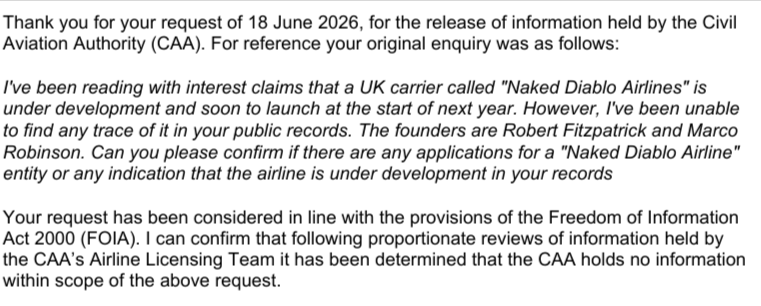
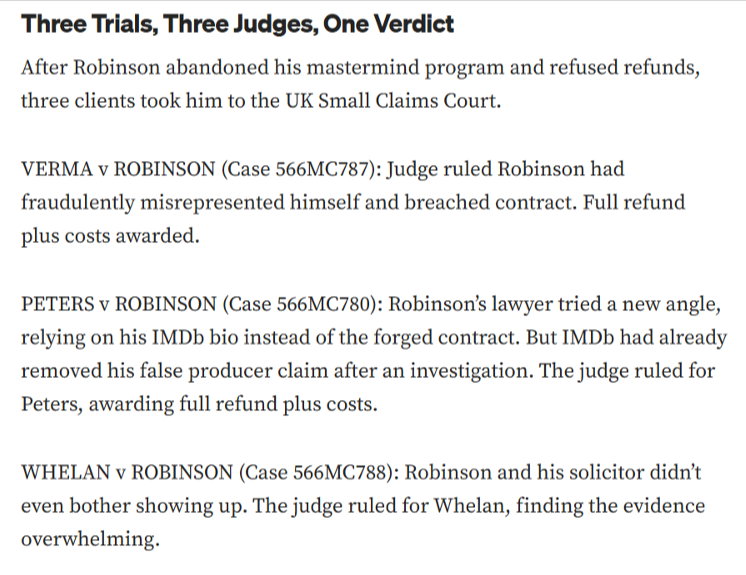
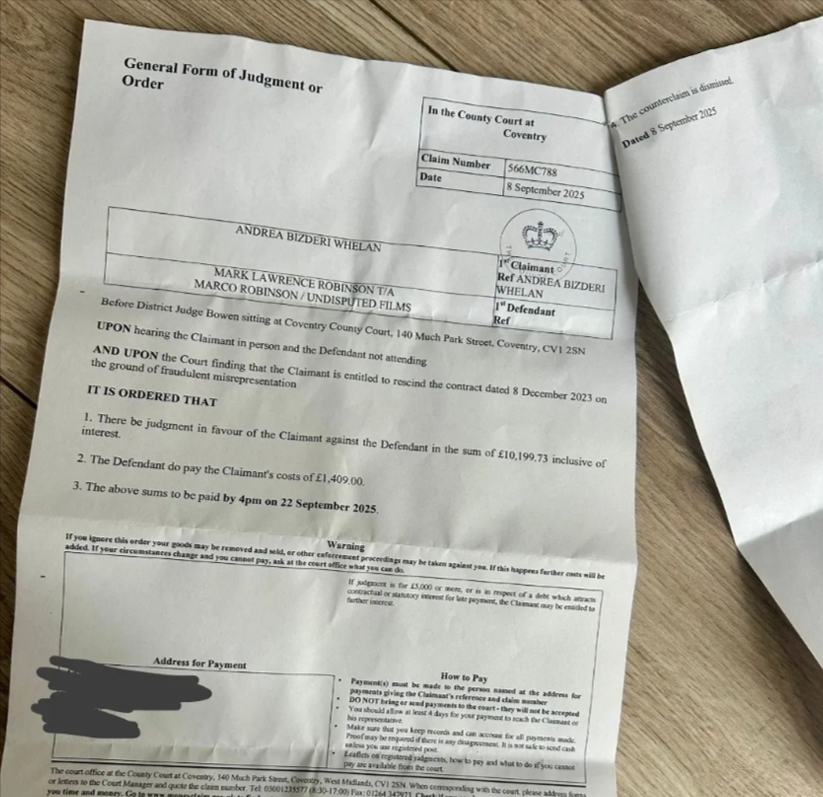
Thus far, Robinson has unveiled exactly two components of his so‑called airline: a set of mock‑up livery renderings and a website holding page. The actual aircraft these designs are meant for have yet to appear — and the airline is still somehow meant to launch in January 2027. At this pace, the planes may have to take off before the paint has even had a chance to dry.
For a venture unironically pitching a “billion‑dollar” airline, launching on the same basic WordPress template they used for the tequila site — a setup technically incapable of running an airline — is a website better suited to hosting cupcake recipes than storing passport data. Another now-deleted comment on the Reddit discussion detailed that WordPress cannot meet PCI‑DSS Level 1 security, meaning it cannot legally process passports, passenger names, or credit cards. Real airlines must license a Passenger Service System like Amadeus or Radixx, which costs £75,000–£250,000 upfront plus £15,000–£40,000 a month in mandatory fees, and they must build a custom NDC API to appear on Skyscanner or Google Flights — a 4–6 month engineering job on its own. The commenter ended by saying, “Slapping a “Coming Soon” sticker on WordPress proves Naked Diablo hasn't even hired a single software architect, let alone started the brutal 12-month compliance process required to actually take your money.”
If you read the Reddit discussion, as above, be aware that some comments appear as “deleted.” Reddit removes comments for a range of reasons — from breaches of subreddit rules to user deletions or reports — and many of the comments I saved are now removed, suggesting someone has been reporting them. It’s worth clicking through any “deleted” markers to view the replies underneath and form your own impression of the discussion’s full context.
For all the noise made by Robinson on social media, so far the only thing cleared for departure is the claim itself.
For a further update see Behind the Hype: What Naked Diablo Airlines Actually Is and Inside the Airline Pitch: A Closer Look.
20. The Magazine Mirage: Buying the Appearance of Credibility
Robinson routinely flashes front-page features on glossies like Global Men and The Enterprise World to project international status and his website lists “Front covers of major newspapers and magazines featuring my work and influence” as credentials for “Speaking & Global Authority.” To an outsider, it looks like mainstream business validation.
In reality, it’s a “Pay-to-Play” illusion, because these aren’t real business magazines, they’re vanity press networks that sell glossy “Top Entrepreneur” covers to anyone willing to pay. They survive by mass-emailing self-proclaimed “gurus” and offering them spots on curated lists like “Top 10 Most Influential Entrepreneurs.”
Their feature packages typically run $1,500–$5,000 USD depending on whether you want a cover, a multi‑page spread, a ghost-written interview, or social‑media promotion.
They don’t investigate claims, they don’t verify financials, and they don’t reference a single Bursa Malaysia filing or audited Tanco report because none of Robinson’s billion‑dollar mythology survives even basic fact‑checking. His own “Entrepreneur of the Year – 2009” claim fits the same pattern: his website names no awarding body, no event, no judges, and no citation, and no independent record of such an award exists (and more recently he has begun implying he won it twice, despite only ever documenting a single year).
These magazines exist to manufacture the appearance of credibility: staged photos, inspiring headlines, and copy‑pasted bios presented as journalism. Robinson’s “entrepreneur” covers aren’t proof of success; he didn’t earn the acclaim — he simply bought the costume.
And Robinson’s newly promoted “Comeback Code” is simply the same play brought in‑house. Instead of paying vanity‑press outlets for manufactured prestige, he has created his own magazine‑style branding so he can sell the same illusion directly to his own followers. There is no evidence of a functioning publication behind it — no website, no ISSN, no distribution, and no editorial structure. What exists are mock covers presented as if they belong to an established media outlet.
The commercial logic is identical to the vanity magazines he previously paid to appear in, but with one key difference: this time, he keeps the upsell revenue himself. A self‑branded “magazine” gives him another surface to monetise — a paid feature, a paid cover, a paid interview, a paid “spotlight” — all sold back to the same Start Over audience already primed to buy symbols of success.
In every case, the pattern is the same: manufacture the appearance of external validation, then monetise it.
21. Times Square: Where Marco Is Happiest Being Amazed by Marco
This pattern of trying to pass off paid placements as public acclaim is just as evident in his Times Square billboard for Start Over, which wasn’t a one‑off flourish but part of a wider routine where he films himself ‘discovering’ his own marketing. That stunt came with the full performance: a staged ‘POV’ caption, slow‑motion shock, and a dramatic sprint toward a screen he’d rented himself — the kind of overacted awe that sends the second‑hand embarrassment into the stratosphere, made even worse when the camera pans to the handful of people nearby, standing in the rain, none of them paying the slightest attention to the billboard or Robinson’s antics.
When asked in comments section how much the Start Over Times Square billboard cost him, Robinson replied ‘NOTHING’ — a claim that only works if you imagine Times Square runs on goodwill and exposure. As if some ad‑tech operator took one look at the weather and thought, ‘You know what this rainy Tuesday needs? A free billboard for a man filming himself sprinting toward it.’
Maybe it cost Marco NOTHING, but someone paid for it. And, of course, he ‘just happened’ to be standing there at the exact moment his ad appeared — a remarkable coincidence, given that Times Square billboards run on fixed schedules he would have received in advance, and someone was already in position to film his big discovery.
The tequila campaign followed the same logic, just without the hammy overacting — he filmed the Naked Diablo billboard and accompanied it with sweeping claims about “Times Square billboards,” “#1 TV documentary series,” “global distribution,” and “podcast tours with some of the biggest names in the world.”
Those claims evaporate on contact with reality. “Times Square billboards” just means he bought an advert. The “#1 TV documentary series” claim isn’t backed by any recognised ranking. “Global distribution” is simply platform availability. And the “podcast tours with some of the biggest names in the world” line has no evidence behind it.
In both cases, the trick is the same: take a paid Times Square advert and present it as if the city were issuing a tribute. What he frames as international recognition is really just a bought‑and‑paid‑for slot he performs as a public honour.
It’s a self‑promotion exercise held together only by the hope no one verifies it.
22. “295,000 Followers and 50 Likes?” — The Maths not Mathsing
Marco’s public Instagram page lists 295,000+ followers, which on paper looks like a serious audience.
But the engagement tells a completely different story.
His posts average around 50–60 likes, which works out to an engagement rate of roughly 0.03%. For comparison, a normal account with that follower count should be pulling somewhere between 1–3% engagement, even on the low end. That’s 2,950–8,850 likes per post, or at the absolute bare minimum around 1,475 if the audience were even half alive.
Instead, the numbers sit at fifty‑odd likes — the kind of engagement you’d expect from a small local business page, not someone claiming a reach of nearly three hundred thousand people. The gap between the follower count and the actual interaction is so wide it’s basically its own postcode.
And then there’s the follower‑quality audit. Modash doesn’t mince words: “83.25% Fake Followers” is what the tool reports on Robinson’s main Instagram page.
Like everything else, what you’re left with is a follower number that looks impressive at a glance, but an engagement pattern that behaves like a completely different account — one with a fraction of the reach.
The façade says “influencer,” but the numbers say “nobody’s home.”
23. ‘Sir’ Marco Robinson
See Deadline article Marco Robinson: Knight Of The Realm
When challenged on his use of the title “Sir,” Robinson’s legal justification is a ceremonial certificate stating that he was formally conferred a title on 1 November 2014 by a modern cultural claimant to the Palembang Sultanate in Indonesia. The punchline — one highlighted in Deadline’s reporting — is that Robinson has presented this to Western audiences as a “Malaysian Knighthood,” creating the impression of official state recognition despite the document originating from an entirely different nation. What Deadline didn’t explore is the underlying context: the historical Sultanate ceased to exist as a sovereign state in 1823, the modern claimant has no governmental authority or role in Indonesia’s honours system, and Indonesia does not operate a system of state knighthoods analogous to the British honours system.
While “Dato’ Seri” is a legitimate honorific in parts of the Malay world, a title issued by a non‑sovereign cultural claimant in Indonesia is not an Indonesian state honour and carries no official recognition even in Indonesia itself: it provides no official entitlement to use either “Sir” or “Dato’ Seri” in Indonesia, Malaysia, the UK, or anywhere else in the world. In practical terms, Robinson’s claimed basis for using the prefix rests not on a recognised knighthood or state honour, but on a ceremonial distinction bestowed by a cultural institution lacking sovereign authority for over two hundred years. To be blunt, it’s not worth the paper it’s printed on.
And the paper it’s printed on only makes the gap between claim and reality more obvious. The document Robinson uploaded on his website — under the heading “Proof of Dato Seri Knighthood Award” — is a heavily stamped letter from the Palembang Darussalam State Customary Palace in Indonesia. To a Western audience unable to read Malay, the seals, crest and formal layout create the visual impression of a royal decree.
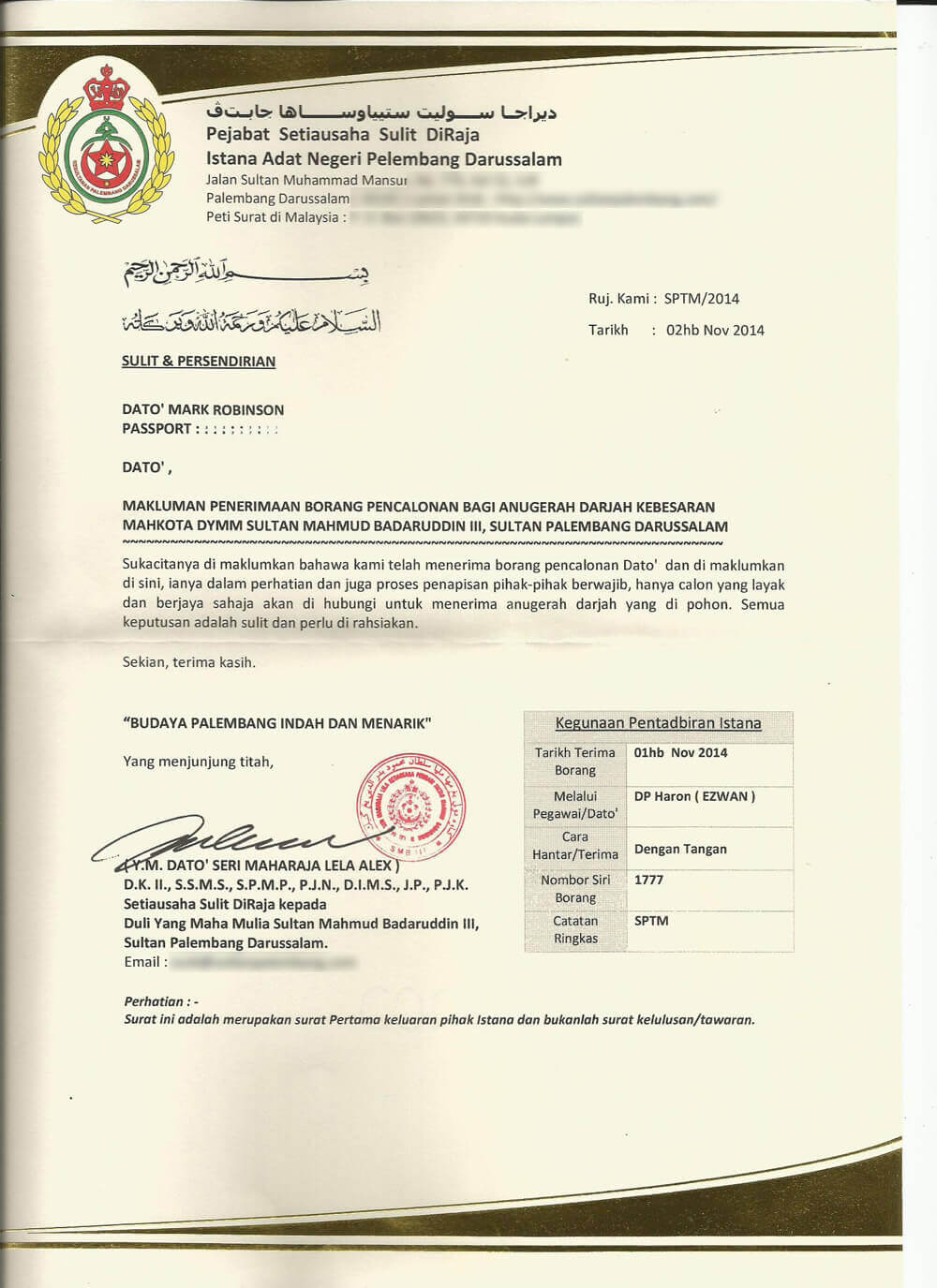
But a direct translation reveals something entirely different. The document is not an award letter at all — it is a standard administrative notice titled “Notification of Receipt of Nomination Form.” It confirms only that a self‑submitted application (Borang Pencalonan Dato’) and a personal profile were handed in for review. Nothing in the text indicates that a title was granted, approved, or even recommended.
The fine print at the bottom makes this explicit: the letter is the first correspondence from the palace and is not an approval, not an offer, and not confirmation of any honour. And just to complete the picture, the “royal palace” address on the letter isn’t a palace at all — it’s a PO Box. A non‑sovereign cultural office, using a PO Box, issuing a receipt for a nomination form. In other words, Robinson took an application‑stage receipt and publicly reframed it as evidence of a conferred knighthood — banking, once again, on no one reading past the letterhead or being able to understand the document at all.
Compounding the inconsistencies, the document originates from Palembang, Indonesia, while the title “Dato’” is a Malaysian honorific that does not exist in Indonesia and can only be granted by Malaysian state rulers or the federal Yang di‑Pertuan Agong. Public Malaysian honours records show no recognised Malaysian title in Robinson’s name, and Indonesia does not operate a system that grants Malaysian‑style honorifics (Indonesia is a unitary constitutional republic. Because it lacks a reigning monarchy, the state has no legal mechanism to grant noble titles).
It’s hard to overstate the absurdity: the palace he claims knighted him has no power to grant titles, least of all Malaysian ones, didn’t grant a title in the document, doesn’t even have a palace — just a PO Box — and Indonesia doesn’t have an honorific system capable of conferring such titles anyway.
Calling himself “Sir Marco” presents a false impression of official status, and under the Consumer Protection from Unfair Trading Regulations that’s a misleading action — traders cannot imply honours, titles, or authority they don’t possess.
Ultimately, it’s a title that doesn’t confer prestige so much as reveal how cluelessly he tried to upsell himself, and exposes him to regulatory action.
24. Why Be One Thing When You Can Be Everything?
Robinson frequently describes himself as a former male model and DJ — claims that appear prominently in his own biographies and LinkedIn posts.
In Life Transformation from 17 years old to 47 years old, he writes that he entered a BBC “Model of the Year” competition at 17 and booked early ski‑wear gigs. A 2016 Daily Mail lifestyle piece later referred to him as a “swimwear model” at 47, though the article relied entirely on photos and information he supplied, naming no agency, campaign, or modelling credits.
Likewise, while he lists “DJ” among his past roles, there is no independent record of professional DJ work — no bookings, no event listings, no promotional materials, nothing beyond his own descriptions.
Robinson also claims to have “sponsored an all‑women’s motorsport team in 2012”. The photos he uses show a car wrapped in Max Generation branding — his incentive‑marketing company — in a format identical to short, per‑race or per‑weekend sponsorship packages common in regional Asian club‑level motorsport. At that level, drivers are constantly scrambling for funding, and for a very low fee an amateur driver will happily let a sponsor wrap the entire car in their corporate colours and even allow the sponsor to describe the entry as the “Max Generation Women’s Racing Team” in marketing brochures. The cost is modest — often only a few thousand pounds for a brief run of events — and the wrap is temporary: once the weekend is over, the vinyl is peeled off and the same car appears at the next race under a completely different sponsor’s name. No independent motorsport registry, race‑result archive, or press coverage records any all‑female team linked to Robinson, nor any “Max Generation Women’s Racing Team.” In practice, the venture appears to have been a short‑lived, low‑cost marketing buy on an existing car rather than a documented racing team, later inflated into a headline achievement in his personal mythology.
Robinson has also talked up a supposed past life as a competitive cyclist, stating he was a “British hillclimb cycling champion”. Yet, once again, the official record disagrees with Robinson’s record. Cycling Time Trials’ national‑championship archives — which run continuously back to the 1940s — contain no entry for any “Marco Robinson” (or “Mark Robinson,” for that matter) appearing on a national hill‑climb podium. The only Robinson to conquer Dovers Hill was Glenn Robinson, who genuinely won the 1988 National Hill Climb Championship. And when it comes to actual British cycling pedigree, the name belongs to figures like Brian Robinson, the first Briton to win a Tour de France stage.
Against that backdrop, Marco’s self‑described cycling credentials look less like a forgotten chapter of sporting history and more like another achievement that exists everywhere except in the official record.
25. The Marco Mitty Problem
If the model‑DJ‑cyclist phase seems inflated, what follows makes it look almost modest — the point where the Marco Mitty problem becomes impossible to ignore and the most outrageous claims of his self‑mythology begin.
He has told audiences that a Russian spy — described in seductive, dramatic terms — was sent to assassinate him on the orders of Vladimir Putin, a story with no evidence, no police report, and no corroboration beyond his own shifting retellings.
In another talk he’s claimed he was once a backing dancer for Michael Jackson, yet there are no photos, no footage, no tour credits, no industry records, and no mention of him in any verified Jackson performance roster.
On StartOverMovement.com, directly beneath an AI‑enhanced portrait, Robinson now claims “over $2Billion in revenue generated online in the past 30+ years,” a number so implausible it would require more than $66 million a year, every year, since the mid‑1990s — despite no trace of any online business, product, platform, filing, or partner capable of generating even a fraction of that. The claim is entirely distinct from his Tanco story, which wasn’t an online business and never reported revenue on anything close to this scale. It also sits awkwardly beside the only independently recognisable milestones he has ever shown: his three ClickFunnels Two Comma Club awards, which certify a minimum of $3 million in funnel revenue (revenue, not profit). The leap from $3 million in documented funnel sales to a sweeping $2 billion lifetime total — a 670‑fold jump — highlights just how vast the gap is between verifiable achievements and the scale of the assertions he makes.
Note on the “Two Comma Club” awards (general context): While internet “gurus” love to flaunt those big, gold‑framed “Two Comma Club” plaques to make themselves look like multi‑millionaires, the reality behind them is pure marketing theatre. You can only apply for a plaque once your ClickFunnels revenue shows the internal milestone, but the award isn’t an official financial honour; you then purchase it from the company for anywhere from $250 to $450 — and award winners are subsequently featured in ClickFunnels’ own advertising.
Deceptive marketers can game the system by artificially inflating the activity inside their funnels to create the appearance of hitting the million‑dollar milestone. Because the software only tracks initial incoming traffic data and completely ignores massive customer refund rates, debt, and Facebook ad bills, the system is easily exploited to project false wealth — and marketers such as Laurence “Law” Payne and Matt Par have been publicly called out within the industry for doing exactly this. A creator can be completely broke in real life while holding a verified million‑dollar plaque.
Ultimately, it is a paid publicity loop, susceptible to abuse, that can be used to manufacture a false illusion of success.
For many years, Robinson has publicly presented himself as a millionaire or multimillionaire. Contemporary publicity around Get a House for Free described him as being “worth £25 million,” yet there is no independent public evidence substantiating that figure. His lifestyle, too, sits at odds with the scale of wealth he claims: for a man who says he has generated $2 billion online, he lives with a modesty that feels strikingly out of step with the fortunes he attributes to himself.
The inconsistencies don’t end with his wealth claims. His homelessness story is just as fluid. Depending on the interview, he was sleeping rough, living in a car, sleeping on a beach, “hidden homeless” in the roof space of a shop, or simply couch surfing with no fixed address. Each version is presented as the definitive truth, chosen to suit the emotional arc of the moment. The timelines don’t align either: he claims to have been a homeless child and teenager, to have lived in a shop roof at 15, to have been “on the streets,” and then to have leapt almost immediately into high‑commission sales roles and international corporate success — all while repeatedly telling audiences he left school with zero qualifications, no degree, and no formal training.
There are no contemporaneous records, no charity involvement, no local reporting, and no third‑party accounts to support any specific episode — just a rotating set of hardship vignettes dialled up or down as needed. His “homelessness” isn’t a single verifiable event; it’s a flexible story-telling device.
Even his medical history shifts. He has publicly given three different ages — 29, 32, and 35 — for when he supposedly suffered a heart attack. There is no medical documentation or consistent timeline, just another dramatic anecdote reshaped to fit the motivational arc he’s selling. As with his other claims, the details change every time he retells them.
Viewed together, these stories form no coherent biography — only a pattern of set‑pieces that change with the audience. When the facts move this easily, the pattern becomes the point: a chain of extraordinary claims that never resolve into a verifiable record, but always place Marco Mitty as the hero at the centre of his own mythology.
26. “The Best Selling Book Series Since Chicken Soup for the Soul,” Apparently
Speaking of outrageous claims, this might be the most palpably absurd one Marco Robinson has ever made. So absurd it deserves its own section, and so ridiculous it’s the easiest to disprove.
Marco loves to insist that his self‑published Start Over book series is “the best‑selling since Chicken Soup for the Soul,” which is hilarious when you remember Chicken Soup is one of the biggest publishing franchises in history. We’re talking half a billion copies, global distribution, decades of sales, translations into dozens of languages — the kind of cultural footprint you can’t fake.
Meanwhile, Marco’s books don’t appear in any recognised sales charts, don’t show up in Nielsen BookScan, don’t have a publisher, don’t have retail distribution, and don’t have a single piece of independent reporting confirming meaningful sales. The only “bestseller” moments they’ve ever had were those brief, easily gamed Amazon micro‑category spikes you get when a handful of people buy the book at the same time. That’s not a publishing phenomenon, that’s a group chat doing a favour.
The scale difference isn’t a stretch, it’s a cosmic joke. One is a global publishing juggernaut. The other is a high‑ticket sales funnel propped up by vanity metrics the wider book industry doesn’t even register.
It’s the literary equivalent of Marco performing a tiny garage gig for a few friends — which he actually did — and then announcing he’s the most successful artist since Elvis Presley. The comparison isn’t just off, it’s so wildly disproportionate it becomes its own punchline. Even for Marco Robinson his book series claim is weapons grade nonsense.
But, as usual, Marco Mitty banks on nobody checking. It’s the same pattern every time: grab a famous success story, stand next to it, and hope the reflected glow fools people who don’t look too closely.
27. Bestseller by Screenshot, Not by Sales
The “bestseller” status claimed by Robinson — both for himself and for the Start Over anthology — is a manufactured marketing device rather than any reflection of genuine public readership. Across his profiles he presents himself as a “12x International #1 Bestselling Author”, yet his books are effectively invisible outside his own ecosystem. None appear on Nielsen BookScan, The Bookseller charts, the New York Times or Sunday Times lists, USA Today, or any recognised industry ranking. No mainstream reviewer, critic, or literary outlet has ever covered his work, and aside from a statistically irrelevant handful of Goodreads entries, there is no independent engagement with his books at all.
A large part of the illusion comes from the platform he relies on. Amazon is not an independent charting authority; it is a retail site whose “#1 Bestseller” badges are algorithmic, temporary, and tied to hyper‑specific micro‑categories that can be gamed with minimal sales. A coordinated surge of a few dozen purchases can push a book to the top of a sub‑subcategory for a matter of hours. Once the badge appears, the screenshot becomes the product — not the book.
This is exactly how the Start Over anthology operates. Co‑authors pay substantial fees to buy their way into a chapter. During a tightly orchestrated pre‑order window, members are instructed to purchase the book simultaneously. The resulting artificial spike briefly forces the title to the top of an obscure Amazon micro‑category. A screenshot is captured, the “#1 Bestseller” credential is minted, and the book immediately sinks back into obscurity. The anthology itself is secondary; the badge is the draw, the bait dangled to hook new high‑ticket mastermind clients.
The tactic Robinson relies on isn’t unique to him; it’s a recycled playbook used across the self‑help and business‑coach industry for more than a decade. Early high‑visibility figures like Tim Ferriss drew attention to coordinated buying windows in the early 2010s, and the method was later industrialised by Brendon Burchard, Grant Cardone, Russell Brunson and a long tail of pay‑to‑publish anthology companies such as MindStir Media and Leaders Press. All use the same formula: micro‑category manipulation, coordinated purchase spikes, and screenshot‑based “#1 Bestseller” claims. Robinson didn’t invent the scheme; he simply adopted a well‑worn gimmick already used by dozens of gurus competing in the same manufactured‑authority marketplace.
Robinson isn’t even original in who he targets. The entire self‑help and business‑guru industry has spent years aiming its messaging at the same vulnerable demographic — people in crisis, people who feel stuck, people desperate for a reset. The “start over” narrative he treats as a personal revelation is just a repackaged version of the reinvention pitch used by every mid‑tier guru‑marketer before him. His only contribution was slapping a new label on a formula that was already being sold to the same audience by dozens of others.
Robinson’s earlier solo book, Close the Deal & Suddenly Grow Rich, follows the same tired pattern. Published in 2018, he continues to market it as a ground‑breaking bestseller, even claiming on his website that it “outsold Malcolm Gladwell.” Yet the book has never charted on any independent list, never appeared in audited sales data, and never received mainstream coverage. Its supposed success, like the Start Over series, rests entirely on short‑lived Amazon algorithm spikes engineered through time‑limited buying windows.
In every case, the “bestseller” status exists only inside the closed loop he constructed. Outside that loop, the numbers — and the industry — show nothing at all.
Again, the only thing Robinson ever scaled to #1 was the story he told about himself.
28. The Industry Blueprint Behind Start Over — And How It Ended in Federal Court
A clear analogue to Robinson’s current “bestseller” model is the publicly documented case of Publishing.com, also known as AIA Publishing Academy. The company became one of the most discussed examples of AI‑driven authorship schemes after years of scrutiny on Reddit communities such as r/Scams and r/selfpublish, followed by a formal enforcement action by the U.S. Federal Trade Commission.
Publishing.com originally promoted a system based on outsourcing: students were encouraged to select broad, generic non‑fiction topics and hire low‑cost ghostwriters to produce short manuscripts. These texts were then repurposed across Amazon storefronts, with the real emphasis placed on converting them into audiobooks for Amazon’s ACX platform. The marketing promised passive income, but students frequently reported additional costs for covers, formatting, advertising, and software that were not disclosed upfront.
When generative AI tools became widely available, the company shifted its model. Students were instructed to use AI to produce short e‑books in a matter of hours, with the focus moving away from writing and toward manipulating Amazon’s ranking system. Coordinated WhatsApp and Telegram groups were used to organise simultaneous purchases of each other’s $0.99 books, creating brief spikes in obscure categories. These spikes produced temporary “#1 Bestseller” labels long enough for screenshots, which were then used as proof of success. Once a student achieved this manufactured milestone, they were encouraged to purchase high‑ticket coaching packages to convert the same AI‑generated text into an audiobook.
The programme became the subject of sustained criticism on Reddit, where users documented aggressive sales tactics, unrealistic earnings claims, and refund barriers. Journalists later obtained customer complaints through the Freedom of Information Act, revealing that many students had spent thousands of dollars—often encouraged to take on debt—only to discover that the promised income was unattainable without substantial additional spending on ads and services.
A major point of public anger was the company’s handling of reviews. Multiple students reported that refunds were contingent on providing positive testimonials, creating a distorted online reputation. YouTube investigators, including Folding Ideas, published detailed analyses describing the operation as a “contrepreneur” model built on manufactured success stories and incentivised reviews.
The situation culminated in a formal action by the U.S. Federal Trade Commission. The FTC imposed a $1.5 million penalty and issued a consent order prohibiting Publishing.com from making unsubstantiated earnings claims, restricting its use of testimonials, and banning deceptive refund practices. The case has since become a widely cited example of the risks associated with “AI passive income” publishing schemes.
Other programmes built on similar “AI‑powered publishing” formula have faced similar outcomes in both the US and the UK. In the United States, operations like Emeka Ossai’s Passive Publishing system, and earlier Kindle “gold rush” coaching outfits ended up in court, refund disputes, or formal regulatory action for misleading earnings claims, manufactured bestseller tactics, and aggressive upselling. In the UK, Trading Standards and the Advertising Standards Authority have taken action against several “write your book in 30 days” and “Amazon bestseller launch” programmes for deceptive marketing, buried refund conditions, and undelivered high‑ticket coaching.
Every version of this model that has ever grown large enough to attract regulatory attention has ended the same way: refunds, sanctions, or collapse once the mechanics were examined.
29. A Scheme Already Written to Its Ending
The structural parallel of Start Over to Publishing.com is difficult to ignore. Publishing.com’s model revolved around AI‑generated books, coordinated buying spikes, manufactured bestseller status, and high‑ticket upsells. Robinson’s current programme follows the same pattern: participants pay thousands for a short book or anthology chapter, are encouraged to use ChatGPT to produce it quickly, and are placed into a WhatsApp group where coordinated purchasing pushes the book to #1 in a micro‑category for a brief window. The resulting screenshot becomes the credential, and further upsells—such as audiobook versions—are offered at additional cost.
The pattern extends to how criticism is managed in Start Over: refunds tied to removing negative reviews, and NDAs used to keep complaints out of sight.
The distinction is that Publishing.com’s practices have already been examined, documented, and sanctioned by a federal regulator. Robinson’s system operates in the same conceptual space: a product is delivered, but the achievement being sold is not organic authorship or genuine bestseller status. It is a manufactured outcome created through coordinated purchasing and algorithmic manipulation, identical in method to the model that led to Publishing.com’s collapse.
In light of the Publishing.com outcome, the direction of travel here isn’t difficult to guess.
30. The “Give Back” Charity That Forgot the ‘Charity’
Robinson frequently invokes his shifting homelessness origin story as moral proof of his compassion. A lived experience he claims inspired him to “give back” through humanitarian work.
Central to that persona is FREEDOMX, a UK charity he presents as a major vehicle in his fight against homelessness. In his marketing funnels, FREEDOMX is framed as a global-impact organisation, a testament to his character, and a reason to trust him with high‑ticket coaching fees.
Except the official record tells a very different story.
According to the Charity Commission for England and Wales, FREEDOMX’s statutory reporting is now over 1,100 days overdue at time of writing, and its last filed accounts show an annual income of just £690. There is no evidence of programmes, outreach, beneficiaries, or operational activity of any kind. No audited projects. No documented impact. No trace of the sweeping humanitarian work described in his promotional material. On paper, FREEDOMX is a dormant micro‑charity — nothing more.
To give his brand an international aura, Robinson boasts of “global philanthropic initiatives” throughout the UK, Malaysia, Indonesia, and Peru. But when you audit the claim, the wider philanthropic footprint shrinks to almost nothing. The UK “initiative” is a single, decade‑old TV episode. The Malaysia and Indonesia references point only to his for‑profit business ventures; even the Malaysian ‘guide dog’ story he repeats in interviews is undercut by Deadline’s finding that no law was changed to match his account. And Peru is a complete public void — lacking press coverage, NGO partnerships, filings, property records, or any independent trace of activity. It is a list of countries selected for effect, polished up to resemble a United Nations charity roster.
Against that backdrop, his association with the legitimate NGO Homeless Entrepreneur stands out as one of the few relationships that can actually be verified — he was officially named an “Impact Advisor” by the group in 2020. Yet even here, the embellishment resumes. His marketing materials claim the partnership has “supported thousands back into housing,” when those figures represent the charity’s cumulative global work, not his contribution. Robinson simply folds the organisation’s entire track record into his personal résumé, letting the charity’s hard‑won impact pad his own profile.
In the end, Robinson’s homelessness and philanthropic “impact” functions exactly like the rest of his mythology: a handful of small, verifiable facts buried under layers of self‑promotion, until the story bears no resemblance to the record that supposedly supports it.
31. Criticism & Tantrums
Robinson’s responses to scrutiny often escalate into what can only be described as public tantrums — dramatic, emotional outbursts that shift attention away from the issue raised and onto the emotional toll he claims to suffer. His reactions follow a predictable pattern of defensiveness, self‑victimisation, and narrative control. Rather than address concerns directly, he reframes himself as the wronged party, and even mild feedback triggers disproportionate intensity — most visibly in his Trustpilot replies.
Across platforms, the same rhythm repeats. Critical comments prompt long, theatrical posts about betrayal, loyalty, or being misunderstood — reactions that resemble narcissistic injury responses (not a diagnosis — just the inevitable tailspin he enters whenever reality has the audacity to contradict him). The focus consistently shifts from the substance of the criticism to the emotional suffering he insists he is enduring.
Instead of reflection or accountability, he turns scrutiny into fuel for the Marco Mitty persona — the embattled visionary whose supposed persecution becomes proof of his exceptionalism.
Criticism doesn’t lead to growth it is just more raw material for brand Marco, turning every public failure into a motivational story about surviving the haters to build his own myth.
Speaking of which, Robinson loves to boast, “I have never met a hater doing better than me... ever.” It’s a recycled hustle‑culture slogan he repeats as if he coined it, and a novel way of admitting he doesn’t meet many people. The film writers who took him to court and won a legal judgment against him certainly did better than him. The tens of thousands of legitimate self‑published authors outranking him on Amazon without need to game the algorithms are doing demonstrably better than him. And anyone who doesn’t pay budget newswire services to manufacture their own good press is doing undeniably better than him.
If the critics are so beneath him, why does he spend so much time and money laundering his own PR to hide what they say?
32. The Paid Newswire Echo Chamber: Pushing Down the Truth
One of Marco Robinson’s most reliable survival mechanisms is his tactical use of low‑cost press‑release syndication networks — ABNewswire, EIN Presswire, Accesswire, and their countless automated clones. Whenever journalists expose contradictions in his story or unhappy clients leave damaging reviews, he launches a counter‑offensive: a flood of self‑written “articles” stuffed with keywords like Marco Robinson reviews, Marco Robinson success, or Marco Robinson vindicated.
Because search engines reward fresh, text‑heavy content from syndicated sources, these paid releases temporarily outrank genuine reporting, pushing critical material onto page two or three of Google. The effect is deliberate: a wall of noise engineered to drown out scrutiny.
None of this is organic. Robinson pays a fee to distribution services that blast his copy to a network of automated affiliate sites, which then scrape and republish it verbatim. This creates a closed‑loop illusion of legitimacy, where dozens of machine‑generated websites appear to “confirm” his preferred narrative — whether it’s inflating Tanco into a “multi‑billion‑dollar success story”, reframing criticism as envy, or heralding a revolutionary new airline without any planes.
For anyone attempting basic due diligence, this manufactured footprint functions as a reputation shield: a synthetic layer of search‑engine clutter designed to bury warnings, obscure negative reviews, and protect his high‑ticket coaching funnels from being examined too closely.
33. Giving Himself A Standing Ovation
In April 2025, by popular demand of absolutely no one, Robinson staged a ‘concert’ ostensibly for friends, though one suspects the main audience was himself, conducting a performance in what looked like a garage with the cars removed — and the cringe was so strong it felt environmentally hazardous.
Critical opinion was, unsurprisingly, divided: the few there in person politely clapped, and everyone else watching, perhaps like me, had the sudden, creeping sense they might actually be dead and this was their punishment. This was after several years of singing lessons Robinson had publicly mentioned taking to “improve” his voice; whatever the number, the return on investment remains about as visible as a refund from one of his courses.
And now, in the same spirit of self‑commissioned acclaim, Robinson is touting a musical about his own life — “Legacy of Spies”, with himself, naturally, in the starring role — and advertising the forthcoming “documentary” he’s making about himself (“Why I Am My Own Greatest Inspiration”, presumably?), plus a “feature film” . It’s a whole ecosystem of self‑celebration — the kind of production line only a truly committed admirer of himself could sustain.
If Kanye West met Marco — a man producing a musical about himself, starring himself, singing in it, making a documentary, and a film about himself — he’d wonder why he’d wasted decades being so shy.
Marco makes the Emperor Commodus look like a model of humble self-restraint.
34. Personal Life
Marco’s relationship with his girlfriend — who is roughly 21 to 22 years old, creating a 36-year age gap— follows the same theatrical, image‑driven pattern as the rest of his personal mythology. He has publicly described her as “the love of my life,” yet in a Trustpilot reply he also alludes to filing a police report against her after a dispute, framing himself as the victim. The relationship appears to be on‑again, off‑again in a way that is hard to miss
The cycle of declarations, disappearances, disputes, and reconciliations — set against a 36‑year age gap — creates the impression of a relationship marked by volatility. Her presence in his output isn’t steady or relational; it’s instrumental. She appears when she reinforces the lifestyle story he’s selling, and vanishes when she doesn’t, functioning less as a real partner and more as a prop within his self-presentation.
EDIT — Since publishing, I’ve been passed two videos saved by a reader taken from Marco’s Instagram stories. Both were filmed during his trip to Cannes in May 2026 and together they offer a small but telling glimpse into the relationship dynamic.
In the first clip, his girlfriend can clearly be heard off‑camera mocking him with “Hi, I’m Marco, I’m so fake” as he films himself. It isn’t banter or flirtation — the delivery is openly contemptuous, with none of the warmth or in‑joke tone you’d expect between partners. The surprising part is that he posted it at all; I can only assume he didn’t hear the remark or wasn’t aware of it when he uploaded the clip.
The second video, posted afterwards — though I suspect filmed before the first — shows the two of them dancing together, smiling and happy. Seen side by side, the shift from playfulness to open contempt — and the fact that he published both — creates an awkwardly candid moment that reveals the volatility sitting just beneath the surface of their relationship.
This unstable dynamic sits uncomfortably beside the vulnerable demographic he actively markets to. Start Over’s community is made up largely of older women, many of whom openly share histories of trauma, abandonment, or abusive partners. These are the exact people Robinson positions himself as a mentor for—women seeking emotional safety, stability, and a sense of being valued after surviving difficult pasts. One reviewer even wrote that, as a survivor of sexual abuse, discovering that Marco was in a relationship with a 21‑year‑old “girl” was triggering, especially when combined with what they described as defensive and dismissive responses to concerns raised.
The optics are made stranger still by the fact that Marco regularly features his daughter in his posts — and she is obviously older than his girlfriend. For followers already sensitive to age gaps and power dynamics, that contrast doesn’t just stand out; it creates a quiet unease, the same kind of discomfort as the former member described above when she realised he was dating someone barely out of her teens. It hints at an undercurrent everyone in the group seems aware of but carefully avoids, a vibe they all feel but steer away from, the kind that makes you wonder why they’re choosing not to look at it.
What makes the overall picture even more jarring — especially for followers who only know the polished version of Marco’s story — is the contrast between the persona he sells today and the public record of the ventures he attached his name to in the past. As previously discussed, in 2015 he was presented as a co‑founder of The Play Experience, an adult‑nightlife project marketed with explicit sexual themes. Most of his current audience has no idea this chapter ever existed, yet it sits there in plain sight, colouring how some readers may interpret the 36‑year age gap, the volatility, and the way women appear in his content only when they serve a purpose. For a community built around healing from harm, the combination of his past branding and his present relationship choices doesn’t just create tension — it raises questions that are hard to ignore once you’ve seen the full picture.
It’s also worth noting — purely as a matter of public reaction — that the Instagram post promoting the Deadline article attracted a large volume of comments from members of the public making serious allegations about Robinson’s behaviour. These are unverified claims made by commenters, not established facts, and this exposé does not endorse, repeat, or validate them. Their relevance here is simply that the intensity of the response illustrates how polarising Robinson’s public persona has become. For anyone reviewing the post themselves, many of the strongest claims appear in the hidden or “view replies” sections, so readers may need to expand those threads to see the full context and make their own assessment.
The Start Over narrative centres on emotional repair, trust, and rebuilding after harm. Yet the unmistakable drama of his turbulent, three‑and‑a‑half‑decades age‑gap relationship mirrors the exact instability many of his followers are trying to escape. Set against the earlier chapter of his public persona, with his involvement in sex‑themed nightlife events and Play Experience posts carrying captions like “She looks so innocent yet she’s a complete sex mad maniac…”, and suddenly the version of himself he sells looks a lot less like the full story.
Whether members see the contradiction or rationalise it away is part of the wider Marco Mitty Problem: the story matters more than the reality. To an outside eye, the way he brings the relationship into view — selectively, confidently, and always on his terms — looks less like introducing and more like a deliberate show, a reminder to his audience of who dictates the frame and who’s expected to accept it.
For women who have already lived through power imbalances and emotional volatility — the very people he claims to help — the dynamic he holds over the group echoes patterns they’ve known, and the unsettled nature of his relationship with a woman younger than his own daughter is not just uncomfortable, it’s familiar in ways they hoped they had left behind.
The Marco Mitty Finale: A Life Lived in Fiction
Marco introduces his “Proof of Work” with the slogan “Documented. Verified. Undeniable.” This article documents, verifies, and demonstrates that every one of those claims is, in fact, deniable.
Across every chapter of his public life, a single pattern repeats. Marco Robinson’s claims — whether about billion‑dollar timeshare empires, award‑winning restaurants, multimillion‑pound property portfolios, revolutionary cryptocurrencies, global tequila brands, airlines, knighthoods, best selling books or miraculous personal histories — collapse the moment they meet independent evidence. Where documentation exists, it contradicts him; where documentation should exist, it doesn’t. What remains is a trail of dissolved companies, failed ventures, unpaid investors, shifting stories, and self‑authored mythology presented as fact.
His personal narratives follow the same script: dramatic, inconsistent, and shaped to fit whatever emotional arc he needs in the moment. His relationship history appears only when it serves the image, and his responses to scrutiny rely on defensiveness, self‑victimisation, and theatrical counter‑narratives rather than accountability. Nothing leads to clarity; everything becomes content.
That’s the deeper pattern: every time one claim is examined, another inconsistency surfaces. Nothing resolves; each thread leads to another loose end. The stories don’t stabilise because they’re not built to — they’re built to be replaced. It’s a matryoshka doll of contradictions: open one, and there’s another version of the same story inside, wearing a new costume and hoping you won’t notice the swap. The whole thing plays out like a hall of mirrors designed by someone who didn’t expect anyone to look too closely — every reflection slightly warped, every angle contradicting the last, and none of it adding up unless you squint hard enough to pretend it does.
Taken together, the evidence reveals not a billionaire architect, property mogul, crypto pioneer, or visionary mentor but a man whose public persona exists only because it is constantly rewritten. What he builds isn’t an empire — it’s a storyline. And like any storyline, whole chapters can be removed when they no longer fit — including a publicly promoted adult‑nightlife venture most of his current followers have no idea ever existed, a Dubai criminal judgment for fraud carrying an unserved prison sentence, and a UK civil ruling for fraudulent misrepresentation.
Even his name has been part of the performance. Earlier Companies House filings list him as Mark Robinson, and while some later records reflect the more cinematic “Marco Robinson,” it’s unclear exactly when or how formally that shift occurred.
There’s nothing unusual about rebranding yourself — unless, of course, you’re simultaneously lecturing followers about authenticity, urging them to “live their truth,” “own their story,” and “show up as their real selves.” When the name, the story, and the persona keep shifting, the only constant left is the marketing.
When the Deadline article broke, Robinson happened to be in New York giving a talk. He opened by addressing it directly, brushing it off with a breezy, theatrical “And it’s all true!” The audience — small, polite, and eager to be entertained — laughed on cue. But the moment carried its own quiet twist: it may have been the only time he’s ever told the truth, and he only managed it by disguising it as a joke.
And that’s the final irony: in Start Over, Robinson teaches that storytelling is the key to success, and on that point he may be right — because when you strip away the slogans, the reinventions, and the theatrics, the only thing he has ever consistently built is the story of Marco Robinson.
For more on Marco Robinson see: Marco Robinson & Start Over — A Closer Look Investing With Marco Robinson: A Guide on How to Lose Everything
For more on Robert Fitzpatrick see: Robert Fitzpatrick: From High Court “Swindle” to Billion‑Dollar Pretender
💬Have your say on Marco Robinson
To guarantee absolute reader privacy and protect this blog from takedown notices or external legal pressures, all community discussions are hosted entirely off-site.
Clicking the links below will open a new browser window to a fully end-to-end encrypted ledger hosted via CryptPad. Your entries are completely anonymous, cannot be tracked, and operate independently of this publishing platform.
* 📝 Click here to Leave an Anonymous Comment
* 👁️ Click here to View the Public Comment Board
Sources
For anyone reading: every point in this post is based entirely on publicly available information, official filings, archived material, and Marco’s own published claims. Nothing relies on private data, speculation, or unverifiable allegations.
Primary sources include:
- Deadline — The Many Faces Of “Sir” Marco Robinson investigative report, published 25 September 2025.
- Companies House records for Naked Diablo Ltd, Marco Robinson’s dissolved companies, and entities he claims ownership of.
- Public interviews where Robinson’s homelessness story, career history, qualifications, and awards shift from version to version.
- Robinson’s own social media posts, videos, and self‑published claims across multiple platforms.
- Archived websites, pitch decks, and promotional materials published by Robinson or his associated ventures.
- Public reporting on the Malaysian timeshare sector in the 1990s–2000s, including its reputation for high‑pressure sales and consumer complaints.
- Historical financial data on Tanco Holdings, including market capitalisation and the MYR–USD peg during the period Robinson references.
- Instagram – The Play Experience — promotional posts including launch announcement and founder references.
- Wayback Machine Internet Archive — archived snapshots of theplayexperience.com (2015–2016) and robfitzpatrick.com (2013 – present).
- Channel 4 listings and programme credits — confirm Get a House for Free was broadcast once as a single documentary on 9 August 2017 at 9:00 PM, with no repeat airings and no creator credit attributed to Marco Robinson.
- The Telegraph — identified the Get a House for Free giveaway property as a £120,000 Preston flat already within Robinson’s buy‑to‑let portfolio.
- National reviews (The Guardian, The Times, The Irish Independent, The Big Issue) — described the Get a House for Free programme as exploitative, including phrases such as “a new low in TV nastiness” and “poverty porn at its most pernicious.”
- Land Registry search — no publicly available record confirming transfer of the Preston flat to the on‑air recipient.
- Property Tribes (forum archive) — long‑running thread where UK landlords and investors documented their experiences with Robinson‑linked property deals; used as contemporaneous testimony and public reaction.
- Public records of the Naked Technologies crypto project collapse.
- Dubai Public Prosecution Portal (Case No. 48248/2018) — Screenshot accessed via UAE‑based VPN; displays anonymised defendant initials, case number, dates, judge, charge category, and judgment timeline consistent with the translated judgment document circulated online.
- Robert (Rob) Fitzpatrick’s personal website — primary source for his self‑published claims.
- fitzpatrickfamilyoffice.com — source for Fitzpatrick’s stated investment operations and claims.
- Lancashire Telegraph — source for Fitzpatrick’s historical background re Freedom International and Tragic aunty 'ripped off' court case.
- This Is Money — source for Fitzpatrick’s historical background re Igennex and Perfect4u.
- Sunday Standard — source for Fitzpatrick’s historical background re C‑Lifestyle Management Group.
- Global Filmz — source for key characters re Fitzpatrick family reality TV series Tequila Empire.
- SiriusXM — source for Fitzpatrick's appearance alongside Billy McFarland.
- FCA Financial Services Register — The FCA’s public register lists all authorised investment firms, fund managers, and individuals permitted to manage client money; Robert Fitzpatrick does not appear in this register.
- UK Fund Manager Directories — Public listings of regulated UK venture‑capital and private‑equity firms contain no entries for Robert Fitzpatrick or any fund associated with him.
- Investment Industry Disclosures — Standard public disclosures and industry announcements show no record of Robert Fitzpatrick operating as a venture capitalist, regulated investor, or family‑office principal.
- Turks & Caicos Sun (Aug 2020) — reported the proposed Dellis Cay acquisition involving Inn Vogue Hotel Group and four named businessmen, including Rob Fitzpatrick.
- Hilton (2025) — announced the Waldorf Astoria Turks & Caicos Dellis Cay project in partnership with the island’s new owners.
- Ritz‑Carlton Developers — confirmed acquisition of Dellis Cay prior to the Hilton development agreement.
- Naked Diablo Website — Official brand website.
- The official Naked Diablo presentation PDF brochure created by the Fitzpatrick family.
- Public records of the El Diablo restaurant closures in Manchester and Florida.
- Publicly accessible information on Casa Maestri, the contract distillery used by hundreds of private‑label brands.
- Tequila Empire verification — Searches across IMDb, Rotten Tomatoes, Metacritic, major TV‑award databases (Emmys, BAFTAs, Golden Globes, Critics Choice), Cannes Film Festival programme archives, and trade‑press outlets (Variety, Deadline, Hollywood Reporter) show Tequila Empire has no chart rankings, no reviews, no nominations, no wins, and no Cannes selections or awards.
- Naked Diablo market‑presence verification — Checks across major US and UK retail platforms (Total Wine, BevMo, Drizly, ReserveBar, Tesco, Sainsbury’s, Asda), national distributor listings, state alcohol‑licensing databases, hospitality supply directories, and trade‑press coverage show no evidence of meaningful market penetration, with Naked Diablo absent from mainstream retail shelves, major distributors, and industry reporting.
- Las Vegas venue verification — Searches across Virgin Hotels Las Vegas’ official venue directory, Mohegan Casino Las Vegas listings, Las Vegas nightlife and hospitality databases, business‑licence records, and local press coverage show no record of any Naked Diablo–branded bar, club, lounge, or venue operating in Las Vegas, and no listing of a Naked Diablo venue inside Virgin Hotels Las Vegas.
- Michael Jackson performance‑credit verification — Checks across official Michael Jackson tour credits, dancer rosters, archival concert footage, rehearsal material, industry databases, and fan‑maintained archives (Bad, Dangerous, HIStory, and This Is It) show no record of any “Mark Robinson” or “Marco Robinson” appearing as a backing dancer, and no public source corroborates the claim.
- “Entrepreneur of the Year” — Searched major award bodies (e.g., EY Entrepreneur of the Year, Great British Entrepreneur Awards, Asia Pacific Entrepreneurship Awards), public winner registries, business‑press archives, regional news, corporate filings, and third‑party award databases; no record of Robinson appears, despite his website now implying he won twice.
- Charity Commission record for FREEDOMX — confirms the charity’s £690 total income, no filed accounts, no annual returns, and 1,100+ days overdue status on the official UK register at time of publishing.
- Trustpilot — reviews and responses, including the widely circulated exchange involving a police‑report reference.
- IPO verification — No IPO activity appears in the official UK registers where any such filing for Start Over would have to be recorded.
- Indonesian honours verification — Indonesia has no honours system that grants titles such as Dato’ Seri, and therefore no official public archive exists to verify such a claim.
- ICF credential search — No ICF coaching credentials or accredited programmes appear for Robinson, Start Over, or Coaching Heroes in the ICF’s publicly searchable directories.
- EMCC accreditation check — No EMCC coach accreditations or programme accreditations are listed for Robinson, Start Over, or Coaching Heroes in the EMCC’s public register.
- Homeless Entrepreneur appointment — Homeless Entrepreneur’s 2020 announcement naming Robinson as an “Impact Advisor.”
- The UK Civil Aviation Authority (CAA) The CAA provides general information on the regulatory process for applying to operate an airline, and a search of its public registers shows no record of any entity named “Naked Diablo Airlines” or any related application.
- Reddit specifically the dedicated discussion in /r/aviation of Naked Diablo Airlines.
- Cycling Time Trials’ national‑championship archives which hold no entry for Marco/Mark Robinson.
- Start Over Amazon ranking verification — Searches across Amazon UK and Amazon US listings for the Start Over series show no evidence of any volume holding a sustained or category‑wide #1 ranking; Amazon pages list the books only within ultra‑niche Kindle subcategories and do not show verified #1 bestseller status in any major chart, nor any independent confirmation of the “twelve consecutive #1 bestsellers” claim.
- Global bestseller verification — Checks across Nielsen BookScan, The Bookseller charts, New York Times and Sunday Times bestseller lists, USA Today list archives, Publisher’s Marketplace, Kobo and Apple Books charts, and Goodreads author statistics show no record of Mark/Marco Robinson or the Start Over series appearing on any recognised bestseller list, and no independent confirmation of the claimed “global bestselling author” or “twelve consecutive #1 bestsellers.”
- FTC action against Publishing.com — Federal Trade Commission complaint and settlement (FTC.gov) detailing misleading earnings claims, coordinated bestseller tactics, required refunds, and the programme’s collapse following regulatory scrutiny.
- ASA rulings on UK “bestseller” and book‑coaching ads — Advertising Standards Authority rulings (ASA.org.uk) addressing misleading claims about guaranteed bestseller status and unverifiable success rates.
- Times Square billboard booking sites — official ad‑booking platforms showing that Times Square screens are purchasable advertising inventory.
- Modash “Check fake followers” free online tool.
- Assassination‑attempt claim verification — Although the claim is inherently implausible, checks across UK national‑press archives, international news agencies (Reuters, AP, AFP), Russian state‑media databases, and publicly searchable police‑reportable incident records show no reporting, documentation, or corroboration of any assassination attempt involving Mark/Marco Robinson.
All quoted text is reproduced under UK fair‑dealing exceptions for quotation and reporting. No copyrighted images have been republished, and all referenced material was publicly accessible at the time of writing.