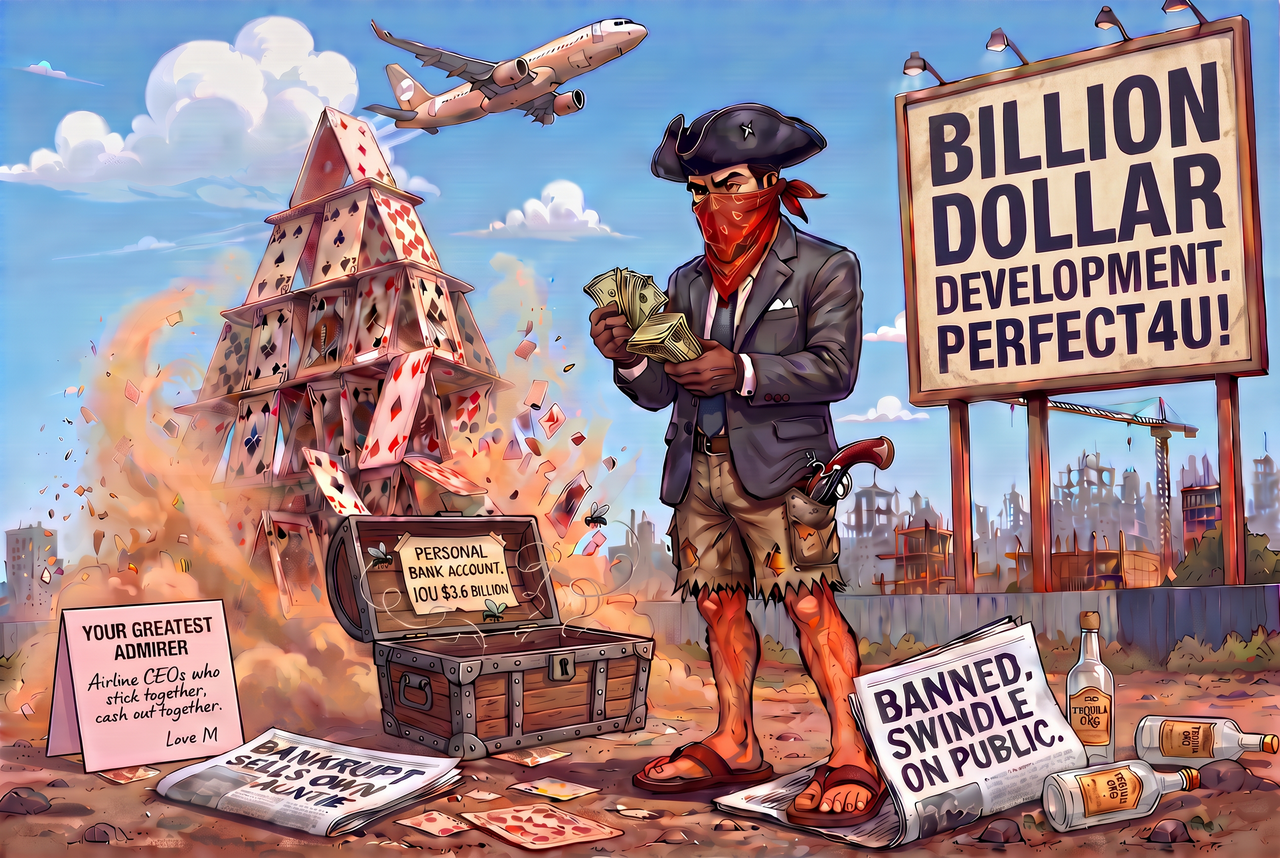
An independent investigation into Rob Fitzpatrick and his billion‑dollar branding claims, evaluating pyramid‑scheme scam complaints, and examining his development projects and business ventures — including Naked Diablo Tequila, the Naked Diablo Airlines venture, and his corporate associations with Marco Robinson.
This article is a supplemental piece to my main investigation into Marco Robinson. As I drafted that work, the section (14) dealing with Rob Fitzpatrick — and the network of entities surrounding him — began expanding far beyond what belonged in a Marco‑focused narrative. The Marco article needs to stay centred on Marco.
This piece exists to provide the additional background that sits behind him: the partner he promotes, the structures he attaches himself to, and the institutional theatre that frames his claims. What follows is the deeper context — the Fitzpatrick ecosystem: a deep dive into the man selling jets, yachts and billion‑dollar deals while the public record shows bans, bankruptcies, pyramid schemes and a “global HQ” in a farm outbuilding.
Click to expand Table of Contents (23 Sections)
- 1. The Tequila Connection
- 2. Inside the “New World” That Never Built Anything
- 3. Caribbean Luxury Real Estate Development Group
- 3.1 Dellis Cay
- 3.2 Puerto Rico: Carib Attempts to Piggyback Sovereign Legitimacy
- 3.3 Puerto Rico: Zero Development Activity and a Manufactured Media Presence
- 3.4 North West Point Provo Turks & Caicos Islands
- 3.5 Personnel Architecture: Manufacturing Institutional Mass
- 3.6 The dck Worldwide Partnership: Real Name, Frozen Relationship
- 3.7 Carib Role in the Fitzpatrick Promotional Ecosystem
- 4. The Grey‑Area Mechanics of Fitzpatrick Non-Developments
- 5. Cloud 9: Equity for Templates
- 6. Legend Advocates: A Sports‑Finance “Consortium” Without a Track Record
- 7. How Legends Advocates Benefits: Reputation First, Revenue Later
- 8. Qualified for the Title, Not the Job
- 9. Netstart Capital: A Small Company Behind a Big Number
- 10. The Lifestyle Pivot: From Ghost Developments to Manufactured Luxury
- 11. Inside the Airline Pitch: A Closer Look
- 12. The History Fitzpatrick Hides — and the Courts Reveal
- 13. The Pay‑Off: Why the Fitzpatrick Model Does Not Create Real Wealth
- Finale: The Long Road From Accrington
- Sources
1. The Tequila Connection
Two of the businessmen named in the Dellis Cay article hosted on Fitzpatrick’s personal website are Simon Tolan and Raymond Jackson. These are not incidental figures: Tolan is publicly presented as a co‑founder of Naked Diablo Tequila, while Companies House records identify Raymond Jackson as an active director and shareholder of Naked Diablo Ltd. The third named businessman, Paul Clarke, appears to have dropped out of Fitzpatrick’s corporate orbit after the Dellis Cay collapse, but both Tolan and Jackson remain closely connected to Fitzpatrick’s ongoing ventures.
Their presence in the Dellis Cay bid further undermines any claim of institutional backing; it shows that the “Inn Vogue Hotel Group” was effectively being fronted by the same promotional circle that later repackaged itself as a self‑described luxury‑spirits brand.
The corporate structure behind Naked Diablo Ltd reflects a clear division of roles. Tolan is publicly presented as a co‑founder and strategic partner across press releases, trade media, and their own television content, yet he does not appear as a director in the company’s legal filings. By contrast, Companies House records list Raymond Jackson as an active director and shareholder, carrying statutory responsibility for the company. This creates a split between the public‑facing promotional figures and the individuals who anchor the formal corporate entity — a pattern consistent with their wider ventures.
2. Inside the “New World” That Never Built Anything
Outside the tequila brand, Fitzpatrick and Tolan also operate together in New World Developments (“NWD”), founded in 2021, where Fitzpatrick is listed as President & Co‑Chairman and Tolan as Development Director.
2.1 San Salvador
The pattern that began at Dellis Cay did not end there. After promoting a billion‑dollar acquisition that never closed and a resort that never broke ground, Fitzpatrick and Tolan moved on to an even larger canvas: a Baker’s Bay‑style mega‑development on 10,000 acres in San Salvador, Bahamas. The escalation was deliberate. Where Dellis Cay relied on borrowed prestige and unverified claims of institutional backing, San Salvador added political theatre, land‑option engineering, and celebrity optics to create the appearance of a fully capitalised, government‑aligned luxury development vehicle.
San Salvador was chosen with intent. The island sits inside the political constituency of Prime Minister Philip “Brave” Davis, giving NWD immediate proximity to senior officials and a receptive backdrop for a project pitched as transformational. Under Bahamian law, a foreign developer would normally require Bahamas Investment Board clearance, but Fitzpatrick sidestepped early scrutiny by aligning with Emmanuel “Manny” Alexiou — a prominent Bahamian attorney and one of the island’s largest private landholders.
By bringing Alexiou into the corporate structure, NWD secured an Option Agreement over his family land at a steep discount to the valuations being promoted. The option allowed NWD to present the 10,000 acres as a corporate “asset” despite owning none of it, and positioned Fitzpatrick not as a developer but as a land‑option broker: if an investor ever committed funds, NWD’s contract architecture ensured it would capture a substantial share of the upside simply for holding the option and producing a paper master plan. The parcel‑analysis documents commissioned for the site confirm the underlying reality: the land belongs to Manny, not NWD, and even he does not own the adjacent parcels required for the development footprint. The “10,000 acres” was never a secured development site — it was a marketing device.
The administrative framing mirrored Dellis Cay’s playbook. In March 2023, The Tribune reported Tolan announcing a $500m–$1bn master plan and claiming NWD had “planning permission in principle” after a meeting at the Prime Minister’s office. As with Dellis Cay, the phrase carried no legal weight: no Environmental Impact Assessment, no planning submission, and no financing evidence were ever filed. The San Salvador pitch went further, embedding aggressive financial projections directly into investor materials. NWD’s internal business plan claimed the project would “unlock $4bn worth of real estate value” and promised unvetted investors a “$5m profit” on individual villa builds after securing upfront $1m deposits.
To manufacture institutional credibility, Fitzpatrick and Tolan leaned heavily on corporate name‑dropping and vendor rebranding. Rosewood Hotels was touted as a luxury partner, but NWD held only a non‑binding Letter of Intent — a standard expression of interest contingent on NWD raising hundreds of millions in capital. Consigli Construction and Liev Rodriguez Architects were listed as “Construction Partners” and master planners, despite being fee‑for‑service vendors producing early‑stage consulting work. And they repeated the same celebrity‑conduit strategy used in their other ventures: arriving on Drew Brees’ private jet and presenting the NFL star as a shareholder, while leveraging broader athlete advisory roles — including JuJu Smith‑Schuster in adjacent ventures — to bypass traditional due diligence with local commissioners.
The promises themselves were impossible: ten luxury hotels, 500 residences, an 18‑hole golf course, an electric racetrack, a mini‑hospital, a police and fire station, and 1,500 permanent jobs — nearly double the island’s population. San Salvador is a remote Out Island with limited utilities, minimal housing stock, and no industrial infrastructure. NWD’s pitches completely omitted the tens of millions in upfront logistical capital required to power any Out Island development footprint — the baseline infrastructure tax real Caribbean developers must pay before building a single villa — and The Tribune openly mocked the job projections. Tolan told Tribune Business that construction would begin in the third quarter of 2023. Instead, the deadline passed without activity; no permits were filed, no infrastructure was built, and the San Salvador project evaporated into another ghost development.
For brick‑and‑mortar builders, a project that fails to break ground is a financial disaster. While the total capital extracted from the San Salvador venture remains shielded behind offshore corporate structures, the financial blueprint of speculative paper development ensures the promoter profits long before a shovel hits the ground. Because the venture never progressed beyond the promotional and pre‑development phase, all potential revenue streams remained confined to these early‑stage mechanisms rather than any realised construction value. For speculative paper developers like Fitzpatrick, it is the business model. By extracting upfront “pre‑development” management fees from early investors, burning through marketing allowances to fund private jet travel and commissioner meetings, positioning the Alexiou option as a fee‑generating consulting asset, and angling for non‑refundable institutional finder’s fees, the promoters ensure they are paid long before the infrastructure realities inevitably collapse the dream. Even without a single villa built, the San Salvador scheme provided multiple avenues for Fitzpatrick to monetise the illusion — a profitable lifecycle disguised as a failed resort.
2.2 Lake Como
Fitzpatrick and Tolan also promoted a Lake Como venture — another glossy, high‑end redevelopment pitch that followed the same pattern. They claimed they were transforming the historic Cotonificio Cantoni mill in Bellano into a cultural centre with a luxury hotel, residential apartments, and an art gallery. In 2024, Tolan used social media to announce that the project was “due to open in 2026” and that they were “taking deposits now” on luxury fractional ownership units, even marketing the scheme with lines like “Who fancies George Clooney as their neighbour?” The Clooney reference itself was geographically absurd: Villa Oleandra sits in Laglio on the lake’s southwestern branch, while Bellano is on the far northeastern shore — roughly an hour away by boat — making the “neighbour” pitch a clear attempt to target foreign investors unlikely to check a map.
Tolan’s solicitation of deposits was even more serious than misleading; under Italy’s Legislative Decree 122/2005, a developer cannot legally accept a single euro of deposit on an unbuilt property without providing a bank‑issued financial guarantee (a fideiussione bancaria). NWD had no institutional bank backing, meaning the public claim that they were “taking deposits” was either an unlawful solicitation of unprotected funds or a deliberate misrepresentation aimed at foreign buyers unfamiliar with Italian real‑estate protections.
The assumption of control was equally impossible. The historic Cotonificio Cantoni mill is not a private asset that can be quietly optioned or acquired; it is a protected cultural‑heritage property tied to the municipality of Bellano. Any redevelopment requires formal public tenders, zoning and heritage approvals from the regional Soprintendenza, and multi‑million‑euro environmental remediation bonds. NWD never won a tender, never held a deed, never filed a remediation plan, and never appeared in any municipal procurement process. While NWD was projecting its luxury fantasy to foreign buyers, the Municipality of Bellano was actively advancing its own independent, public‑sector master plans for the site, entirely oblivious to the paper developer’s marketing. Beyond the marketing, there is no public evidence of permits, construction, institutional financing, environmental approvals, or any progress toward the promised 2026 opening. The project never broke ground and quietly disappeared, while legitimate Lake Como developments — such as the Corinthia Lake Como in Menaggio, backed by regulated European asset managers and slated for a realistic 2028 opening — moved ahead without them.
The Bellano venture was not a stalled construction project; it was another speculative paper‑and‑social‑media development designed to project scale, solicit early interest, and create the illusion of institutional momentum. It relied on glossy mockups and aggressive social‑media hype, but lacked the legal, financial, and administrative foundations required to deliver anything.
2.3 Salt Cay, Turks & Caicos
Completing the graveyard of unexecuted portfolios was a pitch for Salt Cay —actively marketed between 2023 and 2024 as part of NWD's modern 'multibillion-dollar' pipeline push— on a historic, untouched three‑square‑mile island in the Turks and Caicos with a permanent population of fewer than 65 residents. Under a promotional banner titled “The Vision”, NWD marketed a sprawling luxury footprint consisting of a 40‑suite boutique hotel, 40 managed bungalows, 22 five‑bedroom private villas, and an entire dedicated staff eco‑village. The pitch was an administrative impossibility from the outset. Salt Cay’s land base is governed under the territory’s strict Crown Land Ordinance, which prohibits freehold title entirely; all private development must operate through long‑term government leaseholds. NWD’s own fine print quietly admitted that any villa “sales” would be leasehold only — meaning they were attempting to market speculative structures on public Crown land they did not control, without holding a master lease, a development agreement, or any formal rights to build. As in San Salvador, they were presenting unbuilt, unapproved structures on protected government land as if they were part of a deliverable pipeline.
The physical feasibility was equally fantastical. Salt Cay is the smallest settled island in the territory, with a fragile ecosystem, a historic salt‑plantation footprint, and no industrial desalination, no deep‑water aggregate jetty for construction shipping, no heavy‑cargo logistics, and only a micro‑grid serving a population that fluctuates between 50 and 63 residents. Promising a medical centre, a spa, multiple pools, tennis courts, and high‑draw mechanical utility zones on an island reliant on solar‑patch water collection and single‑file commuter flights revealed the scheme as a paper concept designed to simulate portfolio breadth rather than deliverable infrastructure. To build even a fraction of what NWD drew on paper would require a multi‑million‑pound civil‑engineering overhaul just to establish baseline logistics — a level of capital and institutional backing NWD has never demonstrated in any jurisdiction.
The political context made the pitch even more implausible. Salt Cay has a long and painful history with speculative foreign developers: in 2009, a separate multibillion‑dollar mega‑resort backed by Salt Cay Devco collapsed into a UK‑backed Commission of Inquiry into Government Corruption, which exposed systemic bribery involving overseas promoters and Crown Land policy manipulation. As a result, both the Turks and Caicos government and the island’s residents maintain an impenetrable wall against uncapitalised foreign builders attempting to option Crown land. Environmental groups, local heritage advocates, and the Crown Land Unit itself are hyper‑vigilant, and any serious development must pass through a rigid procurement and planning registry. NWD never appeared in any of these processes. Their Salt Cay “vision” existed purely as digital window dressing — another speculative, unfinanced blueprint deployed to pad out a fake multibillion‑dollar pipeline and project institutional scale to unvetted investors, with no legal, political, or infrastructural pathway to reality.
2.4 The Legacy
Across its entire portfolio, New World Developments has not delivered a single project; every venture they announced — San Salvador, Bellano, Salt Cay — collapsed without progressing beyond early‑stage marketing. The company presents itself as a global luxury developer, but its track record is a catalogue of unexecuted schemes, none of which ever secured institutional financing, permits, or construction.
3. Caribbean Luxury Real Estate Development Group
Caribbean Luxury Real Estate Development Group (“Carib”) is one of the lesser‑known companies tied directly to Rob Fitzpatrick, forming part of the wider ecosystem of development identities he has assembled over the past decade. “Lesser‑known” here simply reflects that the company exists almost entirely within Fitzpatrick’s promotional universe: it has no public footprint beyond its own website, no documented development history, and no external recognition in Caribbean real estate or hospitality sectors. It also predates New World Developments by two years.
Fitzpatrick is listed as a co‑founder, and the company’s narrative leans heavily on his claimed background in large‑scale international resort development. Carib was incorporated in Florida in 2019, with its principal address in Boca Raton, and presents itself as a regional developer operating across multiple Caribbean jurisdictions.
The incorporation date matters. Caribbean Luxury Real Estate Development Group was legally formed on 26 March 2019, while New World Developments (“NWD”) states on its website that it was founded in 2021. The two companies are distinct but promote similar development projects, including the same San Salvador development, while naming different people as their leadership. Carib existed before the 2020 Turks & Caicos Sun article that Fitzpatrick displays on his personal website in relation to Dellis Cay, which aligns with Carib listing Dellis Cay while NWD presents a different project, Salt Cay. Carib’s state filings name Sullivan, Fitzpatrick and Nunn, and do not include Simon Tolan — yet the newspaper article identifies Tolan as one of the businessmen behind the Dellis Cay bid. NWD’s later promotional material then introduces Tolan as part of its leadership. The shifting timelines, changing personnel and inconsistent island claims mirror the pattern seen in Fitzpatrick’s own public statements, creating a confusing and contradictory picture of how these projects were being presented and by whom.
From the outset, Carib positions Fitzpatrick as a seasoned operator with decades of experience in luxury real estate, resort construction and master‑planned communities. The website describes the company as a multi‑territory development consortium capable of delivering high‑value hospitality projects, waterfront estates and transformative island infrastructure. It claims institutional partnerships, regional expertise and a pipeline of major developments across several islands.
The branding, structure and presentation of the company match the same digital pattern seen across Fitzpatrick’s other ventures. The website was built by Cloud 9 — the same design agency responsible for New World Developments and other Fitzpatrick‑controlled entities — indicating that Carib is not an isolated venture but another component of the same promotional framework.
Of the “developments” Carib lists, San Salvador is a project Fitzpatrick later repeated under New World Developments; Carib predates NWD, so the San Salvador claim originates here rather than with NWD, and has already been covered. Dellis Cay appears here for the first time as a fully described development concept; its only prior appearance in my reporting was the screenshot Fitzpatrick displayed on his personal website. The remaining entries — Puerto Rico and the North West Point claim on Providenciales — are entirely new.
3.1 Dellis Cay
Carib lists Dellis Cay as one of its flagship developments, presenting it as a luxury resort and villa project within its Caribbean portfolio. As noted above, it is the same August 2020 front‑page story Fitzpatrick features on his website, reporting a proposed billion‑dollar acquisition of Dellis Cay and naming him as one of four individuals behind the bid. However, there is no evidence the transaction ever closed or that the proposed development progressed beyond its initial due‑diligence window. As far as the public record shows, the Dellis Cay acquisition Fitzpatrick positioned himself alongside never resulted in a completed purchase or any subsequent development.
The reporting also referred to Inn Vogue Hotel Group as having access to a “$1 billion distressed‑hotel investment fund,” yet provided no identification of the fund, its investors, its regulatory status, or any independent evidence of committed capital. The only confirmed action was a small, refundable deposit lodged by Inn Vogue to open a 90‑day due‑diligence period — a procedural step that did not require Fitzpatrick, was not funded by him, and did not lead to a purchase. His presence in the article came from the consortium’s self‑presentation to the reporter, not from any verified role within the fund or the capital behind it.
A second Dellis Cay pitch circulated at the same time — and this one was Fitzpatrick’s own creation. The July 2020 investor deck presents a fully built‑out masterplan: 85 villas, 48 condos, a 105‑key Mandarin Oriental hotel, a marina with 80 slips, retail, restaurants, sports facilities, sustainability infrastructure, and a boutique hotel on Little Dellis Cay. It claims that the “development team has a signed agreement to close” on 193 acres for $42 million. Yet the deck provides no proof of land control, no seller identification, no regulatory filings, and no evidence of any relationship with Mandarin Oriental. The financial projections are hypothetical models designed to impress investors rather than reflect any real development progress.
Because these two documents were produced simultaneously and describe unrelated acquisition structures, they reveal a deliberate strategy. Fitzpatrick used the Inn Vogue consortium’s due‑diligence window to generate press legitimacy, then repurposed that proximity to Dellis Cay by authoring his own parallel acquisition narrative. In doing so, he removed the actual bidders, invented a relationship with Mandarin Oriental, and presented a fictional “signed agreement” as the basis for soliciting investment. The second bid was not piggybacking — it was a self‑authored deal that existed only on paper.
Dellis Cay itself remained an unfinished post‑crisis project until it was later acquired by a development group associated with the Ritz‑Carlton Turks & Caicos project, with Hilton announcing the Waldorf Astoria Turks & Caicos Dellis Cay development in 2025. Fitzpatrick has no documented involvement in this later, genuine phase of development.
Across both Dellis Cay claims — the Inn Vogue bid he attached himself to, and the investor deck he authored — the pattern is identical. Fitzpatrick positions himself alongside large‑scale acquisitions and luxury‑brand developments without demonstrating land ownership, capital backing or contractual authority. When the deals dissolve, the promotional material remains online as manufactured credentials, used to imply access to billion‑dollar funds and major resort projects that never existed beyond the page.
The Dellis Cay article is the only public report that ever linked Fitzpatrick to a major acquisition. The story has since disappeared from the Turks & Caicos Sun’s website, and its continued circulation rests entirely on Fitzpatrick’s decision to repost and preserve it himself. For someone who presents as a large‑scale investor involved in multi‑billion‑dollar projects, the fact that this lone, unfulfilled bid — reported only in a small, local, free weekly newspaper with no wire distribution or broader industry reach — is the one piece of external coverage he highlights and returns to makes it unusually revealing.
3.2 Puerto Rico: Carib Attempts to Piggyback Sovereign Legitimacy
Carib’s Puerto Rico development is the only project in Fitzpatrick’s portfolio that isn’t recycled from his earlier brands, and its inclusion reveals a deliberate shift in narrative strategy. Unlike the “untouched island paradise” framing used for Dellis Cay or San Salvador, the Puerto Rico pitch leans on the island’s existing institutional momentum. By attaching Carib to Puerto Rico, Fitzpatrick isn’t just borrowing the prestige of luxury hospitality, he is borrowing the legitimacy of a jurisdiction already associated with large‑scale investment, corporate relocation and tax‑incentive migration under Act 60.
The way Carib presents Puerto Rico follows the same front‑end shell mechanics seen across Fitzpatrick’s other ventures. The language is sweeping and aspirational, positioning Puerto Rico as a “picture‑perfect Caribbean island holiday” with beaches, surf towns and metropolitan lifestyle appeal. But the description never narrows to a specific municipality, region or parcel. Legitimate Puerto Rican developments anchor themselves in identifiable locations — Dorado Beach, Bahia Beach, Palmas del Mar, Rincon — whereas Carib’s positioning remains entirely macro, a sign that the project exists only as a conceptual pitch rather than a grounded development.
Nothing in Carib’s Puerto Rico narrative corresponds to any physical anchor. There are no filings with Puerto Rico’s permitting authority, the Oficina de Gerencia de Permisos, no traceable property identifiers in the CRIM municipal registry, and no environmental impact assessments, which are mandatory for any coastal or resort‑scale construction in a US territory. The project has no presence in Puerto Rican development media, no architectural partners, and no corporate footprint in the Department of State. It is a digital construct, not a development.
The commercial logic behind choosing Puerto Rico is clear. By placing a Puerto Rico project in the Carib portfolio, Fitzpatrick positions himself as someone operating within a jurisdiction that offers tax‑advantaged relocation and a well‑publicised investment climate. For investors familiar with Act 60, Puerto Rico signals sophistication, regulatory literacy and access to US‑aligned financial structures. For Fitzpatrick, it also provides something else: a built‑in institutional alibi. If an investor asks why the project has stalled, he can point to municipal bureaucracy, coastal protection laws or federal compliance bottlenecks. In a jurisdiction with overlapping regulatory layers, complexity becomes a shield.
Seen alongside San Salvador, the Puerto Rico project demonstrates how Fitzpatrick adapts the same promotional template to different psychological hooks. San Salvador sells the romance of frontier development; Puerto Rico sells jurisdictional security and macroeconomic credibility. Both rely on the same absence of land control, the same lack of filings, and the same reliance on narrative rather than substance. The difference is only in the flavour of the pitch.
3.3 Puerto Rico: Zero Development Activity and a Manufactured Media Presence
Carib’s Puerto Rico development never progressed beyond the website. There is no record of land acquisition, no filings with Puerto Rico’s permitting authority, no environmental assessments, and no corporate registration in the Department of State. The project has no presence in Puerto Rico’s development press, tourism media or business reporting. If a resort of the scale Carib implies had even entered preliminary discussion, it would have appeared somewhere in the island’s mainstream outlets — El Nuevo Día, Caribbean Business, NotiCel — yet it does not. The Puerto Rico project has an operational velocity of zero.
The absence of coverage is even more striking when set against the backdrop of Puerto Rico’s genuine luxury development boom. The island has attracted billions in institutional capital under Act 60, and major projects — including the Reuben Brothers' Esencia development in Cabo Rojo — receive extensive international reporting. Carib appears nowhere in this landscape. Its Puerto Rico narrative quietly drafts behind the momentum of real developers, borrowing the island’s macroeconomic prestige without participating in any of its actual investment activity.
The only public traces of Carib in relation to Puerto Rico come from automated corporate directories and paid “industry list” press releases — the kind of SEO‑driven aggregates that do not verify land ownership, permits or financing. These listings create a shallow loop of digital validation, allowing Fitzpatrick to gesture toward “industry recognition” without any underlying substance. They are not journalistic coverage, and they do not reflect real development activity.
Corporate data scrapers reinforce the same pattern. Platforms such as Tracxn and LinkedIn list Carib as an unfunded company with wildly inconsistent staff counts, a sign of algorithmic scraping rather than institutional reporting. A legitimate international consortium operating an actual portfolio of mega-resorts cannot exist simultaneously as a 500-person enterprise on social media and a 4-person unfunded entity on financial analytics scrapers. There are no venture capital announcements, no joint‑venture partnerships, and no construction financing appear anywhere in the financial press.
Taken together, the media and regulatory landscape confirms that Carib’s Puerto Rico project exists only in the digital realm. It is a conceptual extension of Fitzpatrick’s promotional pattern, not a development with any physical anchor, corporate presence or public recognition.
3.4 North West Point Provo Turks & Caicos Islands
Carib Developments presents “North West Point Provo” as one of its flagship resort projects, claiming ownership of forty acres on the western shore of Providenciales, an option on thirty more, and “government letters” permitting expansion to two hundred acres. The company frames the site as prime institutional‑grade Caribbean real estate, emphasising its proximity to the ultra‑luxury Amanyara resort. Yet every part of this claim collapses when set against the actual development history of North West Point.
The site Carib describes is not a Carib project at all. It is the abandoned Six Senses Turks & Caicos master plan prepared in December 2017 by SSTCI Development Ltd, Six Senses Hotels Resorts Spas, and a full team of internationally recognised architects, engineers and planners. The document attached to the project on Carib’s website is the definitive master plan for that resort. It identifies SSTCI as the landowner and developer, Six Senses as the operator, and firms such as SB Architects, EDSA, WSP and ATM as the design and engineering team. Carib and Fitzpatrick do not appear anywhere in the real project’s documentation.
The master plan describes a secluded one‑hundred‑acre property with over a mile of west‑facing beach, directly south of Amanyara. It lays out a full resort concept: freestanding bungalow suites, for‑sale villas, a private residents’ club, agricultural facilities, a medical research clinic, staff housing, and a sustainability infrastructure capable of supporting the entire resort off‑grid. But crucially, the land was never held as a single, unified title. The plan shows the site divided into purchased lots, lots under option agreements, and further parcels still “to purchase”. The project depended on assembling these parcels over time. If option agreements expired or funding failed to complete acquisitions, the development would stall — which is exactly what appears to have happened.
The sustainability and site‑analysis sections reveal further complications. The central lagoon was a stagnant salt‑pond of limited ecological value requiring full revitalisation. The dune system needed restoration and protection. The site bordered the Northwest Marine National Park Reserve, imposing strict environmental controls. Stormwater, erosion and marine‑reserve protection were major engineering hurdles. The real project required extensive ecological remediation, complex engineering and multi‑agency approvals. None of these appear under Carib’s name in any planning, environmental or governmental record.
Despite the scale and professionalism of the 2017 master plan, the Six Senses/SSTCI development never progressed to construction. No planning approvals, environmental permits or land‑assembly completions appear in the public record. By 2024–2025, the land was associated with unrelated developments — NAVA and Navah — neither of which involve Carib or Fitzpatrick.
Carib’s website now presents the same site and the same development footprint as its own project, claiming ownership, options and government approval for a two‑hundred‑acre expansion. There is no evidence for any of it. The company’s description mirrors the Six Senses master plan but lacks any supporting documentation, filings or land registry records. The North West Point development listed by Carib is therefore not a Carib project at all, but an appropriation of a stalled, professionally produced resort concept that Fitzpatrick had no involvement in — a pattern entirely consistent with the other unexecuted “developments” in his portfolio.
3.5 Personnel Architecture: Manufacturing Institutional Mass
Carib’s presentation of its management team and advisory board shows exactly how the brand is engineered. Unlike the small, two‑man structure of New World Developments, Carib displays a large, multi‑layered roster of executives, directors and senior advisors. The design is deliberate: it mimics the scale and complexity of billion‑dollar Caribbean resort groups. But when you look beyond the website, the entire structure has no operational anchor.
A cross‑platform review reveals the same pattern again and again. Most of the people shown on Carib’s roster have no public or legal connection to the company outside Carib’s own site. Their professional profiles either never mention Carib or describe only short, historic consulting roles. None appear in development tenders, zoning applications, architectural partnerships or corporate registries in any of the islands Carib claims to be active in. The personnel mass exists only inside Carib’s digital boundaries.
This inflated structure serves a presentational purpose, not a functional one. By surrounding the core operators with a dense field of impressive titles, Carib creates an immediate sense of institutional weight. A prospective investor scrolling through the site is met with a wall of apparent expertise before they can examine any project details. The effect is psychological: the roster creates the feeling of a large, capable organisation, even though the company holds no land, no permits and no development capital.
The advisory board reinforces the same pattern. It is disproportionately large for a company with no active job sites and no regulatory presence. The board exists only on the website, with no public commentary, no involvement in Caribbean infrastructure, and no traceable institutional footprint. Its purpose is not to advise; its purpose is to signal. It adds another layer of borrowed authority to a brand that operates entirely in the conceptual realm.
Carib’s personnel architecture is a calculated piece of brand‑building rather than a reflection of real organisational depth. And visually, it works against itself. The management and advisory pages are crowded and confusing — too many faces, too many titles, all competing for attention. The bio overlays, when clicked, are hard to read because of the poor website design. Instead of making Carib look organised and capable, the overload and overall amateur look makes it feel unfocused and hard to trust. It doesn’t read like a coherent company; it reads like a collage of borrowed profiles placed together without any real structure. In its current form, the display weakens the credibility it’s meant to build, highlighting the gap between the scale Carib wants to project and the reality it cannot show.
3.6 The dck Worldwide Partnership: Real Name, Frozen Relationship
Carib’s use of dck worldwide as its construction partner is one of the clearest examples of how the company builds the appearance of credibility without any real development behind it. dck is a genuine contractor with decades of experience building large projects across the Caribbean. They’ve worked in The Bahamas and on dozens of islands, and their track record is real. That makes them a powerful name to borrow.
In January 2021, a dck subsidiary posted a short update on LinkedIn saying they had been “selected” by Caribbean Luxury Real Estate Development Group to provide preconstruction and construction management services. That single post is the only public sign that Carib and dck ever had contact. It shows that Carib did reach out and that dck agreed to look at early‑stage planning work. But nothing happened after that.
In real resort development, an announcement like this is usually followed by visible steps: surveys, environmental studies, permit applications, or at least a second update confirming progress. None of that exists here. For five years, there has been complete silence. dck has never mentioned Carib again, and no government filings or industry reports show any active work on Dellis Cay, San Salvador, Puerto Rico or anywhere else Carib claims to be building.
This tells us something important. Being “selected” for preconstruction work doesn’t mean a project is funded, permitted or ready to build. Preconstruction is the lowest‑commitment stage of the process. A contractor can agree to look at early plans without spending money, without taking on risk, and without confirming that the project will ever happen. If the developer fails to secure land or financing, the contractor simply walks away. The developer, however, keeps the announcement.
Carib uses that single 2021 post as a permanent badge of legitimacy. By placing dck’s name on its website, Carib can point to a respected contractor and imply that its own projects are real, serious and ready to move. The partnership becomes a kind of borrowed credibility: dck’s history of building major Caribbean resorts is used to make Carib’s unbuilt concepts look viable.
The reality is simpler. dck worldwide is a real contractor. Carib is a digital‑only development brand. Their relationship began and ended with one early‑stage announcement, and it never progressed into actual construction. The partnership exists today only as a piece of presentation — a frozen moment that Carib continues to use to signal capability it does not possess.
Carib’s inclusion of Liev Rodríguez Architects follows the same pattern: a mainland Spanish firm with no visible Caribbean project history presented as a development partner, despite no evidence of any commissioned work, planning submissions, or regional involvement. The listing functions as borrowed credibility rather than proof of actual activity.
3.7 Carib Role in the Fitzpatrick Promotional Ecosystem
Carib is presented as a standalone Caribbean development company, but its project list does not correspond to any verifiable development activity. San Salvador is a direct repeat of an earlier New World Developments pitch; Dellis Cay appears here for the first time as a fully described concept but has no public record of land control or progress; and the newly introduced North West Point claim is an appropriation of the abandoned Six Senses/SSTCI master plan, a project Fitzpatrick had no involvement in. Only Puerto Rico stands apart as a new territorial entry, but it too lacks filings, permits or any evidence of execution. Carib may be branded as a separate entity, but the underlying material shows it is simply another label applied to a mix of recycled and unsubstantiated ideas.
The brand allows Fitzpatrick to present these disparate claims as if they form part of a coordinated regional strategy. Under Carib, stalled pitches and new additions can be displayed together as a single portfolio without addressing the absence of progress on any of them. The website follows the same presentation patterns seen across his other entities, creating a unified digital format that suggests scale while offering none of the underlying activity that would normally support it.
The presentation itself undermines credibility. The site is crowded, unfocused and overloaded with faces, titles and decorative elements, repeating the same amateur design choices found across Fitzpatrick’s online presence. Instead of conveying organisation or capability, the effect is disjointed and difficult to trust.
Although three of the four projects listed under Carib are new entries, none of them show movement beyond the page. With no milestones, filings or construction activity, the appearance of a growing pipeline comes from adding new claims rather than advancing existing ones. Carib looks expansive online because its portfolio expands on paper, not on the ground. In practice, it functions as a promotional wrapper — a way to signal momentum and diversification without demonstrating any real development progress.
4. The Grey‑Area Mechanics of Fitzpatrick Non-Developments
In practice, both New World Developments and Caribbean Luxury Real Estate Development Group, function as digital showrooms of failed ideas, brands designed to look substantial while never laying so much as a brick.
The modern real‑estate ventures promoted by Robert Fitzpatrick operate in a deliberate legal grey zone rather than in the territory of formally adjudicated fraud. His projects—Dellis Cay, San Salvador, Lake Como, Salt Cay and Puerto Rico —were all announced with sweeping, billion‑dollar ambitions, yet none progressed beyond glossy mockups, early‑stage marketing or speculative social‑media reservations. In several cases, deposits or reservation fees were solicited before any evidence of permits, financing or land control existed, leaving buyers exposed the moment the projects quietly evaporated. Because these arrangements are framed as private civil contracts rather than regulated investments, they fall outside the remit of financial regulators and offer almost no practical recourse when the developments fail to materialise. Taken together, the pattern mirrors the hallmarks of ghost development: high‑visibility concepts presented as major projects, none of which resulted in a verifiable, on‑the‑ground build.
For a traditional contractor, a project that fails to break ground is a financial disaster. For a speculative paper developer like Fitzpatrick, the pre‑construction phase is the profit centre. Long before a project dissolves, the promoter extracts substantial capital through structured pre‑development fees—a category broad enough to absorb corporate salaries, international travel, private jet charters, pitch‑deck production and luxury hospitality. Seed capital raised for “early‑stage costs” becomes the operational budget for the promoters themselves. The business model does not require a single brick to be laid; it requires only a compelling digital brochure, a celebrity‑adjacent marketing hook and a plausible narrative of imminent institutional momentum.
The psychology behind these ventures is not rooted in an explicit desire for failure, but in a calculated indifference to whether the project succeeds at all. Promoters often begin with a small kernel of genuine hope—the fantasy that a sovereign wealth fund or an uncritical institutional buyer might suddenly inject hundreds of millions into the scheme. If such a miracle occurs, they win: they take a massive payout, hire real builders and attempt to deliver the project. But they enter the venture knowing that such miracles are statistically unlikely. Because they do not care about the build, they design the business model around the pre‑construction phase as the primary profit centre. They ensure they are paid handsomely up front, so that if the project inevitably collapses, they have already won.
This is why they consistently target high‑friction environments—remote islands with no utility grids, heavily restricted European heritage sites or culturally protected public land. Complexity becomes the perfect legal alibi. If a promoter launches a standard apartment block in Manchester or Florida and fails to build it, the collapse looks like incompetence or fraud. But if they launch a multi‑billion‑dollar resort on an Out Island with no desalination plant, or a luxury redevelopment of a protected Italian monument, they are guaranteed to hit an insurmountable wall of bureaucracy, environmental law and utility delays. When the project dies, they can point to the local government and tell investors: ‘We tried our best, but the foreign regulatory boards blocked us’. The structural friction of the location becomes their pre‑built legal defence.
To make the illusion credible, the pitches must look immaculate. Promoters pay real architectural vendors to produce professional‑grade master plans, feasibility studies and renderings—documents that look indistinguishable from legitimate institutional developments. These become high‑credibility artefacts: trust assets deployed to impress unvetted high‑net‑worth individuals seeking exclusive “lifestyle” investments and to seduce local politicians eager for headline‑ready economic announcements. The authenticity of the visuals masks the absence of financing, land control or regulatory approval.
And yet, the public‑facing websites are shockingly crude—generic templates, broken formatting, placeholder copy and pages that look spun up in a single afternoon. This is not a contradiction; it is a structural feature of the paper‑developer model. The polished architectural material is crafted only for the targeted audience: investors, commissioners, ministers and mayors. The websites are not designed to withstand scrutiny; they are designed to exist. Their purpose is not persuasion but presence—a digital placeholder that allows the promoters to gesture toward a “global portfolio” without investing in a real corporate infrastructure. In this model, credibility is manufactured privately through paid architectural vendors, while the public shopfront is left threadbare because it is never meant to bear weight.
This duality—immaculate blueprints paired with amateur websites—is one of the clearest tells of the underlying scheme. The polished documents create the illusion of institutional scale, while the crude websites reveal the truth: the promoters never expect the projects to withstand public due diligence. The professional look is essential to sustaining the illusion, but only in the rooms where money changes hands. The websites are simply props, placeholders that allow the promoters to point to “our global pipeline” while keeping overhead minimal and avoiding the scrutiny that a sophisticated digital presence would invite.
A key point with Fitzpatrick’s various “developments” is that the legal responsibility for truthful claims sits with the jurisdiction he names. When someone publicly states they are developing a resort, hotel, or real‑estate project in a specific country, the laws of that country govern what can and cannot be claimed. Each jurisdiction has its own rules on misleading commercial statements, false development approvals, and fabricated investment opportunities, and those rules apply regardless of where the website is hosted. So when Fitzpatrick promotes projects in places like Italy, the Bahamas, or Turkey, any false or unverified claims fall under the advertising, consumer‑protection, and investment‑solicitation laws of those countries.
When a venture like this falters, the legal fallout can be heavily insulated if the underlying entities are placed behind jurisdictions designed to deter litigation. Nevis is one such jurisdiction. Its asset‑protection laws make civil claims prohibitively expensive: any claimant must post a $100,000 cash bond simply to file a lawsuit. For retail investors, that barrier is effectively insurmountable. Criminal exposure is deflected through bureaucracy-as-alibi: the promoters point to the Bahamian Investment Board, an Italian Soprintendenza or Crown Land complications in the Turks and Caicos, framing the collapse as a casualty of foreign red tape rather than a consequence of their own lack of capital, permits or land control.
Once the narrative is in place, the promoters simply pivot. The digital brochure is closed, the social‑media posts are quietly deleted and the corporate entity shifts its attention to the next venture—whether a sports‑betting startup, a premium tequila brand or another unbuilt luxury resort in a new jurisdiction. Across the entire portfolio of New World Developments, not a single brick was laid, yet the illusion itself proved remarkably lucrative. The money is made in the promise, not the project; in the pre‑development phase, not the construction; in the marketing, not the build. It is a business model optimised for extraction, protected by offshore law and sustained by the perpetual reinvention of the next big dream.
There is no public evidence that Robert Fitzpatrick has ever built, broken ground on, or delivered a single real‑world development. Not a resort, not a hotel, not a villa, not a land parcel, not any brick‑and‑mortar project. Every “development” he has promoted exists only in mock-ups and marketing copy.
5. Cloud 9: Equity for Templates
While reviewing Fitzpatrick’s New World Developments site, another pattern emerged. The footer credits the build to Cloud 9 Media Group, a name that initially appears to be an external agency. Following the trail, however, reveals something different: Cloud 9’s client list consists almost entirely of Fitzpatrick‑linked ventures, and Companies House records show the company is not independent at all but registered to his son, Lee Fitzpatrick. In other words, the Fitzpatricks are not commissioning outside developers — they are building and branding their own ventures through an in‑house media company.
One page on the Cloud 9 site is particularly revealing. The so‑called “equity package” offers to build a website for £195 — a price point that barely covers domain registration and basic hosting — and demands corporate equity in return. The structure is commercially illogical: a fledgling entrepreneur pays for template‑level work, hands over their full business plan, financial summary and proprietary concept, and surrenders equity to a Fitzpatrick‑controlled company. This is not a standard agency arrangement but a low‑barrier equity‑harvesting model, one that allows the Fitzpatrick network to accumulate ownership stakes in multiple ventures at negligible cost while keeping branding, promotion and control inside a closed ecosystem.
That raises an unavoidable ethical question. When an experienced operator builds an in‑house media company and then invites first‑time founders to hand over ownership in exchange for a bare‑bones website, the imbalance is obvious. New entrepreneurs don’t have spare equity; it’s the only thing they own. Once they give it away, it’s gone. A model that asks them to part with control, disclose their entire business plan, and pay for the privilege sits in a very uncomfortable place. It doesn’t resemble mentorship or support. It resembles extraction — leaving the Fitzpatrick network holding the only asset that matters: a slice of someone else’s future.
And the quality of the work makes the offer even harder to justify. The sites Cloud 9 produces are basic, template‑driven builds of a standard that would struggle to warrant £195 on their own, let alone an equity stake. That mismatch is what makes the arrangement so troubling: inexperienced founders are encouraged to give away the most valuable thing they have in exchange for work that is visibly low‑grade. It’s not just a power imbalance — it’s a value imbalance. And when the return is this poor, the ethics of taking equity begin to look less like partnership and more like opportunism.
6. Legend Advocates: A Sports‑Finance “Consortium” Without a Track Record
Another venture with Fitzpatrick and Tolan as Co‑Founders and Managing Partners, Legends Advocates, follows the same pattern as their development business.
Legends Advocates markets itself as a sports‑focused advisory consortium aimed at professional athletes and family offices, presenting the organisation as a multi‑entity partnership with global reach. The branding leans heavily on high‑end associations and institutional‑sounding affiliates, yet there is no public record of Legends Advocates completing major transactions, managing regulated investment funds, or delivering institutional‑grade projects. Its public presence consists largely of promotional claims, aspirational deal language, and undeveloped ventures.
Legends Advocates presents a partners page designed to imply a network of heavyweight institutions. The most prominent name, the Adi Dassler International Family Office (ADIFO), is used to suggest heritage‑level backing, yet ADIFO’s own compliance wording makes clear that its advisory arm is separate from the family’s investment decisions and does not endorse or refer clients to Legends Advocates. The only link is historical: Julian “Brad” Bradham once held senior roles at ADIFO before joining Legends Advocates. That biographical detail is inflated into present‑tense partnership, despite ADIFO’s explicit position that it does not underwrite or back external consortiums.
The remaining “partners” reveal a closed loop rather than external institutional weight. Athlon Family Office is genuinely connected because it shares ownership through co‑founder De Anna Guerreiro. New World Developments as previously discussed, is connected to Fitzpatrick and Tolan. And “Lakehouse Capital” turns out not to be the well‑known institutional fund manager but a boutique dot‑io venture co‑founded by Legends team member Gary Nealon — a name that creates intentional ambiguity by echoing a major investment house. Taken together, the partners page is not a map of external institutions but a circle of insiders listing their own side‑ventures to create the appearance of scale and credibility.
Legends Advocates claims to have “40+ clients” and to have facilitated “£500m of investments,” yet the site provides no verifiable examples, no named clients, no case studies, and no attributable endorsements. One testimonial is credited only to “NFL Star,” offering no name, no team, and no identifiable source.
There is almost no evidence of Legends Advocates delivering substantive, standalone business activity. The group’s public output consists largely of press releases and promotional syndication rather than executed deals. Its most high‑profile moment came in late 2023, when it announced itself as the US sports fund backing LKY Sunz’s bid to join the Formula One grid. Press materials claimed a $1 billion funding package, including a self‑declared willingness to pay a $600 million anti‑dilution fee — triple the official requirement at the time. While this inflated figure served as a strategic demonstration of intent to project financial strength, the bid never progressed: LKY Sunz did not advance beyond the application stage and ultimately disappeared after the FIA window closed. No transaction, investment, or operational project followed.
The FIA does not allow teams to simply claim they have $600 million or $1 billion; applicants must prove it through audited business plans, bank‑guaranteed funds, and a fully costed three‑year operating model. Because Legends Advocates operates as a boutique consortium syndicator rather than an independent, institutionally regulated mega-fund, the capital backing the LKY Sunz bid relied on conditional, back-to-back equity commitment letters that would only activate if a grid slot was granted. Once the FIA examined the details, its review process exposed a framework lacking immediate liquid operational infrastructure, relying on a chain of “if‑this‑then‑that” pledges. The bid was ultimately rejected by the governing body because this highly conditional, contingent financial model could not satisfy the strict regulatory requirements for immediate, non-contingent funding. Legends’ inability to demonstrate real, immediate funding was a key part of that outcome.
Legends Advocates devote a page to what they bill as their latest investment with World Champion Fantasy and its PlayerX platform. These services are the perfect case study in how Legends Advocates constructs the illusion of institutional investment. The pitch deck promised a fantasy‑esports empire built on “exclusive worldwide rights” from Riot, Blizzard and Valve, a strategic Verizon partnership reaching “100 million gamers,” a $27 million valuation, a $15 million raise for 29.5% equity, and a projected $74 million post‑investment valuation. But every pillar collapses under basic scrutiny. The “exclusive rights” were just a standard non‑exclusive data feed purchased from GRID Esports. The Verizon “partnership” was a routine 5G accelerator trial inflated into a corporate alliance. And the financials contradict themselves outright: if $15 million buys 29.5%, the post‑money valuation is $50.8 million, not $74 million; if the company is worth $27 million, adding $15 million yields $42 million, not $74 million. The promised 90% IRR over four years is fantasy‑marketing — it implies a near‑$200 million payout on a $15 million investment. These aren’t projections; they’re incompatible numbers pasted together to impress unvetted investors.
The reality is microscopic compared to the hype. WCF raised roughly $1.5 million, not $15 million. PlayerX launched as a modest nine‑employee operation running a basic esports stats dashboard at playerx.gg, powered entirely by GRID’s commercial feeds. The Web3 marketplace, NFT ecosystem, proprietary tech networks and “global exclusivity” evaporated because the capital never arrived to build them. And despite claims of reaching “350 million monthly active users,” the platform has virtually no public footprint: negligible social engagement, no industry presence, no traction in esports communities, and no visibility among fantasy‑gaming competitors. To compensate for the absence of institutional capital, the founders reverted to their core playbook — celebrity validation — bringing in JuJu Smith‑Schuster and later Drew Brees to provide the illusion of scale.
So what became of this “$74 million, industry‑shaking” opportunity? A ghost town. PlayerX is technically still online, but it exists as a minor stats dashboard with almost no active community, no meaningful adoption, and none of the promised infrastructure. It stands as the perfect monument to the Legends Advocates model: a project built on borrowed logos, contradictory valuations and athlete endorsements, designed to look like an institutional investment ecosystem while delivering a completely ordinary, unnoticed application. It is the clearest proof that the group’s real product is not technology or investment — it is concept inflation packaged as opportunity.
Beyond the WCF/PlayerX example, the wider Legends Advocates record shows the same pattern: brief visibility, no execution. Their highest‑profile moment — a short‑lived appearance in Formula One — produced no deals, no investments, and no follow‑on activity. The only other verifiable instance of the Legends Advocates name appearing on a project is in press releases for Smith Arenas, a venture driven entirely by co‑founder De Anna Guerreiro through her separate firm, Athlon Family Office. Legends Advocates did not originate, fund, or execute that deal; it was simply appended to Athlon’s announcement. Personnel turnover reinforces the absence of momentum: senior figures, such as Managing Director Gavin Ford, have quietly departed after short tenures. There is no evidence of Legends Advocates completing a standalone corporate acquisition, managing a regulated investment fund, or executing any substantive transaction. The available record shows Legends Advocates functioning as a promotional vehicle rather than an operating private‑equity consortium — a brand deployed for syndication and visibility, and silent when projects fail to materialise.
In light of that record, Legends Advocates appears to serve primarily as a visibility and positioning tool for Fitzpatrick and Tolan, used to present speculative real‑estate or sports‑investment concepts to high‑earning individuals. As with their other ventures, the public evidence points to image rather than execution. And the only UK‑registered entity carrying the Legends name — Legends Data Company (UK) Limited — is dissolved in the Companies House register, leaving no active corporate presence behind the consortium’s claims.
7. How Legends Advocates Benefits: Reputation First, Revenue Later
The public record shows no evidence that Legends Advocates earned direct revenue from the LKY SUNZ Formula One bid. Nothing suggests the consortium was paid a retainer or advisory fee, and the project itself never progressed beyond a conditional, paper‑based application. Yet the absence of financial flow does not mean the promoters gained nothing. In speculative advisory environments, value is often extracted indirectly, beginning with reputational lift and later converting into real capital through smaller, private ventures.
The LKY SUNZ bid sits firmly in the reputational category. Although it produced no income, it generated global visibility. Motorsport publications around the world described Legends Advocates as the institutional backer of a “$1 billion Formula One bid,” giving Fitzpatrick and Tolan an association with elite sports finance and a Google footprint that appears institutional even though the underlying bid never advanced. This kind of visibility is commercially useful. In private rooms and early‑stage fundraising conversations, perceived scale often matters more than audited financials. The F1 bid was not a financial win; it was a profile win.
That profile was then redeployed into ventures where real money could be raised. The clearest example is World Championship Fantasy (WCF / PlayerX), a tech startup that, according to its own investor materials, secured more than $4 million in early‑stage funding. Because WCF was privately held, its internal allocations are not publicly visible, but the standard mechanics of early‑stage tech finance make the commercial structure clear. Seed capital raised for “platform development” and “intellectual property filings” is controlled by the directors from day one. Before a product launches or earns revenue, that capital typically covers executive salaries, management fees, consulting retainers and travel costs. In this model, the raise itself is the payout.
WCF also relied heavily on celebrity validation. By appointing JuJu Smith‑Schuster to its advisory board and later leveraging Drew Brees across their adjacent real-estate ventures, the promoters exchanged speculative equity for name, image and likeness rights. Their presence on pitch decks created the impression of due diligence and institutional backing, making private investors more comfortable injecting capital into a venture that had not yet demonstrated commercial traction. The promised ecosystem never materialised, but the capital extraction occurred at the beginning, not the end.
Alongside reputational lift and early‑stage raises, Legends Advocates has a third potential revenue channel: private advisory clients. Even without a track record of completed transactions, the consortium markets itself as a cross‑border wealth and investment advisory office. If a private individual, athlete or family office engages them for guidance or introductions, that relationship creates direct commercial value. Advisory fees are typically tied to the engagement itself rather than the success of any particular project. A client who believes they are dealing with a “global sports investment consortium” may agree to pay for strategic advice, capital introductions or ongoing wealth‑management support. In that sense, the visibility generated by high‑profile ventures becomes the justification for charging premium advisory rates.
Seen in context, the Legends Advocates model mirrors the broader pattern that runs through Fitzpatrick and Tolan’s other ventures: value is extracted at the front end, long before any project reaches completion. The same credibility‑manufacturing techniques recur across their portfolio, including the repeated use of high‑profile athletes such as JuJu Smith‑Schuster and Drew Brees in more than one venture to create the appearance of institutional backing. Whether through reputational lift that can be redeployed into private pitches, early‑stage capital raised for speculative tech platforms, or advisory fees from clients who buy into the appearance of global scale, the commercial benefit arrives during the preparation rather than the delivery. Even when a high‑profile bid collapses or a promised ecosystem never materialises, the principals have already secured the part of the process that pays.
8. Qualified for the Title, Not the Job
Fitzpatrick’s credentials collapse the moment they’re checked against any regulated standard. He has no FCA or SEC registration, no Series‑licensing, no fiduciary qualifications, and no audited track record. His “Family Office” is a Nevis shell paired with a UK mail‑drop, and his claimed $400 million portfolio, 100 “millionaires created,” and even his “own Cryptocurrency” leave no public footprint. Nothing about his background qualifies him to manage capital or advise clients.
So how does a former upholsterer from Lancashire who wouldn’t qualify as a junior analyst end up positioned as a Managing Partner in Legends Advocates beside genuine banking and military professionals? Because he wasn’t hired into an existing institution — he co-founded the company. Legends Advocates is a co‑creation of Fitzpatrick, Simon Tolan, and De Anna Guerreiro, designed to merge their networks under a single banner. In alternative‑capital ventures, teams are assembled like film casts: high‑credibility professionals supply the trust assets, while promoters supply the hype. Fitzpatrick’s title reflects that dynamic. The US isn’t Nevis, and because he has no SEC registration, no Series‑licensing, and no legal authority to trade securities or provide regulated investment advice, his role inside Legends Advocates can only operate in the narrow space available to someone without credentials: that of an introducer. He generates buzz, works rooms, and funnels prospects toward the licensed figures who can actually transact. His presence beside legitimate professionals doesn’t validate him; it shows how self‑constructed platforms allow promoters to occupy institutional roles without institutional qualifications.
But perhaps most valuable to Fitzpatrick, by presenting himself as a co‑founder of a global “investment consortium,” he gains the appearance of a legitimate institutional investor — a role his lack of US‑recognised investment credentials prevents him from performing within his own company.
And again, across Fitzpatrick’s ventures, the “official” websites are the same cheap, template‑built pages that undermine the billion‑dollar projects they’re supposed to front. The Legends Advocates site is perhaps the worst example: poorly designed, poorly worded, inconsistently structured, and so difficult to navigate that key executive profiles exist only on unlinked pages — a website so amateurly produced as to be an immediate red flag to any potential client or investor.
9. Netstart Capital: A Small Company Behind a Big Number
Netstart Capital was incorporated in November 2015 and dissolved in October 2019. A detail worth noting is that Gurdeep Singh — Fitzpatrick’s long‑time associate from the pyramid‑scheme era — resurfaces at this time as a co‑director and co‑founder of the company. Singh’s appearance in the venture doesn’t, on its own, establish anything about Netstart’s conduct, but it does show that Fitzpatrick was still working with the same partner from his earlier schemes when launching this supposed investment fund.
During the company’s active period, Fitzpatrick promoted it as a major international investment fund. His websites described a Cayman‑based operation managing over $150 million and investing “tens of millions” into global startups. It was presented as a serious, well‑capitalised enterprise with international reach and a substantial portfolio.
However, the public record doesn’t support this. The UK company behind the brand, Netstart Capital Limited, filed statutory accounts showing it was created with £23 of share capital and later declared total assets of exactly £100 in its final submitted accounts. Nothing in the publicly available filings indicates that the company ever held, managed, or deployed anything remotely close to the millions advertised online.
Netstart’s own website offered little to support the scale of activity claimed. The presentation was extremely basic, with minimal content and generic descriptions of international investment operations. The businesses it listed as supported ventures were similarly slight: simple, template‑based websites with no clear indicators of commercial scale. The majority of these sites have since disappeared entirely, and domain records show that a number of them trace back to the same small farm accounts office in Lancashire, suggesting they were Fitzpatrick family internal projects rather than external, funded ventures.
Netstart was marketed from the outset as a Cayman Islands investment fund. Its promotional material consistently described a Cayman‑based operation managing substantial capital, even though the only incorporated entity behind the brand was a small UK company with minimal assets. The Cayman Islands Monetary Authority maintains a public database of licensed and regulated funds, and there is no public record of Netstart Capital ever being authorised or supervised there. Nothing in the Cayman regulatory record supports the claim that it operated as a legitimate investment fund.
Based on what’s publicly available, Netstart Capital doesn’t resemble a global investment house. It was a small UK company with very limited assets, a simple promotional website, and no visible regulatory presence. The site itself was basic enough that it didn’t suggest the infrastructure behind a major fund. And although it claimed to manage a $150 million investment operation, nothing in the public record supports the existence of any fund anywhere near that size.
A point worth noting is that making false claims about a company’s size, assets, or regulatory status on a website isn’t just “marketing puff.” In the UK, the moment those claims relate to investment activity or are used to attract partners or capital, they fall under strict financial‑promotion and anti‑fraud laws. It does not matter that the company is registered in the Cayman Islands; what matters is where the promotion is made and who it targets. An operator who advertises a $150 million Cayman Islands investment fund that does not exist is not simply exaggerating — they are presenting a false financial representation in a context where accuracy is a legal requirement. UK law treats fabricated fund sizes, invented regulatory credentials, and fictional corporate assets as potentially criminal when used to solicit business or investment. Regulators don’t proactively patrol small websites, which is why such claims can sit online for years, but once money is solicited or a complaint is made, the legal framework is clear and the penalties are severe.
10. The Lifestyle Pivot: From Ghost Developments to Manufactured Luxury
For more than twenty years, the Fitzpatrick network has followed a familiar pattern: announce a big, impressive‑sounding project long before the money, approvals or infrastructure exist; generate excitement; then quietly move on when reality catches up. The locations change — the Bahamas, Italy, Nevis, the UK — but the behaviour stays the same. Each venture begins with bold claims and glossy visuals, and each ends without construction, delivery or measurable progress. The pivot is the constant.
The move into Naked Diablo Tequila follows this same pattern, but in a different arena. Instead of luxury resorts, the promoters have shifted into consumer branding, where the barriers to entry are far lower. The tequila is the centre of this shift. Naked Diablo Limited is a legitimate UK‑registered company, and the tequila itself is a standard white‑label product made by a licensed Mexican distillery. It is a real, trading product — not a placeholder for failed real‑estate ventures. The promoters have openly modelled their strategy on Casamigos: build visibility fast, create cultural momentum, and position the brand for a potential acquisition.
The strategy makes sense on paper. Spirits require far less capital than property, and the industry has a clear path for high‑value exits. But the execution is struggling. Despite billboards, a reality‑TV series and heavy promotional branding, Naked Diablo has not shown the sales or distribution needed for a serious acquisition. Social‑media attention does not equal revenue, and follower counts do not turn into retail traction. The tequila is real — but its commercial performance appears modest compared to the scale of the claims around it.
The 2026 announcement of “Naked Diablo Airlines” was the largest and most dramatic extension of the Naked Diablo narrative. Fitzpatrick and Robinson presented the airline as the next stage of a growing lifestyle brand, positioning it as a global expansion even though no operational groundwork existed. The claim arrived suddenly, with no regulatory filings, no aviation infrastructure and no visible preparation — just a bold announcement designed to make the brand appear bigger, more ambitious and more international than its commercial reality supported.
Aviation is a huge, complex undertaking, and even a minimal model demands expertise, capital and sustained execution. Putting aside Robinson’s typical braggadocio — “building an airline is the easiest thing I’ve ever done” (when he has not) — an airline, even if Fitzpatrick could launch one, cannot strengthen the tequila’s commercial position if the tequila itself is underperforming. Lifestyle ecosystems only work when the core product has momentum. Without strong sales or distribution, the aviation narrative becomes noise rather than leverage: scale added to the story, not to the business.
In conjunction, the tequila and airline ventures show a broader pattern: ambition without traction. Real products, real companies, real promotional effort — but a widening gap between the size of the announcements and the commercial indicators needed to sustain them. Whether Naked Diablo Airlines remains a piece of branding or evolves into something more concrete is unclear. What is clear is that the tequila’s performance, not the scale of the surrounding story, will determine whether the brand moves toward any meaningful exit.
One part of that wider story — the sudden introduction of an airline — deserves a closer look, because the way it has been constructed reveals far more than the branding itself.
11. Inside the Airline Pitch: A Closer Look
Fitzpatrick’s move into aviation is one of the clearest signs of how far the Naked Diablo narrative is being stretched. The tequila is the only part of the brand with a real supply chain and a plausible business path. Aviation, by contrast, is one of the most demanding and tightly regulated industries in the world. It cannot be approached as a lifestyle accessory or a branding flourish.
The airline announcement follows the same pattern seen throughout Fitzpatrick’s history: large, impressive claims made long before any practical groundwork exists. These announcements generate attention, but they do not progress to delivery. Naked Diablo Airlines fits this pattern exactly — a bold, glossy idea with no realistic route to becoming an operational carrier.
And, as Section 10 makes clear, the airline cannot strengthen the tequila’s commercial position. Without strong sales or distribution, an aviation narrative cannot amplify valuation. Instead, the airline simply enlarges the promotional story around the tequila. It adds scale to the language, not to the business.
The question, then, is why Fitzpatrick would announce an airline at all — especially when aviation is expensive, regulated and unforgiving. The answer lies in the same commercial logic that drove his earlier development schemes. Fitzpatrick has always made his money during the pitch phase, not the delivery phase. The developments themselves were never the product. The story was.
The airline fits that model. It does not need to be real to be useful. It only needs to be believable enough to raise money. That point is not speculative. Fitzpatrick said openly on a podcast that if they could get £1,000 from 10,000 people, they would have £10 million. On the same day that interview appeared, Robinson posted his own video, sitting beside Fitzpatrick, telling his followers they could “own a piece” of the airline from as little as £1,000 — while Fitzpatrick nodded along. They were pitching directly to the public.
That pitch immediately collided with another claim: Robinson told viewers that he and Fitzpatrick had already put £10 million into the airline. That statement cannot be reconciled with Fitzpatrick’s admission that they were trying to raise £10 million. The contradiction is not accidental. It is a familiar pattern. Both men have repeatedly made statements that present them as more successful, more funded and more credible than the underlying facts support. The inconsistency is not a flaw in the plan; it is part of the plan.
The fundraising target itself is revealing. The amount they are trying to raise is far above what it would cost to assemble the only version of the airline that might actually exist: a stripped‑down broker‑layer model, a branded front‑end sitting on top of other operators’ aircraft. That model requires no fleet, no AOC, no maintenance infrastructure and no regulatory approvals beyond a reseller arrangement. It is cheap to set up (cheap in relative airline start-up costs — even this version tops out around £500k) , easy to pitch and easy to abandon. It is the aviation equivalent of the development schemes: a large story built on a small foundation.
Once the fundraising logic is understood, the airline becomes straightforward to read. It is not a serious attempt to enter aviation, and it is not a commercial multiplier for the tequila brand. But as a concept, it does help the brand look larger, more ambitious and more global — even if that scale exists only in language. More importantly, it is potentially profitable theatre. By pitching an airline that would cost very little to assemble in its stripped‑down broker form, while simultaneously soliciting sums far above that cost, Fitzpatrick and Robinson create a model where almost any outcome benefits them. If the broker layer somehow takes flight, they pocket the surplus. If it collapses — as the regulatory barriers strongly suggest it will — they can still absorb the raised funds through “admin costs”, consultancy fees and promotional expenses, or any other category that allows the money to be consumed without delivering an airline, and point to aviation complexity as the reason the venture could not proceed. And if the FCA intervenes, that becomes a later problem rather than a deterrent; neither Fitzpatrick nor Robinson has shown much concern for regulatory boundaries in the past.
That pattern is visible in their earlier ventures. New World Developments solicited investment in the Lake Como venture in breach of Italy’s Legislative Decree 122/2005. What Fitzpatrick and Robinson did in the UK was exactly the same but in the aviation industry, rather than the building industry: they invited the general public to invest in a private limited company — a company that had been incorporated only days earlier — and could not legally grant equity, encouraging unqualified retail investors to put money into an unregulated vehicle. They were promoting an investment scheme without authorisation, without disclosures and without any of the protections required under UK financial law. It was an unlawful solicitation dressed up as a lifestyle opportunity. The breach underscores just how casually both men treat regulatory boundaries when those boundaries interfere with the story they want to tell.
That same disregard shows up in their choice of advisers. The announcement of onboarding Phil Wyatt may have seemed surprising to anyone with industry knowledge, but his introduction makes sense once the nature of the venture is understood. Fitzpatrick and Robinson needed someone with genuine aviation knowledge because neither of them understands the regulatory, operational or technical realities of running even a minimal airline. Wyatt has that knowledge — but he also carries a High Court finding that he “dishonestly assisted” in draining Goldtrail’s funds, a judgment upheld all the way to the Supreme Court, and described by The Telegraph in an article entitled Something else for disgraced travel tycoon Wyatt to cry about. No credible airline or charter operator would hire him; his reputation is toxic. And for an airline concept with no licensing, no aircraft, no slots, no funding and founders with no aviation history, no reputable professional would attach their name to it. Any basic due‑diligence on Fitzpatrick and Robinson would only make that reluctance stronger. With one partner carrying a fraud conviction and another described by a High Court judge as running “a swindle on the public,” Wyatt may simply be all they could get. Or, more pointedly, he may be who they chose: a man whose expertise is real and whose history mirrors their own.
And he may also be the key to deliver the only type of “airline” Naked Diablo could ever realistically be — confirmation of the model Fitzpatrick is pursuing.
Wyatt’s company X Aviation Ltd holding 20% of Naked Diablo Airlines Ltd is the clearest evidence that Robinson and Fitzpatrick are not building an airline at all, but the broker‑layer façade discussed earlier. X Aviation isn’t an operator, isn’t a carrier, and has never held an AOC; it’s a brokerage outfit — the kind of company that arranges charter capacity, negotiates with real airlines, and sits between a client and an actual aircraft operator. The only “aviation” entity in the entire Naked Diablo structure is a broker, not an airline.
Fitzpatrick and Robinson take their 40/40 stakes personally because they’re the public‑facing founders; Wyatt routes his 20% through X Aviation because, after XL’s collapse and the High Court’s findings against him, he cannot front a licensed UK airline and has spent the post‑2008 period attaching himself only to asset‑light intermediaries. X Aviation gives him distance, insulation, and a way to appear involved without ever being responsible for operations. And once you see that, Robinson’s talk of visiting Boeing, choosing aircraft, or claims of “having the licence application in” becomes pure performance theatre.
And this is the crucial point: if Naked Diablo were genuinely building an airline, they would need licences they cannot obtain. But if they are building what the structure actually reveals — a broker‑layer front — then they need no licence at all. Brokers do not operate aircraft, do not hold AOCs, and do not fall under airline licensing rules. They sell the idea of an airline without ever being one. A virtual airline only needs a brand, a pitch, and someone like Wyatt whose aviation past is tainted enough that he is willing to attach himself to a venture no reputable operator would touch.
This is why the CAA has zero record of the “airline”. The structure doesn’t require one.
And that structure exposes the final problem. Even if Fitzpatrick and Robinson avoid applying for an Air Operator Certificate or Operating Licence by presenting Naked Diablo as a broker‑layer brand rather than an airline, their own histories still collide with UK aviation regulation. Anyone selling flights or flight‑inclusive packages must either hold an ATOL or trade under a licensed partner, and the CAA assesses whether the people behind the brand are “fit and competent” to make flight accommodation available. That assessment includes past financial behaviour, insolvency events and any evidence of deceptive conduct. With one founder carrying a fraud conviction and another described by a High Court judge as running “a swindle on the public,” the barrier is not the airline licence they are avoiding but the ATOL they are highly unlikely to obtain or outsource in practice. In reality, such histories can lead the CAA to refuse or revoke an ATOL — whether held directly or through a third party — effectively preventing them from lawfully handling or influencing passenger funds.
Success is a bonus, failure an alibi, and the pitch remains the primary profit centre. The airline is theatre, but theatre designed to pay - a low‑cost narrative with a potentially high‑value return, built on the same calculated indifference to delivery and the same ends‑justify‑the‑means approach to financial regulation that has defined Fitzpatrick's ventures for years.
For a deeper dive see — Naked Diablo: How To Build An Airline Without Building An Airline.
12. The History Fitzpatrick Hides — and the Courts Reveal
For the most damning, if not shocking, episodes of Fitzpatrick’s career, see main article section 14.1 Robert Fitzpatrick — The Swindle: The Unmentioned Judgment.
13. The Pay‑Off: Why the Fitzpatrick Model Does Not Create Real Wealth
The question of whether these ventures have made Robert Fitzpatrick the multimillionaire he has claimed to be for over twenty years is answered most clearly by the public record: they haven’t. The front‑loaded extraction model he relies on can generate bursts of cash and moments of high visibility, but it does not produce the stable, asset‑based wealth that genuine multimillionaires possess. His financial footprint shows a pattern of volatility, reinvention and dependency on the next concept rather than the accumulation of lasting capital.
His legal history establishes the baseline. Long before the billion‑dollar resorts, the tequila branding and the Formula One announcements, Fitzpatrick’s financial reality was defined by UK court actions. In January 2000, the Companies Court imposed an eleven‑year director disqualification after describing his operations as an unlawful money‑circulation “swindle.” Subsequent reporting around Igennex and Perfect4U documented periods in which he was an undischarged bankrupt, carrying personal debts rather than managing multimillion‑pound reserves. These are not the hallmarks of a man who built a durable financial foundation early in life.
The lifestyle he presents online — private jets, global homes, luxury launches — is not evidence of accumulated wealth. It is evidence of high overhead. In Fitzpatrick’s model, the money raised for speculative ventures is immediately consumed by the cost of maintaining the appearance of success. Seed capital from early‑stage projects, such as the funding secured for World Championship Fantasy, is spent on executive salaries, consulting retainers, travel and promotional activity long before any product reaches commercial viability. The spectacle is funded by the raise itself. A genuine multimillionaire owns appreciating assets; Fitzpatrick’s model requires him to continually generate new ventures simply to sustain the image of prosperity.
This leads to the deeper structural problem: the continuous reinvention trap. If Fitzpatrick had truly become independently wealthy over a decade ago, he would not need to reinvent himself across entirely unrelated industries. Yet the pattern is unmistakable. When the property options collapsed, he pivoted to white‑label tequila. When tequila growth stalled, he announced a paper airline. When the Formula One bid produced reputational lift but no revenue, he moved into a mobile esports app. When that ecosystem failed to materialise, he shifted again. The cycle repeats because the model demands it. The moment one venture stops producing front‑end capital, another must be created to replace it.
The public claims make the picture even clearer. Fitzpatrick has been telling the world he was a multimillionaire in his twenties for more than two decades, yet contemporaneous reporting showed him living on Burnley Road in Accrington as a bankrupt with more than £330,000 in personal debt. Even his own mythology contradicts itself. In a June 2026 podcast he claimed he made his first million at 24, retired, moved to Mallorca and bought a jet and a yacht — but his own website, quoted in 2002 reporting, put the age at 26, and the public record places him in Lancashire dealing with bankruptcy, not on a yacht in the Balearics. The same inflation continues today. In a March 2026 YouTube interview, when the host said, “So, you’re a billionaire”, Fitzpatrick smiled, nodded and let it stand, replying only, “Very successful.” In another video, during a trailer for Tequila Empire, he declared: “We showed proof of funds at $3.6 billion”. These aren’t slips; they’re part of a long‑running habit of presenting vast wealth that the evidence simply does not support. The numbers change, the ages change, the stories change — but the underlying reality never does.
Fitzpatrick’s $3.6 billion “proof of funds” claim exposes the structural hollowness running through his ventures. A genuine proof‑of‑funds at that scale is an institutional‑grade document issued by Tier 1 banks or sovereign‑level lenders for state‑backed acquisitions or major infrastructure transactions. Fitzpatrick has nothing remotely resembling the asset base required for such a document. His Nevis registration — whatever it may theoretically contain — is, in practice, a mail‑handling address with no disclosed land holdings, no commercial titles, no infrastructure, and no audited accounts. Whether “we have” refers to Fitzpatrick personally, his family, or an alleged fund is immaterial; any interpretation requires an institutional‑scale asset base that simply does not exist. There is no evidence, anywhere in the public record, of assets capable of underpinning a multi‑billion‑dollar financial instrument. The $3.6 billion exists only inside promotional media, unsupported by filings, unsupported by documentation, and unsupported by reality.
The available public records also cut against the image of billionaire‑level living. One of the Fitzpatrick family’s core business hubs throughout the late 2010s was a large, comfortable six‑bedroom home in Rossendale — perfectly respectable, but nowhere near the palatial scale of the wealth he claims to possess. Multiple Fitzpatrick ventures were registered there, including early tech and franchise companies run by his son, and several of Robert Fitzpatrick’s own directorships listed the same address. The property later sold for around £610,000. It is not the backdrop of a man who retired at 24 to live on a yacht in Mallorca, flying around the world in his own private jet. Nor does it align with the billionaire persona he nodded along to in a 2026 interview, or the $3.6 billion “proof of funds” he cited. The documented living arrangements simply do not match the scale of wealth he continues to describe.
Presenting yourself as a multimillionaire or billionaire is, in itself, harmless. People exaggerate their success online and in media all the time, and there is no law against boasting. Even misrepresenting your wealth in a documentary you fund is not, on its own, unlawful. The legal line is crossed only when that claimed wealth is used as part of a pitch to obtain money, investment, or partnership. If a documentary portrays someone as having access to $3.6 billion and that image is then used to win trust, attract capital, or secure business relationships, the claim stops being puffery and becomes a financial representation made for gain. At that point, UK law treats knowingly false statements about wealth as potentially misleading financial promotion or even fraud by false representation. The issue isn’t the self‑description — it’s using that self‑description as a tool to persuade others to part with money, something Fitzpatrick had already demonstrated more than twenty years ago through his involvement in Perfect4U and other pyramid schemes.
Seen across Fitzpatrick’s career, the pattern is simple: the money is always in the moment before anything real exists. Each new venture creates a brief window where image, momentum and big claims can be turned into early income — long before a product, a business or a return ever appears. That’s why the stories keep inflating and the timelines keep shifting. The claims aren’t there to describe wealth; they’re there to generate it. The model rewards the performance, not the outcome, and that is the gap at the centre of Fitzpatrick’s narrative: the wealth he talks about has never been visible in his filings, his assets or his living arrangements. The story keeps growing because the story is the product — and in that light, his partnership with Marco Robinson makes perfect sense.
Finale: The Long Road From Accrington
The distance between the man Fitzpatrick once was and the financial mogul he now claims to be is no distance at all. The same patterns that defined his early ventures in Accrington — the schemes, the bans, the reinventions — simply reappear in new packaging, scaled up and exported across jurisdictions. This isn’t character assassination; it’s the documented record. Every part of this article is drawn from publicly available sources: court judgments, Companies House filings, archived reporting, and Fitzpatrick’s own promotional materials.
His public persona — the “self‑made Multi‑Millionaire,” the global mogul with 22 countries’ worth of business interests and a $400 million portfolio — collapses the moment it meets the evidence. The billion‑dollar funds, the offshore trusts, the vast real‑estate holdings: none of it survives basic verification. The family office is a Nevis maildrop paired with a rural accountant’s address in Lancashire. The investment vehicles he cites have no audited accounts, no regulatory filings, no identifiable assets, and many have no functioning websites. Even his cryptocurrency claim dissolves instantly: there is no token, no contract, no ledger entry — nothing.
For someone who presents himself as a billion‑dollar brand builder and global investor, there’s surprisingly little genuine interest in him. Beyond promotional material for Naked Diablo Tequila and the Naked Diablo Airlines venture, almost nothing appears when you look for independent reporting, discussion, or third‑party information about his work.
Behind the façade lies a history he never mentions. In the late 1990s and early 2000s, he fronted Freedom International and Igennex, both shut down as illegal money‑circulation schemes. A High Court judge described his operation as “a swindle on the public” and banned him from acting as a director for 11 years — one of the longest disqualification orders of its time. A 2001 county court case revealed how he and his wife left a 71‑year‑old relative carrying more than £59,000 in debt taken out in her name; the judge concluded bluntly that Fitzpatrick had been “basically ripping his auntie off.” When those ventures collapsed, he moved offshore and launched Perfect4u, a Gibraltar‑registered pyramid scheme that falsely claimed banking partnerships, collapsed internationally, and resurfaced under new names in South Africa, New Zealand and Botswana. This is not ancient history — it is the foundation of his business career.
The modern ventures follow the same pattern. Billion‑dollar resort schemes in Dellis Cay, San Salvador, Lake Como and Salt Cay never progressed beyond glossy mockups and social‑media hype. Legends Advocates, the sports‑finance consortium he co‑founded, presents itself as an institutional advisory platform, yet it has no track record, no executed deals, and no evidence of managing regulated capital. Its highest‑profile moment — a $1 billion Formula One bid — evaporated the moment the FIA demanded proof of funds. The esports investment his company promoted as a $74 million opportunity turned out to be a nine‑employee stats dashboard with contradictory valuations and no meaningful adoption. Across every venture, the pattern is identical: borrowed prestige, inflated claims, and no execution.
Even the credentials he uses to anchor his image are manufactured. His “family office” website appeared years before the company behind it existed. His personal site has barely changed since 2013. For several years his contact email was a Hotmail address. The numbers he cites — $2 billion AUM, 40,000 acres of real estate, billions in coal reserves — have no supporting evidence anywhere in the public record. The promotional materials read like amateur marketing copy, not the infrastructure of a global investment house.
Viewed as a whole, the picture is unmistakable. Fitzpatrick’s corporate footprint is not that of a global financial player but of a long‑running promotional ecosystem built to look like one. The public record shows a man repeatedly tied to pyramid schemes, a disqualification order, offshore scams, unbuilt developments, and self‑authored digital branding. The institutional world he describes does not exist outside his own websites.
This is the figure behind Naked Diablo Airlines — a venture with no evidence of commercial activity. A venture he fronts alongside a convicted fraudster: Marco Robinson, an absconded UAE convict paired with Fitzpatrick, a man once condemned by a High Court judge as running “a swindle on the public.” Together, they present themselves as success stories as they solicit investment funds from the public.
The empire Fitzpatrick promotes is a façade. The history he omits is the truth. And the pattern — from Freedom International and Perfect4u to New World Developments to Naked Diablo Airlines — is the same: grand claims, borrowed credibility, and ventures that dissolve the moment they meet real‑world scrutiny.
For more on Marco Robinson & Robert Fitzpatrick see Marco Robinson — The Man, The Myth, The ‘Legacy of Lies’ Investing With Marco Robinson: A Guide on How to Lose Everything
💬Have your say on Robert Fitzpatrick
To guarantee absolute reader privacy and protect this blog from takedown notices or external legal pressures, all community discussions are hosted entirely off-site.
Clicking the links below will open a new browser window to a fully end-to-end encrypted ledger hosted via CryptPad. Your entries are completely anonymous, cannot be tracked, and operate independently of this publishing platform.
* 📝 Click here to Leave an Anonymous Comment
* 👁️ Click here to View the Public Comment Board
Sources
For anyone reading: every point in this post is based entirely on publicly available information, official filings, archived material, and Fitzpatrick’s own published claims. Nothing relies on private data, speculation, or unverifiable allegations.
Primary sources include:
- New World Developments — source for company projects .
- Legends Advocates — source for company information .
- The Tribune — article re New World Developments proposed development in San Salvador.
- Blackbook Motorsport — MLKY Sunz’s bid.
- Sportspro — LKY Sunz is seeking to join the Formula One grid.
All quoted text is reproduced under UK fair‑dealing exceptions for quotation and reporting. No copyrighted images have been republished, and all