On Saturday I took delivery of a ream of hand-made Amatruda writing paper (Fig. 32). It's very likely of recent manufacture, with the firm of Cartiera F. Amatruda still a going concern, continuing a tradition of papermaking in Amalfi that goes back to the 13th Century. The ream has the look of a solid book-sized block, wrapped only in a simple paper band. Within are a hundred or so folded, watermarked sheets in a size they call A5+. That’s arguably a little misleading as the unfolded leaves are significantly larger than A5, at about 22 x 17cm (8.7” x 6.7”), i.e. similar to the British Post Quarto format (9” x 7”).
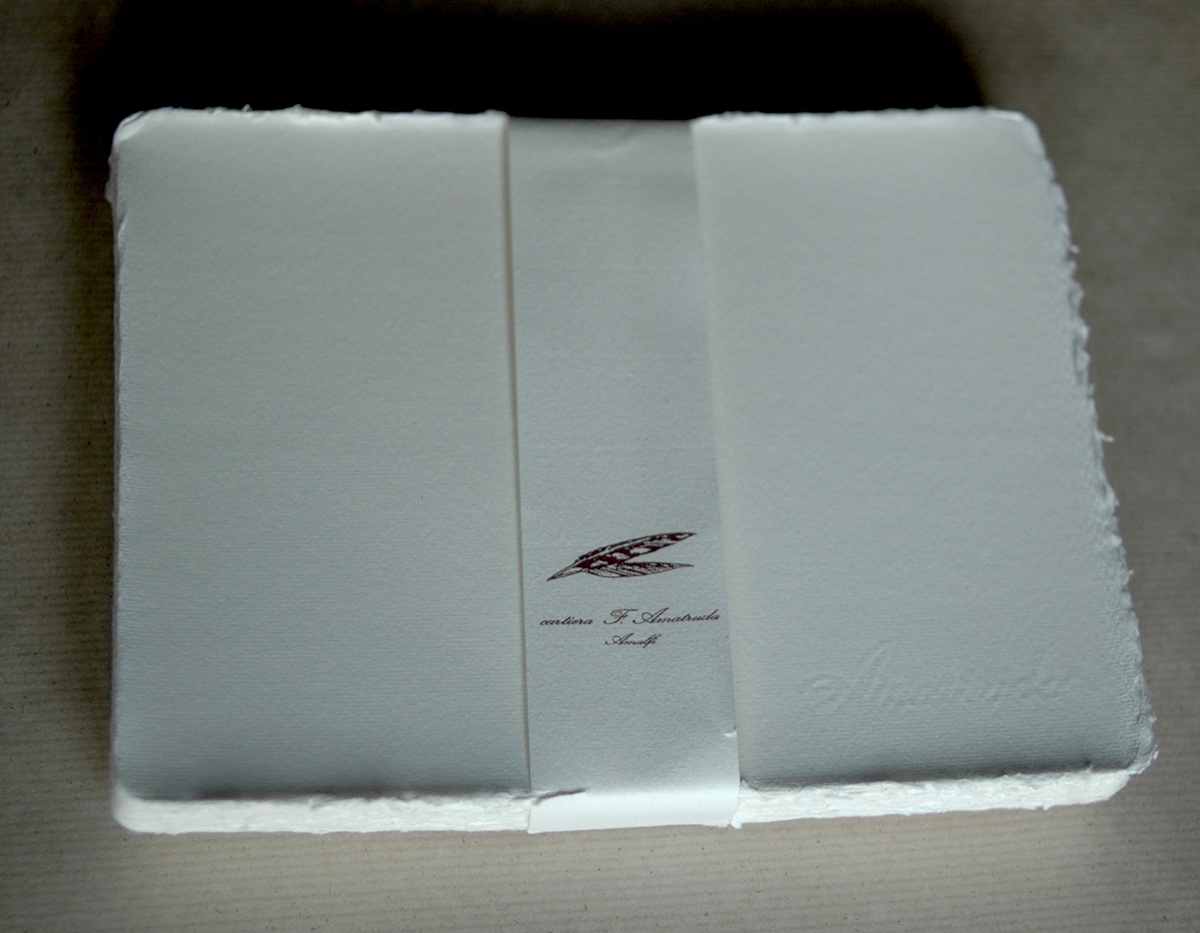
The writing surface is soft and smooth without the hint of oiliness that some hand-made papers have. Its behaviour with fountain pen inks varies: some work very well, while with others there is obvious feathering. I imagine it will be excellent in a typewriter, though I’ve yet to try that. Buying the same quantity of paper direct from the makers would have cost me 25€ plus another 15€ for postage, so the £23 I paid for the second-hand ream wasn’t too bad a bad bargain. The delivery was timely, as I’d lately used the final sheets from a box of old hand-made paper I bought about six years ago.
In newly-arrived music this week, two albums on CD from the ‘10s: which are no longer new but not yet properly retro. Although, having said that, both incorporated retro 20th-Century ingredients when they were freshly released. Coming to me from 2010 was I Learned the Hard Way by Sharon Jones and the DAP Kings. I’d heard a few songs of theirs on the radio here & there, and was familiar with some of the Kings’ contributions to the likes of The Olympians’ debut album, and, famously, to Amy Winehouse’s Back to Black. This strong collection of songs, several of them — in time-honoured style — concerned with problematic romantic relationships, is my first album-sized exposure to the group. Initial favourite tracks include ‘Better Things’ and ‘She Ain’t a Child No More’. Also very effective is the closing combination of ‘If You Call’ and ‘Mama Don’t Like My Man’, where the former boasts one of the fullest arrangements on the album, and feels akin to the climax of a live show; while the latter is simple and stripped down, like an impromptu encore.
And, from 2015, The Bad Plus Joshua Redman. I first became aware of The Bad Plus back in 2003 when their major-label debut These Are the Vistas caught my ear. I bought their subsequent album too, but then failed to keep up with the rest of their career (which now I learn is, alas, approaching its end). Redman, on the other hand, I only first heard the other week. The saxophonist fits in seamlessly with the trio’s forceful, rock-&-pop-tinged style. Hear, for example, ‘As This Moment Slips Away’. The tracks are all original compositions by the four players. Jazz albums quite often forego any dramatic concluding flourish. Here, though, the closing number ‘Silence is the Question’ does have a satisfyingly climactic feel. It’s a re-tread of a composition that also featured on These Are the Vistas, though augmented by Redman’s presence, and with a thirteen-and-a-half minute duration, this version has even more impact.