“Before the invention of the gummed envelope in the 1830s, how did people secure their private letters?” begins the blurb on the front dust-jacket flap of a book that attempts to answer that question — Letterlocking: The Hidden History of the Letter, by Jana Dambrogio and Daniel Starza Smith. A copy arrived on Friday; I finished reading it on Sunday. Returning to the same blurb, letterlocking is defined as “the ingenious process of securing a letter using a combination of folds, tucks, slits or adhesives such as sealing wax, so that it becomes its own envelope”. The book gives an overview of a variety of the relevant techniques, illustrating them with detailed instructional diagrams and wonderful photographs of historical correspondence.
I say I finished the book — rather I finished an initial brisk skim through its text and an admiring perusal of the accompanying images. I intend to go back to it to carefully work through some of the examples and try a little letterlocking of my own. It’s a lovely volume to look at, though I suspect its true merits or faults will come to light while grappling at greater length with its finer details.
The other book I read this week (on Thursday) was another slim volume of poetry: Pink Tongue Out, Blind Cat by María Paz Guerrero, translated from the Colombian Spanish by Robin Myers. It’s another volume I think I’ll have to return to. I confess I ordered it almost purely on the strength of its title and cover design. It didn’t prove the most successful such impulse-buy. The poems, presented with the originals and translations in parallel, have a contemporary & improvisational feel, albeit in a style that didn’t immediately draw me in. Much, if not most of their meaning eluded me. One puzzling feature of the book were italicised lines in the originals. Many of these were given in both English and Spanish in the translated text, while others were left untranslated and others still given only in English. At least some of them appear to be song lyrics: perhaps they are all interpolations of others’ words? Anyhow, some explanatory notes about them would have been a welcome addition. Just enough of it all got through to me that I will want to give it another chance or two before giving up on it.
I loved The Hitchhiker’s Guide to the Galaxy in my youth. I first encountered it in the form of the BBC TV series, which aired when I was twelve. It felt like the perfect entertainment for me at that time. I didn’t get around to reading the books until I was sixteen, when I tore through the first three volumes of the ‘trilogy’ in quick succession. While I enjoyed them very much, it seemed to me that some of the humour was already slightly stale: a little too redolent of the departed ‘70s. In my wisdom, I imagined their appeal surely couldn’t last much longer! Despite that, I still read So Long and Thanks for All the Fish a year or so later (and thought it a let-down). Around the same time, I was amused and frustrated in equal measure by the computer game adaptation of the story. I never did read Mostly Harmless. Much later, enticed by nostalgia, I eventually made the mistake of watching the Hitchhiker's Guide movie when that came out on DVD.
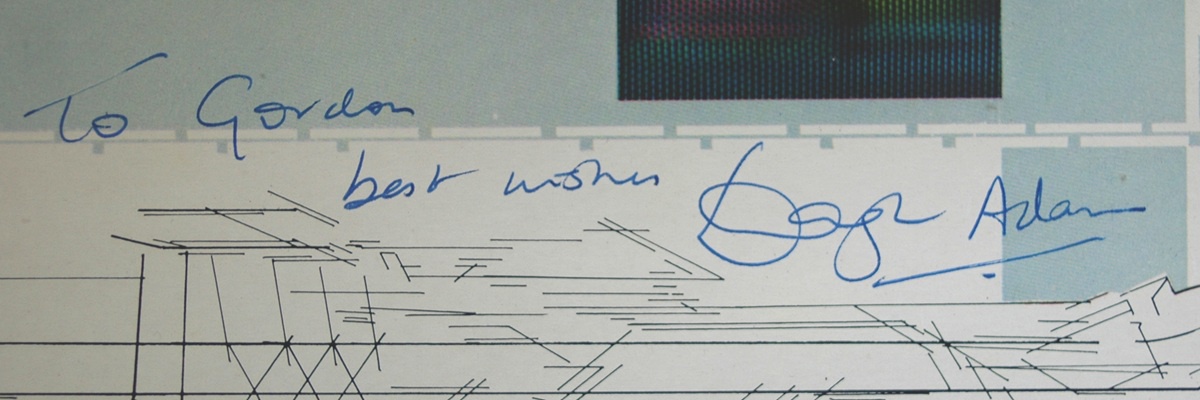
Having missed out on the original radio broadcasts, I’d remained slightly curious about them. On Friday I happened to find a double album version of The Hitchhiker’s Guide in a bin of bargain vinyl at a market stall, and spent £10 buying it along with two other LPs. Vexation ensued when I learned this did not contain the radio shows, but rather a somewhat abridged audio re-recording done in 1979. The irritation soon faded again when I spotted an inscription in the record’s gatefold that read “To Gordon, Best Wishes, Douglas Adams” (Fig. 31). While I’ve no provenance or authoritative opinion to back it up, I like to think it’s a genuine signature (appropriately enough done in blue biro). To my inexpert eye it does resemble other of Adams’ signatures to be found on-line. The recording itself I found only intermittently amusing, with over-familiarity having taken its toll.
At the Marches Deli in Monmouth on Friday they had yet another artisanal Welsh blue cheese (there are more than I had ever imagined!) in the shape of Trefaldwyn Blue, which is my cheese of the week. It says here that “This rich blue cheese has a lovely egg-yolk orange colouring with ample blue veining. It has a dense, buttery texture and a gentle, slightly sweet flavour, with subtle lactic notes.” I can’t argue with that.