I picked up a non-fiction title, The Edges of the World (by Charles Foster) at a local independent bookshop a while ago on a whim as I liked the cover photo and the blurb sounded vaguely interesting. Foster seems like an intriguing character: his Wikipedia page claims he’s a “writer, traveller, veterinarian, taxidermist, barrister and philosopher”. Certainly he has expertise in fields as diverse as evolutionary biology and medical ethics, and his extensive travels must have provided him with a great wealth of experiences to draw on. For all that, alas, what he’s written here is a bad and a dull book.
Its thesis in a nutshell is that ‘edges’ (biological, geographical, cultural, experiential, etc.) are somehow inherently good; and ‘centres’ (settled populations, major cities, established orthodoxies, big government & big business) are necessarily bad. I’m not unsympathetic to parts of this outlook, but Foster’s efforts to press home his point are marred by gross over-generalisations, unsound inferences, barely-relevant anecdotes, cherry-picked examples & vibes-based philosophising. The writing isn’t especially good, but it’s a great deal better than the thinking behind it. I regret having wasted good money on the book, and am embarrassed I compounded my error by reading it.
Penelope Fitzgerald was a writer notable for not having properly embarked on her literary career until her late fifties, going on to turn out three biographies and nine novels before her death in 2000, aged eighty-three. Along the way she also wrote some short stories, eight of which were collected in a slim, posthumously-published volume called The Means of Escape. I’d read some praise of this book which persuaded me to order a copy. I finished reading it on Wednesday.
I had misgivings when I read in the dust-jacket’s front flap blurb that “these stories are wry and mischievous, deft and nimble”. I've nothing against the wry & the deft as such, but when those words crop up in literary marketing I find I’m often unimpressed with the content they advertise. This wasn’t entirely the case here, however. The tales were concise; their settings were varied and the writing was very good indeed: even if some of them did turn out to be a little under-seasoned for my taste. My favourite was the closing story ‘Desideratus’ which seemed to me to pack the most satisfying punch of the set.
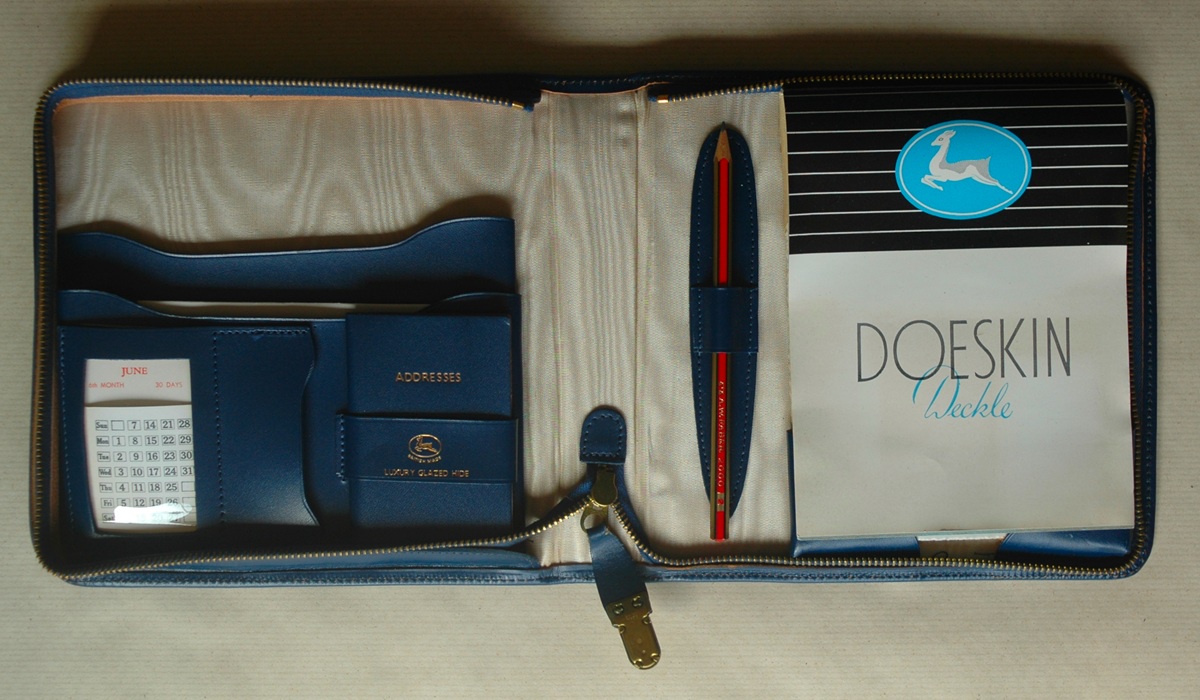
Stationery news: one arrival this week was a vintage blue leather writing case (Fig. 27) containing a quantity of its original ‘Doeskin Deckle’ writing paper and some matching envelopes. I hadn’t been in the market for another writing case, but was curious about the paper. The sheets are ‘Duke’-sized and in a grey colour. They have uneven edges that are ‘pinked’ rather than properly deckled. Its writing surface is very nice, but the discolouration it has sustained (with the envelopes particularly badly affected) suggests its ingredients aren’t perhaps of the highest quality. The case is lovely, though sadly some of the stitching alongside the zip has come undone.
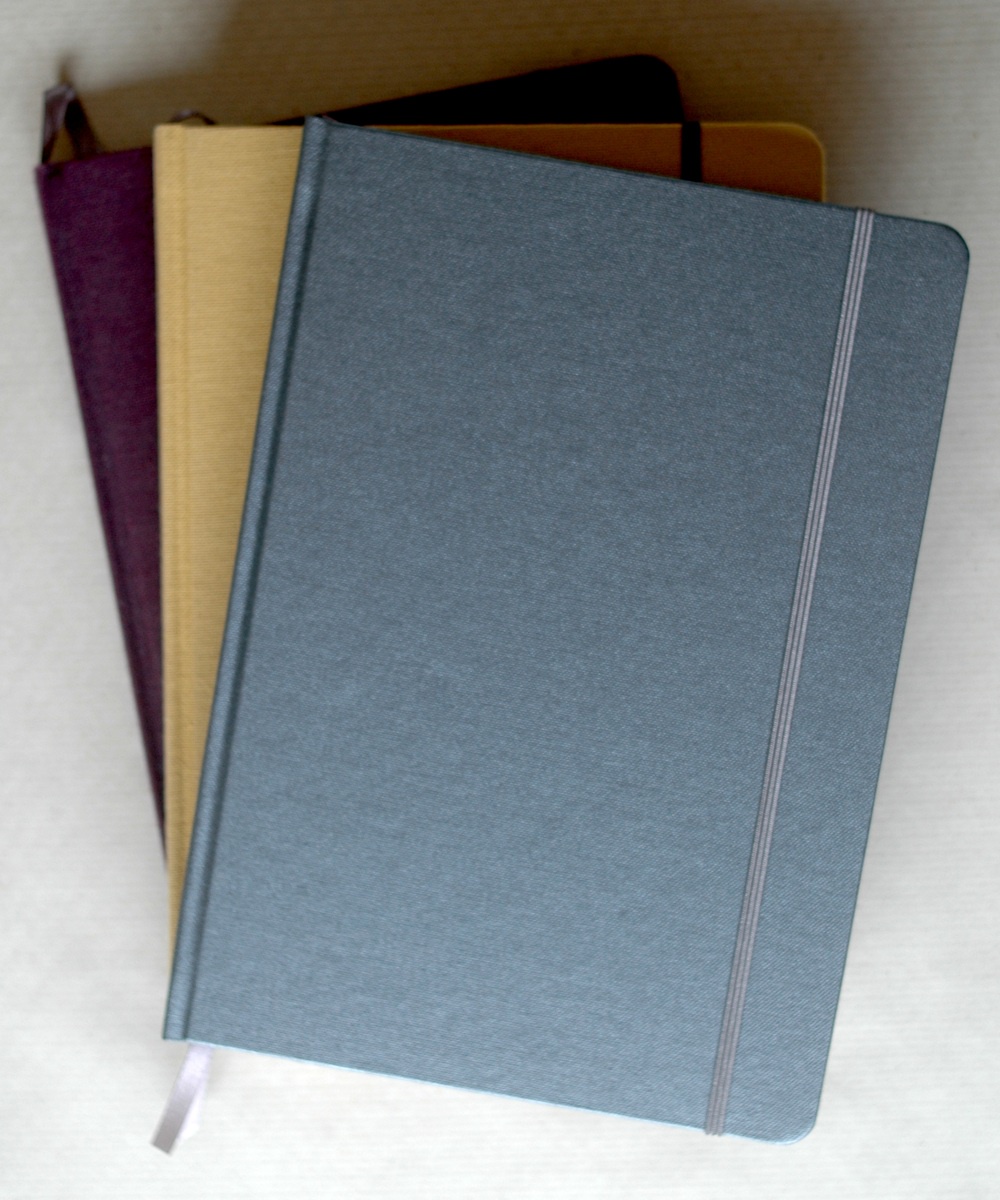
The other delivery was my latest Stamford notebook. I find their ‘crown quarto’ books are just the right size for me, and I appreciate the quality of their paper and of their bindings. On the other hand, they’re expensive, and their page-counts are lower than I would like. The three or four books I’ve ordered from them before have been bound in canvas, whereas the new one has a grey buckram binding (Fig. 28). Despite a slight preference for the look & feel of the canvas, I think the buckram may prove to be more stain-resistant and be less prone to attract cat-hair.