Two recent jazz LP acquisitions from ‘The Vinyl Spinner’ market stall in Monmouth the other weekend: 2 Guitars by Kenny Burrell & Jimmy Raney; and To Someone by The Fred Wesley Quartet.
2 Guitars was recorded and released in 1957. My copy is an ‘80s repress. I was somewhat acquainted with Kenny Burrell’s music, owning a few of his albums already, while his fellow-guitarist Jimmy Raney’s name was less familiar. Belatedly, I realised I’d heard the latter’s playing before on Bob Brookmeyer’s album Trombone Jazz Samba, which had spent some time on my shelves. Burrell and Raney play solo on a ballad apiece, accompanied by Mal Waldron on piano, Doug Watkins on bass and Art Taylor on drums. On the remaining numbers they play together, and are also joined by Jackie MacLean on alto sax and Donald Byrd on trumpet. The two horns push the guitarists back out of the foreground more often than I’d have expected, given their status as co-leaders. There’s nothing exceptional here — but any well-made slice of late-’50s hard bop like this can be a great pleasure to hear. By way of an example tune, ‘Pivot’ is one of the three numbers on the record composed by Waldron.
Fred Wesley is of course best known for his outstanding contributions to funk and soul music in his work with James Brown and George Clinton. I had been quite unaware he was also a jazz musician, so was very curious to hear what To Someone, apparently his debut jazz recording (released in 1990), sounded like. Given its release date, it’s a decidedly conservative affair, all acoustic and very much in the classic ‘50s/‘60s style. With the exception of the aforementioned Trombone Jazz Samba, I can't think of any small band records I’ve heard from that earlier era where a trombone was the only horn, so it made for a change to hear the ‘bone as alone as it is here. While I don’t know that I’m fully convinced that its an ideal lead jazz voice, I did enjoy the record — the playing, recording and mastering are all very good. Wesley’s bandmates (Ken Walker on bass; Bruno Carr on drums; and Joe Bonner on piano) provide sterling accompaniment. I gather the CD version of the album includes another four tracks not included on the vinyl version. The opening number ‘Sandu’ (a Clifford Brown composition) is perhaps my favourite of the six on the LP.
On Friday I finished reading The Pen: a Human History by Simon Garfield. This must be at least the third of Garfield’s books that I’ve acquired. Previously I’d quite enjoyed his blends of well-researched history and amiable rambling: this time though, I found myself less in the mood for it, and was left irritated by the sheer quantity and aimlessness of the rambling. There came a point where he quoted what an LLM had responded to his prompt about the future of the fountain pen: had this not been so near the end of the book I would have abandoned it then & there. It’s by no means a book without interest, but it struck me as falling some way short of its potential.
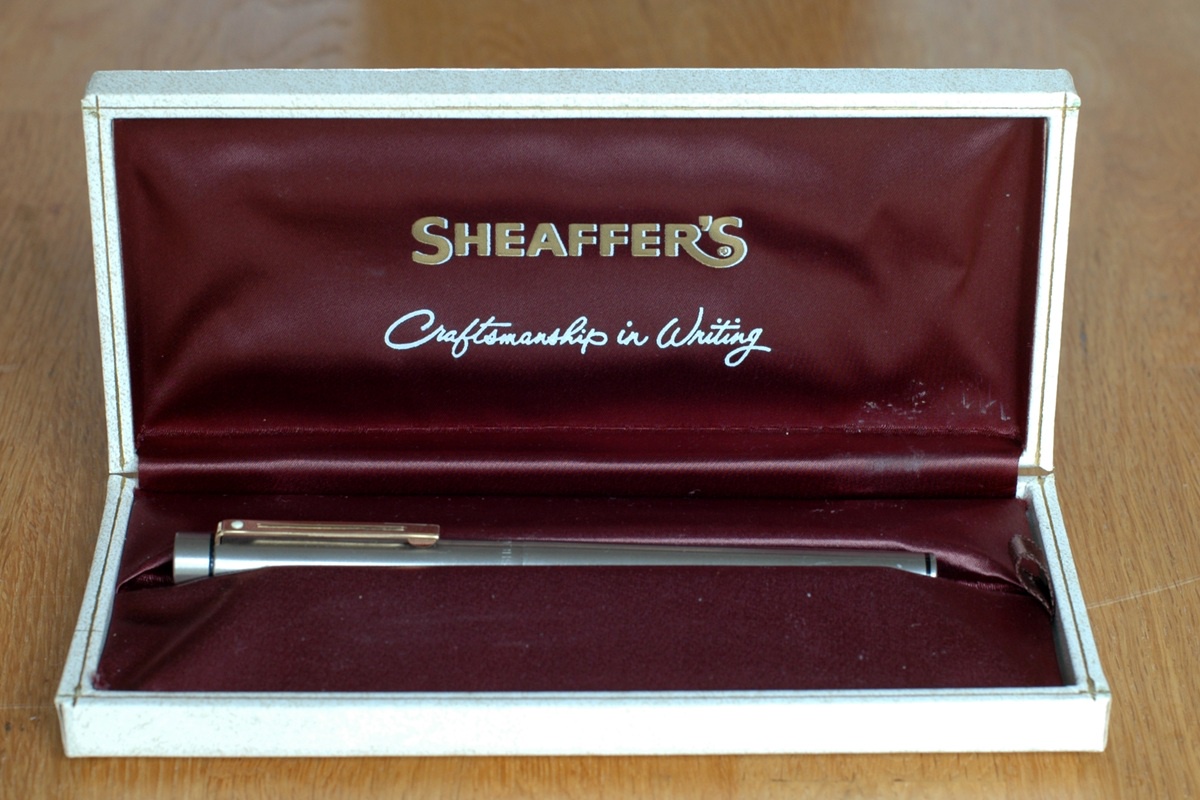
One of the hyperbolic blurbs on the book’s back cover is “Anyone who has read Simon Garfield’s brilliant treasure-chest of fascinating stories will be rushing out to buy a pen” (Jacqueline Wilson). Notwithstanding my dimmish view of the volume, it did indeed contribute toward by decision to buy another fountain pen. I fancied getting a pen with a gold nib, and ended up buying an ‘80s Sheaffer Targa 1001XG (Fig. 44). As the satisfied owner of a regular steel-nibbed Targa, the prospect of getting another fancier one was appealing.
Cheese of the week: Little Hereford. This is a revival of a traditional English farmhouse cheese recipe made from unpasteurised milk with a flavour “somewhere between a Caerphilly and a Cheddar: butter, shortbread, cream; getting sweeter and more tangy with age.”